Foie Gras
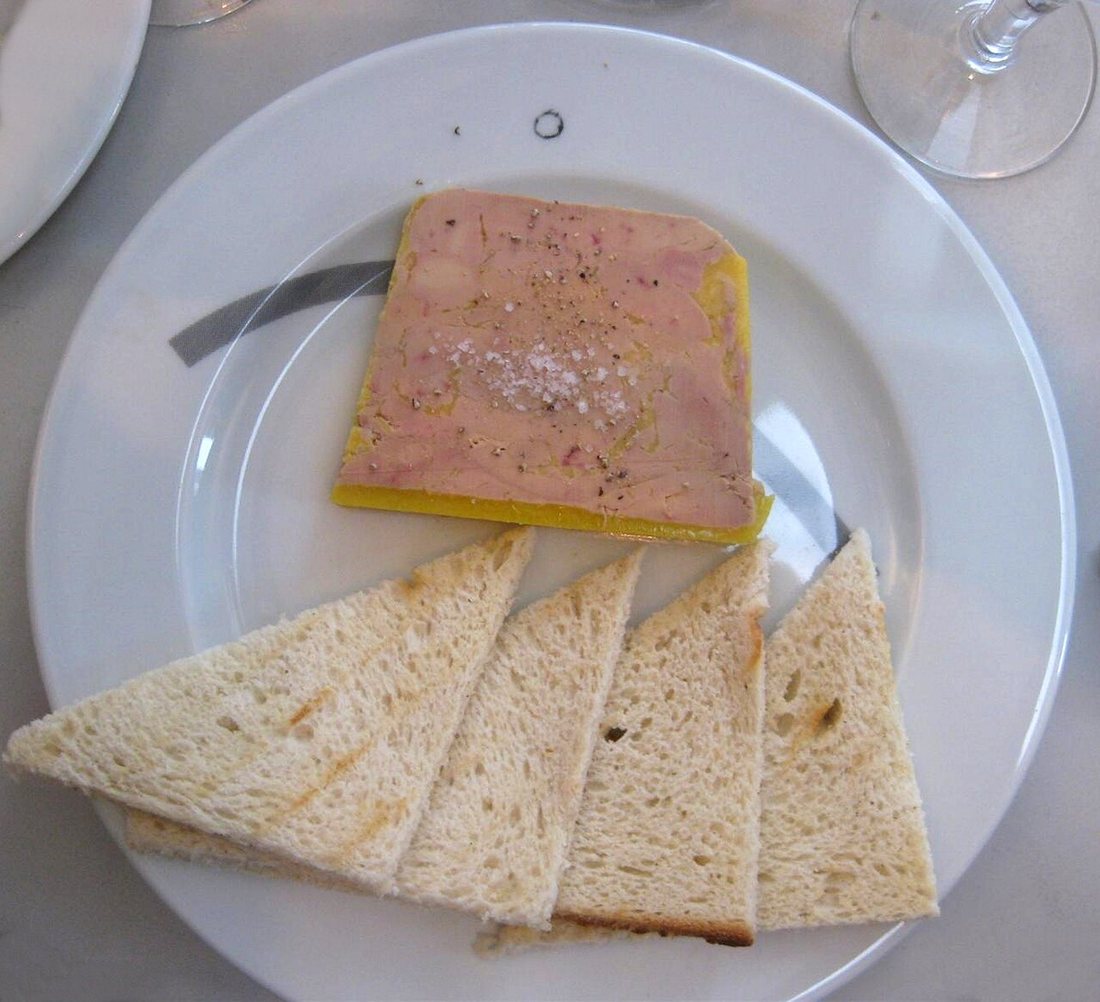
Foie gras is the most written-about liver in the world, and much of what is written about it is wrong. The popular history runs from Egyptian tombs through Roman figs to an eighteenth-century cook in Strasbourg who “invented” the pâté. Each step of that story either overstates its evidence or misreads its source. The version that survives the primary texts is stranger: the Egyptians fattened birds but may not have prized the liver, Pliny’s fig-fed liver belonged to a pig, and truffled foie gras was baked in pastry forty years before the man credited with inventing it.
The liver is also a problem of physics and of law. It is more than half fat, so it melts as it cooks. It sits outside every published food-safety table. And as of 30 September 2026 it is banned, protected, defined or litigated in a patchwork of jurisdictions that disagree with each other.
Egypt: gavage, not foie gras
In the necropolis of Saqqara, a bas-relief in the tomb of Mereruka shows workers grasping geese by the neck and pushing food down their throats, beside tables piled with pellets and a flask for moistening them (English Wikipedia; French Wikipedia dates such scenes to about 4,500 years ago). This is routinely cited as the origin of foie gras. It is evidence of force-fattening whole birds, not of eating fattened livers. English Wikipedia’s own wording is that “whether they particularly sought the fattened livers of birds as a delicacy remains undetermined.” Fattening a bird and prizing its liver are separate practices. The Egyptological publication of the relief itself was not consulted for this page.
Rome: the fig, the goose and the pig
The strongest ancient evidence is in a word. The French foie descends from Late Latin ficatum, “figged”, which the TLFi describes as a calque of Greek sykōton, a fatty liver from an animal fed on figs. The 8th-century Reichenau glosses already have ficato. Italian fegato, Spanish hígado and Portuguese fígado share the root: the ordinary Romance word for “liver” is the name of a fattening recipe.
The Roman texts are less tidy than the usual summary.
- Pliny, Natural History 10.52 (geese): the liver of crammed birds “grows to a great size”, and once removed it is swollen further by soaking in honeyed milk. Pliny says it is disputed whether the consular Metellus Scipio or the knight Marcus Seius discovered this. There are no figs in the goose passage.
- Pliny, NH 8.209 (pigs): the same art “is applied to the liver of sows, as to that of geese”, an invention of M. Apicius: the animals are fattened on dried figs and, when sated, killed suddenly after a draught of honey-wine.
Both English and French Wikipedia misread Pliny, crediting Apicius with feeding figs to geese. In Pliny, the fig method is for pork liver. The fig–goose pairing is real, but it comes from Horace, Satires 2.8.88: “the liver of a white goose fed on rich figs”, served at Nasidienus’s pretentious dinner, around 30 BC. A century later Juvenal (5.114) uses the big goose’s liver as a mark of rank: the patron gets it and the client does not.
The Jewish goose, and the French cookbooks
A widely repeated thesis holds that the fattened goose survived the Middle Ages in Jewish communities of Central Europe. The mechanism offered is plausible: kashrut forbids lard and bars butter with meat, olive and sesame oil were scarce north of the Alps, so goose fat (schmaltz) became the meat-meal cooking fat, and a fattened goose yielded both fat and liver. English Wikipedia quotes Hans Wilhelm Kirchhof of Kassel (1562), that “the Jews raise fat geese and particularly love their livers”, and records rabbinic debate over whether a force-fed goose is treyf. But the same article introduces the thesis as “others claim”. It is contested, and the Kirchhof original was not read for this page.
The French record is firmer. La Varenne’s Le Cuisinier françois (1651) gives four foie gras recipes: en ragoust (“choose the fattest and the palest”), grilled, fried as fritters, and cooked in the embers wrapped in four or five sheets of paper “like a quince”. Le Cuisinier gascon (Amsterdam, 1740) prints Petits Pâtés de Foyes gras aux truffes: livers larded with truffle, a forcemeat of foie gras made for the purpose, all in small pastry cases, baked, then finished with an essence poured inside.
Clause did not invent pâté de foie gras
The standard story credits the pâté to Strasbourg around 1780, under the military governor, the maréchal de Contades, and his cook Clause, who later married a pastry-cook’s widow and sold his pâté à la Contades. French Wikipedia itself calls this “an often-repeated anecdote, poorly referenced”. English Wikipedia names him Jean-Joseph Clause, dates the creation to 1779 and adds a patent in 1784; French sources name him Jean-Pierre. His first name, his date and the patent are all unsettled, and no primary document on Clause was found. What is settled is that truffled foie gras in pastry was in print by 1740, so Clause could at most have been an early commercial maker who attached Strasbourg’s name to the dish. The name held: Brillat-Savarin (1825) describes an enormous Strasbourg pâté de foie gras “in the shape of a bastion”, and foie gras enters English in 1818 as a short form of pâté de foie gras, a dish “originally served in a pastry (as still in Alsace)” (Etymonline). A dated history of the Périgord trade could not be established.
What the liver is
Force-feeding causes hepatic steatosis, a fatty enlargement of the liver (Animals 2026). Livers reach six to ten times normal size (Wikipedia); in mule ducks fattening runs in two phases, glycogen storage then heavy lipid storage, with livers near 758 g (about 1.7 lb) by day 12. Foie gras contains 50 to 60% lipids.
That fat is the cook’s problem. Processors measure a “melting rate”, and one study found liver weight and cooking yield correlated at r = −0.83: the heavier the liver, the more fat it loses in the pan or the terrine. High fat improves the eating quality but reduces yield. A bigger liver is not a better buy for a terrine.
In the US trade, livers are sold as grades A, B and C. Grade A is highest in fat with relatively few veins, suited to low-temperature work such as terrines; Grade B has more protein and holds its structure when seared; C goes to sauces. These grades are a trade convention. No USDA grade standard for foie gras was found, and Wikipedia, the source of the descriptions, names no grading authority.
French legal categories
French law sorts prepared foie gras by how much of it is whole liver. As summarised by French and English Wikipedia (Décret n° 93-999 of 9 August 1993; the decree text itself was not fetched, so treat the thresholds as secondary):
| Label | Meaning |
|---|---|
| foie gras entier | at most two pieces, from two different livers |
| foie gras | pieces from several livers |
| bloc de foie gras | reconstituted from emulsified liver; avec morceaux adds pieces |
| parfait de foie gras | at least 75% foie gras |
| galantine, mousse de foie gras | at least 50% foie gras |
A second axis is the cooking state: cru (raw); mi-cuit, “pasteurised below 100 °C by cooking to the core”, which keeps several months refrigerated when professionally packed; and cuit, sterilized in an autoclave above 100 °C (212 °F). A home terrine is, by these definitions, mi-cuit.
Technique: terrine and torchon
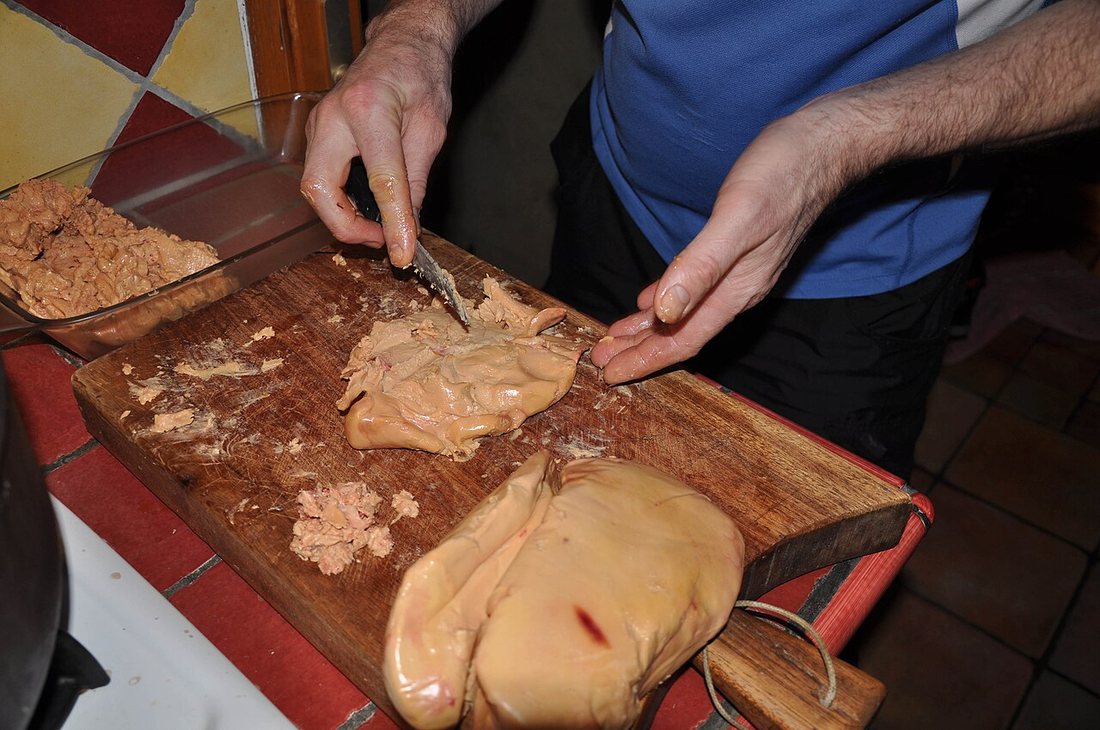
The terrine is the classical form. Escoffier (1907) studs a whole liver with truffles, wraps it in bacon or caul, and sets it “in a thoroughly-sealed terrine”; for a cold dish credited to “Madame Katinka” of Vienna, he covers the cooked liver “with its own grease” and fills the terrine with jelly. He preferred a crust for hot foie gras, because pastry “can absorb the excess of grease”. The collection’s Classic Terrine of Foie Gras offers two end points, 120 °F (49 °C) or 160 °F (71 °C), which shows how far apart working recipes sit.
The torchon (French for dish towel) is rolled tight in cloth and poached. The traditional French method, per French Wikipedia, rolls the liver in film and a cloth and plunges it hors feu — off the heat — into water that has stopped boiling: a falling-temperature poach that needs no thermometer. Kenji López-Alt’s version seasons the opened, flattened lobes with 2.5% of their weight of a salt, sugar, pink salt and pepper mix, rolls them in plastic and quadruple cheesecloth until the roll “feels like a bike tyre”, hangs it one to three days, poaches it just 2 minutes at 160 °F (71 °C), ices it, re-tightens it and hangs it again.
Deveining is contested. Most recipes open the lobes and pull the veins; English Wikipedia notes that “some chefs prefer not to devein”, since the veins help hold the liver together. No sourced professional deveining procedure was found. Nor were any sourced sous vide times and temperatures for a foie gras terrine or torchon; Douglas Baldwin’s standard sous vide guide states that it does not cover terrines, pâtés or foie gras. The collection’s galantine uses a 65 °C (149 °F) bath for 1½ hours, but that is one chef’s number for a composite roll, not a validated foie gras process.
Safety
Foie gras falls outside every published time–temperature table. US guidance puts all poultry, giblets included, at 165 °F (74 °C). The FSIS lower-temperature poultry tables stop at 12% fat, and a fattened liver is 50–60%. No safety-validated low-temperature process for foie gras was found. A pink, just-set terrine is a culinary standard, not a tested one, and should be understood as such.
The law, as of 30 September 2026
Legal status changes quickly; everything below was current on the date above and should be re-checked.
- France. Code rural art. L654-27-1 (Loi 2006-11, in force 6 January 2006): “Foie gras is part of the cultural and gastronomic heritage protected in France. Foie gras means the liver of a duck or goose specially fattened by gavage.” The same sentence that makes it heritage defines it by force-feeding, so a naturally fattened liver cannot be sold as foie gras in France. The outcome of a December 2021 bill to extend the name was not found.
- California. SB 1520 (2004), in force 1 July 2012, bans in-state production and sale of products of force-feeding. It has been upheld, but the Ninth Circuit (Canards v. Bonta, 2022) held that out-of-state sellers may ship to Californians when the order and payment are processed outside the state. Production and in-state sale are banned; buying by mail is not.
- New York City. Local Law 202 of 2019 bans restaurants and shops from selling force-fed products. It has never taken effect. The state agriculture commissioner overrode it in 2022; the Albany County Supreme Court sided with the state in June 2024; the Appellate Division reversed 5–0 for the city on 12 March 2026; the Court of Appeals is weighing whether to take the case.
- Other US cities. One report lists Pittsburgh (2023), Brookline, Massachusetts (2025) and Portland, Oregon (June 2026); these are unconfirmed beyond that report. Chicago’s 2006 ban was repealed in 2008.
- United Kingdom. Production by force-feeding is unlawful; import and sale are legal. A planned import ban did not materialize, and per Wikipedia the Labour pledge was dropped over UK–EU relations.
- European Union. Gavage is legal in only five member states: France, Belgium, Hungary, Bulgaria and Spain (Wikipedia-level).
- Wikipedia also reports a 2026 Brazilian ban, an Indian import ban and an Argentine production ban; none was checked against primary law.
Related pages: Liver Pâtés, Parfaits and Mousses, En Croûte, Galantine and Ballotine, Food Safety and liver in the Offal section.
Comments (0)