Aspic and Head Cheese
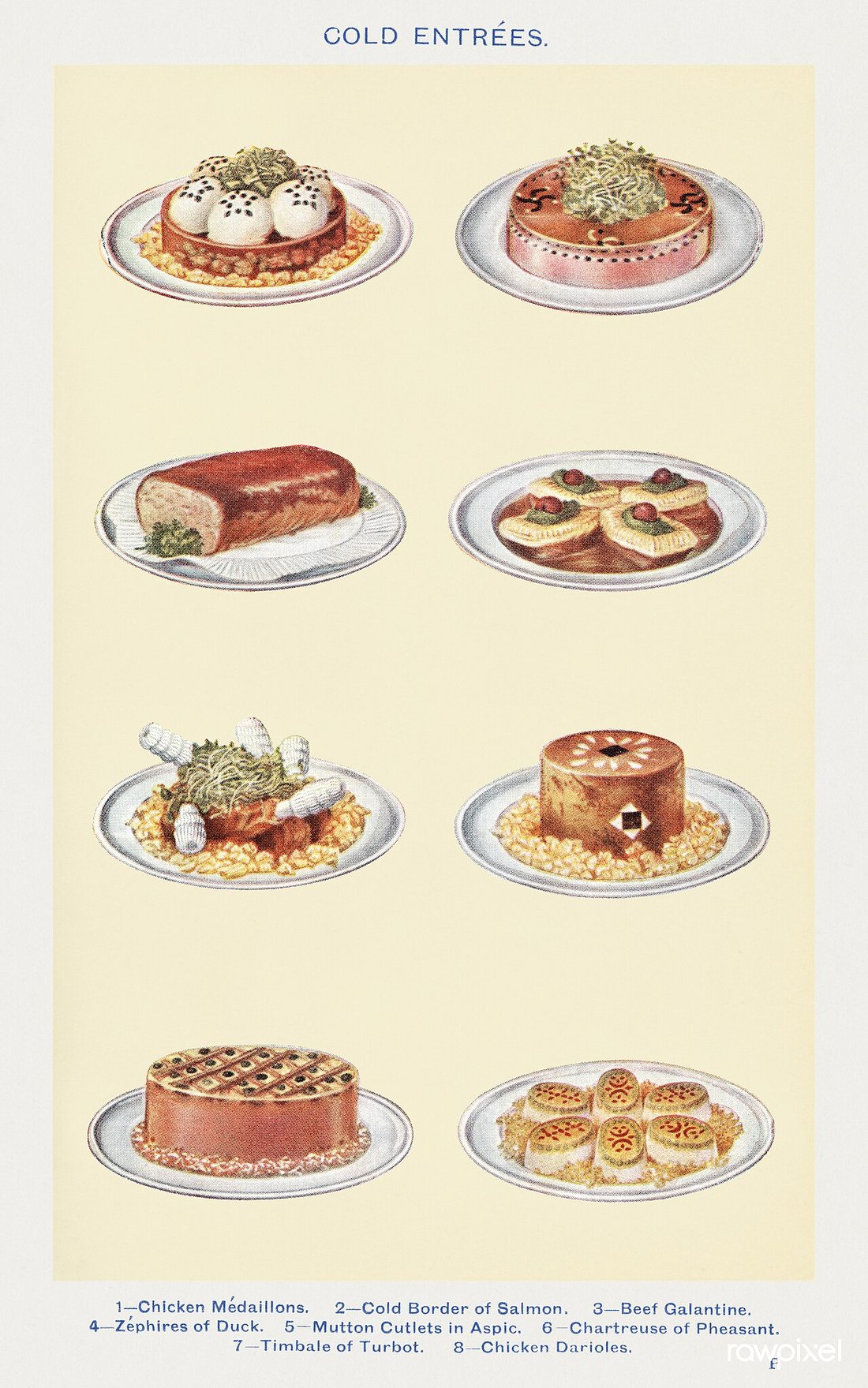
Aspic is savory jelly: stock rich enough in gelatin to set cold, usually clarified, and used to coat, fill or bind cold meat, fish, eggs and vegetables. Head cheese is the same principle with nothing added. The meat of a pig’s head simmers until its own collagen turns the stock to jelly. Escoffier put the case for the whole category in one line: “Jellies are to cold cookery what consommés and stock are to hot … a cold entrée — however perfect it may be in itself — is nothing without its accompanying jelly.”
This page covers where aspic came from, how it is made and clarified, the science of the set in brief, the jellied terrines (jambon persillé, oeufs en gelée, ham hock), and the head cheeses and souses. It ends with the reason jelly is no preservative.
From sauce to jelly
The first aspic was a hot sauce. The TLFi’s first culinary citation is F. Marin, 1742, listing “petites sauces, ravigotte ou d’aspic, ou remoulade”: aspic as a sauce, beside ravigote and remoulade. Le Cuisinier gascon (1740) is two years earlier. It lists “Sauce à l’Aspic” and dishes roast chickens with “une sauce à l’aspic dessous”, a hot sauce poured under a roast. Etymonline dates English aspic to 1769, “a sharp sauce or jelly”, and notes that “the oldest recipes in English are for vinegar-based liquid sauces, not necessarily served cold. The jellied form appears to have evolved.”
Why “aspic” is contested three ways:
- Coiled-snake molds (Dauzat): the jelly was once poured into molds shaped like a snake coiled on itself.
- Snake-like colors (Bloch-Wartburg): the mottled colors of the jelly compared with the asp’s.
- Lavender (Etymonline, hedged): aspic was also a French word for spike lavender, possibly a seasoning. The herb espic was a live kitchen word; the Ménagier de Paris (c. 1393) lists it among the spices for a boar’s-head brawn. That makes the theory plausible without proving any link.
The TLFi endorses neither snake theory. The explanation often repeated online, “cold as an asp”, appears in none of the dictionaries consulted.
The jelly itself is much older than the word. The Viandier sets a gelée with “gigotz ou piez de veau” (legs or calf’s feet) boiled in white wine, the same principle as modern aspic. La Varenne (1651) gives a run of colored jellies: hartshorn, green, red, yellow, violet, blue. Mrs Beeton (1861) defines aspic as “a savoury jelly, used as an exterior moulding for cold game, poultry, fish, &c. This, being of a transparent nature, allows the bird which it covers to be seen through it.” Her ornamental jelly (No. 366) is 4 lb knuckle of veal, a cow-heel, ham, sherry and 3 quarts of water, simmered 4 hours and clarified with 3 eggs. She also quotes Liebig against commercial gelatine, which “possesses no nutritive value”. Boxed gelatin arrived by the 1870s, and Knox sold the first commercial granulated gelatin in 1894 (en.wikipedia).
Wikipedia’s claim that the 1904 Perfection Salad won a Better Homes and Gardens contest cannot be right: that magazine was founded in 1922. Who sponsored the contest could not be established.
Escoffier’s jellies
Escoffier wanted a set as soft as it would stand: “the greater the viscosity of the jelly the less value will the same possess.” His French text asks for a jelly “succulente, d’une limpidité absolue, et collée juste à point”: succulent, perfectly clear, and set just to the point. His “melting jellies” were served in a sauce-boat or poured over in a deep dish, a method he says he “inaugurated at the Savoy Hotel with the Suprême de Volaille Jeannette”. Aspic molds, he says, “are always molds with a central tube, plain or decorated.”
His ordinary aspic stock (No. 158) is veal knuckle, 3 calf’s feet, beef knuckle, pork rind and veal bones, boiled 4 hours, then 2 hours more with vegetables. Test the set before adding gelatine, and add only “a few leaves … being careful not to overdo the quantity”. The feet and rind are supposed to do the work; the gelatine is a correction.
Clarification
The egg-white raft. Escoffier clarifies with 2 lb of lean beef pounded with egg white, brought to the boil while stirring and simmered half an hour. He strains it “through a serviette stretched and fastened across the legs of an overturned stool”, repeating “until the aspic becomes quite transparent”. The upturned stool is equipment any kitchen can reproduce. The collection’s oeufs en gelée (Saveur) uses the same principle at small scale: egg whites and chopped vegetables stirred into cold broth and brought slowly to a boil until a raft forms (5–10 minutes), then left unstirred on low for 20 minutes and strained through a coffee filter without pressing.
Freeze-thaw. Dave Arnold’s alternative (Cooking Issues) needs no heat: “hydrate approximately 5 grams of gelatin into 1 kilo of liquid, freeze the liquid solid, and slowly thaw it over cheesecloth in a refrigerator.” The early drip is the most concentrated, so the method can also concentrate flavor.
The set, in brief
- Gelatin is denatured collagen (Gelatine Manufacturers of Europe). A long simmer converts the collagen in skin, feet and heads to gelatin, which is why those parts go into aspic stock and head cheese. English Wikipedia says the feet contain “more gelatin than any other part of the pig”.
- Bloom measures gel strength. Commercial gelatin runs about 90 to 300 g Bloom, measured on a 6.67% gel.
- It melts below body temperature, which is what gives aspic its mouthfeel, and its strength declines above 100 °C (212 °F), so hard, long boiling weakens a stock.
- Fish aspic is more delicate, because fish gelatin melts at lower temperatures. Vegetables contain no gelatin, so a vegetable aspic has to have it added.
- Fresh kiwi, pineapple and papaya stop a set. Their proteolytic enzymes digest gelatin. Actinidain was identified in 1959 when A. C. Arcus examined why kiwifruit jellies would not solidify. It is inactivated at 60 °C (140 °F), a lower temperature than bromelain (pineapple) or papain (papaya). Cooked or canned fruit is fine; fresh is not. Exact inactivation temperatures for bromelain and papain were not found.
No primary source was found giving gelatin concentrations for a sliceable versus a trembling aspic, so none is given. The protein chemistry of forcemeats and gels is on The Science of a Forcemeat.
Jambon persillé
Jambon persillé de Bourgogne is ham (leg or shoulder) cooked in a broth of white Burgundy, mustard and wine vinegar, with veal or pork feet for natural gelatin. It is then chunked, layered with parsley in a terrine, covered with the warm broth, pressed and set (fr.wikipedia). It is an Easter dish. French Wikipedia says it dates to the 14th century, but that could not be confirmed. Its industrial output rose from 150 tonnes in 1988 to about 2,000 tonnes in 2016, a thirteenfold rise in under thirty years.
The collection’s version (Saveur) starts from a whole 8-lb uncooked ham simmered about 5 hours with veal bones and a split calf’s foot. The stock is reduced, clarified with beaten egg whites and optionally reinforced with gelatin, and the diced ham is layered with four cups of minced parsley in a loaf pan and chilled 24 hours.
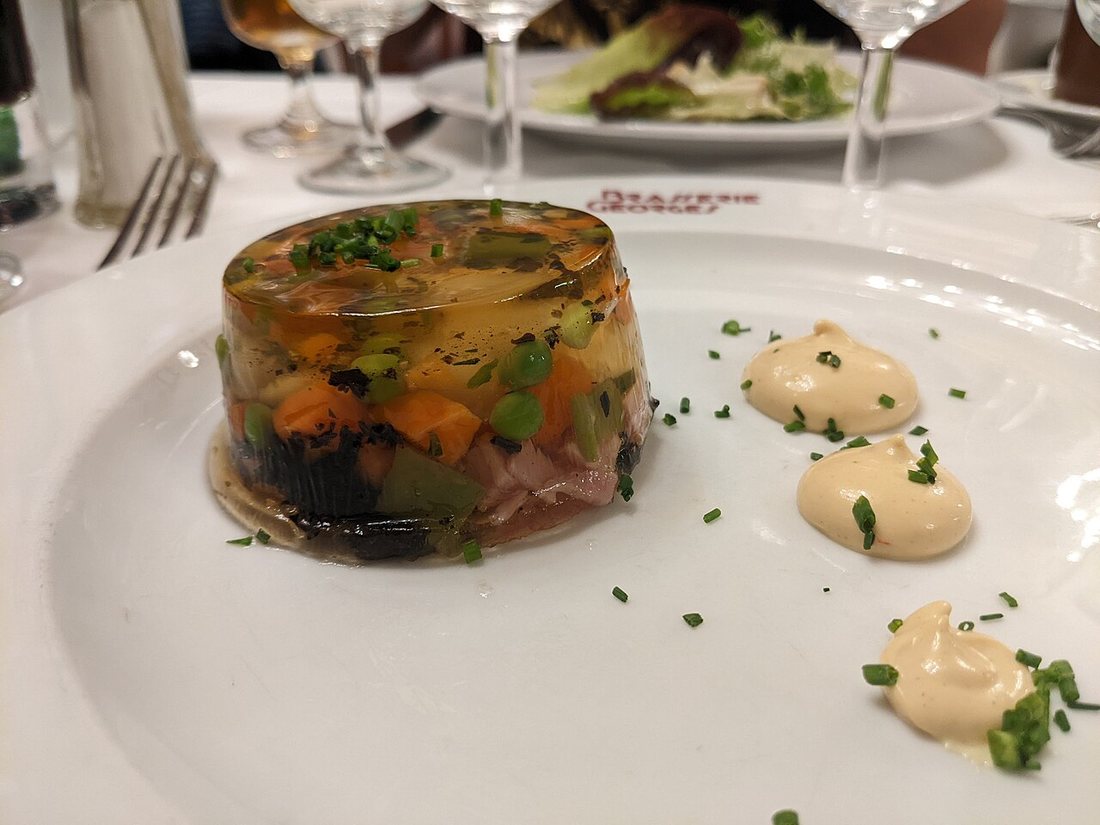
Oeufs en gelée and the ham hock terrine
Oeufs en gelée are the classic small aspic: a trimmed poached egg set in a mold of clear jelly. In the Saveur method, a thin layer of aspic is set in each oiled mold first, then a pattern of pepper diamonds is laid skin-side down, then the egg goes in, covered by ¼ inch (6 mm) of aspic. Dip the molds in hot water for 5 seconds and turn them out.
The ham hock terrine is the British jellied terrine. Galton Blackiston’s (Great British Chefs) cooks trotters alongside the hocks for the set, adds capers, gherkins and parsley, presses it overnight and serves it with piccalilli. The collection has three.
Head cheese: not a cheese
Head cheese is the flesh of a pig’s (or calf’s) head simmered until the stock sets on its own. It contains no dairy and is not a cheese. The Viandier already lists “Fromaiges de teste de sanglier”, “cheeses” of boar’s head, on a medieval menu. French Wikipedia derives the name from molding the meat in cheese forms; that could not be confirmed.
The same dish under other names:
| Where | Name |
|---|---|
| France | fromage de tête, tête pressée |
| Alsace | Presswurst |
| Brussels | kip-kap |
| French-speaking Switzerland | tête marbrée |
| Germany | Sülze, Schwartenmagen, Presskopf |
| Czech Republic and Slovakia | tlačenka, pale or darkened with blood, served with raw onion, vinegar, rye bread and mustard |
| Poland | salceson |
The collection’s pressed pig’s head terrine (Emily Watkins, Great British Chefs) is set in its own strained head liquor with no added gelatin, which is the defining feature. It calls for a brined head but gives no brine recipe, strength or time.
Souse, and the two souses
In North America, souse is head cheese sharpened with vinegar. Louisiana hog head cheese is a heavily seasoned cold cut with green onion and vinegar.
Caribbean souse is a different dish. In Barbados and Trinidad it is pig’s feet, chicken feet or cow tongue served in a brine of water, lime, cucumber, hot pepper and salt, a cold pickled dish traditionally eaten on Saturday mornings. It is pickled, not set. The shared name hides two different ways of handling the same cuts.
Safety: jelly is not a preservative
A clear, well-set aspic looks sealed. It is not a barrier. In France in 1992, 279 people were infected with Listeria between March and December, 92 of them in pregnancy-related cases. “Pork tongue in jelly, a ready-to-eat meat product” was the major vehicle. Other delicatessen products were “contaminated secondarily during handling in food stores” (Appl. Environ. Microbiol. 1995). A death toll of 63 is often quoted, but it could not be confirmed. Listeria grows at refrigerator temperature, so a set jelly does nothing to stop it once it is inside. CDC’s advice for pregnant women and other higher-risk groups is to avoid refrigerated pâtés and meat spreads.
Treat an aspic, a jambon persillé or a head cheese like any cooked meat dish: keep it cold, cut it with clean tools, and use it within the FDA/FSIS 3–4 days for cooked meat dishes once cut. See Food Safety, and for the other cuts in the stockpot, Offal.
Recipes in the collection
- Eggs in Aspic (Oeufs en Gelée)
- Ham and Parsley Terrine (Jambon Persillé)
- Pressed Pig’s Head Terrine (Head Cheese)
- Ham Hock Terrine
- Ham Hock Terrine with Piccalilli
- Ham Hock Terrine with Spiced Pineapple-Ginger Relish: if the pineapple is fresh, keep the relish out of the jelly
- Hog Head Cheese (Souse) Sandwich
- Souse (Pickled Pork) and Onion Sandwich
- Tomato Aspic: the 1944 Army version
- Salmon Mousse: a gelatin-set mold
Comments (0)