Forcemeat Terrines
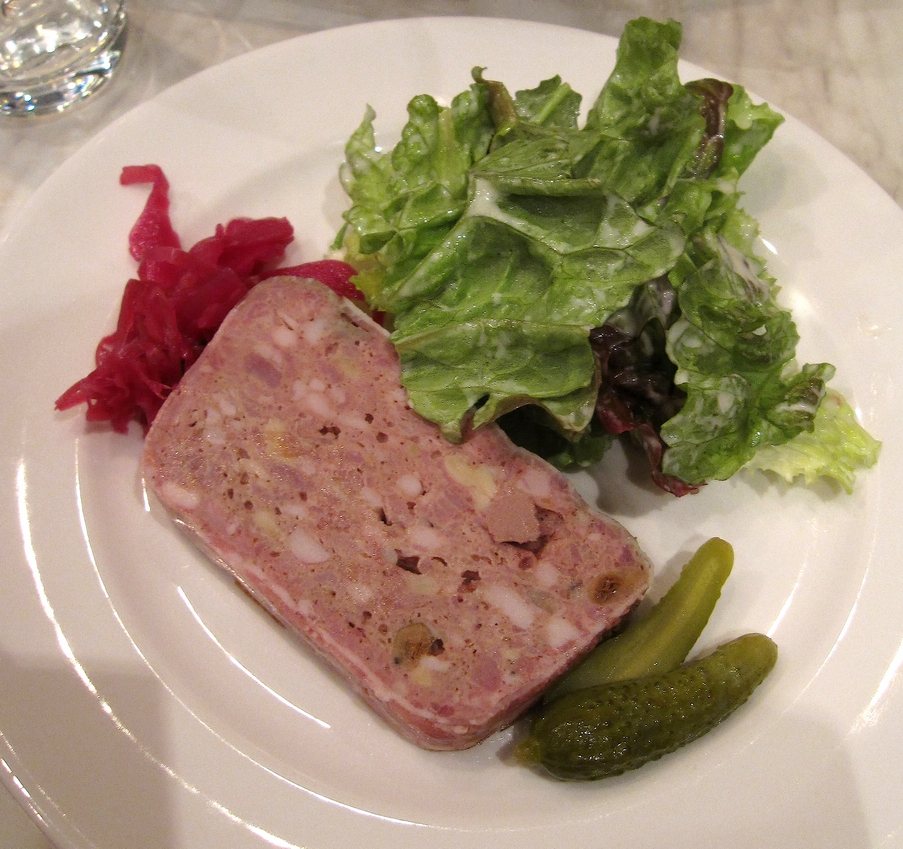
A forcemeat terrine is ground meat and fat, seasoned, packed into a lined mold, baked gently in a water bath, pressed, chilled and sliced. Escoffier (1907) gave the definition that still explains the family best: “A ‘Terrine’ or Patty is only a pie without a crust” (No. 1825). His glossary calls the vessel a terrine à pâté. In the classical usage a terrine is a pâté that has lost its crust, not a coarse pâté as opposed to a smooth one. The popular smooth-versus-coarse split is a later convention (see Pâté, Terrine and the Family).
What follows is the working anatomy: the forcemeats and their numbers, the lining and the inlay, the cook, the two doneness tests that predate the thermometer, pressing, and serving. The kitchen these pages are written for has made liver pâté and a country terrine, and has a terrine mold, a meat grinder and a sous vide circulator.
The country terrine
Pâté de campagne and terrine de campagne are used interchangeably in French (fr.wikipedia): a coarse forcemeat, mostly pork, varying by region. A dated history of the dish under that name could not be established.
The one country pâté with a legal composition found in the research is the Breton. Pâté de campagne breton has held an IGP (Protected Geographical Indication) since 2013. As summarised by French Wikipedia, it is pure pork, with at least 20% liver, 25% throat (gorge), 5% rind and 5% raw onion, plus cooked head trimmings. The EU register entry itself was not read, so those figures stand as summarised rather than as checked against the specification. They are still instructive: a fifth liver, a quarter of the fatty throat, and rind for body is what a regulator decided a country pâté is.
The forcemeats
Modern culinary training (the CIA taxonomy, as reproduced by The Culinary Pro) sorts forcemeats into four:
| Type | What it is |
|---|---|
| Country (campagne) | Rustic, coarse; pork, pork fat, often pork liver and garnish |
| Straight | Smooth, ground progressively large → medium → fine; “equal parts pork and pork fat with a third ingredient, a dominant meat” (en.wikipedia) |
| Gratin | Part of the protein, usually liver, fully or partly cooked before grinding |
| Mousseline | Lean meat, poultry or fish emulsified with egg white and cream (see Fish and Vegetable Terrines) |
The Culinary Pro’s working ratios: “Most ratios use two parts lean meat to one part fat”, salt at “60 parts meat and fat to 1 part salt”, which it restates as 20 g per kg (0.3 oz per lb) although 1:60 works out nearer 17 g, and binders no more than one part to four of meat by weight. Binders include panada (bread, flour or rice paste), egg, béchamel and dry milk.
Escoffier’s numbers
Escoffier’s 1907 forcemeats run much fatter than the modern norm.
- No. 196, pork forcemeat for pies and terrines: 2 lb pork fillet, 2 lb fresh fat bacon, 1¾ oz spiced salt, 2 eggs, 2 Tbsp brandy. “Strictly speaking, it is ‘sausage-meat.’”
- No. 197, forcemeat for galantines, pies and terrines: 1 lb veal, 1 lb pork, 2 lb fat bacon, 3 oz spiced salt, 3 eggs, 3 Tbsp brandy, rubbed through a sieve.
- No. 200, chicken forcemeat: 20 oz chicken, 8 oz pork, 8 oz veal, 30 oz fat bacon, 5 eggs, 2 oz spiced salt, ⅕ pint brandy. Foie gras trimmings may go in but “must not, in any case, exceed one-fifth”, and “As a rule, forcemeat should always be rubbed through a sieve.”
- No. 202, gratin forcemeat: fat bacon, veal and pale calf’s liver, each browned quickly in hot butter, then pounded with butter, egg yolks, reduced espagnole and the Madeira used to deglaze, and sieved.
The classical ratio was about one part fat to one part lean, not the modern two to one. Both figures are sourced. They belong to different eras and are not in conflict. Escoffier also gives the egg a job: it “prevents the grease from melting too quickly, and thus averts the drying of the forcemeat.”
Two of his other rules still hold. For game terrines, stir gratin forcemeat into the raw forcemeat at a quarter to a fifth of its weight (No. 197); this is the classical source of the “gratin portion” idea. His hare pie (No. 1834) also adds “a portion of the hare’s blood”. Truffle goes in at 2–3 oz per pound of forcemeat (No. 200).
Keeping it cold, and testing it
The Culinary Pro says to keep the forcemeat below 40 °F (4 °C), to grind at 28–30 °F (−2 to −1 °C) with chilled grinder parts and bowls, and to work over ice. Warmth “breaks” the mixture and gives a greasy texture. Industrial studies point the same way: meat batters chopped to an end temperature of 15 °C (59 °F) or lower were the most stable (J. Food Sci. 1995). Salt at 1.5–2% of the weight of meat and fat falls within the tested range for dissolving the proteins that bind it. The mechanism, and why “emulsion” is not quite the right word for it, is on The Science of a Forcemeat.
Before the mold is filled, poach a small quenelle in salted water or stock and taste it. If it is rubbery, add fat or cream; if it is loose, add egg white or panade (The Culinary Pro). The test piece is not modern. Escoffier’s godiveau (No. 198) already says to “poach a small portion of it in boiling water in order to test its consistence”, and to work in ice if the mixture is too firm.
Pink curing salt, for color
The regulatory purpose of nitrite in US law is “To fix color”. 9 CFR 424.21(c) allows ¼ oz of sodium nitrite per 100 lb of chopped meat. That works out to 156 ppm ingoing. With Cure #1 (6.25% sodium nitrite), it takes 0.25% by weight of the meat and fat, or 2.5 g per kg. The Culinary Pro’s rule of thumb, ¼ tsp per 2 lb (1 kg) of forcemeat, sits close to that. Without nitrite, cooked pork turns gray-brown; with it, it stays pink.
That a country pâté is traditionally cured for color could not be confirmed in a primary source. The salt does not make a terrine safe to mishandle, either: a 1995 botulism case in Québec involved a commercial pâté de campagne, and two people were paralyzed for months. See Food Safety.
Lining, garnish and the mosaic
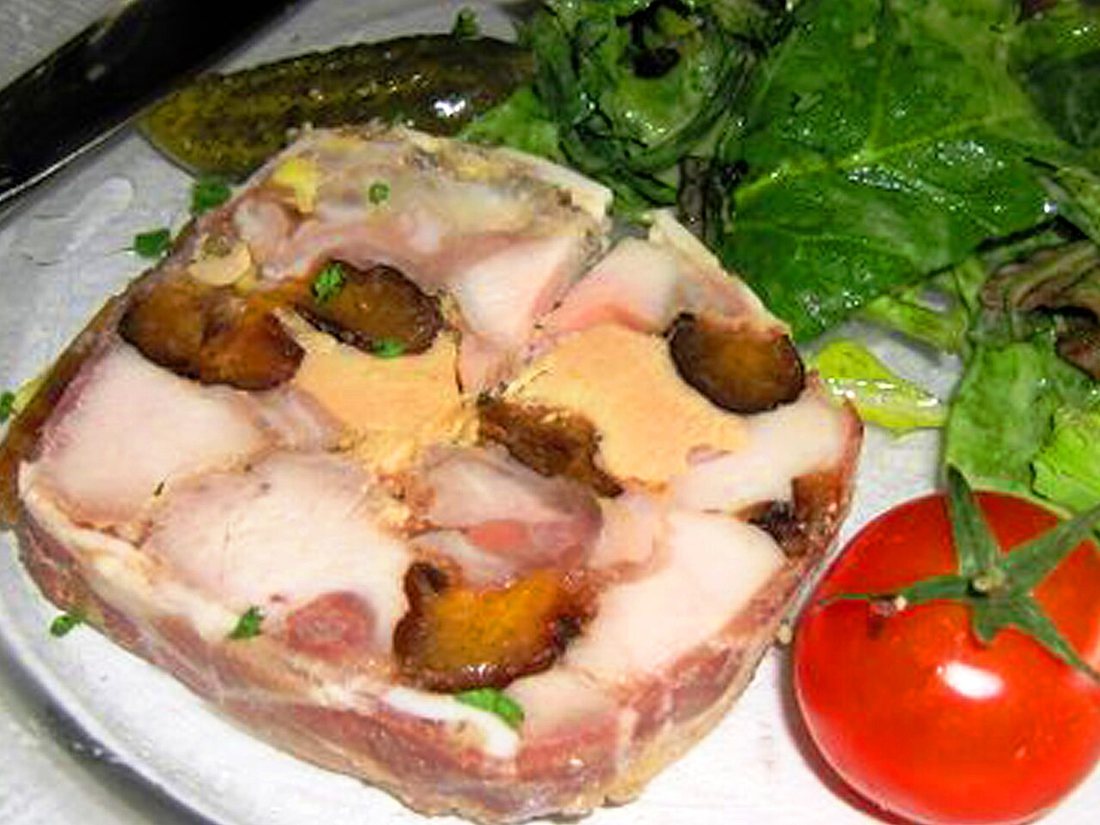
Lining. Escoffier’s hare terrine (No. 1825) says the terrine “should first be lined with slices of bacon”, then filled in layers, and topped with another slice with a sprinkle of thyme and bay. In the 1907 English translation “bacon” almost certainly renders unsmoked fatback (lard gras) rather than smoked streaky, but that could not be checked against the French. Caul fat (crépine), the lacy membrane from around the stomach, is the other classical wrapper; Escoffier wraps foie gras “in thin slices of bacon or a piece of pig’s caul” (No. 1726). Fatback, leeks or ham can also stand in (The Culinary Pro). No source was found for blanched leaves as a lining.
Garnish and inlay. The clearest classical specification is Escoffier’s galantine (No. 1708). Strips of breast meat, truffle, salted fat pork, cooked ham and salted ox-tongue, each ⅓ inch (about 8 mm) square, are laid “alternately and regularly” between layers of forcemeat. The strips run the full length of the mold, so every slice cuts across them and shows the same mosaic. Pistachios are widely described as a classic terrine garnish, but they do not appear in any of the Escoffier passages read, and no source for the claim was found.
Cooking: the bain-marie
Escoffier bakes the terrine in the oven in “a saucepan containing a little water”, which is the bain-marie. No primary source setting out why was found, and classic oven temperatures could not be established either. The usual reasoning is that water cannot rise much above 100 °C (212 °F), so the outside of the terrine overcooks less than it would in dry oven air while the center climbs.
Doneness, before the thermometer
Escoffier gives two tests that need no probe (No. 1825):
- Clear fat. A terrine “is known to be quite cooked when the grease which rises to the surface is quite clear. As long as this grease is turbid, raw juices are still issuing from the forcemeat and the garnish inside.”
- The warm needle. “If the latter withdraws evenly heated throughout its length, the terrine is cooked.”
Both remain good checks alongside a thermometer. The number to reach is set by the meat. USDA (foodsafety.gov): ground pork, ground veal and sausage 160 °F (71 °C); rabbit and venison 160 °F (71 °C); all poultry, including ground poultry and giblets, 165 °F (74 °C). Chicken livers are giblets, so a forcemeat that contains poultry or poultry liver belongs in the 165 °F row. The UK standard is 70 °C (158 °F) for 2 minutes at the center, or equivalent time and temperature combinations. The detail is on Food Safety.
Pressing
Escoffier ties the weight to how the terrine will be served. Use “slight pressure” if it will be served from its dish, and “greater pressure” if it will be turned out and presented, because a terrine that stands on its own needs a denser body (No. 1825). For his galantine the ceiling is “a weight not exceeding five or six lbs” (about 2.5 kg). A second loaf tin loaded with jars or cans makes a serviceable press (Great British Chefs).
Resting, unmolding and slicing
For a terrine served from its dish, Escoffier adds aspic while it is tepid and cools it under light pressure. “When quite cold, clear it of grease; trim its surface, and cut it up in the utensil.” To present it whole, he presses harder, turns it out, trims it all round, sets a layer of jelly in the bottom of the terrine and returns it.
The common advice to rest a terrine for two or three days before cutting, and the figure for how far its temperature keeps rising after it leaves the oven, could not be traced to a technical source, so neither is given here as a number. What can be said is that the resting days come out of its refrigerated life: the FDA/FSIS chart gives cooked meat dishes 3–4 days in the refrigerator. The hot-knife slicing method (dip in hot water, wipe) is widely described, but no source was found for it.
What goes with it
The accompaniments with a source behind them:
- Cornichons and mustard. Matt Ryle serves his pâté en croûte with them (Great British Chefs). Escoffier groups “Mustard, gherkins, capers” together as “hot condiments”, the modern charcuterie-board trio.
- Salad, beets and pickles with pâté de campagne (fr.wikipedia). The Danish liver loaf goes with pickled beets too (see Liver Pâtés, Parfaits and Mousses).
- Cumberland sauce with cold game. Escoffier’s No. 134 is redcurrant jelly, port, shallot, julienned orange and lemon zest, mustard, cayenne and ginger, and he specifies it “with cold venison”. It suits the game and rabbit terrines.
- Piccalilli with ham hock terrine (Galton Blackiston, Great British Chefs), to “cut through the rich flavours”. See Aspic and Head Cheese.
Pickled onions are often suggested as well, but no source for them as a traditional terrine pairing was found.
Recipes in the collection
- Country Terrine
- Country Terrine with Black Pepper & Thyme
- Pork Terrine
- Pork, Apricot and Pistachio Terrine
- Pork, Chorizo and Pink Peppercorn Terrine
- Duck, Chicken and Sour Cherry Terrine
- Guinea Fowl Terrine
- Rabbit Terrine
- Rabbit Terrine with Pickled Walnuts
- Chicken and Mushroom Terrine
- Baked Chicken Liver Mousse (Terrine-Style): the terrine method applied to a raw liver purée, baked to 160 °F, which is below the 165 °F USDA figure for poultry giblets
- Leberkäse (Bavarian Meatloaf): a German cousin baked in a loaf pan
Comments (0)