Food Safety
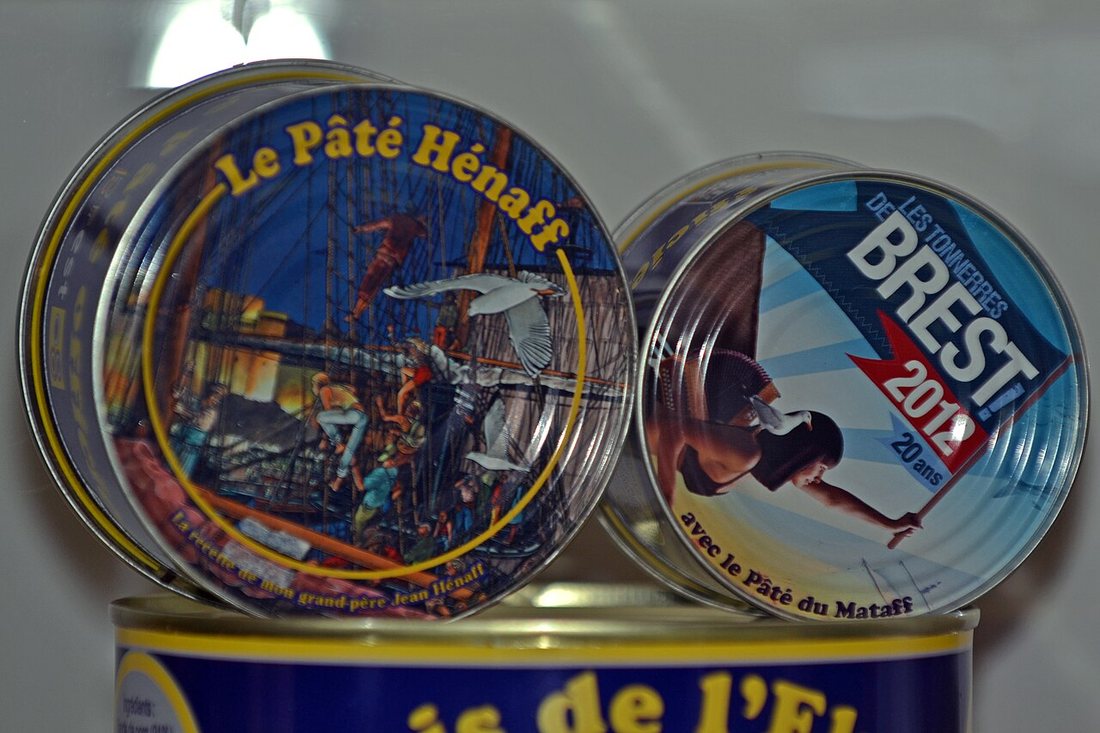
Pâtés and terrines are ground meat, often poultry liver, cooked gently, set cold, sliced over several days, and frequently sealed under fat or jelly. Each of those facts carries a hazard. The record is specific about which ones actually make people ill: undercooked chicken liver (Campylobacter), cold-growing Listeria in ready-to-eat products, and botulism in canned pâté that was not commercially retorted. The fat cap and the aspic, often imagined as protection, have both failed in documented outbreaks.
Target temperatures
| Product | Target core temperature | Source |
|---|---|---|
| Ground pork, beef, veal, lamb (most forcemeats) | 160 °F / 71 °C | USDA, foodsafety.gov chart (reviewed Nov 2024) |
| Rabbit and venison | 160 °F / 71 °C | same |
| All poultry, including ground poultry and giblets (chicken livers) | 165 °F / 74 °C | same; CDC on chicken livers |
| Whole pork cuts, raw ham | 145 °F / 63 °C, then rest 3 min | same |
| Fish | 145 °F / 63 °C | same |
| Casseroles, leftovers, precooked ham reheated | 165 °F / 74 °C | same |
| UK general standard | 70 °C for 2 min at the center; or 60 °C/45 min, 65 °C/10 min, 75 °C/30 s, 80 °C/6 s | UK government, “Cooking your food” |
| Chicken livers, lab-validated for Salmonella with texture kept | 70–73.9 °C (158–165 °F) held 101 to 26 s | Washington State University, Poult. Sci. 2021 |
| Poultry, lower-temperature equivalents (1% fat → 12% fat) | 140 °F/60 °C: 28.1 → 35 min · 145 °F/62.8 °C: 10.5 → 13.8 min · 150 °F/65.6 °C: 3.8 → 4.9 min · 155–156 °F/68.9 °C: about 1 min · 160 °F/71.1 °C: about 26 s · 166 °F/74.4 °C: instant | FSIS 2005, as reproduced by Douglas Baldwin |
Caveats that matter:
- The FDA’s lower-temperature table for beef and pork (for example 140 °F for 12 minutes) is written for intact roasts. Whether it applies to a ground pork forcemeat could not be confirmed. For ground pork, use 160 °F or the poultry table.
- The FSIS poultry columns stop at 12% fat, and fat adds time. A chicken-liver parfait containing its own weight in butter is far outside that range, so the table does not strictly cover it. Hold at the upper end, or reach 70 °C and hold for the WSU times.
- Foie gras sits outside every table above — poultry at 50–60% fat — and no safety-validated low-temperature foie gras process was found. See Foie Gras.
- Some published recipes cook below these lines. The source for the collection’s salmon and whiting terrine gives 120 °F, below FDA’s 145 °F for fish.
Chicken liver pâté and Campylobacter
This is the modern hazard, and the cause is consistent: undercooking to keep the texture. CDC’s report on a 2013–14 Ohio/Oregon cluster says it plainly: “Pâté made with chicken liver is often undercooked to preserve texture.” Partly cooked livers “might be blended with other ingredients and chilled,” which hides how done they were. The report cites prior data finding Campylobacter in 77% of chicken livers cultured, notes that inspection does not require livers to be “free from bacteria,” and that “washing is insufficient.”
A US review (Foodborne Pathog. Dis. 2018) counted 28 chicken-liver outbreaks from 2000 to 2016: 85.7% involved blended dishes such as pâté, 92.8% inadequate cooking, and 18 of the 28 occurred in 2014–16.
| When and where | Cases | Note |
|---|---|---|
| Dec 2006, Forth Valley, Scotland | 48 | 86% attack rate among pâté eaters; the restaurant had changed its pâté cooking method for three weeks |
| Oct 2009, conference, northern England | 59 | first mixed Campylobacter and Salmonella pâté outbreak |
| Sep 2011, wedding, East of England | 49 | dose–response (below) |
| Oct 2013, Australian university college | 56 | Campylobacter isolated from the kitchen’s pâté |
| Dec 2013–Jan 2014, Ohio and Oregon | 5 | the CDC report quoted above |
| Jan 2017, North Yorkshire hotel | 19 | ”outbreaks continue to occur” despite simple, effective cooking methods |
The more eaten, the more illness. At the 2011 wedding, guests who “tasted” the pâté had odds of illness of 1.5; “partly eaten,” 8.4; “most or all eaten,” 36.1.
Searing the outside is not enough. In a 2025 study, 35.7% of broiler livers carried Campylobacter in the inner tissue, not only on the surface. Flash-fried livers left pink in the middle are the recurring vehicle.
Pink is not a reliable test either way. WSU measured the lethality directly. Salmonella is the more heat-resistant organism in liver, so a cook designed for it also handles Campylobacter; at 70–73.9 °C internal a 7-log Salmonella reduction takes seconds. The same group found that livers held in that window were safe and could still be pink. Government “no pink” advice is a proxy for temperature. The temperature is what counts, and only a thermometer measures it.
Freezing helps but does not replace cooking. Freezing livers for 24 hours at −25 °C cut Campylobacter by up to 2 log; a double freeze (24 h, thaw overnight at 4 °C, 24 h again) by up to 3 log (Lett. Appl. Microbiol. 2013).
Listeria: the cold-growing hazard
Listeria monocytogenes grows at refrigerator temperature, so a chilled ready-to-eat product is a growth medium for its whole shelf life.
The UK pâté upsurge, 1987–89. Listeriosis in England, Wales and Northern Ireland nearly doubled between 1985 and mid-1989, then fell sharply (BMJ 1991). Two strains caused 30–54% of annual cases. In 1989, pâtés from a single plant — identified in the paper only as “manufacturer Y” — were more often contaminated, at higher levels, with strains indistinguishable from those behind the upsurge. The decline began when government warnings were issued and that plant’s supplies were suspended. The authors call the contamination “a likely contributory cause.” A 2020 review counts it as a single outbreak of 378 cases, the largest food-attributed listeriosis event in England and Wales from 1981 to 2015. The plant is widely reported as Belgian, but the paper does not name the country, and no primary source seen here does.
France: jelly and fat did not protect.
- 1992, pork tongue in jelly: 279 cases (92 pregnancy-related), March to December; the jellied tongue was the major vehicle, with other delicatessen products contaminated secondarily in shops.
- 1993, rillettes: 38 cases, 31 of them mother-and-newborn; one brand implicated, and the organism was confirmed in unopened plastic cans.
These are the two formats — set in aspic, sealed under fat — that people assume are self-protecting. Neither stops an organism introduced after cooking that grows in the cold. (A death toll of 63 for 1992 is often quoted; it could not be confirmed.)
A present-day check: of 870 liver pâté samples taken in England in 2012–13, 9% were unsatisfactory and none carried Salmonella or Campylobacter; retail pâté was less likely than catering pâté to carry L. monocytogenes.
Pregnancy: two agencies, two answers
As of September 2026 the UK and US disagree.
- NHS (page reviewed 15 June 2026): meat pâté and vegetable pâté are now “foods to be careful with — keep chilled and eat before the use-by date.” Liver and liver products remain on the avoid list, for vitamin A, which “can be harmful to your baby” — not for Listeria. The older “avoid all pâté” advice is still widely repeated and is out of date.
- CDC: avoid “Refrigerated pâté or meat spreads”; choose instead pâté “in sealed, airtight containers that don’t need to be kept refrigerated before opening.” The advice covers pregnant women, newborns, people 65 or older, and people with weakened immune systems.
Botulism and canned pâté
A fat seal or a sealed jar excludes air, and an air-free, low-acid, moist food is exactly what Clostridium botulinum needs. Canned pâté is safe only when it has been commercially retorted.
- Vietnam, 2020: 12 cases from a tinned vegetarian pâté; type B toxin-producing C. botulinum found in household samples.
- Hanoi: type A(B) botulism from a home-canned vegetarian pâté.
- Québec, 1995: a husband and wife were hospitalized for months with paralysis after eating a commercial pâté de campagne. How it was packaged or mishandled could not be established.
No tested home-canning process for pâté could be confirmed. The claim that duck confit keeps “two to three years” in a cool cellar (Ruhlman) is tradition, not a validated process. Refrigerate rillettes, confit and potted meats.
Curing salt
Many country terrines use pink curing salt. The US limits are in the table at 9 CFR 424.21(c) (not 424.22, which is the bacon rule):
- Nitrite, stated purpose “To fix color”: ¼ oz per 100 lb of chopped meat — 0.25 ÷ 1,600 = 156 ppm ingoing. Finished product is capped at 200 ppm nitrite.
- With Cure #1 at the usual 6.25% sodium nitrite (a product strength, not an eCFR figure), 156 ppm is 0.25% Cure #1 by weight of meat and fat — 2.5 g per kg, about 1.1 g per lb.
- Sodium ascorbate or erythorbate, to accelerate or preserve color: ⅞ oz per 100 lb, about 547 ppm.
In a terrine cooked through and kept cold, nitrite’s color role — pink instead of gray-brown — is the obvious one. The Québec case above shows a cooked pâté de campagne is not immune to botulism if mishandled.
Storage
The FDA/FSIS refrigerator and freezer chart has no pâté row. The nearest rows:
| Row | Refrigerator | Freezer |
|---|---|---|
| Cooked meat and meat dishes | 3–4 days | 2–3 months |
| Variety meats (liver, tongue, kidneys), raw | 1–2 days | 3–4 months |
| Gravy and meat broth | 1–2 days | 2–3 months |
Baldwin’s sous vide guide gives cook-chill limits set by non-proteolytic C. botulinum: below 2.5 °C (36.5 °F) up to 90 days; below 3.3 °C (38 °F) under 31 days; below 5 °C (41 °F) under 10 days; below 7 °C (44.5 °F) under 5 days. Those apply to pasteurized food chilled rapidly and left sealed in its bag. They do not license a terrine that has been unmolded, cut and wrapped. The conservative reading is eat a cut terrine within 3–4 days. The cookbook claim that a whole, fat-sealed terrine keeps about a week could not be sourced. One published rillettes recipe (Emma Macdonald, Great British Chefs) gives up to two weeks sealed in the fridge and three days once opened.
For how liver pâtés are made, see Liver Pâtés, Parfaits and Mousses; for the physics behind the temperatures, The Science of a Forcemeat.
Comments (0)