The Science of a Forcemeat
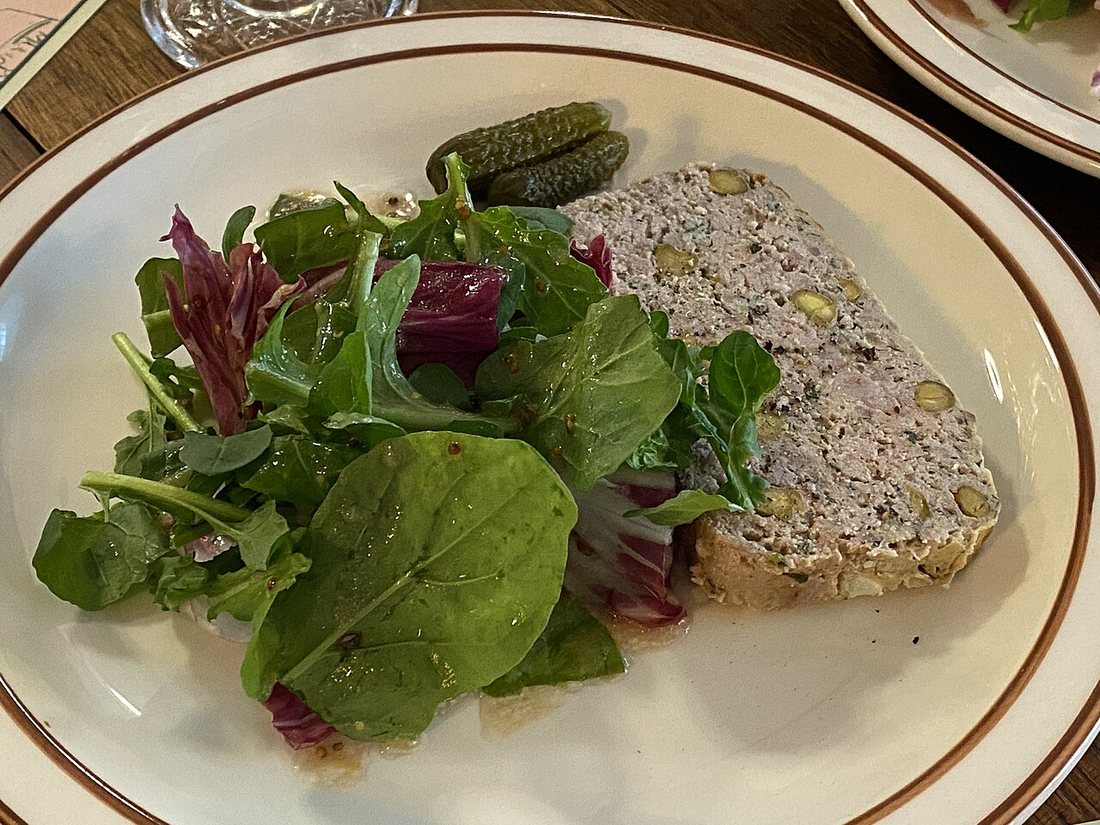
A forcemeat is ground or pounded meat and fat, salted, bound, and set by heat into something that slices. Nearly every failure in the family — a terrine that weeps fat, a mousseline that goes grainy, a liver pâté that turns chalky, an aspic that will not set — comes back to one of a short list of variables: salt, temperature while working, fat-to-lean ratio, the binder, the final core temperature, and, for jellies, what the gelatin is being asked to do.
Much of what is taught about these variables is right. Some of it is shorthand that does not survive a look at the literature, and a few widely repeated numbers turn out to have no primary source at all. Those gaps are marked below rather than filled.
Salt: what actually binds a forcemeat
Salt is not only seasoning here. It dissolves the muscle’s myofibrillar proteins (myosin and actomyosin), which then form a sticky matrix that sets into a gel when heated. That gel is what holds a terrine together when it is cut.
A 2025 pork-sausage model (J. Anim. Sci. Technol.) tested 1.0, 1.5 and 2.0% salt by weight. At 2.0% the batter had the highest protein solubility (0.61 g/g) and the lowest cooking loss (2.8%). A forcemeat salted at 1.5–2% of the combined weight of meat and fat — 15–20 g per kg, roughly 0.25–0.3 oz per lb — sits inside that tested range. The Culinary Pro, a culinary-education site, gives a ratio of 60 parts meat and fat to 1 part salt and restates it as 20 g per kilo; the two do not agree (1:60 is about 17 g per kilo), but both sit inside the tested range.
Escoffier’s forcemeats specify “spiced salt” by weight and note that the amount varies “according as to whether the atmosphere be dry or damp” (1907). Salt percentages quoted from the CIA’s Garde Manger or Ruhlman’s Charcuterie could not be read first-hand for this section and are not repeated.
Is it an emulsion? A correction
Forcemeats, and sausage batters generally, are routinely called emulsions. The standard review is less sure. Gordon and Barbut (Crit. Rev. Food Sci. Nutr., 1992) set out two competing explanations:
- the emulsion theory — a protein film forms around each fat globule;
- the physical-entrapment theory — a protein matrix holds the fat in place during chopping and heating.
They conclude that “some aspects of stabilization cannot be explained adequately by either one of these theories.” No newer work overturning that review was found. The honest description is a fat dispersion held in a protein gel, often called an emulsion — useful kitchen shorthand, contested as a technical term.
The practical point survives either way: the protein has to be extracted (salt) and the fat has to stay in small, firm pieces until the protein sets around it (cold).
Keeping it cold
The data here come from industrial bowl-chopper studies, but the mechanism carries to a home grinder and food processor. Friction heats the mix; the fat softens and smears instead of cutting cleanly; the cooked product weeps fat and liquid.
| Study | Finding |
|---|---|
| Reduced-fat beef frankfurters (J. Food Sci. 1995) | End-point chopping at 15 °C (59 °F) or below gave the most stable batters; above 15 °C lowered quality |
| Emulsion-type pork sausage (J. Food Sci. 1990) | Water-holding capacity fell as chopping temperature rose; 12.8 °C (55 °F) gave the best yield |
| Bologna (Meat Sci. 1996) | A lower chopping temperature reduced purge loss in chilled storage |
A working rule of grind near-frozen, finish the mix at or below about 15 °C / 60 °F is consistent with this. The popular “keep it under 40 °F” is repeated by teaching sites (The Culinary Pro gives 40 °F / 4 °C, and 28–30 °F for grinding) but was not found in a primary study. It is a sensible margin, not a measured threshold.
In practice: chill the grinder head, auger, knife and plate in the freezer; grind into a bowl set over ice; and work in batches rather than letting the whole mix sit out.
The panade
A panade (panada) is a starch binder — puréed cooked potato, cream-soaked bread or pâte à choux, in the CIA definition as reported by Wikipedia. What it does is now measured. In lean poultry gels, Barbut (Poult. Sci. 2023) found that all breadcrumbs significantly reduced cooking loss and lowered hardness, chewiness and gumminess, and that the crumbs were “well connected to the cooked meat matrix, and fully hydrated.”
So a panade does two jobs: it holds water, and it interrupts the protein network. The result is a forcemeat that stays moist and tender rather than springy. The Culinary Pro caps binders at about 4 parts meat to 1 part binder by weight.
Fat to lean: two eras, both sourced
The ratio most often taught today is leaner than the classical one.
- Escoffier, 1907, ran about 1:1. His pork forcemeat for pies and terrines (No. 196) is 2 lb pork to 2 lb fresh fat bacon — and he adds, “Strictly speaking, it is ‘sausage-meat.’” His forcemeat for galantines and terrines (No. 197) is 1 lb veal plus 1 lb pork to 2 lb fat bacon: the fat equals the lean combined. His chicken forcemeat (No. 200) is 30 oz fat to 36 oz lean.
- The modern professional norm is about 2:1 lean to fat. The Culinary Pro: “Most ratios use two parts lean meat to one part fat,” up to 1:1 when binders are used.
These are not a contradiction; they are different eras. The CIA’s “straight” forcemeat is reported by Wikipedia as equal parts pork and pork fat with a third, dominant meat, but the book itself was not read. Research liver pâtés run 30–40% fat.
Escoffier’s egg
The egg is usually described as “a binder.” Escoffier gave it a mechanism. In his pork forcemeat he writes that “the addition of the egg in these cases prevents the grease from melting too quickly, and thus averts the drying of the forcemeat.”
The mousseline’s egg white
The mousseline is the forcemeat most dependent on technique. Escoffier’s No. 195: 1 lb chicken pounded with salt, pepper and nutmeg; two egg whites worked in; the paste sieved; then one pint of thick cream added gradually, “keeping the receptacle on ice.” The ice bath is in the classical recipe. (The 1907 English pint is most likely imperial, about 568 ml, which puts the cream above the weight of the meat; the French original was not checked.)
His note on the white is the useful part: it “is not essential if the meats used already possess a certain quantity of albumen; but without the white of egg the forcemeat absorbs much less cream.” The white raises how much cream the paste can carry — it is doing more than binding. His correction for a finished mousseline: “a little white of egg if it be too light, and a little cream if it be too stiff.” The same principles, he says, apply to fish and shellfish.
The test quenelle, and the ice
Poaching a spoonful of forcemeat before filling the mold is sometimes presented as a modern restaurant habit. It was already standard in 1907. Escoffier’s godiveau (No. 198) rests the veal and kidney-fat paste on ice overnight, works in 14 oz of clean ice in small pieces, then says to “poach a small portion of it in boiling water in order to test its consistence” — more ice if it is too firm, a little egg white if too flimsy. The Culinary Pro gives the same logic today: rubbery means add fat or cream; loose means add egg white or panade.
Liver: temperature is texture
Liver is where the margin between safe and grainy is narrowest, and it has been measured. Washington State University researchers heated chicken livers across 60–90 °C (Poult. Sci. 2021):
- cooking loss and shrinkage rose with both time and temperature;
- at 70 °C (158 °F) the livers kept a shear resistance similar to fresh liver;
- at 73.9–90 °C (165–194 °F) they became tougher.
Overcooked liver protein squeezes out water, and that is the physical basis of a dry, crumbly, grainy pâté. The same group’s recommendation — hold 70–73.9 °C for 101 to 26 seconds — is covered on the safety page. Frozen livers lost more water on cooking than fresh.
Soaking liver in milk: no evidence either way. A literature search turned up no study on milk-soaking and flavor, bitterness or blood removal. It is a tradition, and should be treated as optional and untested. The common explanation of bitterness — bile from a nicked gall bladder — could not be established from a citable source, and no study relating bitterness to cooking temperature was found.
Why a water bath
No primary source explaining the bain-marie was reached, so what follows is physical reasoning, not a sourced finding. Water under a lid cannot rise much above 100 °C (212 °F), and it transfers heat far more gently than oven air at 150–175 °C (300–350 °F). The outside of the terrine therefore overshoots less while the center climbs. Given that 70 °C against 90 °C is the difference between tender and grainy liver, a gentle gradient matters.
Escoffier’s own doneness test needs no thermometer: a terrine is cooked “when the grease which rises to the surface is quite clear. As long as this grease is turbid, raw juices are still issuing.” A probe thermometer is the modern check; see the equipment page.
Gelatin
Gelatin is denatured collagen. Its setting strength is expressed as a Bloom value; commercial gelatin runs about 90 to 300 g Bloom, measured on a 6.67% gel. The full test conditions were not confirmed first-hand, and no primary source gave gram-per-liter concentrations for a sliceable versus a trembling aspic.
Three properties explain most of what cooks see:
- It melts below body temperature, which is why a good aspic dissolves in the mouth. Fish gelatin melts at lower temperatures still, making fish aspic more delicate.
- Its strength declines above 100 °C, so a stock boiled hard and long sets less well.
- Vegetables contain none, so a vegetable terrine needs gelatin or another setting agent added.
Escoffier wanted the softest set that would hold: “the greater the viscosity of the jelly the less value will the same possess.” See Aspic and Head Cheese.
Fresh fruit and gelatin. The enzyme actinidain was identified in 1959 when A. C. Arcus examined why kiwifruit jellies would not set: a protein-digesting enzyme was breaking down the gelatin. Actinidain denatures at about 60 °C (140 °F), lower than bromelain (pineapple) or papain (papaya). The practical rule follows: cooked or canned fruit is fine; fresh kiwi, pineapple or papaya is not. The exact inactivation temperatures for bromelain and papain could not be established here.
Pasteurized versus sterilized
A 2023 study compared pork-liver pâté pasteurized at 70 °C for 10 minutes with pâté sterilized at 122 °C for 10 minutes. Sterilization raised oxidation, hardness, cohesiveness, gumminess and springiness, and lowered sensory appeal; higher fat (40% against 30%) also firmed the pâté. This is why a shelf-stable tinned pâté spreads and tastes unlike a fresh terrine — and the retort that makes the tin safe is the same step that changes its texture.
Recipes in the collection
- Country Terrine
- Pork Terrine
- Salmon and Whiting Terrine — a fish mousseline
- Chicken Liver Parfait (Sally Abé)
- Baked Chicken Liver Mousse (Terrine-Style)
- Eggs in Aspic (Oeufs en Gelée)
- Ham and Parsley Terrine (Jambon Persillé)
- Pressed Pig’s Head Terrine (Head Cheese)
- Roasted Vegetable Terrine
- Salmon Mousse
- Tomato Aspic
Comments (0)