Around the World
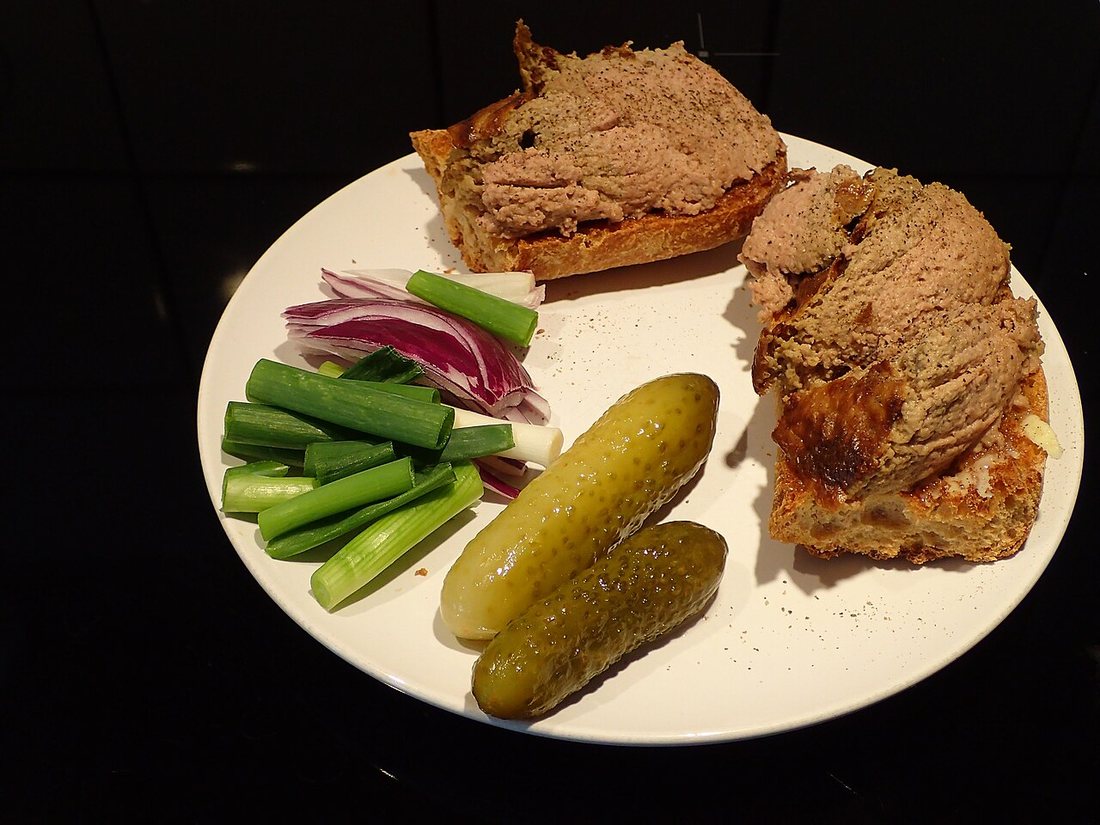
Wherever the pig or the goose was kept, cooks found a way to turn liver, trimmings and fat into something that could be spread, sliced or kept. The French words spread with French cooking, and a surprising number of national dishes turn out to be French imports that were naturalized and then forgotten as imports: Danish leverpostej began in a Frenchman’s shop, and the Vietnamese pâté arrived with the colonial baguette. Others grew independently from the same materials, and some carry names that mean nothing like what they contain.
This page is a tour, not a census. Where the sources reached for this section were silent, it says so rather than filling the gap.
Denmark: leverpostej
Leverpostej is Denmark’s everyday liver pâté: ground pork liver and lard (or fatback), onion, flour, egg, salt, pepper and allspice, sometimes with a little cured anchovy, poured into a loaf pan and baked (Wikipedia). It is eaten cold on rye bread (rugbrød), or warm with pickled beets or gherkins and fried bacon or sautéed mushrooms.
Its origin is French. According to Danish and English Wikipedia, François Louis Beauvais, a Frenchman, received permission in 1847 to sell French-style pork products from his shop on Østergade in Copenhagen, and sold liver pâté “with great success” to the city’s bourgeoisie. By 1900 production had moved to dedicated factories; before the First World War it was a working-class staple; in two 1992 surveys Danes named it their favorite sandwich topping. These details rest on Wikipedia alone. Stryhn’s, founded on Amager in 1945, makes about 85,000 units a day.
The technique is unlike a French liver pâté: a flour-and-egg bind poured and baked, which gives a loaf that slices and spreads at once. The collection’s Leverpostej, from the Danish dairy Arla, is a butter version rather than a lard one: 300 g (10½ oz) pork liver, ¼ liter (1 cup) milk, 150 g (5 oz) melted butter, a tablespoon of flour, onion, egg and salt, all blitzed in a food processor, then started in a cold oven set to 175 °C (350 °F). Its oregano is unusual; allspice, the classic Danish spice, appears only in Arla’s Christmas variation.
Germany: Leberkäse, which may contain no liver
Leberkäse, rendered in the collection’s title as Bavarian meatloaf, has a name that suggests liver cheese, and German food law takes the name seriously. According to German Wikipedia, Leberkäse sold in Germany must contain liver unless it is sold as Fleischkäse or as Bayerischer Leberkäse. The liver share is otherwise not fixed, except that coarse and Stuttgarter Leberkäse must contain at least 5%. So the best-known Leberkäse, the Bavarian, is the one legally permitted to contain none. The primary source for the rule, the official Leitsätze für Fleisch und Fleischerzeugnisse, was not consulted, so the percentages should be treated as secondary.
The etymology is contested. Leber may be liver, or it may come from Laib, “loaf”; Käse may be the Bavarian word for a paste, or it may describe a loaf shaped like a cheese. Wikipedia gives both readings and neither is settled. The collection’s Leberkäse (Bavarian Meatloaf) is the Bavarian type.
Belgium: the pâté that is a pie
Belgium’s protected pâté is not a spread at all. Pâté gaumais, from the Gaume in Belgian Lorraine, is a raised pie filled with noble cuts of pork marinated in wine or vinegar (French Wikipedia). Its specification is precise: round, at least 15 cm (6 in) across, at least 200 g (7 oz), at least 30% meat. It gained a Belgian label on 12 July 1998 and EU Protected Geographical Indication on 9 October 2001; twelve producers held it as of 2024. An annual contest is held at Virton on 26 December. It is a reminder that pâté originally meant the pastry-cased dish (see En Croûte, Galantine and Ballotine).
Vietnam: pâté and the bánh mì
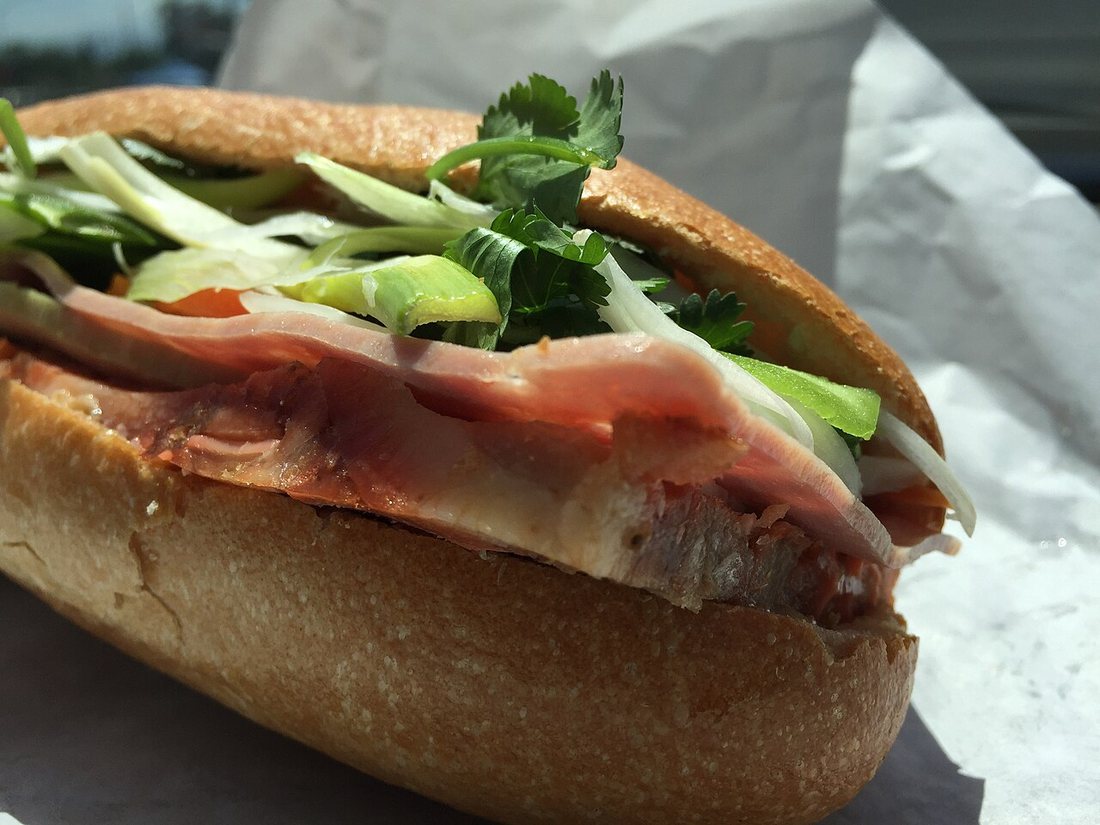
The French brought the baguette and the pâté chaud to Vietnam from the 1860s. According to Wikipedia, “until the 1950s, sandwiches hewed closely to French tastes, typically a jambon-beurre moistened with a mayonnaise or liver pâté spread.” In 1958 the shop Hòa Mã, in Saigon’s District 3, run by northern migrants Lê Minh Ngọc and Nguyễn Thị Tịnh, became one of the first to sell bánh mì thịt, the filled sandwich. The liver pâté on the bread is older than the bánh mì itself, and remains a standard layer of bánh mì thịt nguội.
The collection’s Vietnamese Chicken Liver Pâté and Chả Lụa for Bánh Mì (Saveur) uses chicken livers poached in stock, bread, shallot browned in butter, cognac, five-spice and fish sauce. Its own headnote calls it a quicker stand-in for “a time-consuming old-fashioned loaf of pork liver”, which indicates that the traditional Vietnamese pa tê is pork-liver based and baked. A traditional pork-liver recipe from a reachable source was not found.
The Philippines: liver spread
Filipino liver spread is a canned purée of pork, beef or chicken liver with cereal and/or offal, sold under brands including Reno, Argentina, CDO and Purefoods (Wikipedia). It is as much an ingredient as a spread: it thickens and flavors lechon sauce, the Tagalog paksiw na lechon, household caldereta, and Filipino spaghetti. Its history, and the history of the Reno brand, could not be established from the sources reached.
Ashkenazi chopped liver
Chopped liver is the Ashkenazi Jewish member: historically made with goose liver, now usually chicken, with onion, hard-boiled egg and schmaltz, served on matzah or rye (Wikipedia). Wikipedia’s pâté article files it as “a similar recipe”, with schmaltz in place of butter. Structurally it is a coarse cooked-liver spread, chopped rather than sieved, and bound by egg and fat rather than a butter or cream emulsion. The use of schmaltz ties it to the goose-fat thesis discussed on the Foie Gras page. The kosher rule that liver is kashered by broiling is mentioned in English Wikipedia’s foie gras article but was not confirmed from a primary source.
The dish also gave English an idiom. The Random House Historical Dictionary, as reported, traces the dismissive sense to Jimmy Durante in 1954: “Now that ain’t chopped liver.”
The collection’s Chopped Chicken Liver is Andrew Zimmern’s, made with schmaltz and egg.
Russia, Poland and Central Europe
Poultry-liver pashtet is popular in Russia, Poland, the Czech Republic and Croatia, with the liver “first cooked (boiled or fried) and mixed with butter or fat” (Wikipedia). In Russia it is often molded into the shapes of animals, such as hedgehogs.
Polish pasztet is widely associated with Easter and with a baked loaf, but no source reached for this section supported that detail, so it is not described further here.
The Czech and Slovak tlačenka is a pressed head cheese, made either pale or darkened with blood, and served with raw onion, vinegar, rye bread and mustard. Its relatives across Europe are the French fromage de tête and tête pressée, the German Sülze, Schwartenmagen and Presskopf, and the Polish salceson (see Aspic and Head Cheese).
Britain: potted shrimp
Potted shrimp is a Lancashire dish of brown shrimp (Crangon crangon) in butter with nutmeg or mace and sometimes cayenne; the butter is the preservative (Wikipedia). Mrs Beeton’s 1861 recipe heats a pint of shelled shrimps in ¼ lb (115 g) of butter with a blade of pounded mace and cayenne, “but do not let it boil”, then pots them and seals them with melted butter to “carefully exclude the air.” No protected-name status for Morecambe Bay potted shrimp was found; the dish does not appear on the list of UK protected food names, and it should not be described as protected.
The collection’s Potted Shrimp with Mace Butter (Josh Eggleton) adds shallot, garlic and paprika and is served warm; the classic form is chilled until the butter sets as a seal.
France: two regional pâtés and their legends
Pâté de Pézenas
The petit pâté de Pézenas is a small, spool-shaped case of pâte brisée filled with lamb, brown sugar (cassonade) and lemon, eaten hot. The origin story is a legend, and even the account that repeats it says so. French Wikipedia: Lord Robert Clive stayed three months in Pézenas in 1768, and “according to a legend very popular in the town”, his cook, who had come from India, created the pâté during the stay. The first printed mention it gives is 1928 (Austin de Croze, Les plats régionaux de France), followed by Curnonsky and de Croze in 1933. A gap of 160 years between an event and its first citation makes the Clive origin unverifiable. A confrérie followed in 1991, and the recipe was deposited with the French patent office (INPI) in 2009.
The oreiller de la Belle Aurore
The oreiller de la Belle Aurore, “the pillow of the beautiful Aurore”, is often presented as a Lyonnais showpiece invented by Brillat-Savarin for his mother. The primary source says otherwise. Lucien Tendret, La Table au pays de Brillat-Savarin (Belley, 1892), describes the yearly village-fair dinner at Brillat-Savarin’s house at Vieu, in the Valromey, where “the traditional pâté of square shape” is eaten, “called for this reason the pillow of the beautiful Aurore”, after his mother, Claudine-Aurore Récamier. It is named “pillow” for its square shape, and it is a pâté of Belley in the Bugey (Ain), not of Lyon. Tendret’s finish is the classic one: reduced beef bouillon poured into the pâté after it comes out of the oven.
French Wikipedia adds that Brillat-Savarin himself never gives the recipe, and that the dish was revived in the 1950s by the Lyonnais charcutier Claudius Reynon. Those details rest on Wikipedia alone.
The pâté en croûte goes global
The most technical of the French forms now has an international circuit. The Championnat du Monde de Pâté-Croûte, founded in 2009 by a Lyonnais confrérie, has been won by Japanese chefs six times in sixteen editions (2014, 2017, 2019, 2021, 2022 and 2024), three of them in a row from 2019 to 2022. The dish that the organizers say “suffered for a long time from industrial charcuterie” in France is now being refined in Tokyo and Kobe.
Comments (0)