Reading the Label: 00, T55, Type 405 and Atta
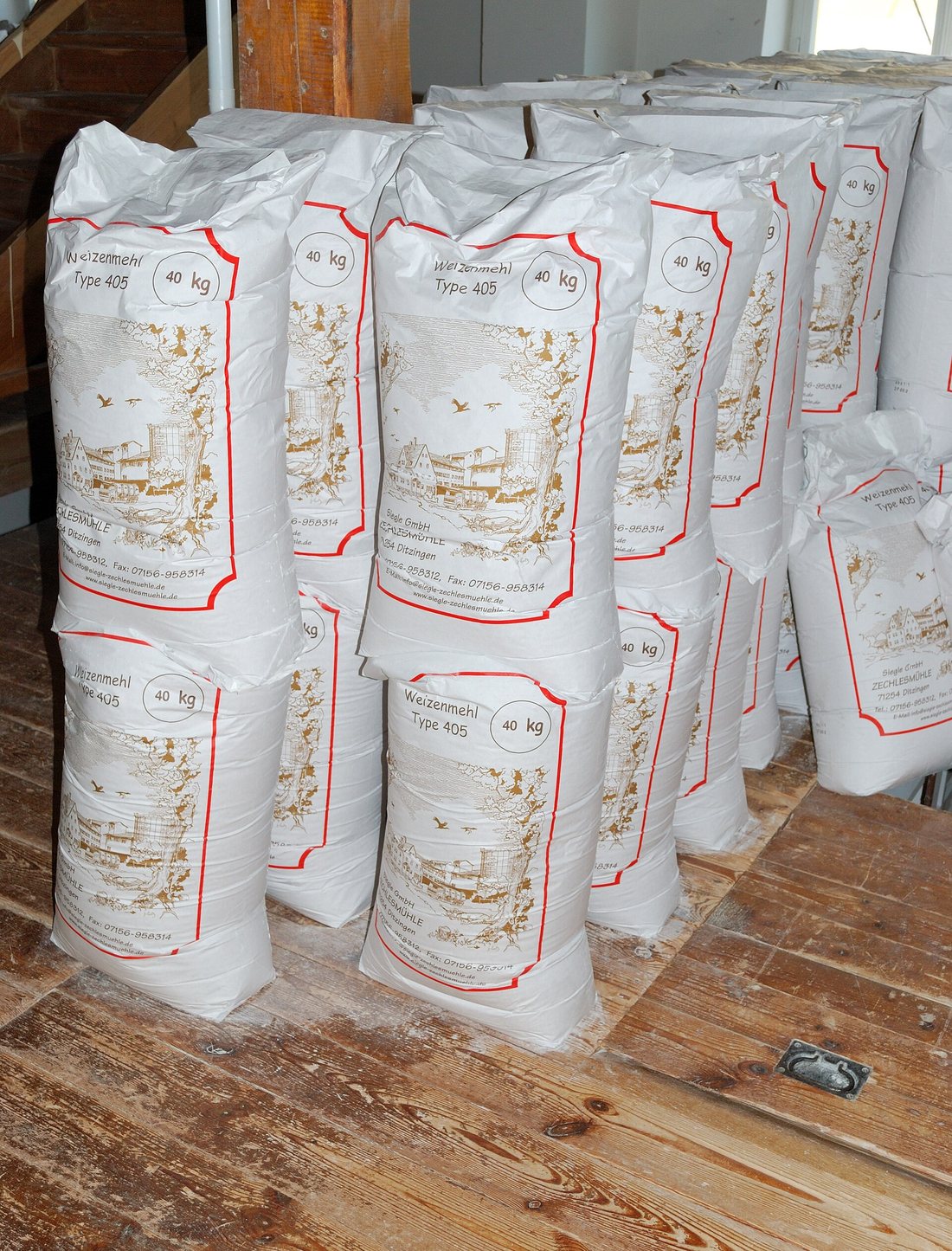
European flour codes look like protein grades and are not. They grade how refined the flour is, measured as mineral ash. An American bag answers the question “what is this for?” and sometimes “how much protein?”; a European bag answers “how white is this?” Neither answers the other’s question, which is why a recipe translated from Italian or French so often goes wrong at the flour.
Italy: Tipo 00 to integrale
Italian flour types are set by law in DPR 9 febbraio 2001, n. 187. For soft wheat (grano tenero) the table reads, per hundred parts of dry matter:
| Type | Ash, maximum | Protein, minimum |
|---|---|---|
| Tipo 00 | 0.55% | 9.00% |
| Tipo 0 | 0.65% | 11.00% |
| Tipo 1 | 0.80% | 12.00% |
| Tipo 2 | 0.95% | 12.00% |
| Integrale (wholemeal) | 1.30–1.70% | 12.00% |
Three things follow from the decree’s own text, and each corrects a popular belief:
- “00 means high protein” is false. Tipo 00 has the lowest protein floor of the five soft-wheat types. A 00 flour can be strong or weak; Caputo sells a 00 at 12.5 per cent protein for pizza and another 00 at 11 per cent for pastry, and both are legally 00.
- “00 means the finest grind” is false. The decree says outright that “la farina tipo 00 può essere prodotta anche sotto forma di sfarinato granulare (granito)” — Tipo 00 may be made as a granular product. The zeros grade ash, not particle size.
- “00 is pizza flour” is half true. The Associazione Verace Pizza Napoletana’s 2024 rules allow flour “type 00” or “type 0” (with 5–20 per cent Tipo 1 permitted), and what they actually specify is a performance range — dough strength W 250–320 and protein 11.5–13.5 per cent. The 00 guarantees only that the flour is white. The dough strength has to come from the maker’s specification sheet.
The table binds flour sold for bread-making; flours for other uses are exempt.
What 00 genuinely does well is fresh egg pasta: its whiteness and fine, even texture let an egg dough be rolled thin enough to see a hand through. Even there it is not essential — Eataly’s own method in Fresh Egg Pasta (Tipo 00) allows unbleached all-purpose flour instead.
Durum has its own table: semola (ash up to 0.90, protein at least 10.5), semolato, semola integrale and farina di grano duro. Semola rimacinata — “re-milled semola” — is semola ground a second time to a flour-like fineness, which the decree permits “exclusively for bread-making and for the consumer.” It is the flour of the breads of Puglia and Sicily, used in the Durum Sourdough (Pane Tipo di Altamura) and Handmade Orecchiette recipes. Italian semola and American semolina are the same kind of coarse durum product; US law caps semolina’s ash at 0.92 per cent.
France: the T numbers
A French type number is the ash content multiplied by ten thousand — T55 is about 0.55 g of ash per 100 g — measured by burning at 900 °C. The commonly given ranges:
| Type | Ash | Traditional use |
|---|---|---|
| T45 | under 0.50% | pastry |
| T55 | 0.50–0.60% | white bread, baguette |
| T65 | 0.62–0.75% | pain de campagne |
| T80 | about 0.75–0.90% | pain bis |
| T110 | 1.00–1.20% | semi-wholemeal |
| T150 | over 1.40% | intégrale |
The legal basis is an arrêté of 13 July 1963, which was not read in the original; the T80 upper bound is given as 0.90 in some sources and 1.00 in others, so it is marked as approximate. (A blog error sometimes repeated says T45 contains “45 grams” of minerals. It is 0.45 g per 100 g.)
French law also fixes the baguette de tradition. Décret 93-1074 of 13 September 1993 allows only three additions, all of them enzyme sources: up to 2 per cent fava-bean flour, 0.5 per cent soy flour and 0.3 per cent wheat-malt flour (Legume, Nut and Seed Flours).
Germany: the Type numbers
German Type numbers, under DIN 10355, are the same measurement in different units: milligrams of mineral per 100 g of dry flour. Type 405, the ordinary household flour, holds about 405 mg. So T55 ≈ Type 550, T45 ≈ Type 405, T110 ≈ Type 1050, and an Italian 00 (ash up to 0.55 per cent) sits between Type 405 and 550.
| Wheat | Ash | Rye | Ash | |
|---|---|---|---|---|
| Type 405 | up to 0.50% | Type 815 | up to 0.90% | |
| Type 550 | 0.51–0.63% | Type 997 | 0.91–1.10% | |
| Type 812 | 0.64–0.90% | Type 1150 | 1.11–1.30% | |
| Type 1050 | 0.91–1.20% | Type 1370 | 1.31–1.60% | |
| Type 1600 | 1.21–1.80% | Type 1740 | 1.61–1.80% |
German spelt has its own Types 630, 812 and 1050. Wholemeal (Vollkorn) is classified but has no specified mineral content. The rye grades matter most for rye bread (Rye, Barley and Oats).
Britain: “plain” and “strong”
No legal definition of plain or strong flour was found. Trade guidance puts strong flour at about 12–14 per cent protein and plain at about 10–12, but these are ranges, not rules. What British law does fix is fortification: non-wholemeal wheat flour must carry added calcium, iron, niacin and thiamin, and under a 2024 statutory instrument it must also carry folic acid, at a dose and start date reported as 250 µg per 100 g from 13 December 2026 (from summaries of the instrument; confirm on the instrument itself before relying on it). “Self-raising” is the British spelling of self-rising.
India: atta and maida
India’s food regulator, FSSAI, defines atta as “the coarse product obtained by milling or grinding clean wheat” — the whole-wheat flour of chapati and roti, usually milled in a chakki (a small stone or disc mill). Maida is refined white flour. The standards set gluten minimums: at least 6.0 per cent for atta and 7.5 per cent for maida, dry basis. Since 2019 FSSAI has asked for atta to be labelled “whole wheat flour” and maida “refined wheat flour.” Atta is finer than American whole-wheat flour and milled from different wheat, which is why the Flatbreads section treats it as its own ingredient.
Translating a recipe
Because the systems measure different things, a translation needs two numbers: the ash (from the type) and the protein or W (from the maker’s specification).
| A recipe calls for | Refinement | A reasonable US starting point |
|---|---|---|
| Tipo 00 for pasta | very white | all-purpose flour, or a 00 sold for pasta |
| Tipo 00 for pizza | very white, W 250–320 | a 00 sold as pizza flour; otherwise bread flour |
| Tipo 00 for cakes | very white, weak | pastry or cake flour |
| T45 / Type 405 | very white | all-purpose or pastry, by protein |
| T55 / Type 550 | white | all-purpose or bread flour |
| T65 / Type 812–1050 | slightly brown | bread flour with 10–20% whole wheat |
| T110–T150 / Type 1600 / integrale | brown to wholemeal | whole-wheat flour |
The table is a starting point, not an equivalence: an American whole-wheat flour is coarser than most European wholemeal, and a US all-purpose is usually stronger than a French T55.
In this section: History · The science · Milling · Wheat classes · Reading the label · Heritage wheats · Michigan · Home milling · Rye, barley, oats · Corn, rice, starches · Buckwheat and small grains · Legume, nut, seed · Gluten-free · Safety and storage · Corrections
Comments (0)