Buckwheat, Sorghum, Millet and the Pseudocereals
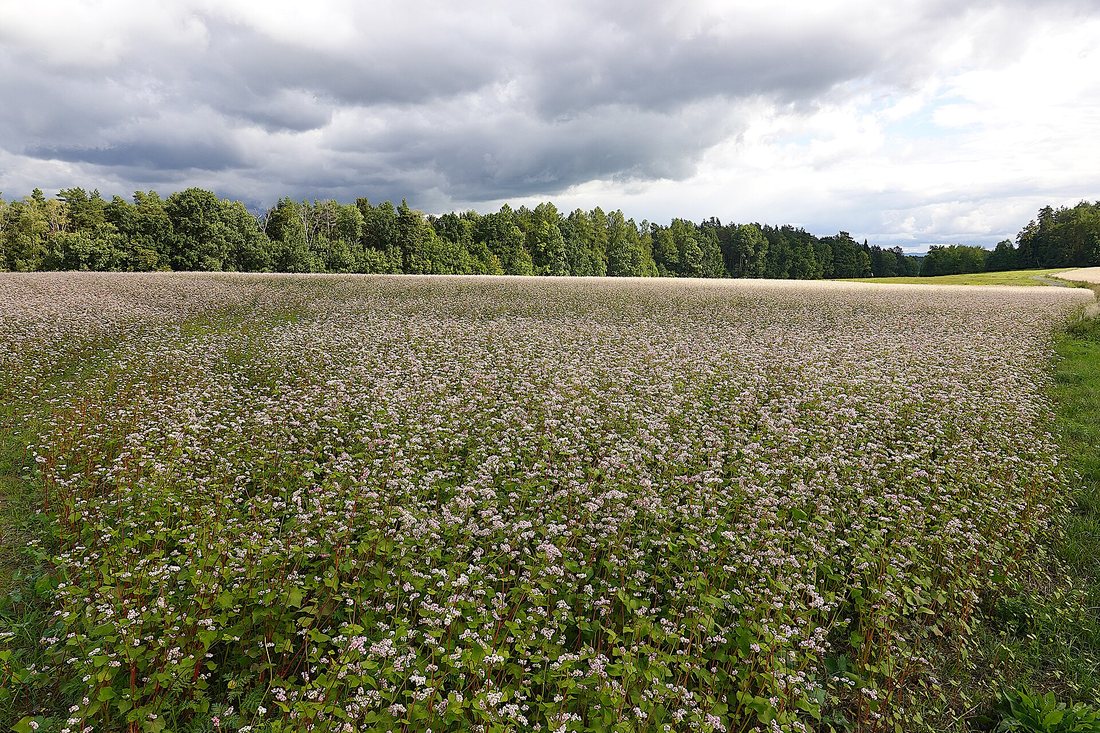
The grains on this page are small, mostly gluten-free, and — in the case of buckwheat, amaranth and quinoa — not grasses at all. Buckwheat deserves the most space: it is the flour of soba and the Breton galette, and it is also one of the most dangerous food allergens in East Asia.
Buckwheat is not a wheat
Fagopyrum esculentum belongs to the Polygonaceae — the knotweed, sorrel and rhubarb family. Its “grain” is a seed, which makes it a pseudocereal. It has no gluten, and a buckwheat dough holds together by starch and by the stickiness of its own proteins, which is enough for a crêpe and not enough for a noodle without great skill.
The Bretons call it blé noir, “black wheat,” so the botanical mistake is built into a protected name: Farine de blé noir de Bretagne / Gwinizh du Breizh has held an EU Protected Geographical Indication since 2010. It is the flour of the Breton galette, made with buckwheat, water, salt and often an egg — no wheat — in the Buckwheat Galettes (Galette Complète). (The collection also has Galettes Bretonnes, which are butter biscuits, a different thing entirely.)
The most traditional Russian blini are yeasted buckwheat pancakes eaten at Maslenitsa, with wheat blini in the north-west. (A widely quoted line from the historian William Pokhlebkin, that blini predate the wheel, is rhetoric rather than evidence.) The collection’s buckwheat pancakes are the Army’s Buckwheat Griddle Cakes, part wheat, and there are two gluten-free buckwheat sourdough breads.
Soba, and what the packet does not say
Soba made from buckwheat alone crumbles, so most soba uses wheat as a binder (tsunagi). The Japanese miller Takayama Seifun sets out the names:
- Ni-hachi (二八, “two-eight”) — 80 per cent buckwheat, 20 per cent wheat, the classic ratio. A second explanation of the name holds that Edo-period soba cost 16 mon, two times eight. Neither story is settled.
- Jūwari (十割, “ten tenths”) — 100 per cent buckwheat, which takes real expertise.
A packet of Japanese dried soba can legally be mostly wheat. Under Japan’s labelling standard for dried noodles, dried soba must state its buckwheat ratio only if it contains less than 30 per cent; the JAS grades require at least 40 per cent (standard) and 50 per cent (superior). Unlabelled, “soba” means at least 30 per cent buckwheat and says nothing more.
The showcase is Handmade Soba (80% Buckwheat) — about 78 per cent in practice. No measured 100 per cent buckwheat method was found in the sources reached. Serve it as the collection’s Cold Soba with Dipping Sauce (Zaru Soba).
Buckwheat allergy
This is buckwheat’s most important property, and it is easy to underrate.
- Japan has required buckwheat to be declared since its allergen labelling began on 1 April 2002, at levels above 10 ppm, and does not allow vague “may contain” warnings. Korea also requires it; a 2021 review names only those two countries as regulating it.
- In Japanese and Korean school surveys, buckwheat allergy affects about 0.1–0.2 per cent of children, with 4 to 60 cases of buckwheat anaphylaxis per 100,000 schoolchildren; it accounts for about 3 per cent of food anaphylaxis in Japan and is hard to outgrow (Plants, 2021).
- France, where buckwheat is not a mandatory EU allergen, recorded 71 buckwheat anaphylaxis cases from 2002 to 2023.
- In Sapporo on 8 December 1988, a sixth-grade boy reacted to gomoku soba in his school lunch, was sent home alone after his teacher telephoned his mother, suffered a severe asthma attack and died. His parents sued the city, and the Sapporo District Court gave its first-instance judgment in 1992.
Buckwheat flour may also carry wheat from shared mills; a coeliac cook needs flour labelled gluten-free.
Sorghum (jowar)
Sorghum’s main protein, kafirin, is the most water-repellent of the cereal proteins and cross-links through disulphide bonds when heated — which makes sorghum one of the few foods whose protein becomes less digestible when cooked, falling from 88–93 per cent to 45–56 per cent in the studies reviewed. There is no gluten. A sorghum dough must be made with hot water, which gelatinises enough starch to hold the flatbread together; it is patted rather than rolled. The showcase is Jowar Bhakri (Sorghum Flatbread). (The collection’s other “sorghum” recipes are all sorghum molasses.)
Millets
Pearl millet (bajra) flour goes rancid in about five to seven days, occasionally up to two weeks, because the grain carries 5–6 per cent fat and active lipase. Buy it fresh or grind it in small amounts. Finger millet (ragi) is notable for its calcium — about 344 mg per 100 g, as quoted from India’s national food tables.
Amaranth and quinoa
Amaranth (huauhtli in Nahuatl) appears in the pre-conquest tribute lists beside maize, beans and cacao. The popular story that Cortés banned it on pain of death has no primary source that could be found, and is not repeated here as fact. Its surviving form in Mexico is alegría, popped amaranth bound with honey or piloncillo.
Quinoa seeds are coated with bitter saponins. Bolivian commercial varieties average about 2.7 per cent, far above the bitterness threshold of about 0.12 per cent, and washing, abrasion or pearling brings them down. A bitter quinoa flour was under-processed.
Teff
The world’s smallest grain — under a millimetre, with 100 to 150 grains to one wheat kernel — so it is always milled whole. Its home is injera; the collection’s Injera (All Teff) and the Flatbreads section cover it.
In this section: History · The science · Milling · Wheat classes · Reading the label · Heritage wheats · Michigan · Home milling · Rye, barley, oats · Corn, rice, starches · Buckwheat and small grains · Legume, nut, seed · Gluten-free · Safety and storage · Corrections
Comments (0)