Durum, Ancient and Heritage Wheats
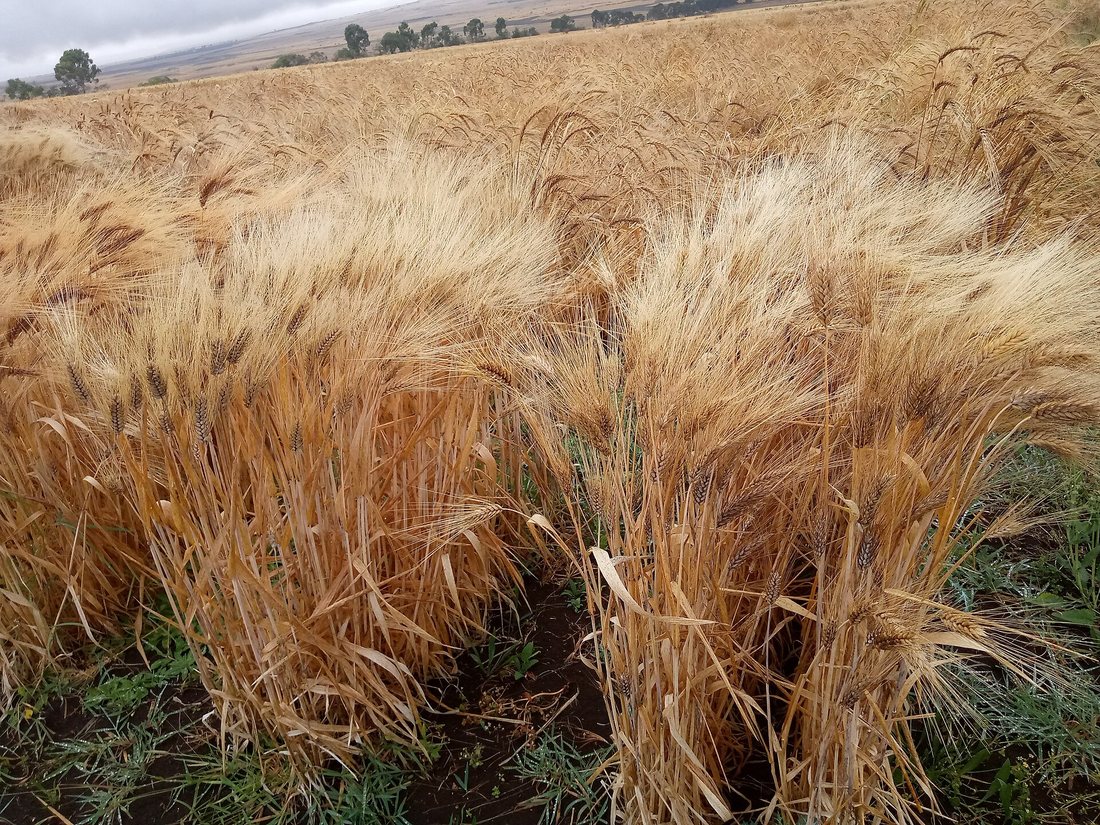
“Ancient grain” is one of the most effective phrases on a flour bag. The grains are real, the flavours are real, and several of them bake beautifully. What is mostly not real is the health story attached to them. This page takes the grains one at a time and then the claims.
The family tree, briefly
Wheats differ in how many sets of chromosomes they carry. Einkorn (Triticum monococcum) is diploid — two sets. Emmer (T. turgidum ssp. dicoccum) and durum are tetraploid, carrying the A and B genomes. Common wheat and spelt are hexaploid (AABBDD): somewhere in the Fertile Crescent, a tetraploid wheat crossed with a wild goat-grass and picked up the D genome. That third genome matters twice on this page — it carries the genes that make wheat soft or hard (The Science), and it carries the main coeliac trigger.
In Italy, farro is an umbrella name for the hulled wheats — commonly split into farro piccolo (einkorn), farro medio (emmer) and farro grande (spelt). A primary source for that three-way usage was not found, and in American shops “farro” usually means emmer.
Durum
Durum is the hardest wheat, with no puroindolines at all, high protein and a strong but not very elastic gluten. It shatters into gritty, amber semolina rather than powder, and its dough can be dragged, pressed and shaped without springing back — which is why it makes dried pasta and the water-and-flour shapes of southern Italy. Ground finer as semola rimacinata, it makes the yellow-crumbed breads of Puglia and Sicily. The two showcase recipes are Handmade Orecchiette and Durum Sourdough (Pane Tipo di Altamura).
Einkorn
The oldest domesticated wheat. Its gluten is weak and very extensible, and its flour takes up water slowly, so a correct einkorn dough feels wet and sticky and a baker’s instinct to add flour is exactly wrong. Jovial, the main US supplier of einkorn flour, tells bakers to refrain from adding flour and uses a short, nearly no-knead mix — the method in the Einkorn Sandwich Bread.
Emmer and spelt
Emmer is the wheat of ancient Egypt and early Rome and the usual American “farro.” Spelt is a hulled hexaploid, closely related to common wheat. Both ferment fast; spelt’s gluten is extensible but fragile, so it tolerates a short rise and little kneading and is often baked in a tin for support. The showcase is the Honey Spelt Sourdough Bread — about three-quarters spelt. A tested, measured 100 per cent spelt loaf was not found in the sources reached, and none is invented here.
Khorasan and KAMUT®
Khorasan is a large-grained tetraploid wheat. KAMUT is not a grain but a trademark, registered by the Quinn family of Montana in 1990. The brand’s standards — as reported by secondary sources; the brand’s own page returned an error — require the ancient khorasan variety, organic certification, protein of 12–18 per cent and near-freedom from contamination with modern wheat. The story that the seed came from 36 kernels taken from an Egyptian tomb in 1949 is the brand’s origin story and is not verified. A buyer paying for KAMUT is buying a guarantee about growing and purity, not a different grain from khorasan.
Heritage varieties: the stories and the records
Turkey Red. The well-known story says Mennonite immigrants from the Russian Empire carried Turkey Red hard winter wheat to Kansas in 1874, a child picking the seed kernel by kernel, and founded the Kansas wheat industry. Bethel College’s archivist John D. Thiesen, writing in Mennonite Life in 2025, found “no contemporary 1870s evidence that the immigrants brought seed wheat with them.” The kernel-picking tale first appears in print around 1927, fifty-three years after the migration. Other Kansas sources note the Mennonites bought spring wheat in 1875. Large imports of Turkey Red came in 1885–86, through the miller Bernhard Warkentin working with USDA’s Mark Carleton. The Mennonite connection is real; it ran through one miller and the USDA a decade later, not through a seed chest in 1874.
Red Fife. In 1842 David Fife of Otonabee Township, Ontario, received a sample of wheat that, according to the Dictionary of Canadian Biography, came “from a cargo from Danzig” unloaded in Glasgow and “contained only a few grains of spring wheat.” Red Fife became the male parent of Marquis, the wheat that opened the Canadian prairies. The family story that a cow ate all but a few of the first heads does not appear in the Dictionary entry.
White Sonora. A soft white wheat brought to the Sonoran Desert by Spanish missions in the seventeenth century, first for communion wafers; by the late 1700s the region grew 700,000 pounds a year, used for large flour tortillas and pinole (Native Seeds/SEARCH). It nearly vanished commercially by 1975 and is now on Slow Food’s Ark of Taste. Whether it was introduced by Father Kino or earlier, around 1640–50, is told both ways.
”Easier to digest, lower in gluten”
These are the claims that sell ancient grains, and the evidence runs against most of them.
Gluten quantity. Geisslitz, Longin, Scherf and Koehler (Foods, 2019) measured common wheat against spelt, emmer and einkorn and found that “common wheat had the lowest protein, gluten and gliadin contents, which is actually contrary to consumer expectations.” The ancient wheats bake weaker not because they have less gluten but because the ratio is different: gliadin to glutenin was about 2.5 in common wheat, 3.3 in spelt, 4.9 in emmer and 6.5 in einkorn. More of the stretchy fraction, less of the elastic one.
Modern breeding. The idea that modern wheat was bred to carry more gluten was tested directly. Pronin, Börner, Weber and Scherf (Journal of Agricultural and Food Chemistry, 2020) grew 60 German varieties from 1891 to 2010 side by side for three seasons and found gluten content constant over 120 years — gliadins down about 18 per cent, glutenins up about 25 per cent.
Coeliac disease. The protein fragment that most strongly triggers coeliac disease, the α-gliadin 33-mer, sits on the D genome. Schalk and colleagues (Scientific Reports, 2017) found it in all common wheat and spelt flours tested and below detection in durum, emmer and einkorn. That does not make those three safe. In a 60-day trial, coeliac patients in remission ate 100 g of einkorn a day (Zanini and others, European Journal of Nutrition, 2015); the authors concluded that einkorn “is toxic for celiac disease patients” and “not a safe cereal for celiacs.” An earlier short study had reported the opposite — which is exactly why short or laboratory results must not be read as safety.
Einkorn, emmer, spelt, khorasan and durum are all wheat. None is safe for coeliac disease.
Fructans and IBS. For people who react to fermentable carbohydrates rather than gluten, the evidence is mixed. Emmer tends to carry fewer fructans; spelt’s overlap bread wheat’s. A 2022 study of Spanish retail breads found that artisan spelt breads had the lowest fructans but supermarket spelt breads did not, and that long-fermented breads had lower gluten but higher fructans than short-fermented ones. How the bread is made moves the numbers at least as much as which wheat is in it.
What the ancient wheats genuinely offer is flavour, colour and a different kind of dough — reasons enough to buy them.
In this section: History · The science · Milling · Wheat classes · Reading the label · Heritage wheats · Michigan · Home milling · Rye, barley, oats · Corn, rice, starches · Buckwheat and small grains · Legume, nut, seed · Gluten-free · Safety and storage · Corrections
Comments (0)