Legume, Nut and Seed Flours
These flours are protein and fat rather than starch, and each holds a batter together in its own way: chickpea by its protein, almond by its fat and egg, coconut by soaking up everything in sight, chestnut by its own sugars. Several also carry a safety point that has nothing to do with gluten.
Chickpea: besan, gram and garbanzo
Besan is milled from split, skinned desi chickpeas — chana dal, the small brown-skinned Bengal gram. The chickpea or garbanzo flour in Western shops is usually milled from whole kabuli chickpeas, the large pale ones; retailers describe it as coarser and a little more bitter raw than besan, though no scholarly comparison of the two was found. “Gram” came into English in the eighteenth century from Portuguese grão, from Latin granum — so gram flour is, literally, grain flour.
Chickpea flour has enough protein to bind a batter with no egg and no gluten, which is how it makes:
- the thin baked pancakes of the Mediterranean coast — farinata in Liguria, cecina in Tuscany, socca in Nice — and the fried set batter called panisse. The collection has Socca (Chickpea Flatbread). (The story that farinata was invented by Genoese sailors after the Battle of Meloria in 1284, when a storm mixed chickpea flour and oil in the hold, is a legend with no documentary source.)
- the fritters of India — pakora and bhaji. The showcase is the Onion Bhaji, in which salted onion releases the water that hydrates the besan.
Fava and soy: flours inside French bread
Fava (faba) bean flour is permitted in the French baguette de tradition at up to 2 per cent, and soy flour at up to 0.5 per cent (Décret 93-1074, 1993). Both are there as enzyme sources. Enzyme-active soy flour’s lipoxygenase bleaches the crumb white by oxidising its carotenoids and strengthens the gluten, typically at about 0.5 per cent of the flour weight — a natural bleaching agent, doing the job chemicals do in American flour (The Science).
Favism. People with G6PD deficiency can suffer a dangerous breakdown of red blood cells from compounds (vicine and convicine) in fava beans, chiefly raw ones. Fermenting fava flour degraded both completely within 48 hours in one study (Scientific Reports, 2016).
Soy flour contamination. In a 2010 study of 22 naturally gluten-free grains and flours not labelled gluten-free, the worst was a soy flour carrying 2,925 ppm of gluten (Gluten-Free).
Raw legume flour is not ready to eat
Raw legumes carry proteins that heat destroys. The best-documented is phytohaemagglutinin in red kidney beans: raw beans carry 20,000–70,000 haemagglutinating units, fully cooked ones 200–400, and as few as four or five raw beans cause illness. The FDA’s Bad Bug Book adds the counter-intuitive part — heating to 80 °C can make them five times more toxic than raw, so an undercooked bean dish is worse than a raw one, and a slow cooker that never passes 75 °C may not be enough. Boil briskly for at least ten minutes.
For flour, the rule is simple: a raw bean flour in a batter that never boils carries the same risk as undercooked beans. Chickpea-flour dishes — socca, pakora, panisse — are all fully cooked. (Phytohaemagglutinin is characteristically a problem of Phaseolus beans; levels in chickpea flour were not found.) Soy’s trypsin inhibitors are also destroyed by heat or fermentation. And raw chickpea flour, like raw wheat flour, is an agricultural product that has not been through a kill step: do not taste the batter (Safety and Storage).
Almond: flour and meal
Almond flour is usually blanched (skinned) almonds, finely ground and pale; almond meal is usually unblanched, coarser and darker. The terms are unreliable on labels — Bob’s Red Mill now calls all its ground almonds “almond flour.” Almond flour brings fat, moisture and flavour and almost no structure, so it needs egg and, often, a little wheat flour. The showcase is the Financiers (Almond Tea Cakes), in which there is twice as much almond flour as wheat.
Salmonella outbreaks traced to raw almonds, in Canada in 2001 and Oregon in 2004, led to a mandatory pasteurisation rule for California almonds from 1 September 2007. American “raw” almond flour is normally pasteurised.
Coconut
Coconut flour is about 61 per cent dietary fibre (Trinidad and others, 2006) and behaves like a sponge. It cannot replace wheat one for one; a small amount soaks up several eggs and a great deal of liquid. No manufacturer’s official substitution ratio was found.
Chestnut
Chestnut flour is sweet, fine and gluten-free, and it was for centuries the bread of the poor in the chestnut mountains of Corsica and Tuscany. Both have protected flours:
- Farine de châtaigne corse (AOC 2006, EU PDO 2010) — from local chestnut varieties, trees at least ten years old, stone-milled, and not to be sold after 31 December of the year after the harvest. The rule itself is a lesson: chestnut flour goes stale.
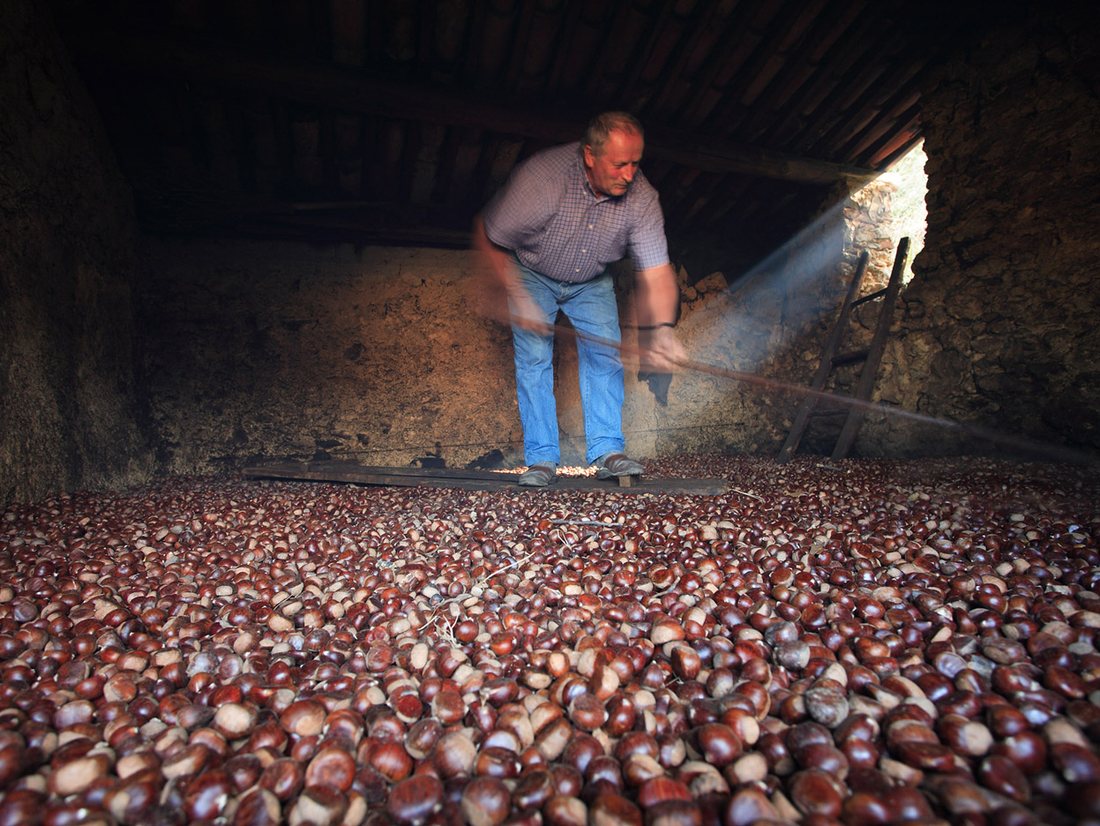
- Farina di Neccio della Garfagnana DOP — from named local varieties in twenty municipalities of the province of Lucca, the chestnuts dried in stone huts called metati over slow fires of chestnut wood only.
The showcase is Castagnaccio (Tuscan Chestnut Cake): chestnut flour, water and oil with pine nuts, raisins and rosemary, and barely any sugar.
Acorn
Acorns are full of bitter tannins that must be leached out. The Miwok of California pounded shelled acorns to meal and leached it in a shallow sand basin three or four feet across, pouring water over it — cold at first, then warmer, “until quite hot water was used”; “usually ten applications of water sufficed to remove the tannin” (Barrett and Gifford, Miwok Material Culture, 1933). Korean dotorimuk is a jelly made from acorn starch and water, cooked until it gelatinises and set as it cools — the same flour-and-starch distinction as cassava and potato (Corn, Rice and the Starches).
Flax and chia
Ground flax or whole chia seed mixed with three times its volume of water forms a mucilage gel — the “flax egg” used to bind vegan baking. Flax also carries cyanogenic glycosides. The European Food Safety Authority (2019) set an acute limit that, in the worst-case linseed it measured, a person could reach by eating 1.3 to 14.7 g of ground linseed at once, depending on body weight. EFSA later played down the alarmed news coverage that followed, and the average linseed it measured carried about half the worst case. Whether baking destroys some of the cyanide was not confirmed in the sources reached.
Tiger nut
Tiger nut is not a nut. It is the tuber of a sedge, Cyperus esculentus, grown in Valencia under the Denominación de Origen Chufa de Valencia and pressed into horchata de chufa. Its flour is sweet and fibrous, and its name matters for anyone avoiding tree nuts, though allergy data for it were not found.
In this section: History · The science · Milling · Wheat classes · Reading the label · Heritage wheats · Michigan · Home milling · Rye, barley, oats · Corn, rice, starches · Buckwheat and small grains · Legume, nut, seed · Gluten-free · Safety and storage · Corrections
Comments (0)