South Asia: Roti, Paratha, Puri and Naan
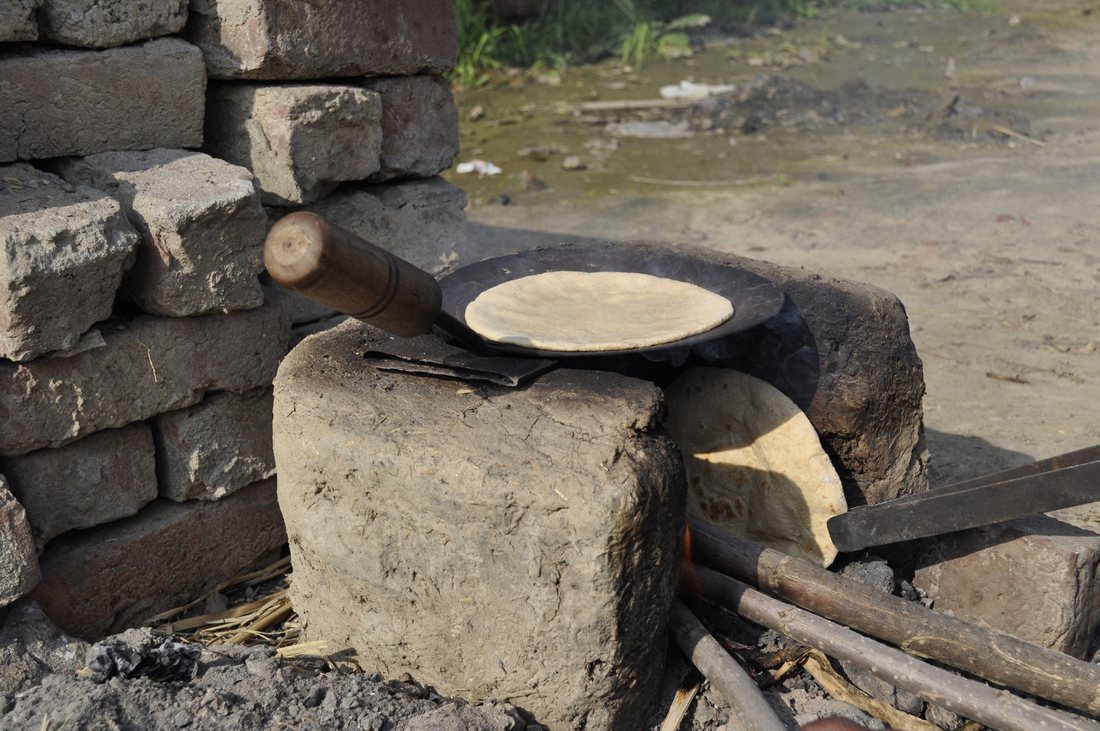
The everyday bread of North India and Pakistan is not naan. It is roti — whole-wheat, unleavened, cooked in a minute on an iron griddle at home, meal after meal. The collection’s owner has made naan, roti and paratha.
Roti, chapati and phulka
Roti is made from atta, a finely stone-ground whole-wheat flour, and water. There is no yeast. The dough is rolled thin and cooked on a tava. Roti comes from Sanskrit roṭikā, “bread”; chapati from a word tied to slapping the dough flat between the hands. In much of North India the two words mean the same thing.
A phulka is a roti cooked partway on the tava and then set directly on the flame, where it balloons. The water in the dough turns to steam and pushes the two faces apart — the same mechanism as a pita’s pocket.
Chapati is named in the Ain-i-Akbari, the record of the Mughal court of Akbar in the late sixteenth century. Claims that chapati is “5,000 years old” rest on griddle-like objects from the Indus Valley, which suggest a possibility rather than proving a bread.
Roti is not naan. Roti is unleavened whole wheat on a griddle; naan is leavened white flour in a tandoor.
The new collection recipe is Roti (Chapati).
Paratha: the layered bread
A paratha is atta dough brushed with ghee and folded or coiled so the fat separates many layers, then rolled and griddle-fried. It can also be stuffed, as with aloo paratha. The name is usually derived from para, “layer.”
How old it is is argued among India’s own food historians. The twelfth-century Manasollasa is often cited as the first mention, but K. T. Achaya read those recipes as closer to a different roti, and Pushpesh Pant has written that “there is no evidence of paratha in Ancient India.”
The name has travelled far: porotta in Kerala, palata in Myanmar, farata in Mauritius, roti canai in Malaysia (and prata in Singapore), and buss-up-shut — “burst-up shirt” — in Trinidad.
The new collection recipe is Paratha.
Puri
Puri is a small round of atta, oil and water, rolled and deep-fried, where it puffs into a hollow ball. Bengali luchi is the white-flour version. The earliest recipe usually cited is in the fifteenth-century Ni’matnama of the Mandu sultanate. The new collection recipe is Ajwain Puri.
Bhakri
In Maharashtra, Gujarat and Karnataka, the field-worker’s bread is bhakri, made from sorghum (jowar), pearl millet (bajra), rice or finger millet — grains without gluten. The dough is mixed with hot water and patted flat with the palms, because it will not stretch under a rolling pin. It is cooked on the tava and then roasted over the flame, and it doubles as a plate.
Naan and the tandoor
Nān is simply the Persian word for bread. The first English use cited for it, from 1803, describes the peoples of the Russian Empire, not India. In South Asia, the poet Amir Khusrau, around 1300, mentions naan-e-tunuk (light) and naan-e-tanuri (tandoor-baked), eaten by Muslim nobles. Under the Mughals, naan was an elite bread.
Naan needs a tandoor, which most homes do not have, and tandoor cooking reached the mainstream only after 1947, when Punjabi refugees opened restaurants in Delhi. The restaurant most associated with that spread is Kundan Lal Gujral’s Moti Mahal, which moved from Peshawar to Delhi after Partition. So naan is best described as a tandoor bread; in most Indian homes the daily bread is roti.
Kulcha is a close cousin — leavened, refined flour, tandoor-baked, and often stuffed (Amritsari kulcha).
The collection has Naan, Gluten-Free Naan and Garlic Naan (Pizza Oven). At home, a baking steel or stone under a hot broiler, or a very hot cast-iron pan, stands in for the tandoor.
Dosa and appam
South India also makes flatbreads from poured batters. Dosa is a fermented batter of rice and black gram (urad dal), usually about 3 or 4 to 1, spread thin on a tava; appam is a fermented rice and coconut-milk batter swirled in a curved pan, once raised with palm toddy. Like injera, these are breads where the fermentation happens in a batter rather than a dough. Where dosa began — Tamil country or Udupi in Karnataka — is disputed.
Flatbreads: What a flatbread is · The history · The science · Ovens and griddles · The Middle East · South Asia · The Americas · Europe · Africa and East Asia · Making them at home · Corrections · ← Breads
Comments (0)