Gluten-Free Flour and Blends
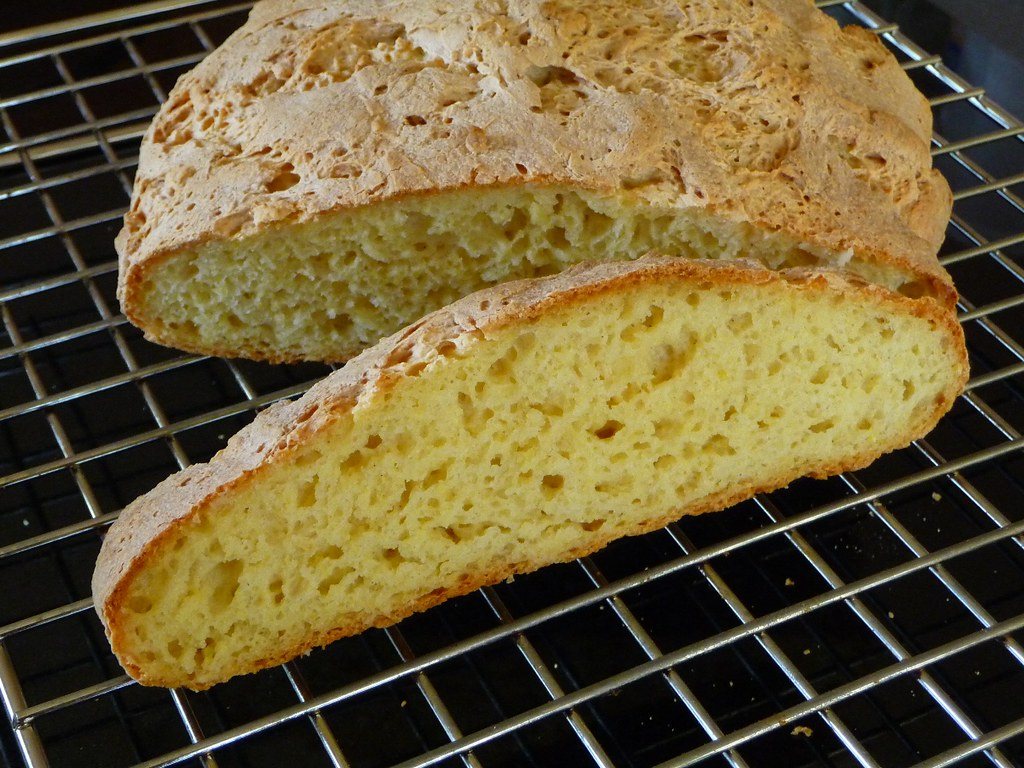
Gluten does three jobs in a bread: it traps gas, it sets into the walls of the crumb, and it holds water. No single gluten-free flour does all three, which is why gluten-free baking runs on blends, and why the blends all look alike once their labels are read.
The three parts of a blend
A 2024 review of gluten-free bread research (Foods) and the work it cites describe the pattern:
- Starch — rice flour, tapioca, potato or corn starch — is the bulk. It gelatinises in the oven and sets.
- Protein — egg, dairy, legume flour, sorghum — brings browning and some structure. Adding proteins together with a hydrocolloid brought gluten-free crumb porosity close to that of wheat bread.
- A hydrocolloid binder — xanthan, psyllium, guar or HPMC (hydroxypropyl methylcellulose) — forms the gas-holding film gluten would have made. Psyllium raises dough elasticity and gas retention but can make the crumb gummy and the crust hard; HPMC is often the most effective for volume and a soft crumb; and in one study, removing xanthan actually gave a softer, less gummy crumb. More gum is not always better.
What the “cup-for-cup” blends contain
The three best-known American blends, from their ingredient lists (in descending order by weight; no brand publishes percentages):
| Blend | Ingredients |
|---|---|
| King Arthur Measure for Measure | rice flour, whole-grain brown rice flour, whole sorghum flour, tapioca starch, potato starch, cellulose, xanthan gum, vitamins and minerals |
| Bob’s Red Mill Gluten Free 1-to-1 | sweet (glutinous) white rice flour, whole-grain brown rice flour, potato starch, whole-grain sweet white sorghum flour, tapioca flour, xanthan gum |
| Cup4Cup Multipurpose (original) | cornstarch, white rice flour, brown rice flour, milk powder, tapioca flour, potato starch, xanthan gum |
All three are a rice base, at least two starches and xanthan, and they differ in the protein or “extra”: sorghum, sweet rice, or milk powder. That is the starch-protein-binder logic exactly. Cup4Cup was reportedly reformulated in 2024 without milk powder; the current label was not verified. King Arthur recommends Measure for Measure mainly for recipes without yeast.
King Arthur also prints a make-at-home blend: 6 cups (32 oz) stabilised brown rice flour, 2 cups (10¾ oz) potato starch and 1 cup (4 oz) tapioca flour or starch. By weight that is about 68 per cent brown rice, 23 per cent potato starch and 9 per cent tapioca — and it contains no gum, so recipes add it separately. The showcase, Gluten-Free Scones with a Homemade Blend, uses exactly that arrangement and rests the dough for 15 minutes so the rice flour can hydrate.
The law, and the problem with “naturally gluten-free”
In the United States, “gluten-free” means under 20 ppm of gluten (FDA final rule, August 2013). Twenty was chosen because it is the lowest level validated methods can reliably measure. Codex and the EU use the same 20 mg/kg for “gluten-free,” and allow “very low gluten” up to 100 mg/kg for specially processed ingredients.
A flour made from a gluten-free plant is not the same as a gluten-free flour. Tricia Thompson, Lee and Grace (Journal of the American Dietetic Association, 2010) tested 22 inherently gluten-free grains, seeds and flours not labelled gluten-free: 13 were below 5 ppm, but 7 of the 22 — nearly a third — were at or above 20 ppm, and the worst, a soy flour, carried 2,925 ppm. Together with her 2004 oat study (Rye, Barley and Oats), the practical rule for a coeliac kitchen is clear: buy flours labelled gluten-free, not merely flours of a gluten-free species.
Other flours in a gluten-free kitchen
- Rice is the base of most blends, and rice carries arsenic; varying the flours — sorghum, buckwheat, teff, millet, chickpea — spreads the exposure (Corn, Rice and the Starches).
- Oats are gluten-free only when grown and milled to be; most coeliacs tolerate uncontaminated oats, but not all.
- The collection’s gluten-free breads include 100% Brown Rice Sourdough Bread, Gluten-Free Sourdough Bread and Gluten-Free Bread (Dairy-Free Option).
- Several of the showcase recipes are gluten-free by nature: Pão de Queijo, Butter Mochi, Puto, Castagnaccio, Buckwheat Galettes, Onion Bhaji and Jowar Bhakri — each safe for a coeliac only if every ingredient is certified gluten-free.
In this section: History · The science · Milling · Wheat classes · Reading the label · Heritage wheats · Michigan · Home milling · Rye, barley, oats · Corn, rice, starches · Buckwheat and small grains · Legume, nut, seed · Gluten-free · Safety and storage · Corrections
Comments (0)