Safety and Storage
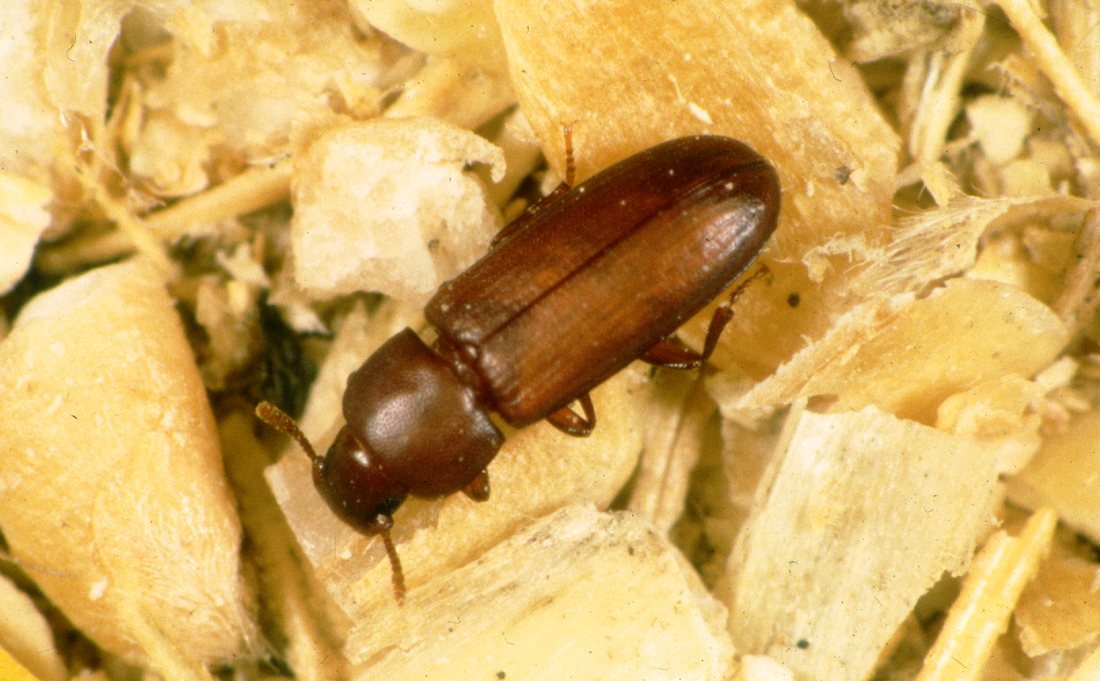
Flour looks like the safest thing in the kitchen: dry, stable, and years from the field. It is in fact a raw agricultural product, and since 2016 it has been the vehicle for four American outbreaks. This page covers why, what the popular fix gets wrong, how long flour keeps, and what is actually living in an old bag.
Flour is raw
“Grains are harvested, ground and sometimes bleached, but processing raw grains into flour does not kill bacteria,” the FDA says. Grain grows outdoors, animals cross the fields, and nothing in milling is designed to kill what they leave. Bleaching is not a kill step. The CDC’s summary is blunt: “Most flour is raw … Germs are killed only when flour is baked or cooked.”
The outbreaks:
| Years | Organism | Illnesses / states | Hospitalised | Vehicle |
|---|---|---|---|---|
| 2015–16 | E. coli O121 and O26 | 63 / 24 | 17 (1 kidney failure) | General Mills flour from a Kansas City facility; recall from 31 May 2016, expanded in July |
| 2018–19 | E. coli O26 | 21 / 9 | 3 | ADM Milling flour sold under several brands; the strain was found in an unopened bag |
| 2021 | E. coli O121 | 16 / 12 | 7 | raw cake mix |
| 2022–23 | Salmonella Infantis | 14 / 13 | 3 | Gold Medal all-purpose flour; recalled 28 April 2023 |
The 2016 outbreak study (Crowe and others, NEJM, 2017) found illness strongly associated with “tasting unbaked homemade dough or batter.” The size of the 2016 recall is reported inconsistently: it began at about ten million pounds and grew to tens of millions.
Age does not make flour safe. At room temperature, pathogenic E. coli in wheat flour stayed viable for at least nine months, with positive samples up to 280 days (Forghani and others, Applied and Environmental Microbiology, 2018).
What the FDA says
- “Never eat or taste raw flour, dough, or batter.”
- “Do not try to heat treat flour in your own home. Home treatments of flour may not effectively kill all bacteria and do not make it safe to eat raw.”
- “Do not let children use raw dough for crafts or play clay.”
- “Do not use raw cookie dough in ready-to-eat ice cream.”
Why home heat-treating does not work as advertised
The popular method is to microwave or bake flour until it reads 160 °F (71 °C), or to bake it at 350 °F for five minutes, and then use it in edible cookie dough. The measured kinetics say why the FDA advises against both:
- Dry flour protects bacteria. Low water activity makes them more heat-resistant. In the same 2018 study, E. coli in dry flour “survived for up to 60 min at 70 °C.” A pile of flour that reads 160 °F for a moment has not been pasteurised.
- The 350 °F method falls short. Jung and Schaffner at Rutgers (Journal of Food Protection, 2022) tested the claim — from a YouTube channel with more than 20 million subscribers — in a household toaster oven, with flour about 2 cm deep. Salmonella and its surrogate had D-values of 1.66–1.92 minutes at the 177 °C (350 °F) setting: each 1.7–1.9 minutes cuts the population tenfold. Five minutes therefore gives roughly a 2.6- to 3-log reduction — about a thousandfold — well short of the 5-log (100,000-fold) standard expected of a ready-to-eat kill step. The authors were cautiously positive that home baking “has potential”; the arithmetic shows it is not there at five minutes.
- Models overpromise. A 2024 Michigan State study warned that predictions built from simple laboratory data overestimated the kill in a real bake by a “fail-dangerous” margin.
The validated route is commercially heat-treated flour, and edible cookie-dough products made with it. A validated home time and temperature does not exist.
How long flour keeps
- White flour keeps longest: it has almost none of the germ’s oil. Millers commonly date it 9–15 months after milling.
- Whole-wheat flour goes rancid — first by enzyme, then by oxygen (The Science) — and is commonly dated 3–9 months after milling. Cold slows both processes.
- Whole berries keep for years in cool, dry, sealed storage (Home Milling).
- Nut, seed and some grain flours spoil much faster. Pearl millet flour turns in about a week (Buckwheat and the Small Grains); chestnut flour’s own protected-name rules forbid selling it past the end of the year after the harvest.
USDA FoodKeeper figures for flour could not be retrieved, so no official month counts are given here.
”Weevils in the flour”
Weevils are not, for the most part, in the flour. Rice and granary weevils feed on whole grains and seeds. The insects found in flour are mostly flour beetles — the red and the confused flour beetle — along with sawtoothed grain beetles, drugstore and cigarette beetles, and the Indian meal moth, which University of California IPM calls “the most common moth found on food products in the home.”
- They usually arrive already in a package from the shop.
- To kill them: heat the food at 155 °F for about 20 minutes with the oven door propped open, or freeze it at 0 °F for four days in a freezer that does not self-defrost (University of Kentucky).
- To keep them out: containers “with tight-fitting lids; plastic bags aren’t adequate,” and flours used rarely kept in the freezer.
Keep the two reasons for freezing flour apart. A freezer kills insects. It is not a kill step for E. coli or Salmonella: no source consulted treats freezing as one, and those bacteria survive nine months in flour at room temperature.
In this section: History · The science · Milling · Wheat classes · Reading the label · Heritage wheats · Michigan · Home milling · Rye, barley, oats · Corn, rice, starches · Buckwheat and small grains · Legume, nut, seed · Gluten-free · Safety and storage · Corrections
Comments (0)