Rye, Barley and Oats
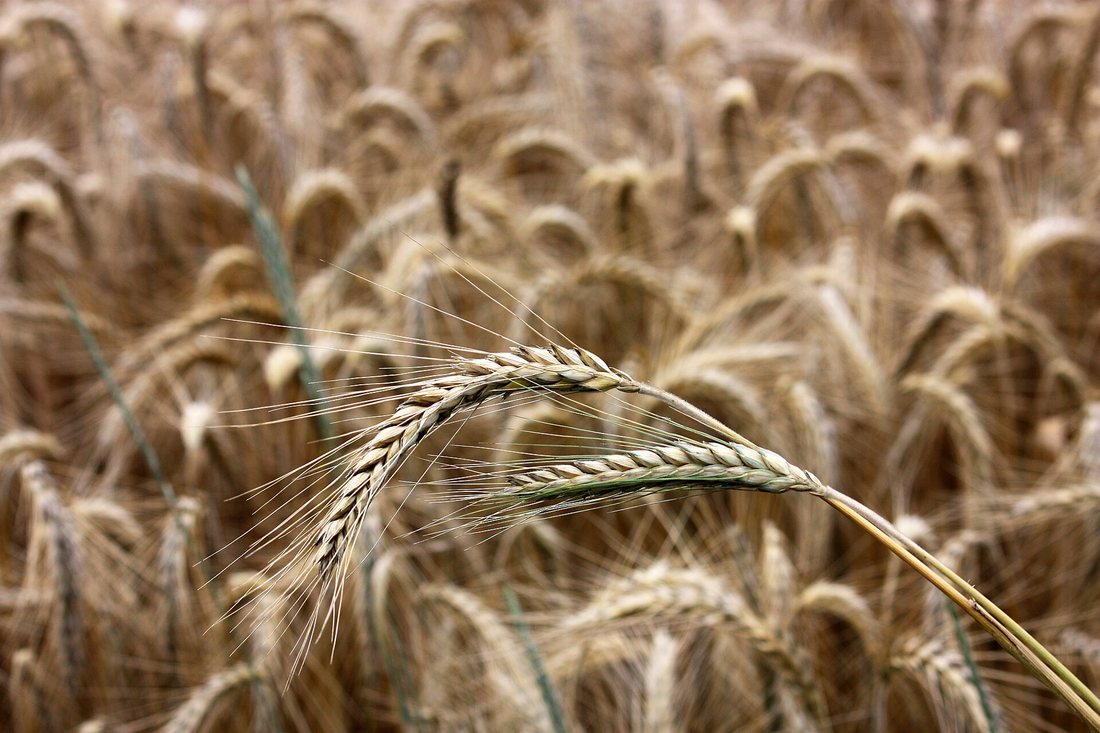
These three are wheat’s nearest relatives, and none can make a wheat loaf. Rye comes closest and fails for an interesting reason; barley and oats bring a fibre that bakers either love or fight. All three count as gluten grains for coeliac purposes, though oats only by contamination.
Rye: structure without a network
Rye proteins cannot form the continuous, elastic network that wheat gluten does. In rye bread the structure is carried instead by starch and above all by arabinoxylans (pentosans) — fibres that hold enormous amounts of water. Wholemeal rye carries 6.5 to 12 per cent arabinoxylan on a dry basis, against 3.1 to 6.2 per cent in wheat (a Comprehensive Reviews in Food Science and Food Safety review). A rye dough is therefore a sticky paste, and a 100 per cent rye loaf is spooned into a tin rather than shaped.
The real problem is an enzyme. Rye carries more starch-digesting α-amylase than wheat, and its starch gelatinises at a lower temperature, so in the oven the enzyme is still working while the starch is setting. Left alone, it digests the crumb into what the German baking-ingredient maker IREKS calls a “damp and soggy” mass. Acid is the cure. The enzyme works best at about pH 5.0–5.5; acidify the dough and it slows, and the acid also makes the arabinoxylans hold more water.
“Rye has to be sourdough” is half true. Rye needs acid. Sourdough is the traditional way of getting it, and the arabinoxylan literature suggests biological acidification works best — but IREKS’s own worked example makes a sliceable loaf from a weak rye flour with a commercial dough acidifier. The necessity is chemical; the sourdough is tradition and flavour.
Rye grades
American light, medium and dark rye follow the bran content — light rye is endosperm only, medium is what is left after the bran and shorts come out, dark rye varies from sifted to mostly bran by producer, and pumpernickel meal is coarse whole rye. None of these is a regulated grade.
German rye is graded by ash, like its wheat (Reading the Label). From the German millers’ association table:
| Type | Ash (dry matter) | Share of German rye milling |
|---|---|---|
| 815 | up to 0.90% | 3.4% |
| 997 | 0.91–1.10% | 21.3% |
| 1150 | 1.11–1.30% | 42.6% |
| 1370 | 1.31–1.60% | 8.1% |
| 1740 | 1.61–1.80% | 1.7% |
| Backschrot 1800 | up to 2.20% | 9.3% |
Type 1150 is the everyday German rye; Backschrot 1800 contains everything except the germ.
Pumpernickel has a legal definition in Germany, and it is demanding: the Leitsätze für Brot und Kleingebäck require at least 90 per cent rye meal or wholemeal meal and a bake of at least 16 hours, typically at 100–120 °C. The long, low, steamy bake is what makes it dark and sweet. American “pumpernickel,” often coloured with cocoa, coffee or caramel, is a different bread.
The showcase is the Danish Rye Bread (Rugbrød), in which every gram of flour is rye. The collection’s older Rye Bread, from the 1944 Army cookbook, is only about 20 per cent rye.
Ergot
Rye is the favourite host of Claviceps purpurea, a fungus that replaces grains in the head with dark sclerotia loaded with alkaloids related to LSD. Eaten in bread, it causes ergotism: in one form, gangrene — the medieval “St Anthony’s fire,” named for the order of monks who treated it — and in another, convulsions.
The EU now limits ergot tightly (Regulation 2021/1399): 0.2 g of sclerotia per kilogram of unprocessed rye since July 2024, and 250 µg of ergot alkaloids per kilogram in rye milling products. Mills clean rye with special care for this reason.
Two famous stories need care:
- Salem, 1692. In 1976 Linnda Caporael proposed in Science that the Salem accusations were caused by convulsive ergotism. Later that same year, also in Science, Spanos and Gottlieb answered point by point: convulsive ergotism outbreaks occurred among people with severe vitamin A deficiency, and Salem’s farmers had fish and dairy; one afflicted person was an eight-week-old infant, and nursing infants do not get ergot poisoning; most people in the afflicted girls’ own households were unaffected; and the girls’ fits began and stopped on social cues, such as the sight of an accused witch. The ergot explanation of Salem is a single famous hypothesis, answered in the same journal the same year, and it is not the historians’ consensus.
- Pont-Saint-Esprit, 1951. A mass poisoning from bread in a French town. More than 250 people fell ill; death counts differ between sources. Most academic accounts accept ergot, but a 1954 inquiry blamed a mercury seed fungicide and a 2009 book blamed a CIA experiment with LSD — a theory historians have found without solid evidence. The cause is still contested.
Barley
Barley and oats are the cereals richest in β-glucan, a soluble fibre that makes batters viscous and carries an FDA-authorised heart-health claim (at least 3 g a day from whole oat or barley sources). In a wheat dough, barley weakens the gluten: replacing 10–40 per cent of the wheat with hull-less barley flour shortened dough development and stability in one study. It bakes best in flatbreads, quick breads and blends.
Two barley flours have long histories. Tsampa, roasted barley flour, is a Tibetan staple (the sources reached for it were not scholarly). Beremeal, from bere, an old six-row barley, is still stone-ground by water at Barony Mill in Orkney, which has milled since 1873, for bannocks. The collection already has a Barley Sourdough Bread (Scalded Flour).
Oats
Oats need heat before they are milled. Oat groats carry active lipase and lipoxygenase that turn them rancid and bitter within weeks; mills steam and kiln them, and it is the steam, not dry heat, that kills the lipase. Oat flour holds together by starch and β-glucan viscosity, with no gluten network.
Oats and coeliac disease are a matter of contamination more than chemistry. Oats’ storage protein, avenin, is only 10–15 per cent of oat protein, and after a 100 g daily oat challenge about 8 per cent of coeliac patients showed an inflammatory T-cell response — against 75–80 per cent after wheat bread (Frontiers in Nutrition, 2019). The real danger is wheat, barley and rye picked up in fields, trucks and mills. When Tricia Thompson tested ordinary oats in 2004 (NEJM), Quaker oats contained 338 to 1,807 ppm of gluten, and none of the three brands tested “could be relied on to be gluten-free.” US law allows oats to be labelled gluten-free if they test under 20 ppm.
Scottish oatmeal is sold as pinhead (groats cut in two or three), coarse, medium and fine. Samuel Johnson’s dictionary defined oats as “a grain, which in England is generally given to horses, but in Scotland supports the people”; the retort, reportedly Lord Elibank’s — “and where else will you see such horses and such men?” — reached print second-hand, through Walter Scott. The collection’s Scottish Oatcakes and Oat Bannock (Skillet) are the oat showcases.
Triticale
A cross of wheat and rye. The first deliberate cross (A. S. Wilson, Scotland, 1875) was sterile; the first fertile one was W. Rimpau’s in Germany in 1888 — one head of fifteen kernels. Its flour is weak for bread and is usually blended with wheat, and as a wheat hybrid it contains gluten.
In this section: History · The science · Milling · Wheat classes · Reading the label · Heritage wheats · Michigan · Home milling · Rye, barley, oats · Corn, rice, starches · Buckwheat and small grains · Legume, nut, seed · Gluten-free · Safety and storage · Corrections
Comments (0)