Corn, Rice and the Starches
This page covers the flours that are nearly all starch — corn, rice, cassava, potato, arrowroot and sweet potato — and the most useful distinction in the gluten-free kitchen: the difference between a flour, which is the whole food dried and ground, and a starch, which has been washed out of it.
Corn: the naming trap
In Britain and Australia, “cornflour” — one word — is what Americans call cornstarch. American “corn flour,” two words, is finely ground whole corn, which Britain calls maize flour. A British custard recipe that calls for cornflour to thicken it wants starch; American corn flour would give a gritty, yellow, under-thickened result.
In US law, corn flour and cornmeal are the same material at two sizes. White corn flour (21 CFR 137.211) must be ground and bolted so that at least 98 per cent passes a No. 50 sieve; white corn meal (137.250) must pass a No. 12 sieve but may have no more than 35 per cent finer than a No. 72 gauze — meal is legally prevented from being too fine. Masa harina is different in kind: dried dough of corn that has been nixtamalized, cooked in alkali. Its story, and pellagra’s, are told in the Flatbreads and Breakfast sections, and the collection’s Corn Tortillas (Masa Harina) is its showcase.
Rice: two different flours
Rice flour comes in two kinds that behave nothing alike, and confusing them ruins a recipe.
- Ordinary rice flour is from non-glutinous rice. It makes light, crisp or fluffy things: batters, and the steamed Filipino Puto.
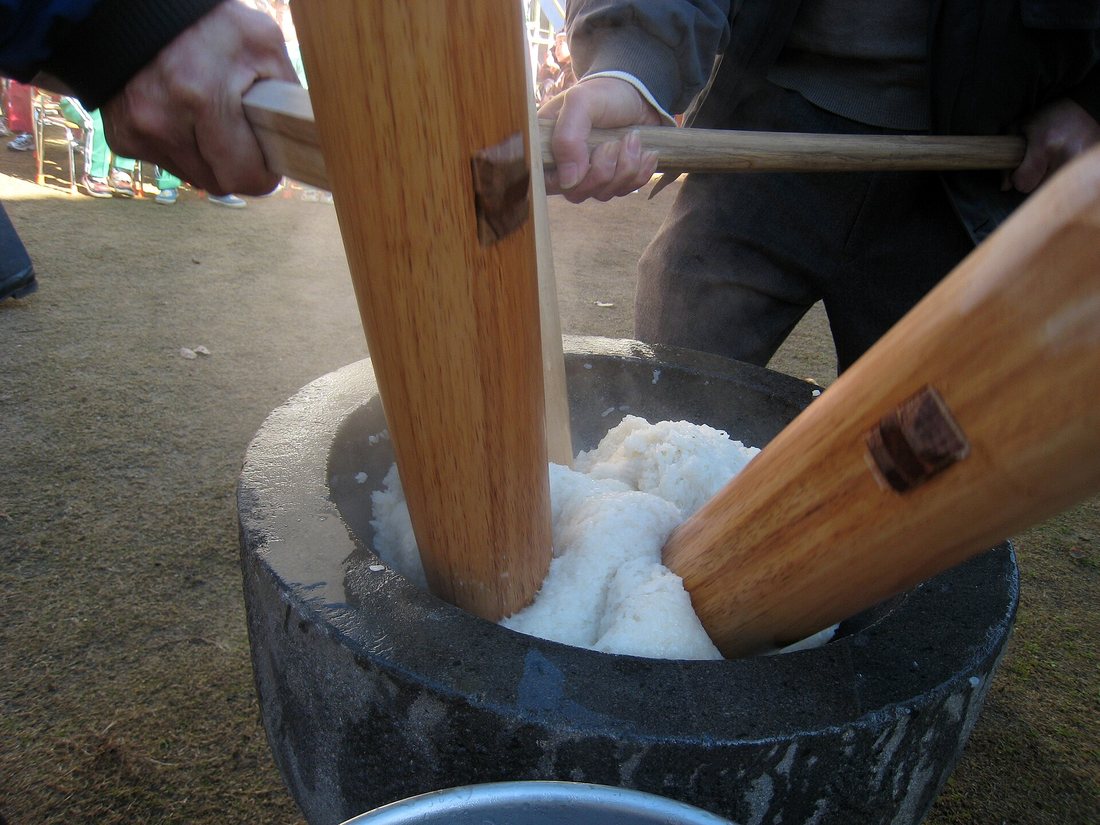
- Glutinous (sweet) rice flour is from waxy rice, whose starch is essentially all amylopectin: amylose 0–2 per cent, switched off by a single gene. Amylopectin makes a bouncy, chewy, stretchy set — mochi, and the Hawaiian Butter Mochi.
“Glutinous” means glue-like. Glutinous rice contains no gluten.
Japanese shops sell two glutinous rice flours. Mochiko is ground dry to a fine powder; shiratamako is wet-milled — the rice soaked, ground to a paste, dried and sold as coarse granules — and gives a softer, stretchier dough that stays pliable after cooling. (These production details come from cooks’ writing; no primary source was found.) In American Asian groceries the Erawan three-elephant brand codes its bags by colour: red lettering for rice flour, green for glutinous rice flour, blue for tapioca starch.
South Indian idli and dosa batters are rice with split black gram (urad), leavened by fermentation in which Leuconostoc mesenteroides dominates, making both lactic acid and carbon dioxide (Mukherjee and others, Applied Microbiology, 1965).
Arsenic
Rice takes up inorganic arsenic from paddy soil and water more than other grains do. The FDA’s action level for infant rice cereal is 100 ppb (final guidance, August 2020). Its sampling of rice products found, per serving, 7.2 µg in brown rice, 4.6 µg in white long-grain, 3.5 µg in basmati and 6.6 µg in rice pasta. The EU caps milled rice at 0.20 mg/kg and rice cakes and crackers at 0.30. No FDA or Consumer Reports figure for rice flour specifically was found — the FDA’s tables have no flour category. Rice-based gluten-free baking is one of the larger routes to rice intake, which is one reason to vary the flours in a gluten-free kitchen.
Cassava: flour and starch
Cassava flour is the whole peeled root, dried and milled — starch and fibre together, and it behaves like a flour in flatbreads and tortillas (the collection has Gluten-Free Cassava Flour Tortillas). Tapioca is the starch washed out of the pulp. It thickens, and when scalded it turns into a stretchy paste that bakes into the hollow, chewy Pão de Queijo. Brazilian cooks use two tapiocas: polvilho doce (sweet) and polvilho azedo, a fermented sour starch that adds lift and tang.
Cyanide, and konzo
Cassava contains cyanogenic glycosides that release hydrogen cyanide. Codex limits edible cassava flour to 10 mg/kg total HCN; “bitter” varieties carry more than 50 mg/kg in the fresh root. Eaten underprocessed, in a protein-poor diet, bitter cassava causes konzo — a sudden, permanent paralysis of the legs, which appears in epidemics during famine; an outbreak in Mozambique in 1981 affected more than a thousand people during drought (PLoS Neglected Tropical Diseases review).
The processing fix is simple. In J. Howard Bradbury’s wetting method, cassava flour is mixed with water, spread thin, and left two hours in sun or five in shade so the cyanide can escape; it cuts total cyanide three- to six-fold. In field trials in the Democratic Republic of Congo, flour fell below 10 ppm and no new konzo cases were recorded in 18 months. The cassava flour and tapioca sold for baking in American shops are from sweet varieties, fully processed; the danger belongs to famine conditions and bitter roots, not supermarket starch.
Potato, arrowroot and sweet potato
- Potato flour is whole peeled potato, cooked, dried and ground: beige, flavourful, and it holds moisture (it is in the 100% Whole Wheat Sandwich Bread for that reason). Potato starch is the starch alone: white and neutral. They are not interchangeable in gluten-free baking.
- Arrowroot is the starch of Maranta arundinacea — but tapioca is often sold labelled as arrowroot, and the adulteration is common enough that analytical chemists have developed methods to detect it.
- Sweet-potato starch makes Korean dangmyeon, the glass noodles of japchae.
- Acorn starch makes Korean dotorimuk; see Legume, Nut and Seed Flours.
How starches and flours combine in a gluten-free blend is on the Gluten-Free page.
In this section: History · The science · Milling · Wheat classes · Reading the label · Heritage wheats · Michigan · Home milling · Rye, barley, oats · Corn, rice, starches · Buckwheat and small grains · Legume, nut, seed · Gluten-free · Safety and storage · Corrections
Comments (0)