The History: From a Grinding Stone to a Five-Pound Bag
Flour is older than farming, older than bread, and for most of its history it was brown. The white, fine, shelf-stable powder sold in a paper bag is a product of the 1870s: of a Hungarian machine, a Minneapolis mill that exploded, and a string of federal fights over what may be added to it. Most of the famous dates in the story hold up. A few of the famous claims do not.
Before farming: grinding stones
The oldest firm evidence of people grinding wild cereal is about 23,000 years old. At Ohalo II, a drowned camp on the shore of the Sea of Galilee, a flat grinding stone carried 150 starch grains on its upper surface, 127 of them from grasses. Piperno, Weiss, Holst and Nadel (Nature, 2004) called it “the earliest evidence of human processing of wild cereals, including barley and possibly wheat” — at least 12,000 years before anyone domesticated either.
“Humans made flour 30,000 years ago” is a real finding, reported loosely. In 2010 Revedin and colleagues (PNAS) found starch on grinding stones from three Upper Paleolithic sites in Italy, Russia and the Czech Republic. The press ran it as the oldest flour. The starch was “mostly of cattail and fern” — ground roots, not grain. It is flour in the sense of a powder, not in the sense of this section. The same pattern turned up in the Flatbreads section, where the “14,400-year-old bread” proved to be crumbs made partly from club-rush tubers: the earliest “flour” is often not cereal at all.
The quern, and then the mill
For thousands of years grain was ground on a saddle quern — a rubbing stone pushed back and forth across a bed stone, a tool in use in Iberia since the sixth millennium BC. The rotary quern, one round stone turned on top of another, appears in the western Mediterranean in fortified hilltop sites of north-east Iberia from the late sixth or early fifth century BC and replaced the saddle quern there over the following two centuries. (A figure that rotary querns were “six to twelve times more efficient” circulates widely; no source for it was found, so it is not repeated here.)
Harness the turning stone to water or wind and the rotary quern becomes a mill. The miller’s craft was in the stones. A millstone’s face was cut — dressed — into sections called harps, each carrying furrows with names that sound like a guild roster: master, journeyman, apprentice, butterfly. The flat ground between them, the lands, was cut with fine lines; on French burr stones a skilled millwright could cut up to thirty lines to the inch. The meal that came off the stones was bolted — sifted through cloth, silk for the finest grades — to separate bran from the white endosperm.
Oliver Evans: the mill with no one in it
In 1785 Oliver Evans and two brothers built a mill on Red Clay Creek in Delaware that moved grain through the building by machine: bucket elevators, conveyors, Archimedean screws, and a raking device called the hopper-boy that spread and cooled the meal. The Linda Hall Library describes a system that could receive grain, raise it, grind it, dry it and package it with no human work except starting, stopping and repair; it cut the crew from four men to one. Evans held the third patent the United States ever granted, dated 18 December 1790 and signed by Thomas Jefferson; the document itself was lost in the Patent Office fire of 1836. His Young Mill-Wright and Miller’s Guide (1795) ran to fifteen editions by 1860.
Evans automated the mill. He did not change what the mill made. The stones still ground the whole kernel in one pass, and white flour was still whatever the bolting cloth could separate.
Rollers: Budapest to Minneapolis
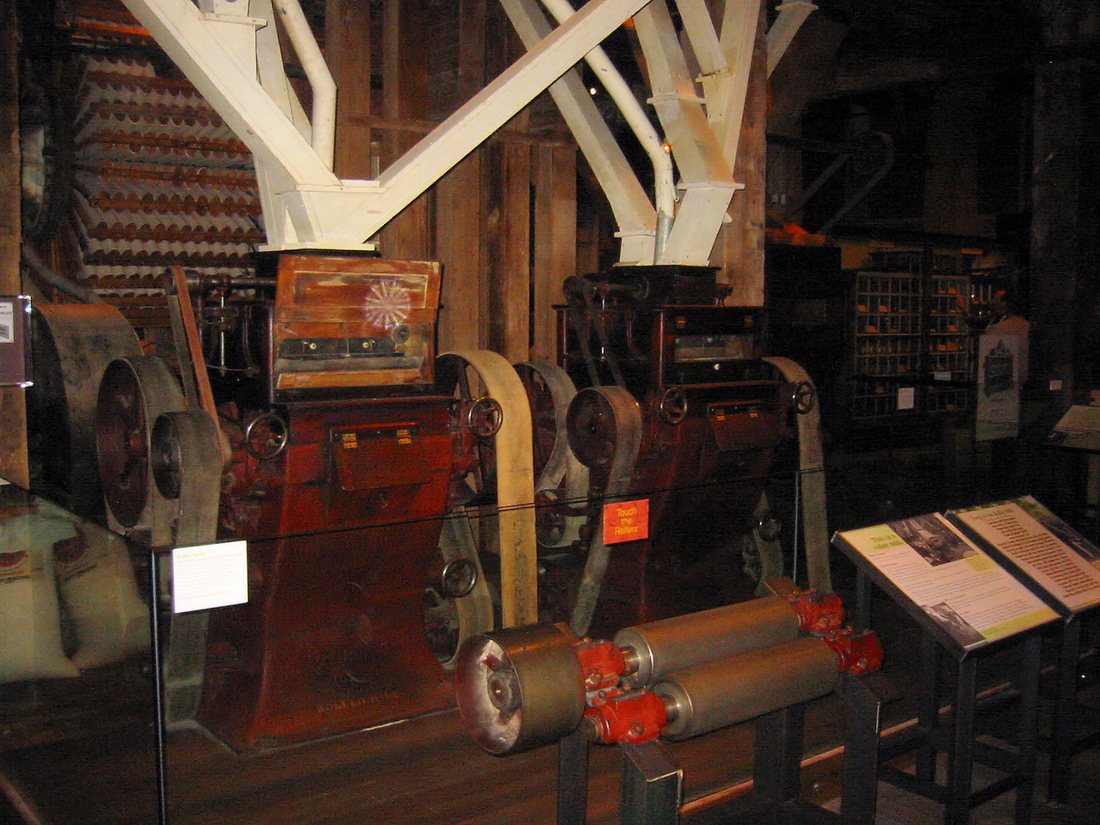
The change came from Hungary. Through the 1860s and 1870s Hungarian mills developed “high” or gradual milling: instead of grinding the kernel once, they broke it in stages between rollers and sifted between each stage. András Mechwart of Ganz & Co. in Budapest built on Friedrich Wegmann’s porcelain rollers in 1874, and the firm made chilled-iron rolls. (Several earlier Hungarian dates that appear in popular histories could not be traced to a primary source and are left out.)
Minneapolis needed the new method more than anywhere. An 1886 account reproduced by the Minnesota Historical Society explains why: the region grew hard spring wheat, and the old stones “did not thoroughly remove the bran” from it, so spring wheat sold for “thirty cents a bushel less than the winter wheat.” The fix was “new process” milling: rollers “revolving at unequal rates of speed” that sheared the kernel open rather than crushing it, plus the middlings purifier, which blew air through sifted particles to lift away bran. The middlings purifier is usually told as a Minneapolis invention. The same 1886 account credits it to a French inventor, Joseph Perrigault, in 1860; C. C. Washburn brought it to Minneapolis in 1871, and La Croix and George T. Smith improved it there. It was a French device, made to work on American wheat.
The top grade of the new flour was sold as “patent” flour — a trade name, not a legal patent — and for three years it fetched a uniform ten dollars a barrel regardless of the price of wheat. By 1886 Minneapolis had 26 mills grinding about 24 million bushels a year; Pillsbury’s A Mill alone could make 5,200 barrels a day.
The explosion
At about 7 p.m. on 2 May 1878, Cadwallader Washburn’s A Mill blew up. All fourteen workers inside were killed, and four more died in neighbouring mills: eighteen dead. MNopedia records that the Diamond and Humboldt mills also exploded; General Mills’ own history says the blast “leveled five other mills and engulfed several city blocks in flames.” The Minneapolis Tribune estimated the city had lost a third to a half of its milling capacity. University of Minnesota professors traced the cause to two millstones running dry against each other, striking a spark that ignited the flour dust.
The detail worth holding onto is that the disaster came from the old technology. The rebuilt A Mill opened in 1880 as an all-roller mill, with a dust-collecting system that the engineer William de la Barre brought from Philadelphia — and Washburn shared it with his competitors. Washburn-Crosby later merged with three rivals to form General Mills (1928). The mill stopped grinding in 1965, burned in 1991, and its ruins are now the Mill City Museum.
Whiter still: bleaching
Roller flour was whiter than stone flour, but fresh flour still carries a cream colour from carotenoid pigments, and it whitens slowly as it ages in air. Bleaching does in minutes what aging does in weeks.
The first federal fight was over the Alsop process, which bleached flour with nitrogen peroxide gas. Harvey Wiley’s Bureau of Chemistry seized a shipment of 625 sacks sent from Lexington, Nebraska, to Castle, Missouri, carrying nitrites at 1.8 parts per million. In United States v. Lexington Mill & Elevator Co. (decided 24 February 1914) the Supreme Court held that the 1906 Food and Drugs Act reached only an added substance that “may render such article injurious to health,” and that the burden of showing it lay on the government. The government lost the principle it wanted — that any added poison is adulteration — and bleached flour stayed on sale, labelled as bleached.
The next bleach was Agene (nitrogen trichloride), used by 1948 on about 80 per cent of American white flour. In 1946 the British physiologist Edward Mellanby showed that agenized flour gave dogs “running fits”; the toxin was later identified as methionine sulfoximine. The FDA ordered Agene out by August 1949. It is often said that Agene caused widespread neurological disease in people. The record of the time says the opposite: TIME reported in November 1948 that “a similar diet had no bad effects on 20 human guinea pigs.” The ban was a precaution based on animal evidence — probably a sound one, but not a response to a human epidemic.
Today US law lists the permitted bleaching and maturing agents: oxides of nitrogen, chlorine, nitrosyl chloride, chlorine dioxide, benzoyl peroxide, and azodicarbonamide (up to 45 ppm). What each actually does to a dough is on the science page.
Bromate
Potassium bromate is not a bleach; it is a slow oxidiser that strengthens dough, and when used correctly it is meant to be consumed entirely in the oven. US law allows up to 50 ppm in “bromated flour.” It was found to cause tumours in rats in 1982; the UK banned it in 1990 and Canada in 1994. California listed it under Proposition 65 on 1 January 1990 (not 1991, as a widely read miller’s page says), and the California Food Safety Act, signed on 7 October 2023, bans it from sale in that state from 1 January 2027. The FDA added bromate to its list of chemicals under review on 4 March 2024.
Claims that it is already banned elsewhere in the United States run ahead of the law. As of this writing an Illinois bill to ban it had died, and a New York bill had passed the legislature in April 2026 without a governor’s signature being found.
Enrichment: putting back what the mill took out
Roller milling separated the germ and bran so cleanly that it also removed most of the grain’s B vitamins and iron. In the American South, where a diet of refined corn and flour met poverty, pellagra — niacin deficiency — killed nearly 7,000 people a year at its peak in 1928.
The FDA set enrichment standards for flour and bread in 1941. Enrichment was voluntary until January 1943, when War Food Order No. 1 briefly made it national; after the war the rule passed to the states, and twenty-eight had passed some mandatory law by 1949. US enriched flour must now carry, per pound: thiamin 2.9 mg, riboflavin 1.8 mg, niacin 24 mg, folic acid 0.7 mg and iron 20 mg.
“Enrichment ended pellagra” is true but incomplete. An NBER study by Clay, Schmick and Troesken (2017) found pellagra deaths tracked cotton production, and used the arrival of the boll weevil — which pushed Southern farmers from cotton into food crops — as evidence that diet change itself mattered. Their conclusion credits both: fortification “significantly decreased the pellagra death rate and led to pellagra’s elimination around 1950.” (Pellagra is chiefly a disease of corn eaten without nixtamalization; that story is told in the Flatbreads and Breakfast sections.)
The second round came in 1998, when folic acid was added to enriched grain. The birth rate of neural tube defects fell from 10.7 to 7.0 per 10,000 — about 35 per cent, or roughly 1,300 affected births avoided every year (Williams and others, MMWR, 2015). It is one of the most measurable public-health effects any food additive has had, and it matters to anyone who stops buying enriched flour; see Home Milling.
Self-rising flour
Self-rising (British: self-raising) flour is flour with the chemical leavening already mixed in. It was patented by Henry Jones, a Bristol baker, on 17 March 1845, and by the end of the following year he was supplying Queen Victoria. The flour’s adoption for use in the Crimean War in 1855, reportedly at Florence Nightingale’s urging, is told two ways — one account says the Navy took it up, another the Army — and the patent text itself, including the original composition, was not seen. Today’s US standard allows only phosphate or aluminium-phosphate acids with the soda, “seasoned with salt.”
In this section: History · The science · Milling · Wheat classes · Reading the label · Heritage wheats · Michigan · Home milling · Rye, barley, oats · Corn, rice, starches · Buckwheat and small grains · Legume, nut, seed · Gluten-free · Safety and storage · Corrections
Comments (0)