The Science: Protein, Starch, Water and Ash
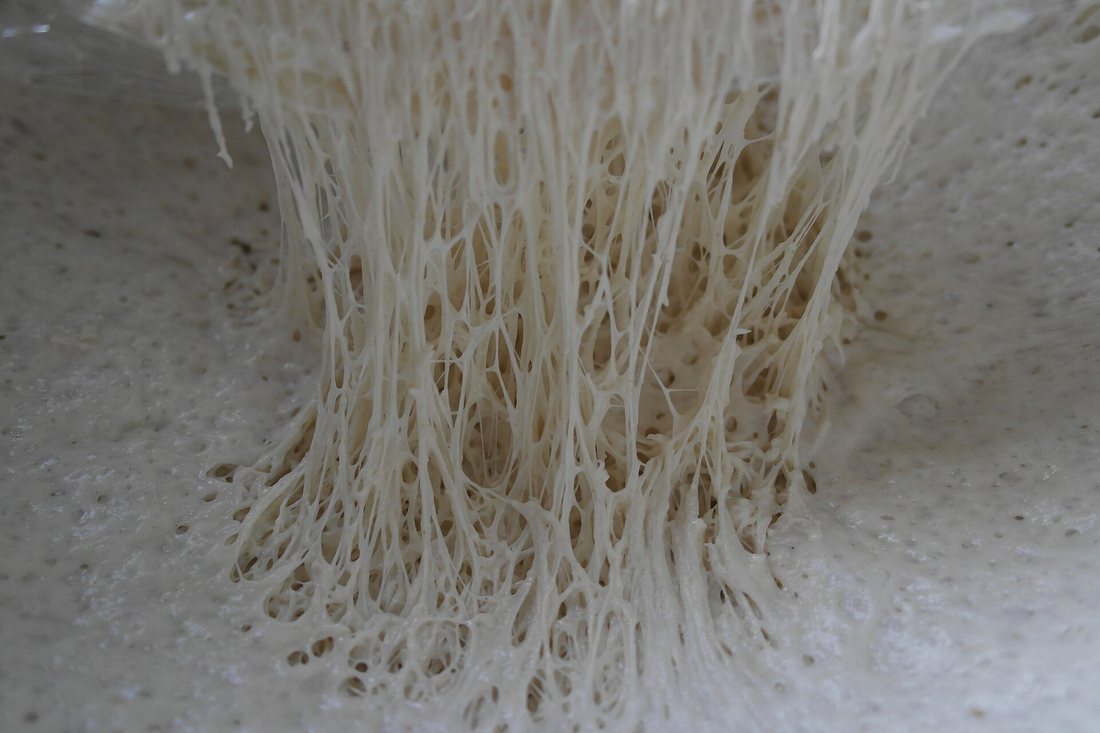
Flour is mostly starch, but its behaviour in a bowl is decided by smaller things: two families of protein, a few per cent of damaged starch, the fibre that came with the bran, and enzymes that were waiting in the seed for it to sprout. Almost every instruction in a bread recipe — how much water, how long to knead, how long to rest — is a way of managing one of them.
What a wheat kernel is
A wheat kernel is about 83 per cent endosperm, 14.5 per cent bran and 2.5 per cent germ by weight (BAKERpedia’s reference figures).
- The endosperm is the seed’s food store: starch granules packed in a matrix of protein. White flour is ground endosperm.
- The bran is the protective outer layers, mostly insoluble fibre, with the mineral-rich aleurone layer on its inner face.
- The germ is the embryo. It is small but carries most of the kernel’s oil — and the oil is what turns whole-wheat flour rancid.
A 60-pound bushel of wheat yields about 42 pounds of white flour (a Kansas Historical Society teaching figure), about 70 per cent. If the endosperm is 83 per cent of the kernel, roughly a sixth of it is lost with the bran and shorts in every mill. Perfect separation is impossible, and the size of that loss is one of the things a mill’s “extraction rate” describes (Milling).
Gluten: two proteins, one network
Wheat’s storage proteins fall into two families, told apart by whether they dissolve in dilute alcohol:
- Gliadins dissolve. They are mostly single protein chains, roughly 28,000–55,000 in molecular weight.
- Glutenins do not. They are enormous aggregates — from about 500,000 to more than ten million — built from high- and low-molecular-weight subunits linked chain to chain by disulphide bonds (Wieser, Food Microbiology, 2007).
Add water and work, and the two form gluten: a stretchy, gas-holding network that gives dough its “water absorption capacity, cohesivity, viscosity and elasticity,” in Wieser’s words. The textbook shorthand — gliadin gives extensibility, glutenin gives elasticity — is broadly right and widely taught, but it is a simplification; the properties belong to the network as a whole.
The protein number on a bag measures quantity, not quality. Bread-making quality is “associated particularly with allelic variation in the HMW subunits of glutenin” (Bromilow, Shewry and others, Frontiers in Plant Science, 2017): which versions of those large subunits a wheat carries decides how well its glutenin builds. Two flours at 12 per cent protein can bake quite differently. This is why the European millers’ W value — a measure of dough strength — appears on Italian pizza-flour specifications alongside protein (Reading the Label).
Hard and soft is a gene, not a protein level
“Hard” and “soft” wheat describe how the endosperm breaks, not how much protein it has, though in commerce the two travel together. Hardness is set at a single locus on chromosome 5D carrying two genes, Pina-D1 and Pinb-D1, which make proteins called puroindolines. When both work normally, they coat the starch granules and stop starch and protein from bonding tightly: the kernel crumbles, and it is soft. Lose or mutate either one and the endosperm becomes a solid glassy block that fractures through the starch granules: hard. Durum wheat has no puroindolines at all and is the hardest of all.
Damaged starch: the hidden water sponge
When a hard kernel shatters through its starch granules, some granules crack. Damaged starch behaves nothing like intact starch. Teobaldi and colleagues (Foods, 2024) give the figures: damaged granules absorb 200 to 430 per cent of their weight in water at room temperature, intact ones 39 to 87 per cent. In hard wheat flour, damaged starch can be 8 per cent or more of the total starch. Damaged granules are also far easier for enzymes to break into sugar, which feeds yeast.
The chain runs: hard kernel → shattered endosperm → more damaged starch → thirstier dough and faster fermentation. Stone mills produce more damaged starch than roller mills (Carcea and others, Foods, 2022), which is part of why freshly stone-ground flour feels different in the hand.
Why whole wheat drinks more water
Water in a dough is held by three things, and they hold very different amounts (figures from a water-absorption study in Foods, PMC7540380):
| Component | Water held, relative to its own dry weight |
|---|---|
| Intact starch | about 0.5 × |
| Protein | about 1.8 × |
| Damaged starch | 3–4 × intact starch |
| Arabinoxylans (bran fibre, “pentosans”) | about 10–11 × |
Arabinoxylans are only about 1.35–2.75 per cent of white flour but hold ten times their weight in water, and bran brings a great deal more of them. That is why a whole-wheat dough needs more water than a white one, and why it keeps absorbing water as it rests. In one 2026 measurement, stone-milled refined hard spring flour absorbed 68.9 per cent water against 66.0 per cent for the same wheat roller-milled.
Ash: the mineral fingerprint of bran
Burn a sample of flour at about 900 °C and what is left is ash — the minerals. Since the minerals are concentrated in the bran and aleurone, ash measures how much of the outer kernel got into the flour: how white, or how refined, it is.
Europe grades flour by ash (Reading the Label). The United States does not grade by it, but it does cap it: the legal definition of flour allows ash up to one-twentieth of the protein percentage (dry basis) plus 0.35. A 12 per cent protein flour may carry up to 0.95 per cent ash. The lowest-ash commercial flour is chlorinated cake flour, at about 0.36–0.40 per cent (Wheat Marketing Center).
Falling number: sprout damage
A seed’s job is to sprout, and when it starts it releases α-amylase, an enzyme that turns stored starch into sugar. Wheat caught by rain in the field can begin that process in the head. Flour from it makes a sticky, gummy crumb.
Millers test for it with the falling number: the time in seconds for a plunger to fall through a hot paste of meal and water. More enzyme, thinner paste, faster fall. USDA’s Wooster laboratory gives the working bands: cake flour wants 350 seconds or more; cookies and cereals use a 250-second cut-off; above about 400 seconds the reading reflects things other than amylase. The target is a band, not a maximum — flour with too little amylase gives yeast too little sugar, so mills add it back as malted barley flour (US law allows up to 0.75 per cent) or fungal amylase.
What bleaching and maturing actually do
The chemicals the law lumps together as “bleaching agents” do quite different jobs:
- Benzoyl peroxide only whitens. It oxidises the yellow carotenoids over about 36 hours and has “little or no effect on ‘maturing’” the dough.
- Chlorine dioxide acts almost instantly and both whitens and matures — improving handling and loaf volume.
- Azodicarbonamide is legally a bleaching agent “even though it has no whitening effect on flour.” It is a fast-acting dough strengthener. The FDA opened a formal reassessment of it in May 2026.
- Chlorine gas is the one that changes a recipe’s outcome. Used on cake flour at 1,200–2,500 ppm, it drops the flour’s pH to about 4.5, oxidises the starch surface, and leaves the protein unable to form gluten — “no gluten development, only viscosity,” in the Wheat Marketing Center’s summary.
Chlorinated flour matters for high-ratio cakes, where sugar outweighs flour: the modified starch holds the heavy, sugary batter up while it sets. The usual home substitute for cake flour — all-purpose flour with some of it replaced by cornstarch — lowers the protein but does not modify the starch, which is why it makes a decent butter cake and a disappointing high-ratio one. (That explanation follows from the Wheat Marketing Center material; no side-by-side bake test was found.) Heat-treated cake flour, dry-heated at about 140 °C, is the unchlorinated alternative. The Golden Chiffon Cake is the showcase recipe for cake flour.
“Unbleached” has no legal definition. It means only that no bleaching ingredient was added. An unbleached flour may still contain malted barley, enzymes and ascorbic acid.
Aging does the same job slowly. Left in air, unbleached flour whitens and its dough becomes more elastic as sulphydryl groups in the protein oxidise to disulphide bridges. King Arthur gives about two weeks in summer to a month in winter; an Indian food-science text gives six to eight weeks for the pigments. The sources disagree, and both are ranges.
Why whole wheat goes rancid — twice
In an intact kernel the fat and the enzymes that attack it are kept apart. Milling mixes them. Two different processes follow:
- Hydrolytic rancidity. The enzyme lipase splits the oil into free fatty acids. Heat or steam can stop it: steaming kernels before milling cut lipase activity by 81 per cent without affecting starch or gluten (Poudel and Rose, Food Chemistry, 2018). This is how “stabilised” whole-wheat flours work.
- Oxidative rancidity. Oxygen and light attack the unsaturated fats, making the aldehydes and ketones that smell stale. Steaming did not stop this. Only cold, dark and airtight storage slows it.
White flour keeps for so much longer because it has almost none of the germ’s oil and little of its lipase. Storage times are on Safety and Storage.
In this section: History · The science · Milling · Wheat classes · Reading the label · Heritage wheats · Michigan · Home milling · Rye, barley, oats · Corn, rice, starches · Buckwheat and small grains · Legume, nut, seed · Gluten-free · Safety and storage · Corrections
Comments (0)