Home Milling: A Buyer's Examination
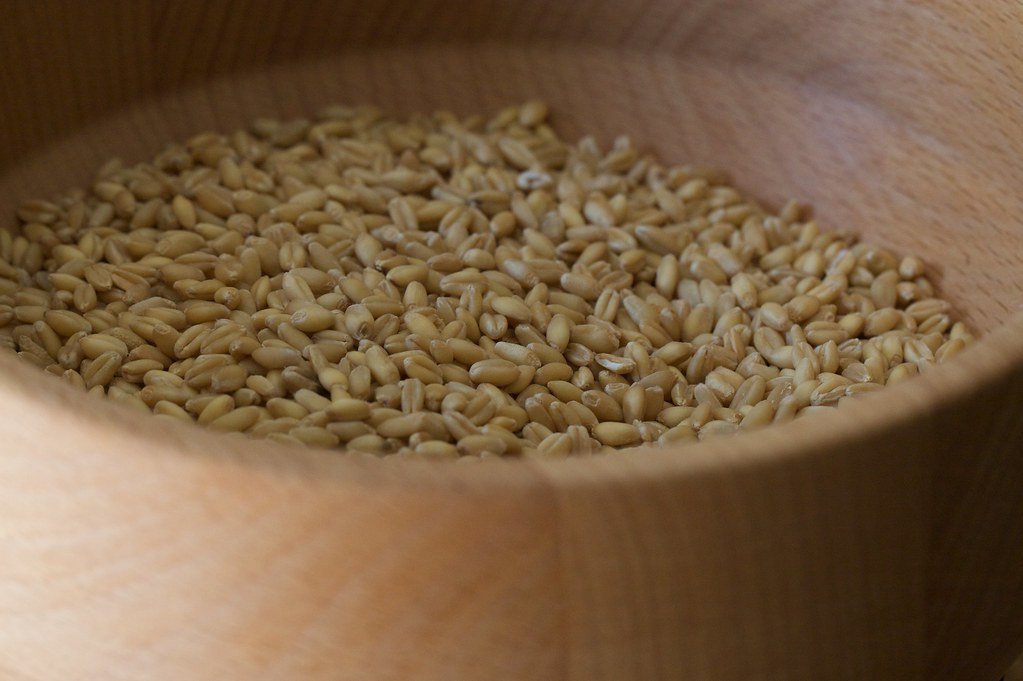
No grain mill has been bought yet. The kitchen these pages were written for bakes with store-brand flour, and home milling and specialty grains are the next thing it means to try. So this page is not a review. It is what a careful buyer would want to know first: how the mills work, what the makers claim and what they admit, what fresh flour does in a dough, and what changes nutritionally when enriched store flour is replaced by flour milled at home.
Two ways to break a grain
- Stone (burr) mills grind between a fixed and a turning stone; the gap sets the fineness. Most home stones are corundum-ceramic — aluminium oxide set in a binder — and a few are granite.
- Impact mills (“micronizers”) fling the grain at high speed against stainless-steel fins. NutriMill describes its Classic as a “high-speed impact chamber (micronizer) with stainless steel milling heads.” They are fast and loud, with fewer fineness settings than a stone mill.
- Hand mills use steel burrs, stone burrs or both, and are slower but need no power.
Corundum or granite? A granite-mill maker argues that corundum stones are artificial and bound with resin while granite is natural and self-sharpening; the corundum makers argue the reverse on consistency. No independent measurement of how much stone either kind sheds into flour was found. It is a maker’s argument, not a finding.
The mills
Prices and specifications as given on makers’ and major retailers’ pages, 30 September 2026:
| Mill | Type | Motor | Stated output | Price (USD) | Warranty |
|---|---|---|---|---|---|
| Mockmill 100 | corundum-ceramic stone | 360 W | 100 g/min | $380 | — |
| Mockmill 200 | corundum-ceramic stone | 600 W | about 200 g/min of soft wheat | $470 | 6 years, non-commercial |
| Mockmill Lino 100 / 200 | corundum-ceramic stone | 360 / 600 W | 100 / 200 g/min | $680 / $775 | 12 years (retailer) |
| KoMo Fidibus Classic | ceramic-corundum stone | 360 W | about 3.5 oz/min at finest | $619–$814 by wood | 12 years |
| NutriMill Harvest | corundum stone | 450 W | not stated | $499 | 5 years |
| NutriMill Classic | impact | 1,200 W | up to 20 cups a batch | $329 ($279 on sale; listed sold out) | 5 years + lifetime motor/heads |
| WonderMill (electric) | impact | 1,250 W | ”over 100 lbs of flour per hour” | about $330–$407 at retailers | lifetime heads, 6 years other |
| Wonder Junior Deluxe | hand; stone and steel burrs | — | — | about $330 | — |
| Country Living | hand; carbon-steel burrs | — | — | about $810 | lifetime |
Output figures are the makers’ own, usually for soft wheat at a middle setting; hard wheat at a fine setting is slower.
What each will grind — and what ruins it
The makers’ own statements, taken together, show a clear pattern:
- No electric stone mill checked accepts oily seeds on their own. The Mockmill manual allows oily seeds only mixed into dry grain, at no more than 5 per cent oily to 95 per cent dry. NutriMill says of its mills, “Do not grind oily seeds.”
- Steel burrs are what handle oil. The Wonder Junior’s steel burrs are sold for cocoa, nut butters and oily foods; Country Living sells an accessory for them.
- Popcorn splits the field. The impact mills (NutriMill Classic) grind popcorn and dried corn; the KoMo stone mill says not to grind popcorn, though it takes dent (field) corn.
- The KoMo’s list of what it will grind is long — hard and soft wheat, oat groats, rice, spelt, Kamut, buckwheat, barley, rye, millet, teff, quinoa, amaranth, sorghum, lentils and dry beans — and its list of what it won’t is short: herbs, oilseeds, popcorn and fibrous material.
The heat claim
NutriMill advertises that the Classic keeps flour “around 118°F to preserve nutrients.” No study was found showing that flour temperatures in that range — about 40–50 °C — measurably destroy nutrients in home milling. “Cool milling preserves nutrients” should be read as marketing until someone measures it.
Sifting: high-extraction, not white
Sieves for fresh flour are sold in 30, 40, 50 and 60 mesh, the higher numbers finer. Home bakers report removing about 15 per cent through a 40-mesh screen, leaving flour of roughly 85 per cent extraction, and advise buying 20–30 per cent more berries if sifting. Those figures come from forums and blogs, not controlled measurements.
The label systems show what that flour is: an 85 per cent extraction flour is roughly a T80 to T110, a German Type 1050. A home sieve cannot make white flour. It makes a lighter whole-grain flour — a very good one, but not a 00, and not a bread flour from a roller mill.
Fresh flour in the dough
- It needs more water. “When using flour I’ve milled myself, I almost always have to increase the hydration,” writes Maurizio Leo (The Perfect Loaf). Bran and germ absorb more water, and absorb it slowly, so the dough can feel loose at first and tighten as it rests.
- It ferments faster. Fresh whole flour has its full load of enzymes, and stone milling adds damaged starch (The Science). The same author advises against long autolyse with fresh flour; that is a practitioner’s observation, not a measured figure.
- “Bran cuts the gluten” is partly right for the wrong reason. The image of sharp bran slicing strands is folk mechanics. The food-science literature describes bran diluting the gluten, disrupting gas cells, competing for water and releasing compounds (ferulic acid, glutathione) that interfere chemically. Twenty per cent added bran cut bread volume by about a fifth in one study.
To age or not to age
Here the evidence is genuinely unsettled, and both positions have a basis.
- For aging: oxidation during storage turns free sulphydryl groups in the protein into disulphide bridges, strengthening gluten. Fresh flour is described as over-pliable, and two to four weeks is often cited to stabilise it. Commercial white flour is aged, or matured chemically, for exactly this reason.
- For milling to order: whole flour starts going rancid within days to weeks of milling. The only sensory test found — a small Bastyr University student study (2012) of whole-wheat flatbread from flour aged 0, 3 and 10 weeks — found “no significant difference in texture, flavor, or preference.” It was small, and the ten-week flour was a different product, so the comparison was confounded.
Aging demonstrably changes refined flour. Whether it improves home-milled whole flour enough to outweigh the staling of its germ oil has not been well tested. Practitioners mostly mill the day of baking or the day before.
Buying and keeping berries
- Hard red or hard white berries for yeast bread; soft white or soft red for pastry, cookies, biscuits and cake (Wheat Classes). Hard white gives a milder, paler whole-wheat flour. Michigan sources are on the Michigan page.
- Whole berries keep for years; flour keeps for months. Utah State University Extension advises rotating stored wheat so none is older than five years, keeping it at 40–60 °F, and keeping moisture under 12 per cent to prevent mould. A Brigham Young University study found wheat sealed in No. 10 cans still made acceptable bread after 32 years — but that is sealed, low-oxygen cans, not a paper sack in a pantry.
- Millers date whole-wheat flour roughly 3–9 months after milling, against 9–15 months for white.
That asymmetry is the real argument for home milling: store the seed, and mill to order.
The nutrition claims
“Fresh flour loses 40 per cent of its nutrients in 24 hours and 90 per cent in 72.” This circulates widely on mill-seller and homesteading sites. No primary study behind it was found, and one blogger who repeated it later appended a correction. The controlled study found — Nielsen and Hansen, Cereal Chemistry, 2008 — measured vitamin E over 297 days of storage: a loss of 24 per cent in stone-milled flour and 50 per cent in roller-milled. Vitamin E does decline, over months, by a quarter to a half.
Home-milled whole wheat is not better than store flour on every nutrient. It gains fibre, magnesium, zinc and manganese. It loses most of the folic acid that US law adds to enriched flour — USDA data put enriched all-purpose at about 291 µg folate (DFE) per 100 g against about 44 µg for whole-grain flour — and a little iron. That trade-off matters most to anyone who is, or may become, pregnant: folic acid in enriched flour prevents roughly 1,300 neural tube defects a year in the United States (History).
Fresh milling does nothing for gluten disorders. Fresh einkorn or spelt is still wheat (Heritage Wheats).
What to try first
For a first experiment, the natural subject is the 100% Whole Wheat Sandwich Bread: bake it once with bagged white whole wheat, then again with fresh-milled hard white berries at the same weight, adding water until the dough feels the same. The difference between the two loaves will teach more about fresh flour than any specification sheet.
In this section: History · The science · Milling · Wheat classes · Reading the label · Heritage wheats · Michigan · Home milling · Rye, barley, oats · Corn, rice, starches · Buckwheat and small grains · Legume, nut, seed · Gluten-free · Safety and storage · Corrections
Comments (0)