Milling: Stones, Rollers and What the Law Calls Flour
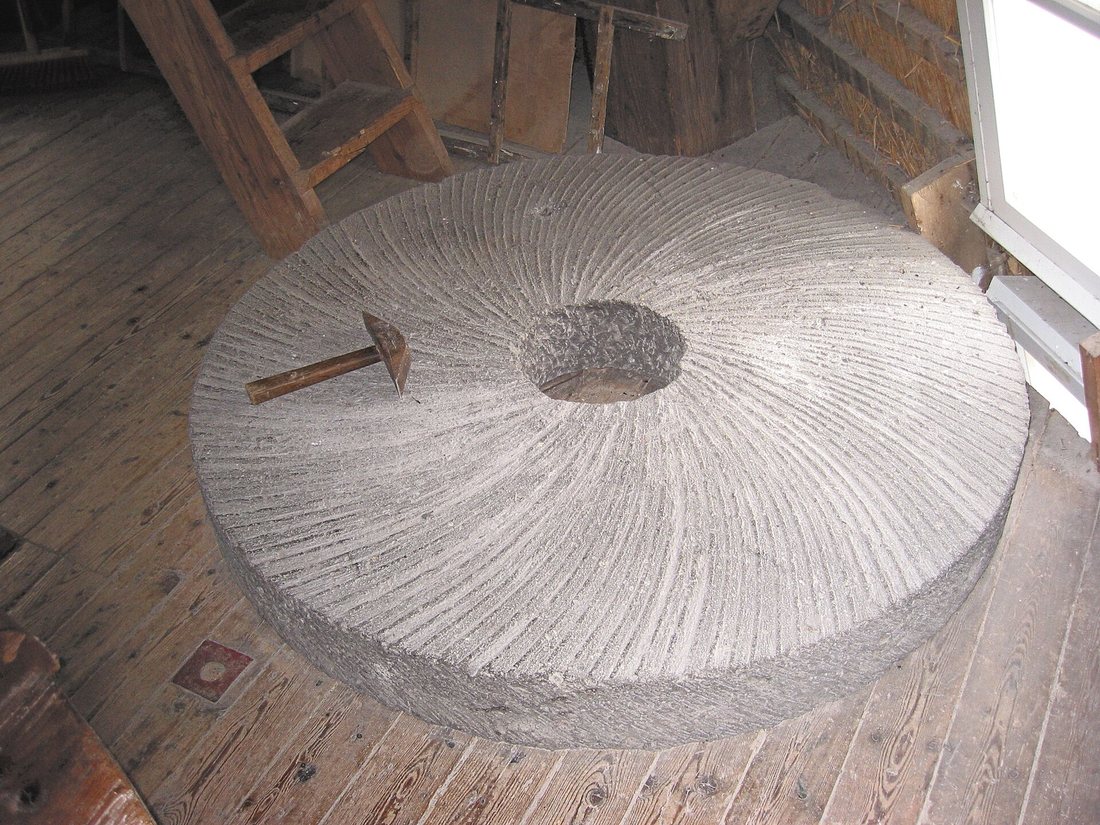
There are two ways to turn a kernel into flour. A stone mill grinds everything at once and sifts afterwards, if at all. A roller mill takes the kernel apart in stages and sorts the pieces as it goes. Almost everything sold in an American supermarket comes from the second, and the legal definitions of “flour” and “whole wheat flour” were written around it.
The stone mill
A stone mill grinds the whole kernel between a turning runner stone and a fixed bed stone. Bran, germ and endosperm come out together as one meal. The gap between the stones sets the fineness; the cut pattern of furrows and lands on their faces (History) carries the meal outward from the centre. Grinding generates heat, and old millers knew it could crack a stone. How hot the flour itself gets in a modern stone mill was not found measured in any source consulted, so no figure is given here.
Stone-ground meal can be sifted to take out some bran — that is what bolting was — but a stone mill can never make flour as white as a roller mill, because the bran has already been ground into fine pieces mixed through the endosperm.
The roller mill
A roller mill works by gradual reduction. The 1886 Minneapolis account describes it precisely: kernels pass between “grooved rollers revolving at unequal rates of speed.” Because one roll turns faster than the other, the kernel is sheared open rather than crushed:
- Corrugated break rolls split the kernel and scrape the endosperm off the bran in several passes.
- After each pass, sifters and purifiers sort the stock by size and weight. Bran flakes go one way, germ another, endosperm chunks (middlings) another.
- Smooth reduction rolls grind the middlings down to flour in further passes.
Each pass produces a separate stream of flour, differing in colour, ash and protein. The miller blends streams to make the products on the shelf; the whitest streams from the centre of the kernel made the premium “patent” flour of the 1870s. Details such as how many streams a modern mill runs, and the moisture and time used to temper wheat before milling (conditioning it so the bran toughens and peels cleanly), were not found in a primary source and are not given here.
Extraction rate
Extraction is the share of the kernel’s weight that ends up as flour. Wholemeal is 100 per cent by definition. White flour runs at about 70–72 per cent. Anything in between — 80 or 85 per cent — is a high-extraction flour, with some bran and germ left in. Home millers who sieve fresh flour are making high-extraction flour (Home Milling).
Most “whole wheat” was taken apart and put back
Most supermarket whole-wheat flour in the United States is roller-milled into separate streams and then recombined. That is legal, because US law defines whole-wheat flour by proportion, not method: 21 CFR 137.200 requires that “the proportions of the natural constituents of such wheat, other than moisture, remain unaltered.” A mill that removed some germ to lengthen shelf life and did not put it all back would no longer be making whole-wheat flour under that rule. Whether any mill does so was not found.
Is stone-ground more nutritious?
This is the most common claim made for stone milling, and the best test found says no — with a real difference hiding behind it.
Carcea and colleagues at CREA in Rome milled eight soft-wheat mixes both ways (Foods, 2019 and 2022). They found “no compositional difference between a stone milled or a roller milled flour if, in this latter one, the milling streams are all recombined” — in protein, ash, fat, total fibre, polyphenols, alkylresorcinols and phytic acid. What did differ was particle size and starch damage: the stone-milled flours “in all cases” had significantly more damaged starch.
Stone-ground whole wheat and recombined roller whole wheat differ as baking materials, not as food. Stone flour is thirstier and ferments faster (The Science); it is not more nourishing. (The study covered soft wheat, Italian mixes and one research group — a strong result, not the last word.)
“Stone ground” has no federal definition in the United States. It describes a method, and says nothing about whole-grain content: a stone-ground cracker may still be made mostly from white flour.
What the law calls flour
The US standards of identity for flour are in 21 CFR Part 137. They hold several surprises.
| Standard | What it says |
|---|---|
| Flour (137.105) — also “white flour,” “wheat flour,” “plain flour” | Ground and bolted from wheat other than durum; at least 98% passes a 212-micron (No. 70) cloth; moisture no more than 15%; ash capped by the protein formula. Permits bleaching agents, ascorbic acid up to 200 ppm, malted barley flour up to 0.75%. Must say “Bleached” if bleached. |
| Bromated flour (137.155) | Potassium bromate up to 50 ppm, only in flours “whose baking qualities are improved” by it. |
| Enriched flour (137.165) | Per pound: thiamin 2.9 mg, riboflavin 1.8 mg, niacin 24 mg, folic acid 0.7 mg, iron 20 mg; calcium optional. |
| Instantized flour (137.170) — “instant blending,” “quick-mixing” | All passes a No. 20 sieve and no more than 20% passes a No. 200; made by selective grinding or agglomeration so it pours. |
| Self-rising flour (137.180) | Flour with sodium bicarbonate and a phosphate acid, “seasoned with salt”; must give off at least 0.5% carbon dioxide. |
| Whole wheat flour (137.200) — also “graham flour,” “entire wheat flour” | Natural proportions unaltered; much coarser sieve limits than white flour. Permits some bleaching agents. |
| Semolina (137.320) | From durum; passes a No. 20 sieve but no more than 3% through a No. 100; ash no more than 0.92%. |
Four things in that table are worth knowing:
- Whole-wheat flour can legally be bleached, with azodicarbonamide, chlorine dioxide, chlorine or nitrosyl chloride.
- “Graham flour” is a legal synonym for whole-wheat flour in the United States, not a separate coarser product.
- “Wheat flour” on an ingredient list means white flour. The FDA’s 2006 draft guidance says so directly: wheat flour “is a synonym of flour … and thus, the bran and germ have been removed.”
- There is no legal standard for “bread flour,” “cake flour,” “pastry flour” or “all-purpose flour.” They are trade names (Wheat Classes).
In this section: History · The science · Milling · Wheat classes · Reading the label · Heritage wheats · Michigan · Home milling · Rye, barley, oats · Corn, rice, starches · Buckwheat and small grains · Legume, nut, seed · Gluten-free · Safety and storage · Corrections
Comments (0)