Starting a Coffee Business · 12 of 20
Honey in Coffee
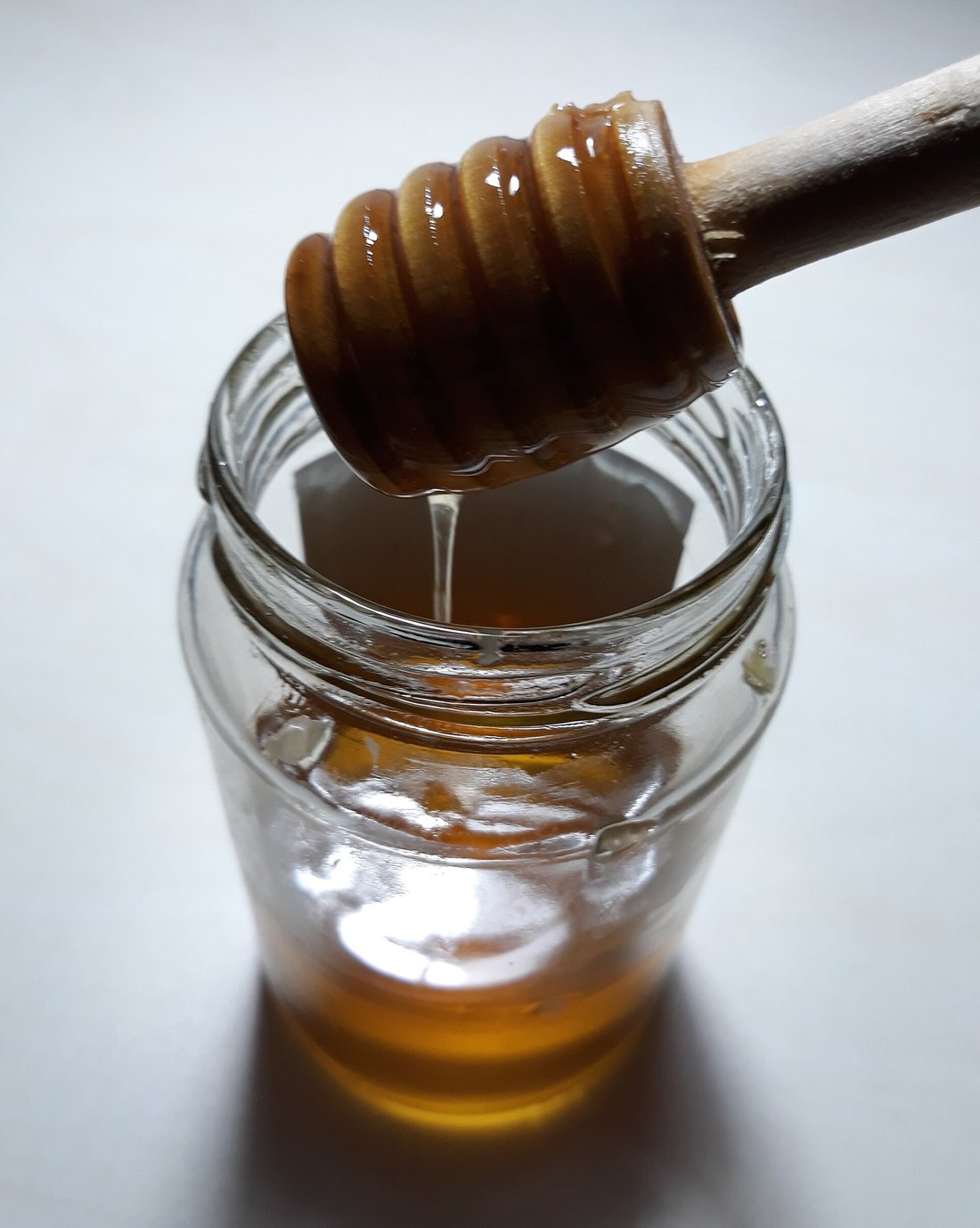
I keep bees and sell the honey, so honey in the coffee is the one thing this stall has that no other coffee stall does. It has one practical problem, which I already knew from the kitchen: honey stirs into a hot drink and sits in a lump at the bottom of a cold one. This page explains why, gives the fix, and sets out a short list of honey drinks to test. The drinks are proposals; none has been made and sold yet.
Why honey will not mix into a cold drink
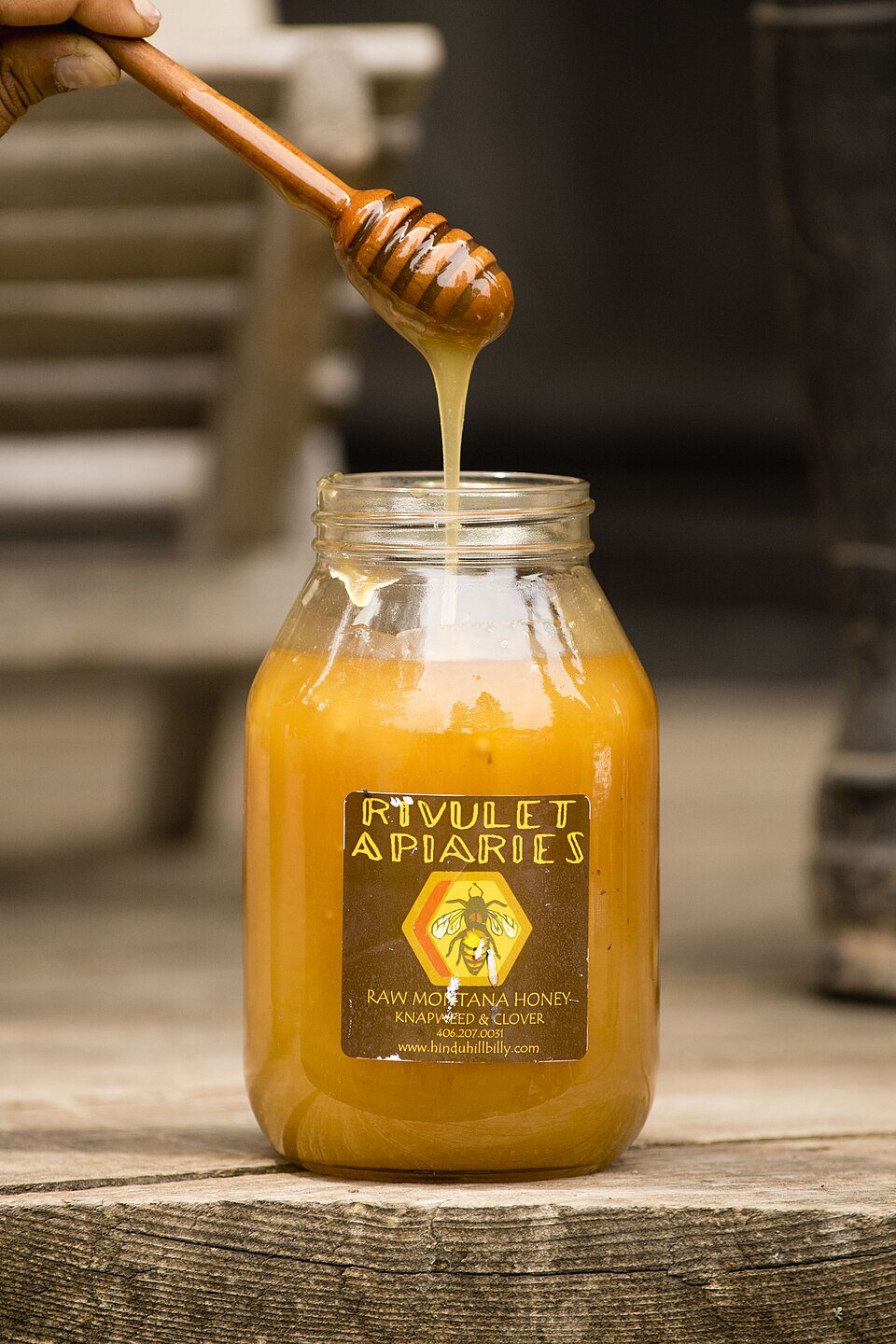
Honey is thick, and it gets much thicker as it cools. The Food and Agriculture Organization’s beekeeping handbook gives measured viscosities for a clover honey with 16% water:
| Temperature | Viscosity (poise) |
|---|---|
| 160 °F (71 °C), about a hot cup of coffee | 2.6 |
| 103 °F (39 °C) | 21 |
| 84 °F (29 °C) | 68 |
| 69 °F (21 °C), room temperature | 190 |
| 57 °F (14 °C) | 600 |
From a hot cup to a cool one, honey becomes more than two hundred times thicker. The table stops at 57 °F; an iced drink is colder still.
The same handbook gives the fix. At a fixed 77 °F, honey with 15.5% water measures 138 poise, and honey with 20.2% water measures 20. A little added water thins honey far more than warming does. That is why bartenders do not use honey; they use honey syrup.
Honey syrup
Honey mixed with water, by weight, in a squeeze bottle. (The sugar syrups, and whether glycerine or gum arabic belongs in any of them, are on Syrups.)
| Honey to water | Water in the syrup | Character |
|---|---|---|
| 3 to 1 | about 38% | Thick, pours easily, tastes most of honey. The ratio one respected bar reference recommends. |
| 2 to 1 | about 45% | The National Honey Board’s recipe |
| 1 to 1 | about 59% | Thin; dilutes the drink |
How to make it without cooking the honey. Put the squeeze bottle on a scale, weigh in the honey, add a third as much warm water, cap it and shake. The water should be warm, not hot: about 100 °F, which is two parts cool water to one part from the hot-water pot. Heating studies find no measurable change in honey held at 104 °F (40 °C); above about 140 °F (60 °C) its enzymes break down within half an hour, and at 176 °F almost at once. (The National Honey Board’s own recipe brings the syrup to a simmer. For a beekeeper selling raw honey, the cooler method is the one to be able to describe on the sign.)
It does not keep. Honey lasts for years because it holds so little available water that its own yeasts cannot grow; the limit is a water activity of about 0.61. Every syrup ratio lands far above that, on an estimate from published sugar-solution data, so every honey syrup can ferment. The sources disagree on how fast: the National Honey Board says four weeks refrigerated, the bar reference says a few days. Neither publishes a test.
The law settles the question for a stall anyway. A syrup mixed at home is home-prepared food, which a licensed booth may not use, so it has to be mixed at the stall on the day (the rules page). Mix a small bottle each market morning, keep the spare in the cooler, and pour out what is left.
Keeping it pourable in April. A 3-to-1 syrup pours from a squeeze bottle at ordinary temperatures. On a 45 °F morning, stand the bottle in a cup of warm water from the pot.
How much to use. For the sweetness of two teaspoons of sugar in an 8 oz cup, or three in a 12 oz cup:
| Sweetener | 8 oz cup | 12 oz cup |
|---|---|---|
| Honey syrup, 3 to 1 | 13 g | 20 g |
| Honey syrup, 2 to 1 | 15 g | 22 g |
| Maple syrup, straight | 12 g | 18 g |
| Simple syrup, 1 to 1 | 16 g | 24 g |
A squeeze bottle with a marked pour, or a half-ounce pump, makes that repeatable. These treat honey’s sugars as equal to table sugar gram for gram, so they are a starting point to adjust by taste.
Does hot coffee ruin the honey?
Two questions get mixed together.
- Safety: nothing found suggests honey stirred into hot coffee is harmful.
- Quality: coffee is served at 160 to 185 °F, and honey’s enzymes do not survive that for long. Whether anyone can taste the difference in a cup of coffee is not documented.
The flavor of the honey survives and is the point. A customer who wants the honey raw should have it in a cold drink.
Which honey with which coffee
No published source pairs particular honeys with particular coffees. What follows is reasoning from flavor, to be tested at the stall, and the honey pairing card sets it out in full.
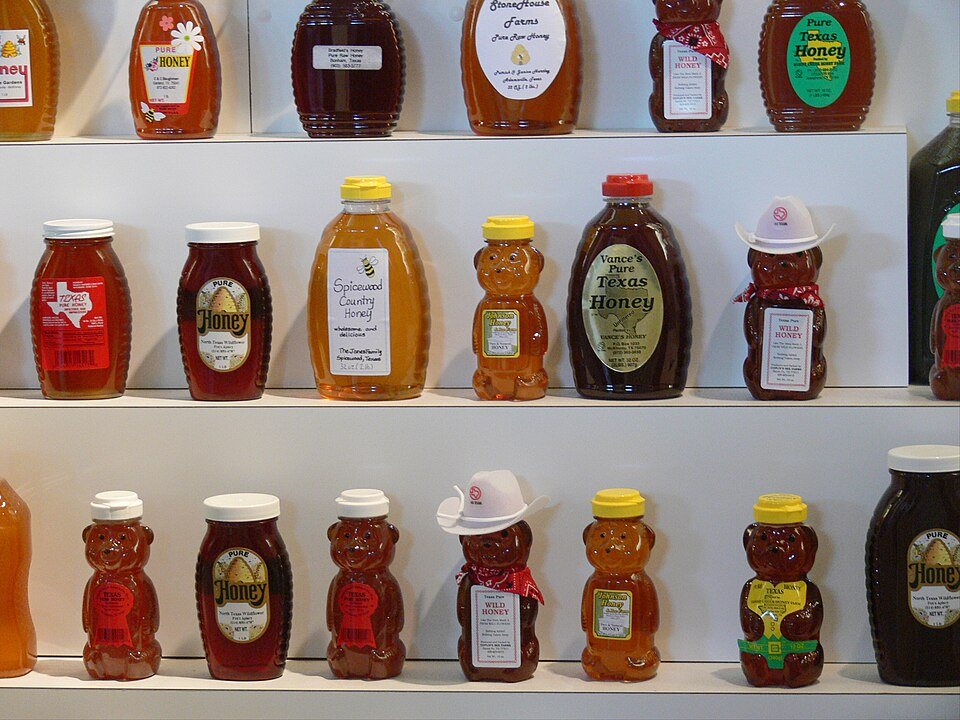
My own honey changes through the season (Honey describes it): a light, floral spring honey; a mild clover honey in midsummer; and a darker, stronger fall honey from goldenrod and aster.
| Honey | Try it with | Why |
|---|---|---|
| Light spring | Light and medium roasts; washed Ethiopia; iced coffee | A delicate honey is lost under a dark roast |
| Clover, midsummer | The house medium roast; anything with milk | Mild and sweet; it sweetens without changing the coffee |
| Dark fall | Dark roast; phin coffee; anything with condensed milk | A strong honey stands up to a strong coffee |
The general rule to test: match weight to weight. Light honey with light coffee, dark honey with dark coffee.

Drinks to test
Proportions are for a 12 oz cup. Each is a starting recipe to make, taste and correct before it goes on a sign.
Honey coffee, hot. 10 oz of the house coffee, 20 g of honey syrup, stirred. The simplest drink here, and the one that sells the honey: the bottle on the counter is the same honey as the jars on the table.
Honey and milk coffee, hot. 2 oz of phin concentrate, 20 g of honey syrup, 4 oz of hot water, 3 oz of half-and-half. This is the stall’s answer to a latte, without an espresso machine or a steam wand. The half-and-half takes the edge off the hot water’s temperature, so warm the cup first.
Iced honey coffee. Flash-brewed coffee, 20 g of honey syrup stirred in while the coffee is still warm, poured over a full cup of ice, with or without milk.
Honey phin coffee, iced. 2 oz of phin concentrate, 1 tablespoon of condensed milk, 15 g of dark honey syrup, stirred, over ice. Half the condensed milk of a cà phê sữa đá (kah fay shoo-uh dah · [kaː˨˩ fej˧˧ ʂɨə˨˩˦ ʔɗaː˦˥]), with honey making up the sweetness.
Honey and cinnamon. Any of the above with a honey syrup that has had a cinnamon stick steeped in the water first. Ground cinnamon does not dissolve; it floats or settles as sludge.
Honey and vanilla. I make my own vanilla extract, and a few drops in the honey syrup is enough. Extract is at least 35% alcohol by law; in a cup it is a trace.
Maple coffee. 18 g of maple syrup in a hot house coffee. Maple reads as maple even at a low dose, and it needs no thinning.
A drink of honey, milk and spice with espresso is sold in cafés as café con miel or café miel; a café in Mount Pleasant lists one at $4.25, a quarter more than its plain latte. The name is Spanish; no documented history of the drink was found, so the menu should not claim one.
Milk and honey mixed ahead
Milk premixed with honey would be quick to pour, and no published recipe or holding guidance for it was found. Honey stirred into cold milk meets the same viscosity problem, so it would be made with honey syrup. Once mixed it is a dairy product: it keeps like milk, not like honey, and it belongs at 41 °F or below. Make it at the stall, in a small bottle, for the day.
Things to put on the sign
- “Honey processed” coffee has no honey in it. It is a way of drying coffee with the sticky fruit pulp left on the bean. A stall that sells honey and coffee will be asked, so if a honey-processed coffee is ever on the table, say so on the card.
- Honey is not for infants. The CDC’s advice is not to give honey to a child under one year old. Nothing found requires that on a menu or a label in Michigan; a line on the board is good practice.
- Raw, and from these hives. If the syrup is made with warm water and never cooked, say so. It is true, and nobody else can say it.
Existing recipes in the collection
Sources
- FAO, Value-added products from beekeeping, chapter 2 (viscosity tables after Munro, 1943).
- National Honey Board, honey simple syrup recipe and “Honey and coffee” article; Difford’s Guide, “Honey and honey syrup.”
- Water activity: Chen, “Relationship between Water Activity and Moisture Content in Floral Honey,” Foods 8(1), 2019; Tokuoka and Ishitani, Journal of General and Applied Microbiology 37, 1991. The syrup figures are estimates from sugar-solution data, not measurements of honey syrup.
- Heating: studies of diastase and HMF in heated honey, read as summaries.
- CDC, botulism prevention.
- Ponder Coffee Co. menu (Café Miel).
- USDA maple syrup grade standards; 21 CFR 169.175 (vanilla extract).
Comments (0)