Coffee · 14 of 21
Syrups for Coffee: Sugar, Honey, Glycerine and Gum
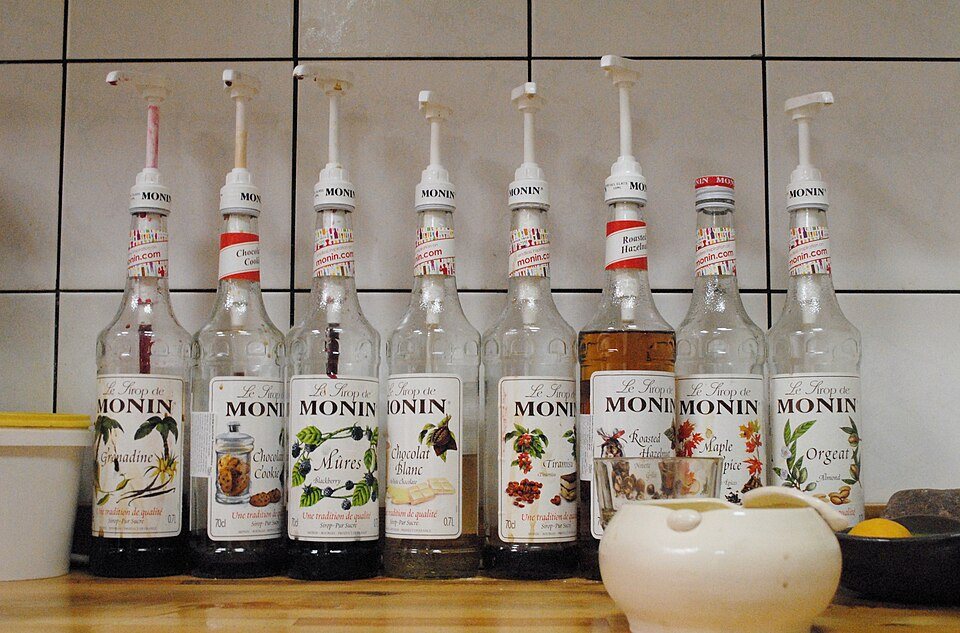
Sugar will not dissolve in iced coffee, and honey sinks to the bottom of it, so anything cold is sweetened with a syrup. This page has the syrups by weight, how much goes in a cup, and how long each keeps. Then it takes up a question from my own bar: I put glycerine in my simple syrup to give it body. Does that belong in a coffee syrup, and how is it different from gum arabic, which bartenders used for the same purpose a hundred and fifty years ago?
The short answer surprised me. At the amount I use, the measured evidence says the glycerine is probably too little to feel once the syrup is in the drink. Gum arabic is a different kind of ingredient and does more per gram, but it is slow, cloudy and expensive, and in a large coffee it is thinned out as well.
The syrups, by weight
Make them on a scale. A cup of sugar weighs less than a cup of water, so “one to one” by cups is a weaker syrup than one to one by weight. The last two columns give the sweetness of two teaspoons of sugar in an 8 oz cup and three in a 12 oz cup: a place to start.
| Syrup | Recipe, by weight | How to make it | 8 oz cup | 12 oz cup | Keeps |
|---|---|---|---|---|---|
| Simple syrup | 1 sugar : 1 water | Stir into hot water until clear; cool | 16 g | 24 g | About a month, cold |
| Rich syrup | 2 sugar : 1 water | Heat gently to dissolve; cool | 12 g | 18 g | Longer than simple; still cold |
| Demerara or brown sugar | 1 : 1 or 2 : 1 | As above, with raw or brown sugar | 16 g / 12 g | 24 g / 18 g | As above |
| Vanilla | Simple syrup plus vanilla extract to taste | Add the extract after the syrup has cooled | 16 g | 24 g | About a month, cold |
| Honey syrup, 3 : 1 | 3 honey : 1 water | Weigh into a squeeze bottle with warm water (about 100 °F); shake. Do not boil. | 13 g | 20 g | Mix on the day |
| Honey syrup, 2 : 1 | 2 honey : 1 water | As above | 15 g | 22 g | Mix on the day |
| Maple syrup | Straight | Nothing to make | 12 g | 18 g | Refrigerate once open |
| Monk fruit and erythritol blend | 1 blend : 1 water | Dissolve warm | 16 g | 24 g | Cold, a few days |
| Allulose | 1 allulose : 1 water | Dissolve warm | 23 g | 34 g | Cold, a few days |
What each tastes of, and which coffee it suits, is on the printable card: Syrups and Sweeteners: Recipes by Weight (PDF). Honey has a page of its own, Honey in Coffee, because it behaves differently from sugar. The vanilla can be home-made extract.
Rich syrup keeps better than simple because more of its water is tied up by sugar. Neither is shelf-stable. Both live in the refrigerator, or in the cooler at a stall.
My simple syrup, and what is in it
My simple syrup is not quite the one in the table. It is 237 g of water, 200 g of sugar and 19 g of food-grade vegetable glycerine: one cup, one cup and one tablespoon, put on a scale. I add the glycerine for mouthfeel.
In numbers, that syrup is 44% sugar, 52% water and 4.2% glycerine. A 20 g dose, about what a 12 oz iced coffee takes, carries 8.8 g of sugar and 0.83 g of glycerine.
Glycerine: what it is
Glycerine, glycerin and glycerol are three names for one substance. It is a small molecule, a sugar alcohol, made by splitting fats and oils. The European Food Safety Authority describes it as “a clear, colourless, hygroscopic syrupy liquid.” The bottle of pure glycerine is very thick: about 1,400 times the viscosity of water.
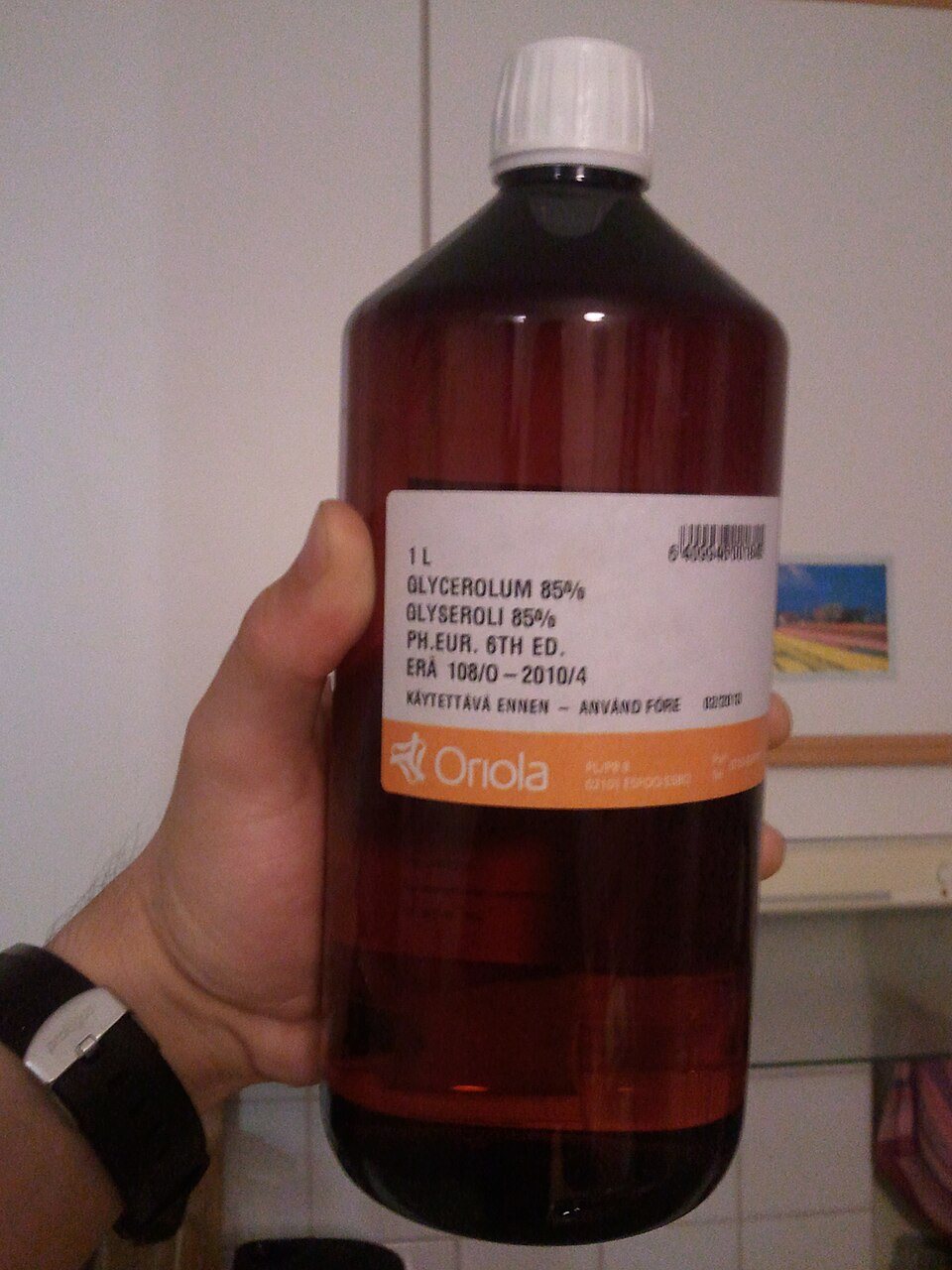
- It is legal and ordinary. In the United States it is on the list of substances “generally recognized as safe when used in accordance with good manufacturing practice” (21 CFR 182.1320), with no numeric limit. In Europe it is additive E 422.
- It is sweet, somewhat less than sugar, and it has calories: makers’ data sheets give about 4 per gram. It counts as carbohydrate on a label, not as sugar.
- “Vegetable” matters to some customers. Glycerine can be made from animal fat as well as from plant oils, so it is vegan or kosher only when the bottle says so.
Can anyone feel 4% glycerine in a drink?
This is the part I had never checked. The thick liquid in the bottle is not what reaches the mouth. It is diluted twice: once into the syrup, and again into the drink.
What is measured. The only careful threshold in print comes from wine, where glycerol is a natural part of the drink and tasters have argued about it for decades. In 1984 Ann Noble and G. F. Bursick had trained tasters compare a dry white wine with and without added glycerol. Their abstract gives two numbers:
- Tasters could detect added sweetness at 5.2 grams per litre.
- To feel added thickness took 25.8 grams per litre. Below that, “glycerol does not produce a detectable increase in perceived viscosity.”
Later wine studies mostly agree. One found glycerol’s contribution to perceived body “nominal” next to sugar and alcohol. Two found a small effect at 5 to 10 grams per litre in some wines. A third, by the same group, found none. Nobody reports an effect below 5.
What my syrup delivers. Here is the glycerol in the finished drink, for a light and a heavy hand:
| Drink | Syrup added | Glycerol in the drink | Against the 25.8 g/L thickness threshold |
|---|---|---|---|
| A 3 oz stirred cocktail | 10 g | 4.2 g/L | 6 times below |
| The same | 20 g | 7.6 g/L | 3.4 times below |
| An 8 oz hot coffee | 10 g | 1.7 g/L | 15 times below |
| The same | 20 g | 3.2 g/L | 8 times below |
| A 12 oz iced coffee | 10 g | 1.2 g/L | 22 times below |
| The same | 20 g | 2.3 g/L | 11 times below |
Every line is well under the threshold. In coffee it is not close.
Glycerine thickens water no more than sugar does. This was the second surprise. A classic set of measurements puts a 10% glycerol solution at 1.31 centipoise at room temperature; a 10% sugar solution is 1.34. Water is 1.0. Gram for gram they are the same. So the 19 g of glycerine in my syrup thickens it about as much as 19 g more sugar would. The body I notice in the bottle is real, but most of it is the sugar’s.
Heat thins all of it. Water is less than half as viscous at 140 °F as at room temperature, and syrups follow. Whatever body a syrup adds, a hot coffee shows less of it than an iced one.
The honest limits of that conclusion. The thresholds were measured in white wine, at room temperature, not in coffee or a cocktail. No sensory test of glycerine in either has been published. And a spirit-forward drink is a different thing from a wine: it may be that glycerine softens the burn of alcohol in a way that is not thickness at all. So I am not throwing my recipe out. I am going to test it, and the test is easy: make two bottles, one with and one without, and run the triangle game from the tasting page on a few friends. If nobody can pick the odd glass, the glycerine goes.
Should glycerine go in a coffee syrup?
Reasons it does no harm:
- The dose is tiny. A 20 g serving of my syrup has 0.83 g of glycerine. The British warning about glycerol is for children’s slush drinks, where one 350 mL cup can hold about 17 g, twenty times as much.
- It is cheap. The glycerine in a 750 mL bottle of syrup costs about 35 cents at one seller’s quart price.
- It mixes instantly and stays clear.
Reasons to leave it out:
- It probably cannot be felt in a cup of coffee, by the numbers above.
- It does not preserve the syrup. Worked out from published sugar tables, 4% glycerine lowers the water activity of a one-to-one syrup from about 0.95 to about 0.93. Mould and yeast are comfortable at both. A rich two-to-one syrup, at about 0.86, does far more with no additive at all.
- It is one more thing on the label, and one more question from a customer. A bottled syrup has to list it: it is over 2% and it is there for a purpose.
- A market stall cannot sell bottled syrup from a home kitchen at all. Michigan’s cottage food list says, in so many words, “No simple syrups.” Syrup for the drinks is mixed at the booth under the food licence (the rules page).
What the commercial syrups do. The ingredient lists on the makers’ own pages show it. Torani’s vanilla and caramel syrups have none. Monin’s plain cane syrup has none. Monin’s vanilla syrup in the glass bottle lists vegetable glycerine third, after sugar and water, and the same flavor in the plastic litre does not. Monin does not say why. My guess is that it carries the flavoring, not that it adds body, but that is a guess.
My answer: for a coffee syrup, no. Sugar and water do the work, and a rich syrup gives more body than a simple one with nothing added. In the cocktail syrup I will keep it until the triangle test tells me otherwise.
Gum arabic: a different kind of thing
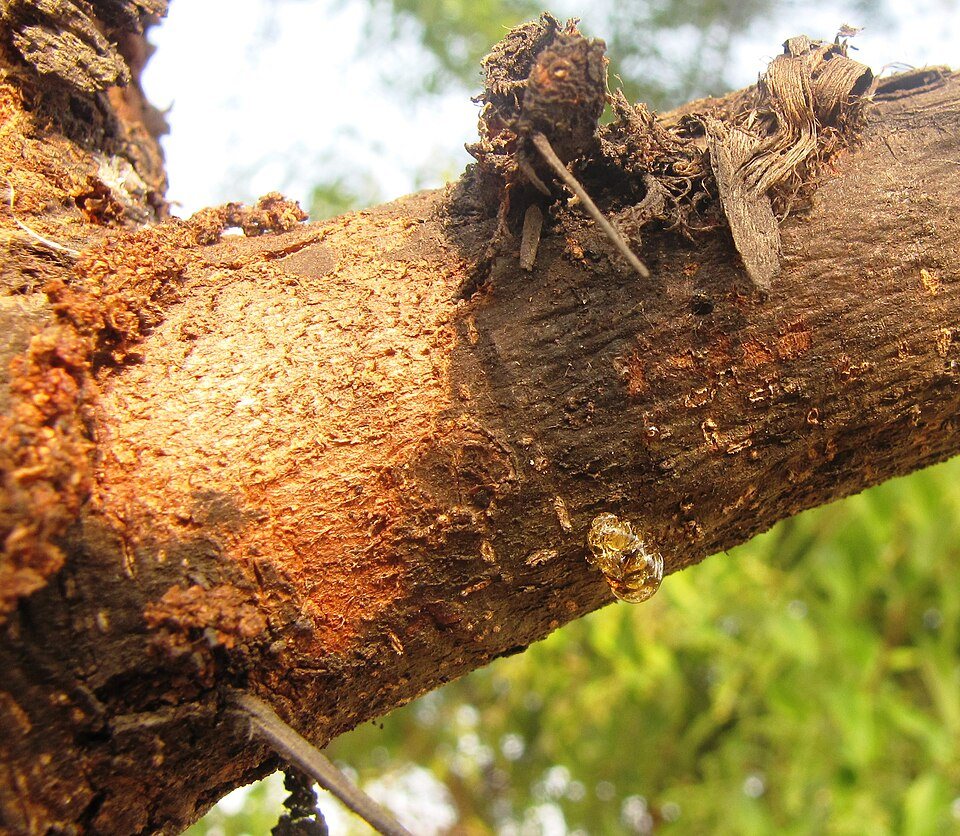
Gum arabic is the dried sap of acacia trees: in the words of the federal regulation, “the dried gummy exudate from stems and branches of trees of various species of the genus Acacia.” Syrup made with it is gomme, or gum syrup, and it is what nineteenth-century bars sweetened with. The 1862 bar manual bound with Jerry Thomas’s How to Mix Drinks gives a recipe by the barrel: “20 lbs. of best clear white gum arabic dissolved in 4 gallons of water, nearly boiling hot; take 60 lbs. of sugar, melt and clarify it with 1 gallon of water … add the gum solution, and boil for 2 minutes.” That works out to a syrup that is about 16% gum. My own gomme syrup is a modern, lighter version.
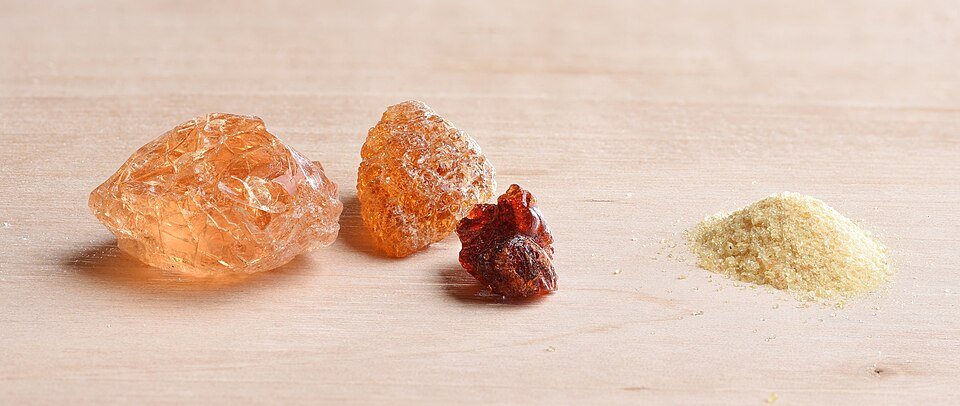
Where glycerine is one small molecule, gum arabic is a tangle of very large ones: branched chains of sugars with a little protein attached, thousands of times heavier than a glycerine molecule. That difference is the whole comparison.
| Glycerine | Gum arabic | |
|---|---|---|
| What it is | One small molecule, a sugar alcohol | A mix of very large sugar-and-protein molecules; a soluble fibre |
| Sweet? | Yes, a little less than sugar | No |
| Thickening, gram for gram | About the same as sugar | Several times more than sugar or glycerine |
| Holds flavor oils in suspension | No | Yes. This is its main job in soft drinks. |
| Clarity | Clear and colourless | A straw-yellow syrup with a foamy head; needs a day to settle |
| Making it | Pour and stir | Slow. The powder clumps, and wants hours or an overnight soak. |
| In a hot drink | Stable | Stable in heat and in acid, but its proteins are damaged by long hot storage |
| Keeping | Does not spoil; does not preserve the syrup | The gum itself is broken down by bacteria over time; keep it cold |
| US rule | ”Good manufacturing practice”; no number | A percentage limit in the finished food: 2% in soft drinks, 1% in most other foods |
| Cautions | Large amounts in small children | Wind, at 30 g a day; the dry powder is an allergen for people who work with it |
| Cost per 750 mL of syrup | About $0.35 | About $16 at a small-jar price, for a syrup that is 10% gum |
Why gum works where glycerine does not. Thickening comes from the size of the molecule. A 1% solution of gum arabic is about 23% thicker than water, by one published measurement; 1% of sugar or glycerine adds about 3%. And the gum’s small protein fraction lets it coat droplets of oil, which is why a gomme-sweetened drink is said to feel “silky” and to hold together.
Is it felt in coffee? By the same arithmetic as before, and with the same caution: a 10%-gum syrup puts about 1% gum into a small stirred cocktail, which is over the wine tasters’ thickness threshold. In an 8 oz coffee the same spoonful gives 0.4%, and in a 12 oz iced coffee 0.3%, both under it. So gomme plausibly earns its trouble in a three-ounce drink and plausibly does not in a twelve-ounce one. That is an estimate across two papers, not a tasting.
The rule to know. The federal regulation limits gum arabic to a percentage of the food “as served.” Soft drinks get 2%. Coffee and syrups are not named, and on a plain reading fall under “all other food categories,” at 1%. The 1862 recipe, used with a heavy hand in a small drink, would go over that. A modern 10% gomme in a cup of coffee would not come near it. No regulator has said which row applies to a coffee drink, so that reading is this page’s own.
Side by side: which to use where
| For | Use | Why |
|---|---|---|
| Iced coffee, cold brew, a flash-brewed pour-over | Simple or rich syrup, nothing added | Sugar is doing the work. Neither additive can be felt at this dilution. |
| A honey coffee | Honey syrup, mixed on the day | Honey is the point, and it brings its own body |
| A small, strong drink: a cocktail, or a phin coffee served short | Gomme, if you want to feel it | Enough gum reaches the mouth to register |
| A spirit-forward cocktail, quickly | Glycerine syrup, pending the triangle test | Ten seconds’ work; the evidence for it is thin |
| Anything sold in a bottle | Sugar and water only | The shortest label, and no cottage food route exists for syrups anyway |
What is not known
- Any tasting study of glycerine or gum arabic in coffee, in cocktails or in soft drinks. Every threshold here is from white wine.
- A measured shelf life for a syrup with glycerine in it. The water-activity figures are calculated.
- Why Monin puts glycerine in some syrups and not others.
- Which row of the federal gum arabic limit covers a coffee drink.
- Anything published on what either does to espresso crema or milk foam.
Sources
- European Food Safety Authority, re-evaluation of glycerol (E 422), 2017, and of acacia gum (E 414), 2017; its 2026 opinion on glycerol in beverages.
- 21 CFR 182.1320 (glycerin) and 21 CFR 184.1330 (acacia), 2024 edition; 21 CFR 101.4 on listing ingredients.
- Noble and Bursick, “The Contribution of Glycerol to Perceived Viscosity and Sweetness in White Wine,” American Journal of Enology and Viticulture, 1984; Nurgel and Pickering, Journal of Texture Studies, 2005; Gawel, Van Sluyter and Waters, Australian Journal of Grape and Wine Research, 2007.
- Segur and Oberstar, “Viscosity of Glycerol and Its Aqueous Solutions,” Industrial and Engineering Chemistry, 1951; Nordzucker, The Functional Properties of Sugar, 2020, for sugar’s viscosity and water activity.
- UK government, “Glycerol in slush ice drinks,” July 2025.
- Sanchez and others, Food Hydrocolloids, 2002, for the viscosity of acacia gum.
- Christian Schultz’s manual in Jerry Thomas, How to Mix Drinks, 1862; Difford’s Guide on gomme.
- Michigan Department of Agriculture and Rural Development, cottage food list.
- Monin’s and Torani’s own product pages for the ingredient lists, and two sellers’ pages for prices, read 2 October 2026.
- The dilution tables and the cost and water-activity figures are worked out from those sources.
Comments (0)