Fat
Here is the thing nobody taught me, the thing I had to learn by ruining sausage: fat is not the afterthought in a sausage, it is half the sausage. I spent my first years obsessing over the lean — what animal, what cut, how fresh — and treating fat as a number I threw in at the end to hit a ratio. That was backward. The fat is where the flavor lives, it is what makes the bite juicy instead of dry, and the kind of fat you use decides whether your finished sausage shows clean white specks or turns into a greasy smear that fats out in the pan. In forty years I have come to believe fat is the single most under-taught variable in the whole craft. Everyone argues about spice blends. Almost nobody tells a beginner why their venison snack sticks came out crumbly and gray, and the answer is almost always the fat — too little of it, the wrong kind, or handled too warm.
This page is about getting it right. It pairs with the meat page — meat and fat are the two halves of the block you build — and with the salt page, because salt is the third leg that ties them together. Read all three before you grind anything.
Fat is not fat — the kinds of pork fat, and why they are not interchangeable
The biggest mistake I see is treating “pork fat” as one thing. It is not. A pig carries several very different fats, and they behave so differently on the cutting board and in the finished sausage that using the wrong one will wreck a batch no matter how good your recipe is. Ranked from hardest to softest, here is what you are choosing between.
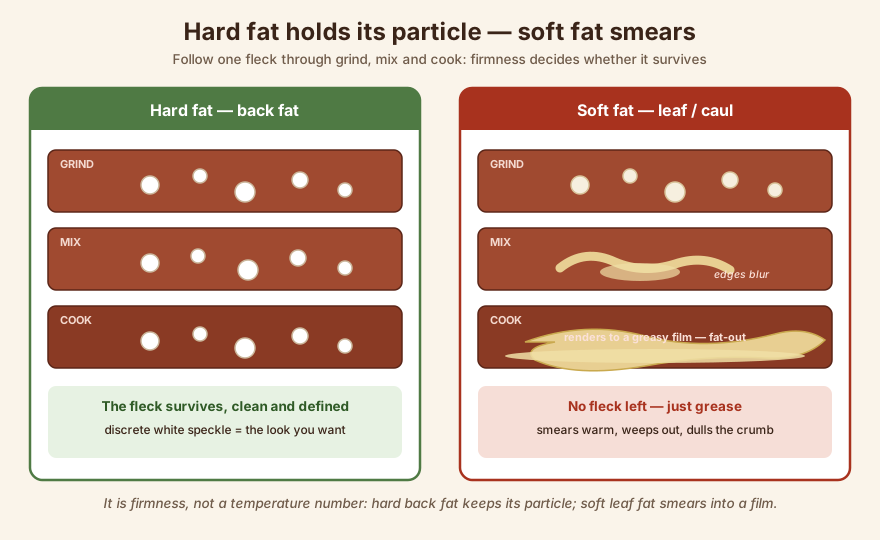
Back fat (fatback) is the hard, dense subcutaneous fat off the pig’s back — the slab that runs along the spine under the skin. This is the gold standard, and if you are making salami, summer sausage, snack sticks, or anything dry-cured, this is the fat you want. It is firm, it holds its shape, and it resists smearing. When you grind cold back fat it comes through the plate as distinct particles and stays distinct — which is exactly why a good salami slice shows clean white flecks in a rosy field instead of a uniform pink paste. Back fat is what makes that picture possible. I keep a supply of it the way I keep salt: it is a staple, not a specialty item.
Jowl fat (cheek fat) is the fat from the hog’s cheek, and it sits right in the middle of the firmness range — softer than back fat, firmer than belly. What jowl gives up in a little firmness it more than pays back in flavor: it is intensely porky, and a lot of charcutiers rate it equal to or better than back fat for dry-cured salami precisely because you want those visible fat specks and jowl delivers them with more character. It is also the muscle that gives you guanciale. If you can get jowl, treat it as a treasure — it is a back-fat-grade structural fat with an extra dimension of flavor.
Soft belly fat is the fat of pork belly — the same cut that becomes bacon. It is rich and it tastes wonderful, but it is soft and low-melting, and it smears more readily than back fat. That is fine in a fresh sausage where a slightly softer, more uniform texture is acceptable and welcome — a bratwurst, a breakfast link, an Italian sausage that is going straight into a hot pan. It is the wrong choice for a dry-cured stick where you need particles to stand up over weeks of drying. Belly is a fresh-sausage fat.
Leaf fat (leaf lard, kidney fat) is the soft visceral fat from around the pig’s kidneys, and this is the one that trips people up, because it looks like premium fat and it is — for the wrong job. Leaf fat is the prize fat for pastry; rendered, it makes the flakiest pie crust and biscuit you will ever eat. But it is soft, it is low-melting, and it will not hold a particle. Grind leaf fat into a sausage and it smears into a greasy film almost immediately. It is essentially the opposite of back fat. If someone hands you a bag of “the good soft white fat from inside the pig,” thank them, render it into lard for your kitchen, and do not put it in your salami. Leaf fat is for the pastry board, not the stuffer.
A note on melting-point numbers. You will find craft tables online that print specific melting-point temperatures for leaf fat versus back fat — and I want to warn you off relying on them, because the common tables actually contradict each other. One widely-copied chart lists leaf fat as the higher-melting fat, which is exactly backward from how it behaves in a sausage, where leaf is the one that smears. The temperatures are unreliable and I won’t quote them to you as gospel. What is reliable and unanimous is the firmness ranking and how the fat behaves: back fat and jowl are firm and hold their particles; belly and leaf are soft and smear. Trust your fingers and your eyes — how the fat feels cold, and whether it stays in clean specks when you grind it — not a thermometer reading off a table that argues with itself.
Firmness is the whole point — clean particles versus a greasy smear
Everything about choosing fat comes down to one behavior: does it hold its shape or does it smear? That is the entire game, and once you understand it you understand why the fat kinds above matter.
A firm, high-melting fat like back fat stays in distinct particles all the way through grinding, mixing, stuffing, and slicing. In the finished sausage those particles read as clean white flecks suspended in the lean. They melt in a controlled way during cooking, basting the meat from the inside, and in a dry-cured product they stay put over the whole drying period. That is the texture you are after — juicy, structured, and it looks right when you cut it.
A soft, low-melting fat does the opposite. Under the pressure and friction of the grinder, or under the warmth of your hands during mixing, it softens and smears — it stops being particles and becomes a film that coats every lean particle in a slick of grease. That film is a disaster on two fronts. First, it looks wrong: instead of clean specks you get a homogenous, greasy paste. Second, and worse, that grease coating blocks the lean particles from binding to each other, so the sausage comes out crumbly instead of cohesive. And when a smeared sausage hits heat, the fat renders early and pools — the sausage “fats out,” leaking a puddle of grease into the pan and leaving a dry, cottony interior behind. Fatting out is the single most common way a sausage fails at the stove, and it starts with fat that smeared before it ever got cooked.
Here is the part that connects fat to your whole workflow: whether a fat smears is only partly about which fat it is. It is mostly about temperature. Even hard back fat will smear if you grind it warm. Even soft belly fat behaves better if it is near-frozen. Fat smear is a temperature failure before it is anything else. This is the whole reason I preach cold — meat and fat both near frozen, a sharp knife or a sharp grinder plate, a chilled bowl underneath. A sharp blade cuts the fat into clean particles; a dull blade crushes and drags it, generating heat and smearing it. Cold fat plus a sharp edge equals clean particles; warm fat plus a dull edge equals a greasy mess. I develop this at length on the grinder page, because the equipment and the fat are really one topic — the whole anti-smear discipline exists to keep the fat in particles the fat wants to stay in when it is cold. Read that page as the mechanical companion to this one.
Iodine value — why the pig’s diet changes the fat
Now for the part that surprised me when I first learned it, because it explains why two pieces of “pork fat” can behave completely differently even when they are the same cut off two different pigs. It comes down to what the pig ate.
Fat firmness is really a question of fatty-acid chemistry: saturated fats are firm, unsaturated fats are soft and oily. The measure processors use is iodine value (IV) — essentially a number for how unsaturated the fat is. Higher IV means softer, oilier fat; lower IV means firmer fat. And here is the link that matters: a pig’s diet directly changes its iodine value. Corn is high in unsaturated fat, and modern commodity hogs are increasingly finished on DDGS — dried distillers grains with solubles, the leftover from ethanol production — which is even higher in unsaturated fat. Feeding those grains, especially DDGS, softens the pig’s fat, and it does so in a dose-dependent way: the more distillers’ grains in the diet, the softer the backfat.
The numbers are real and sourceable. A pig finished on a normal corn-and-soybean-meal diet carries backfat around IV 63 to 68. Push the diet to something like 30% DDGS and the iodine value climbs past 74 — and the industry widely treats IV 74 as the line, above which the fat is considered too soft to process well. Soft, high-IV fat does exactly what you would now predict: it smears more easily on the cutting board and in the grinder, it slices poorly, and — because polyunsaturated fat oxidizes faster than saturated fat — it goes rancid sooner, giving you a shorter shelf life and off-flavors down the road.
This is not a purity argument or a nostalgia argument, and I want to keep it out of that register — it is straight fatty-acid chemistry. But it does mean that a hog raised on a varied diet with plenty of pasture and scraps can genuinely hand you firmer, cleaner-cutting, slower-to-turn fat than a commodity corn-and-distillers’-grain hog. That is not sentiment; that is the iodine value showing up on your knife. I make the fuller version of this case over on why sausage is different today — this is just where the chemistry lands on your cutting board. When you can choose your fat source, this is one more reason the animal matters.
The 70/30 rule — how much fat, and why you cannot cheat it
Now the number everybody wants: how much fat? The answer that has served me for forty years is roughly 70% lean to 30% fat, with the sweet spot living around 25 to 30% fat. Lean it toward 70/30 for anything smoked or grilled that will shed moisture in the process; run it a touch leaner at 75/25 for a cleaner, slightly less rich read. Either way, you are building a block to a target — you do not trust a cut to hand you the right ratio, you weigh lean and fat separately and build to a number. That discipline is the whole reason the ingredients pages exist.
What makes this a rule and not a preference is that it is a two-sided cliff, and both edges are unforgiving.
Too lean is the mistake I see most, and it is the one you cannot fix. Go below about 15% fat and you get a dry, crumbly, flavorless sausage — and here is the hard truth that took me too long to accept: no amount of seasoning will save it. You cannot spice your way out of insufficient fat. Fat is the flavor carrier — most of what we call “flavor” in a sausage is fat-soluble and rides in the fat — so a lean sausage is not just dry, it is muted, because the vehicle for the flavor isn’t there. People taste a bland, crumbly link and reach for more salt, more garlic, more paprika, and it never comes right, because the problem was never the seasoning. This is exactly why lean wild game must be fatted, and why “healthy low-fat sausage” is mostly a contradiction in terms.
Too fat is the other cliff, and it is the one that fats out. Push much past 30% and the sausage turns greasy and chewy, and when it cooks the excess fat renders and pools — a puddle in the pan, a slick on the plate. There is such a thing as too much of a good thing here, and the sausage tells on you the moment it hits heat.
So why does 25 to 30% land right? Because fat is doing three jobs at once, none of which is “filler.” It is the flavor carrier, as above. It is the mouthfeel — the juiciness and richness that makes a bite satisfying instead of dry and tight. And, held in clean cold particles, it is part of the bind: the fat particles get trapped in the protein matrix that the salt-solubilized proteins build (that is the salt page’s story), and a properly bound sausage holds those particles in place, releasing their flavor and juice as it cooks rather than weeping them into the pan. When fat is cold and in particles it helps the bind; when it is warm and smeared it sabotages the bind. Same fat, opposite outcome — the difference is temperature and handling.
Working with fat — keep it cold, and fatting lean game
Everything above turns into a handful of habits at the bench, and they are simple.
Keep the fat cold and firm — colder than you think. I want my fat, like my meat, right at the edge of frozen when it goes through the grinder — firm to the point that a cube resists your thumb. Cut your back fat into strips and get it into the freezer until it is stiff but not rock-solid; grind it cold, into a chilled bowl, and don’t let it sit out warming up while you fiddle with the stuffer. If the fat starts to soften and look greasy on the plate, stop, put everything back in the freezer for twenty minutes, and let your grinder cool too. Warm fat is the enemy and cold is the cheapest fix in the whole craft — it costs nothing but patience.
Grind fat cold and with a sharp plate. A sharp, cold plate and knife slice fat into clean particles; a dull warm one smears it. This is worth the maintenance — I keep my grinder plates and knives sharp specifically so the fat comes through as particles and not paste. If you are grinding a lot in one session, grind in stages and re-chill, because the machine itself warms up and starts working the fat.
Fatting lean game. This is where a lot of my sausage-making lives, because wild game — venison, elk, goose breast, wild turkey, rabbit — is extremely lean and carries almost no usable fat of its own. You have to add fat, and the fat you add should be hard pork back fat, for every reason on this page: it holds its particles, it does not smear, and it does not carry a gamey or waxy note. My field rule of thumb is about one-third added fat — build the block so that roughly a third of the total weight is pork back fat, which lands you in that 20 to 30% finished-fat window. In practice: four pounds of venison to about one pound of back fat runs lean, around 20%; three and a half pounds of venison to a pound and a half of back fat runs richer, around 30%. Weigh it — do not eyeball a cut — because that is the only way you know your number. And a word of warning against a shortcut: some people fat their game with well-marbled pork butt instead of pure back fat because it is convenient, but then you don’t actually know how much fat you added, since the butt is part lean too. Convenient, imprecise. For game I want the pure back fat and the weighed number. (Do not carry your pork freezing habits across to bear or wild boar — that is a trichinae safety issue, and it lives on the meat page, not here.)
Get the fat right — the right kind, the right amount, kept cold and cut clean — and you have solved the biggest, quietest problem in sausage-making before you have opened a single jar of spice.
Next: salt — the first functional ingredient, the one that goes in before anything else and does four jobs at once. Or head back to the sausage kitchen.
Comments (0)