Phosphates & Additives
This is the chemistry-set page, and I’ve gone back and forth for years about whether it even belongs in a collection that’s mostly about meat, salt, fat, and smoke. Here’s where I landed: it belongs, but not as a shopping list. It belongs as a page about restraint. Somewhere along the way sausage-making picked up a reputation as a place you dump powders — phosphates for juiciness, MSG for savoriness, this-or-that for shelf life — and the truth I’ve settled into over forty years is close to the opposite. Almost every additive on this page is a tool for a specific, narrow job, and a home cook working with good meat and cold hands needs very few of them. One of them is a genuine safety improvement and I’ll tell you plainly which one. The rest earn their place only when they’re doing something real that the meat, the salt, and the technique cannot do on their own — and never as a way to paper over a mediocre batch.
So read this page the way I use it: as a menu of things that exist and honestly do what they claim, followed every time by the question that actually matters — do you need it? Most days, for most sausage, the answer is no. That’s not a purist’s affectation. It’s just what happens when you spend enough years learning that the flavor comes from the pork and the fat and the seasoning, and the additives are, at best, around the edges.
Let me lay out my own standard before the chemistry, because it’s the filter everything else runs through.
The ethos — minimal, and for a reason
I keep my additive shelf short. Deliberately. I buy some of my seasoning blends and a few of the specialty powders from P.S. Seasonings — they’re good, they’re consistent, and I’d rather buy a clean pre-mix than keep a dozen little jars of chemicals I use twice a year. But the operative word is few. I’m not opposed to additives on principle — I use cure in every smoked and fermented sausage I make, and cure is an additive — but I am opposed to using them as a substitute for the things that actually make a sausage good: quality meat, the right ratio of fat, cold handling, a proper salt bind, and real seasoning.
This is the same argument I make on where the flavor went: the industrial sausage got blander and wetter and more additive-dependent not because the additives are evil, but because they became a way to make cheap, watery, lean trim taste like something and hold water it had no business holding. The additive became the crutch that let the meat get worse. When you make your own, you don’t have that problem to solve — so you don’t need most of the chemistry that exists to solve it.
My rule, and it’s the whole page in one sentence: add something only for what it genuinely does, never as a flavor prosthetic. Erythorbate for a cured product because it makes the cure faster and safer. A phosphate for a frankfurter if you actually want that commercial snap and juiciness. Rosemary extract if you’re freezing a fatty sausage and want to hold off rancidity. And past those three, honestly, not much else on a home bench.
Phosphates (STPP) — juiciness you can buy in a bag
Sodium tripolyphosphate — STPP — is the juiciness additive. It’s what makes a commercial hot dog snap and squirt, what keeps a bologna from weeping in the package, what stops a mass-produced breakfast link from shrinking to a dry pebble in the pan. It goes into cooked and emulsified sausages: franks, bologna, hot dogs, smoked and breakfast links. And it does two things at once.
First, it raises the meat’s pH. Muscle protein holds the least water right around its isoelectric point, near pH 5.3 — that’s the pH where the protein’s charges cancel out and it can’t grab onto water. Phosphate nudges the pH up and away from that point, and the further you are from 5.3, the more water the protein will hold. Second, it helps unlock the salt-soluble proteins — the same myosin and actin that salt extracts to build the bind. Phosphate makes that extraction more complete. The combined result is a juicier, firmer sausage with a tighter bind and noticeably lower cook loss — less shrinkage, less fat-out, less weeping.
The dose is 0.3 to 0.5% of the meat block, and the U.S. FSIS legal ceiling is 0.5% of the finished product — that cap is real and it’s low, so if you ever do use it, weigh it on a fine scale the same way you’d dose cure. Overdo phosphate and you get a soapy, metallic off-taste and a rubbery bite; it’s not a “more is better” ingredient.
Here’s my honest take: phosphate is a commercial-juiciness tool, and a home cook mostly doesn’t need it. When you’re building a frankfurter from decent pork and the right fat ratio, keeping the emulsion cold with ice so it doesn’t break, and salting properly to develop the bind, you already get a juicy, snappy sausage. Phosphate closes the last few percent of the gap between a good homemade frank and a commercial one — and that gap is mostly about squeezing maximum yield out of the meat, which is a factory’s problem, not yours. If you want to chase that exact commercial texture in your hot dogs, use it, at 0.3–0.5%, and it’ll do exactly what it says. For everything else I make, it stays in the bag.
Why phosphate has no business in a dry-cured sausage
This one matters, because it’s a place where reaching for the “juiciness additive” would actively wreck the product. STPP is deliberately absent from dry-cured and fermented sausage, and the reason is pH.
A fermented salami’s entire premise is dropping the pH — the starter culture eats the sugar, excretes lactic acid, and that falling pH is what tangs the flavor, firms the texture, and creates the first and most important safety hurdle in a product that never gets cooked to a kill step. Now look at what phosphate does: it raises pH. So adding phosphate to a fermented sausage would fight the fermentation directly — blunt the acid drop you’re working so hard to achieve, weaken the safety hurdle, and hold onto water you’re specifically trying to drive out over weeks of drying. It’s not just unnecessary in dry-cured work; it’s working against the whole design. Phosphates belong to the cooked-sausage world. In the dry-cured world they’re a mistake. Keep the two straight and you’ll never be tempted.
⭐ Cure accelerators: sodium erythorbate & ascorbate — the one real safety win
If there’s a single additive on this page I’ll tell you to actually keep on hand, it’s this one — and it’s the one nobody at the backyard-smoker level seems to talk about. Sodium erythorbate, sodium ascorbate, and ascorbic acid are reducing agents, and in a cured sausage — one that already contains nitrite from the cure — they do three genuinely useful things.
- They speed the cure. They accelerate the reduction of nitrite into nitric oxide, which is the reactive form that actually binds to myoglobin and fixes the cured color. The cure develops faster and more completely.
- They fix a brighter, more stable color. More nitric oxide, formed quickly and thoroughly, gives a more uniform pink cured color that holds up better against fading when the sliced sausage sees light and air.
- ⭐ They cut nitrosamine formation — and this is the real point. By consuming the free residual nitrite left over in the finished product, they shrink the pool of leftover nitrite available to react with amines and form nitrosamines, which are carcinogens that form especially under high heat — the classic case being bacon frying in a hot pan. Less residual nitrite means fewer nitrosamines. This is a real, measurable safety improvement, not a marketing claim, and it’s exactly why erythorbate isn’t merely allowed in American bacon — for bacon it’s required.
I want to be clear about that, because I spend a lot of this page telling you that you probably don’t need things. This is the exception. This one is a genuine safety improvement, and I’ll say so without hedging. If you’re making a cured, nitrite-containing sausage — and especially anything you’ll cook hot, like bacon or a smoked sausage that’ll hit a hot grill — a cure accelerator makes the finished product measurably safer at essentially no cost.
Erythorbate is the industry standard. It’s the stereoisomer of ascorbate — chemically a mirror-image twin. It does the identical cure job, it just has no vitamin-C activity, and it’s cheaper and more stable in the mix, which is why the trade uses it. The typical dose is about 0.05%, roughly 500 ppm. For reference points on the label: the general cure allowance for these agents is 547 ppm (that’s the old ⅞-ounce-per-100-pounds-of-meat figure), and USDA specifically requires 550 ppm of erythorbate or ascorbate in bacon to suppress nitrosamines — those two numbers are the same allowance written two ways, so don’t let them confuse you.
One critical caveat, and it’s the flip side of everything above: these are cure accelerators, not curing agents. They do absolutely nothing on their own. They only work in the presence of nitrite from the cure — they speed up and clean up a reaction that only happens when nitrite is there. So in a fresh, nitrite-free sausage, erythorbate is pointless; there’s no cure for it to accelerate. It’s a tool for cured products only. But for cured products, it’s the one additive on this page I think is genuinely worth adding every time.
MSG & hydrolyzed vegetable protein — safe, and a crutch
Let me be fair before I’m skeptical, because the fairness matters. MSG — monosodium glutamate — is safe. The FDA classifies it as Generally Recognized as Safe (GRAS), the international food-safety bodies put it in their safest category, and the old “Chinese restaurant syndrome” scare was never once substantiated in a controlled, double-blind trial. It’s the sodium salt of glutamate, an amino acid that’s naturally in Parmesan, tomatoes, mushrooms, aged meat, and soy sauce — it’s the taste we call umami, the savory, mouth-filling fifth taste. Hydrolyzed vegetable protein (HVP) and autolyzed yeast are essentially the “natural-label” routes to the very same free glutamate. If someone tells you MSG is poison, they’re wrong, and I won’t pretend otherwise to score a point.
But here’s the honest framing for my bench: MSG is a flavor crutch. It amplifies a savoriness that should be coming from good meat, proper salt, real fermentation, and time. In a sausage built from quality pork and the right fat, you don’t need it — the umami is already there, developed by the ingredients doing their jobs. Where MSG shows up heavy, it’s very often papering over lean, watery, or flavorless raw material — making cheap meat taste like more than it is. That’s exactly the dynamic I described up top and on where the flavor went: the additive becomes the reason the meat is allowed to get worse.
So my position isn’t “never.” It’s: if you reach for MSG, reach for it as a light seasoning on an already-good sausage, not as the thing that makes the sausage taste of anything. If a batch tastes flat and your instinct is to fix it with a spoon of MSG, stop and ask whether the real problem is under-salting, too-lean a meat block, or a tired spice blend — because it usually is, and MSG will only mask it. Fix the sausage, don’t costume it.
Antioxidants vs. rancidity — BHA/BHT & rosemary extract
Fat doesn’t spoil the way meat spoils. It goes rancid — it oxidizes, the fat molecules reacting with oxygen into the stale, cardboard, paint-like off-flavors that ruin an otherwise good sausage. It’s the number-one chemical spoilage of sausage, and it’s worst exactly where sausage is most vulnerable: fatty product, freshly ground so maximum fat surface is exposed to air, and frozen or long-stored, where it creeps along slowly over months in the freezer. If you’ve ever pulled a bag of homemade sausage out of the deep freeze after half a year and found it tasting faintly of old crayons, that’s rancidity, and it’s a race against oxidation you were always going to be running. (This is the same fight I get into on the fat page — fresh fat, minimal grinding heat, and fast, airtight freezing are the front line.)
Antioxidants neutralize the free radicals that drive the reaction. Two roads:
| Antioxidant | Type | Typical limit | Notes |
|---|---|---|---|
| BHA / BHT | Synthetic | 0.01% of the fat in fresh sausage; 0.003% of total weight in dry sausage | The old industry-standard synthetics — effective, cheap, but the “chemical” label a lot of home makers now want to avoid |
| Rosemary extract | Natural, clean-label | ~2500 ppm in studies | Matched BHA/BHT in the fridge and out-performed them in raw frozen sausage at holding color and suppressing rancidity |
That last line is the one worth knowing: rosemary extract isn’t just the clean-label alternative, it actually beats the synthetics where it counts most — in frozen product, where it out-performed BHA/BHT at protecting both color and flavor over freezer storage. Mixed tocopherols (vitamin E) are another natural option. So for a home maker who freezes sausage — which is most of us — this is the additive most worth considering, and rosemary extract is the choice that fits a minimal, clean ethos while genuinely doing the job better than the chemistry it replaces.
But — and this is the theme of the whole page — the best defense against rancidity isn’t an additive at all. It’s technique. Use the freshest fat you can get. Keep the grind cold so you’re not driving oxidation with friction heat. Vacuum-seal to get the air out. Freeze fast and use it promptly rather than letting it ride in the freezer for a year. Do those things and most home sausage never gets close to rancid before it’s eaten. Reach for rosemary extract when you’re deliberately building a big frozen stock of a fatty sausage and want insurance — not as a license to skip the cold handling and the vacuum bag.
Putting it together — the short shelf
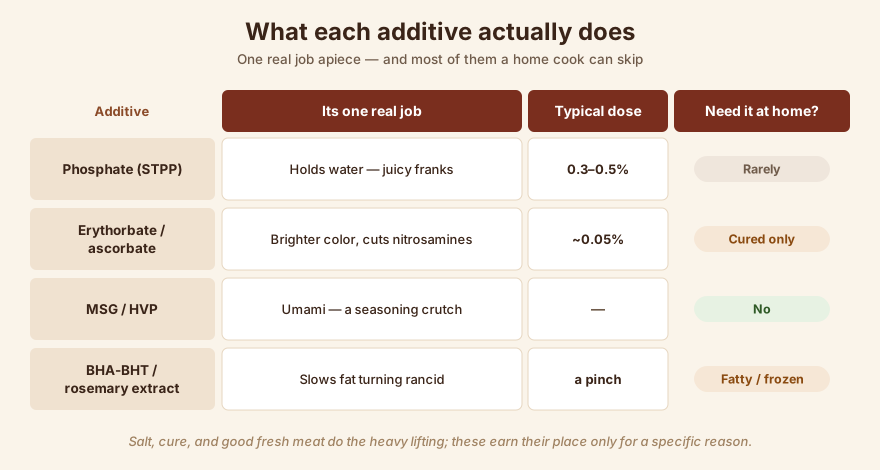
Step back and look at what actually earned a place. Every additive on this page does something real, but each one does exactly one narrow thing, and most of them a home cook can skip:
| Additive | Its one real job | Do you need it? |
|---|---|---|
| Phosphate (STPP) | Holds water and fat in cooked/emulsified sausage for commercial juiciness | Rarely — only if chasing exact hot-dog texture. Never in dry-cured |
| ⭐ Erythorbate / ascorbate | Faster, brighter cure — and cuts nitrosamines (real safety win) | Yes, for any cured/nitrite sausage. The one to keep |
| MSG / HVP | Adds umami | No — a crutch; fix the meat and seasoning instead |
| Rosemary extract (or BHA/BHT) | Slows rancidity in fatty, frozen product | Only for long-frozen fatty sausage — and technique comes first |
That’s the honest map. None of these fixes bad meat. Phosphate can’t rescue watery trim into a good sausage; MSG can’t season your way out of a flavorless block; erythorbate does nothing at all without cure present; rosemary buys time against oxidation but can’t un-spoil already-tired fat. Every one of them is a finishing tool at the edges of a sausage that’s already good because of the meat, the fat, the salt, the cold hands, and the seasoning.
So keep the shelf short. Erythorbate for anything cured — that one’s not optional in my book, because it’s a real safety improvement. A phosphate on hand if you want to build commercial-style franks and chase that juiciness. Rosemary extract if you freeze fatty sausage in bulk. Buy your blends from someone good — P.S. Seasonings is where I get mine — and past that, let the ingredients carry the flavor. The best sausage I’ve ever made had almost nothing on this page in it. That’s not a coincidence. That’s the point.
Part of Sausage Ingredients, and one piece of the whole craft at Sausage. Next, the part of the flavor that isn’t chemistry at all — the spices that actually make each sausage what it is.
Comments (0)