Salt
Salt is the first thing that goes into a sausage, and after forty years of making them I’ve come to think of it as the most misunderstood ingredient in the whole craft. Not the most complicated — that would be the curing salts, which is a different page and a different animal entirely. Ordinary salt is chemically about as simple as it gets: sodium chloride, the stuff on your table. What’s misunderstood is everything it does. Most people think salt seasons a sausage. It does — but seasoning is the least of its four jobs, and the one that matters most is invisible. Salt is what physically holds the sausage together, and if you get the salt wrong, no amount of skill at the grinder or the smoker will save the batch.
So let me be clear about the distinction before I go any further, because it trips up beginners constantly. This page is about the ordinary salt — the plain salt you’d weigh out by the tablespoon-and-then-some for any batch. The pink cure, Prague powder, Insta Cure, Tender Quick — that’s a separate, tiny, safety-critical addition that lives on its own page and I’d rather you read that one twice. Here, we’re talking about the salt that does the structural and preservational heavy lifting in every sausage, cured or not.
Salt’s four jobs
Salt earns its place in a sausage four different ways, and they’re worth taking one at a time because most cooks only know about the first.
1. Flavor
The obvious one. Salt makes the meat taste like something. Under-salt a sausage and it tastes flat and dull no matter how good your spice blend is — salt is what makes pepper taste like pepper and pork taste like pork. But in engineering terms this is the least important of the four jobs, and I put it first only to get it out of the way. If seasoning were all salt did, we could shake it on at the end like we do a steak. We can’t, and the reason why is job number two.
2. The myosin bind — the reason salt goes in first ⭐
This is the single most important fact on this page, and it’s the one almost nobody outside the trade understands. Salt dissolves protein out of the lean meat, and that dissolved protein is the glue that holds a sausage together.
Here’s the mechanism, plainly. Muscle is built from proteins, and the big structural ones — the myofibrillar proteins, chiefly myosin — are not soluble in plain water. You can mix ground meat with water all day and it stays a loose, crumbly pile. But those same proteins are soluble in salt water. When salt hits the wet surface of the lean meat, it pulls myosin into solution — and dissolved myosin is sticky. Tacky. It coats every particle of meat in a gummy film, and when you mix the meat until it turns tacky and starts to cling to your hand and the side of the bowl, what you’re feeling is extracted myosin. That tacky extract is what the trade calls the primary bind. It’s the glue. When the sausage later cooks, that dissolved-protein glue sets into a cohesive gel that traps the fat and the juices in place and gives a properly-made sausage its snap and its sliceable structure. A meat emulsion — a hot dog, a bologna, a fine bratwurst — is literally a suspension of fat particles held together by salt-dissolved, heat-setting proteins. No salt, no myosin in solution, no glue, no sausage. Just a crumbly tube of seasoned mince.
And this is why salt goes in first, mixed into the lean, before the fat. You are not seasoning the meat at that stage — you are extracting protein from it. The salt has to reach the wet lean surfaces and do its dissolving work, and it does that best on lean meat, mixed until tacky, before the fat gets folded in to coat everything in grease and block protein-to-protein contact. Salt the lean first, mix to the tack, then the fat. I cannot count the number of crumbly, fatty, disappointing sausages I’ve eaten over the years that came apart at the first bite for exactly one reason: the maker treated salt as seasoning, threw it in at the end with the spices, and never developed the bind. Around 2 to 3% added salt is where you get maximum myosin extraction — which, not by coincidence, is right in the range we salt sausage anyway. Salt the lean first. If you remember one thing from this page, remember that.
3. Preservation
Salt lowers the water activity of the meat — the amount of water in the sausage that’s chemically “available” for microbes to use. Bacteria, molds, and yeasts need free water to grow; salt ties some of that water up and makes the sausage a harder place to live. In a fresh sausage this buys you a little time. In a dry-cured sausage that hangs for weeks, water activity is the master control on safety and spoilage, and salt is the first hurdle in that system — which is exactly why dry sausages carry more salt than fresh ones. This is also why salt and drying go hand in hand: as a dry sausage loses moisture, the salt that’s left behind concentrates, the water activity drops further, and the sausage gets safer as it gets drier. Preservation isn’t a bonus of salting; for cured meat it’s half the reason the salt is there at all.
4. Safety
Related to preservation but worth stating on its own: enough salt materially raises the odds of killing off the things that can hurt you. The numbers are real — in one study of dry-cured sausage, raising the added salt from 1% to 3% increased the odds of achieving a 5-log reduction of Salmonella by about seven and a half times. Salt isn’t the only hurdle, and for smoked and fermented products it isn’t the specific control for the deadliest hazard — botulism control is the curing salt’s job, and fermentation safety is its own fast game. But ordinary salt pulls real weight as one of the stacked hurdles that keep cured sausage safe. Skimp on it to make a “healthier” low-salt sausage and you’re not just making a flat, crumbly one — you may be making a less safe one.
How much — measure it as a percentage of the meat
Here is the professional way to think about salt, and it’s simpler than the folk method it replaces. You don’t salt a recipe. You salt a weight of meat, by percentage.
Weigh your whole meat block — lean and fat together, in grams. Multiply by your salt percentage. That’s how many grams of salt you weigh out. That’s the entire method.
The percentages, by product:
| Product | Salt (% of meat block) | Why |
|---|---|---|
| Fresh sausage (brats, fresh Italian, breakfast links) | 1.5 – 2% | Enough for flavor and full myosin extraction; it gets cooked and eaten soon, so preservation isn’t the driver |
| Fresh Italian / classic brat | ~1.5 – 1.8% | The common practitioner band |
| Dry-cured sausage (salami, Landjäger, saucisson) | 2.5 – 3% | Higher for two reasons at once — preservation and maximum protein extraction |
That’s the whole map. Notice the dry-cured sausages carry more salt, and understand why: it’s doing double duty. The extra salt drops the water activity for the weeks of drying ahead, and it also extracts myosin harder for a tighter bind in a sausage that never gets a cook step to firm it up. Below about 2.3% salt in a dry sausage, the water-activity barrier gets weak and you’re courting spoilage; above about 3% it starts tasting harsh. The traditional 2.5–3% band is where the salt does its safety job without ruining the eating.
This percentage-of-meat-weight approach is the heart of what’s called equilibrium salting, or EQ for short. The idea: you calculate the exact amount of salt as a fixed percentage of the meat’s weight, add all of it, and let it distribute evenly through the whole mass. That’s the opposite of the old method of burying meat in a mountain of salt and pulling it out when it “looks done.” EQ’s payoff is that you cannot over-salt — you only ever add the amount you calculated. It’s the same discipline as weighing in grams, which brings me to the most practical thing on this page.
⭐ Why measuring salt by volume lies — with the real numbers
If you take nothing else from this page but the myosin bind, take this second: a tablespoon is a lie when it comes to salt, and you must weigh it in grams.
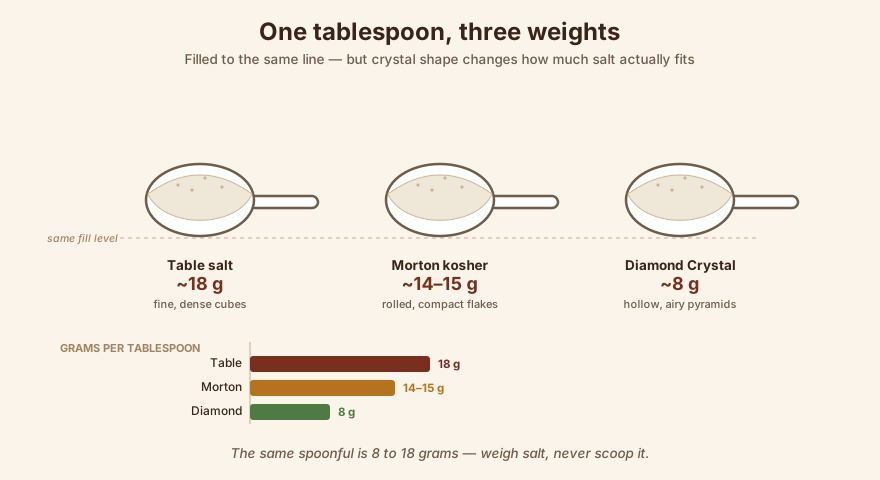
Here’s the problem, in hard numbers. Salt is sold in different crystal shapes, and crystal shape determines how much salt actually packs into a spoon. Same spoon, wildly different weights:
| Salt | ≈ per teaspoon | ≈ per tablespoon |
|---|---|---|
| Table salt (fine grain) | ~6.0 g | ~18 g |
| Morton kosher | ~4.8 g | ~14 – 15 g |
| Diamond Crystal kosher | ~3 g | ~8 g |
Look at that spread. “A tablespoon of salt” means anywhere from 8 grams to 18 grams depending on what’s in your box — that’s more than a 2× range. Diamond Crystal kosher, with its big hollow flaky crystals, weighs roughly half what fine table salt weighs at the same volume. And here’s the part that catches even experienced cooks: Morton kosher is not the same as Diamond Crystal. They’re both “kosher salt,” they sit next to each other on the shelf, and a tablespoon of Morton weighs nearly twice what a tablespoon of Diamond Crystal does, because Morton’s crystals are pressed into denser flakes that pack tighter. Two boxes labeled the same thing, delivering a 2× difference. A recipe that says “1 tablespoon of kosher salt” hasn’t told you anything.
Now put that against your salt target. For a fresh sausage you’re aiming at 1.5–2% of the meat weight. The difference between 8 grams and 18 grams of salt in the same small batch is the difference between an under-salted sausage that won’t bind and tastes of nothing, and one that’s inedibly, harshly salty. For a cured sausage it can be the difference between safe and spoiled. A volume measure of salt, for sausage, is meaningless. You cannot make a sausage repeatable that way, and you cannot make it safe that way.
So the rule is simple and it never changes: weigh the meat, multiply by your salt percentage, and weigh out that many grams of salt on a scale. Do that and the whole problem evaporates. I use kosher salt — I always have, because that’s what my grandfather used and it’s in the kielbasa recipe I spent years reverse-engineering from the memory of a smell. But here’s the thing people miss when I say that: the brand and type of kosher I use barely matters, precisely because I’m weighing it, not scooping it. Twelve grams of salt is twelve grams of sodium chloride whether it came from a Diamond Crystal box or a Morton box or a bag of fine sea salt — once it’s on the scale, the crystal shape is irrelevant. The whole reason brand matters to volume cooks is that they’re measuring a shape instead of a weight. Weigh in grams and you’re free of it. This is the same logic, exactly, that governs the curing salts and dosing on a scale — it just matters even more there, because the cure is toxic in excess. With ordinary salt the penalty for guessing is a ruined batch; with cure it’s a hospital visit. Learn the discipline here, on the forgiving ingredient, and it’ll be second nature by the time it counts.
Salt types — and why to skip the iodized table salt
You have real choices in what salt to use, and one to avoid.
Kosher salt is my choice, and the sausage-maker’s default. It’s pure sodium chloride with no iodine and no anti-caking agents — a clean, neutral salty flavor and nothing else. It dissolves cleanly into the meat, which matters when you’re relying on it to extract myosin evenly. The big, easy-to-pinch crystals are also just pleasant to handle. (And to be clear again — I use it out of habit and family tradition, not because its crystal shape does anything magic. On the scale, its virtue is purely that it’s pure, additive-free salt.)
Sea salt and canning/pickling salt are also fine, provided they’re pure — additive-free sodium chloride with nothing blended in. Canning salt in particular is nice because it’s guaranteed free of anti-caking agents (that’s the whole point of it, so your pickle brine stays clear). Any pure, additive-free salt will do the sausage’s four jobs.
Iodized table salt — avoid it. There are two real reasons, and they’re not superstition:
- The iodine can interfere with the beneficial lactic-acid bacteria that drive a fermented sausage’s cure. If you ever move into fermented or dry-cured work, iodine is a genuine liability, not a folk tale.
- The anti-caking agents — the compounds that keep table salt free-flowing — don’t fully dissolve. They cloud a brine and can throw a faint chemical off-taste into the meat. You’ll never gain anything from them in a sausage and you can lose a little cleanness of flavor.
Neither of these will wreck a batch of fresh brats on its own. But there’s no upside to iodized table salt in sausage-making and a couple of small downsides, so the sensible default is plain, non-iodized salt — kosher, canning, or pure sea salt. It costs the same. Use it.
Too little, too much — and why there’s no fixing it after
The two failure modes bracket why the whole weigh-it discipline exists.
Under-salted is the sneaky one, because people expect an under-salted sausage to just taste bland — and it does, but that’s the smaller problem. The bigger problem is that without enough salt, the myosin never comes out of solution, the bind never develops, and the sausage is crumbly. It falls apart on the fork, it renders its fat out because nothing’s holding the fat in, and it eats dry and loose even if the fat ratio was perfect. A beginner tastes that crumbly, greasy result and blames the grind, or the fat, or the mixing — and sometimes those are the culprit, but very often the real answer is not enough salt to build the glue. Flat and crumbly is the signature of an under-salted batch.
Over-salted is the brutal one, because there is no fixing it after the fact. Once the salt is in the meat and mixed through, it’s in. You cannot pull salt back out of a bound, mixed, stuffed sausage. You can’t rinse it, you can’t soak it, you can’t dilute it without re-grinding an entire second unsalted batch to blend in — and even that only works if you have the meat on hand and are willing to double your batch to rescue it. Practically speaking, an over-salted sausage is a wasted sausage. Harsh, inedible, and unrecoverable.
And that asymmetry — under-salt and it won’t bind, over-salt and there’s no undo — is the entire argument for weighing salt in grams every single time. There’s no room to “salt to taste” the way you would a soup, tasting and adjusting as you go, because you can’t taste raw sausage meat safely and you can’t adjust downward once it’s mixed. You get one shot to put the right amount in, and the only way to hit it reliably is to weigh the meat, know your percentage, and weigh the salt. Do that and salt is the most forgiving, dependable ingredient on the bench. Guess at it and it’s the one that quietly ruins batches you’ll blame on everything else.
That’s the whole case, and it’s the same case I make about the meat block and about dosing cure on a fine scale: build to a weighed number, don’t trust a cut or a spoon or your eye. Sausage is one of the few things I cook where I never wing it, and salt is the first reason why. It goes in first, it does four jobs, and you get exactly one chance to get its weight right.
Part of Sausage Ingredients, and one piece of the whole craft at Sausage. Next, the ingredient that looks like salt but isn’t — the curing salts, where weighing in grams stops being about flavor and starts being about safety.
Comments (0)