Cultures & Fermentation
Every other ingredient I write about in this section is inert. Salt sits there. Cure #1 sits there. Dextrose sits there until something eats it. This one is alive, and that changes how you have to think about it. A starter culture is a freeze-dried dose of living bacteria that you wake up, feed, and turn loose in the meat, and if you treat it like a spice — dump it in dry, mix on autopilot, hope for the best — you will either get a bland sausage or a dangerous one. I’ve been making fermented sausage for a long time, and the culture is the one ingredient I still respect the way you respect a live animal. You don’t command it. You set the table for it and let it work.
If you’ve read the Landjäger craft page, some of this will be familiar — that’s the recipe where I first had to learn all of it properly. This page is the general version: what the bug does, which bugs to buy, how to keep them alive, and why speed is a food-safety issue and not just a flavor preference.
What fermentation actually does
Strip away the mystique and a fermented sausage is a very simple biological engine. You add sugar. You add lactic-acid bacteria — LAB, mostly Lactobacillus and Pediococcus species. The bacteria eat the sugar and excrete lactic acid. That acid drops the pH of the meat batter, and the falling pH is the whole point of the exercise.
It does three good things at once. It gives you the tang — that clean sour note that reads as “salami” and not “raw ground pork.” It firms the texture, because muscle protein gels tightest near its isoelectric point around pH 5.3, which is right where a good fermentation lands you. And most importantly it is the first and most important safety hurdle in a product that is going to be eaten without ever seeing a real cook step. A dry-cured salami is never heated to a temperature that kills anything. The acid is the kill. Or more precisely, the acid is the wall the bad organisms can’t climb.
That’s the LAB doing the loud work. Almost every commercial culture also carries a quieter partner — a Staphylococcus species like S. carnosus or S. xylosus (some blends use a Kocuria). These don’t make acid. They do two other jobs: they help reduce the nitrate or nitrite in your cure into the reactive form that fixes the cured pink color, and they throw off the aroma compounds — the nutty, aged, faintly funky smell that separates a real cured salami from something that just tastes sour. So a single packet is really two organisms with two jobs: acid for safety and firmness, Staph for color and aroma. Keep that split in your head; it explains a lot of what follows.
The three cultures I reach for
You don’t culture a fermented sausage with “some bacteria.” You buy a specific strain blend picked for the temperature you plan to ferment at and the flavor you’re after. There are dozens on the market, but three cover almost everything a home maker will ever do. Here’s how I think about them.
| Culture | What’s in it | Temperature window | Character | What I use it for |
|---|---|---|---|---|
| Bactoferm T-SPX | Lactobacillus sakei + Staphylococcus carnosus | 64–75°F (cool) | Slow, rounded, traditional | Old-world dry salami, French saucisson, Italian-style, Landjäger |
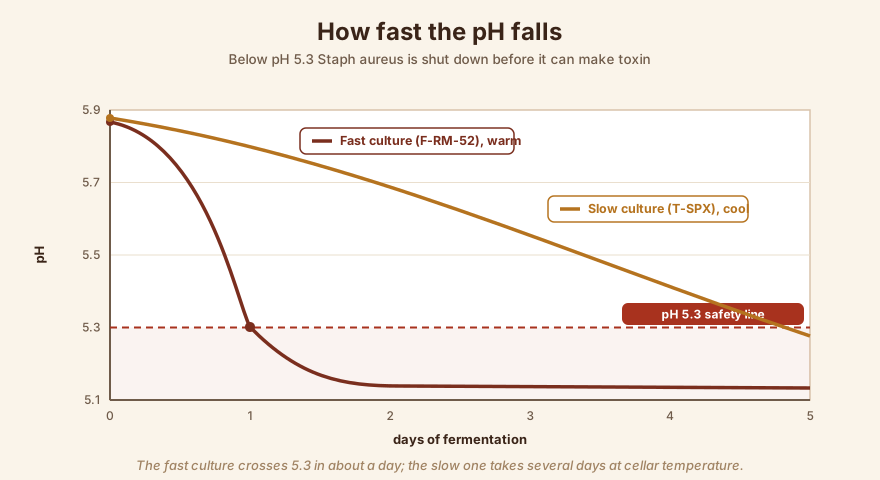
| Bactoferm F-RM-52 | Lactobacillus sakei + Staphylococcus carnosus | 72–90°F (warm) | Fast, sharp, tangy | Northern-European and American semi-dry styles |
| Bactoferm F-LC | Pediococcus acidilactici + Lactobacillus curvatus + Staphylococcus xylosus | Cool, or US-style up to ~110°F | Fast plus bioprotective | Anything where I’m worried about Listeria |
T-SPX is my traditionalist. It ferments slowly at cool cellar temperatures — the mid-60s to mid-70s — and because it works slowly it develops the complex, rounded, faintly barnyard flavor of a properly aged dry salami. It’s the culture I want in a saucisson or a real Italian-style salami, and it’s what goes in my Landjäger. The trade is patience: at 65°F it takes its time getting the pH down, and you have to give it that time at high humidity or the fermentation stalls (more on that below).
F-RM-52 is the workhorse when I want speed and a sharper edge. It runs warm — into the 80s — and it drives the acid down fast, giving a cleaner, tangier, more assertive sour that’s closer to the American semi-dry style you’d recognize in a summer sausage. Less complexity than T-SPX, more immediate punch. When I want the sausage done in days rather than weeks, this is it.
F-LC is the one I reach for when safety is on my mind, and it deserves its own section.
F-LC and the Listeria bonus
F-LC does everything a fast culture does — reliable, quick acidification — but it carries a genuine extra hurdle. Its Pediococcus and Lactobacillus curvatus strains produce bacteriocins, little antimicrobial proteins (pediocin and bavaricin are the named ones), and those bacteriocins actively suppress Listeria monocytogenes.
This matters more than it sounds. Listeria is the one pathogen that is genuinely comfortable in the conditions a salami presents: it tolerates cold, salt, low water activity, and no oxygen — the exact wall that stops most other bugs. Acid alone slows it but doesn’t reliably finish it. So F-LC throws a second, chemical weapon at it on top of the pH drop. The culture is actually patented specifically for that bioprotective quality, which tells you the manufacturer thinks it’s the headline feature, not a footnote.
I use F-LC on anything that’s going to be sliced and handled after it’s dry — the products where somebody’s hands touch the cut face after all my hurdles are already in place. Its S. xylosus partner still handles the color and rounds out the flavor, so you’re not giving up the aromatics to get the protection. If you only ever buy one culture and you want the safety margin, this is a defensible choice.
Dextrose is the fuel — no sugar, no acid
Here’s the part people skip and then wonder why their sausage never soured: the bacteria can only make acid out of the sugar you give them. No fuel, no fermentation. It’s not magic in the packet; it’s metabolism, and metabolism needs food.
The food is dextrose — glucose — and the reason it’s dextrose and not table sugar is that dextrose is a simple sugar every lactic bacterium can eat directly, without having to break anything down first. Table sugar (sucrose) has to be split, some cultures do it poorly, and you lose time you don’t have. Dextrose feeds them the instant they wake up.
And the dose sets your floor. The rule of thumb I work from:
Roughly 1 gram of dextrose per kilogram of meat drops the finished pH by about 0.1 unit.
That rule of thumb is only useful if you are actually reading the pH afterwards, and a meat batter is one of the harder things to measure — you want a spear tip, not the round bulb sold for liquids. Measuring pH covers the instrument, the calibration routine, and the storage mistake that kills more probes than use does.
So if I want to take a batter from around pH 5.9 down to about pH 5.0 — a solid, safe, pleasantly tangy target — I’m looking at roughly 9 grams per kilo, and in practice 0.5 to 0.7% dextrose (5–7 g/kg) is the range I live in. More sugar means a lower final pH, which means more sour and a firmer, safer sausage, right up until it crosses into unpleasantly acidic. You literally dial the tang by dialing the dextrose.
Treat that 0.1-per-gram figure as a compass, not a scale. The real number moves with your starting pH, how much the meat itself buffers the acid, and how completely the culture finishes the job. But the direction and the rough magnitude are dependable, and it’s the single most useful number in fermented-sausage work: you decide how sour and how safe the sausage will be when you weigh out the sugar, not later.
Chlorinated tap water kills the culture
This is the mistake that ruins a batch silently, and I want it in bold because I’ve watched people make it and never figure out why their fermentation “didn’t take.”
You don’t throw the freeze-dried culture in dry. You rehydrate it first — stir it into a little water so the bacteria wake up and rejoin the party before they hit the meat, which gives them a head start and a faster, more even ferment. My standard move: about ½ teaspoon of culture into ½ cup (roughly 150 mL) of water, stir, and let it sit 15 to 30 minutes at room temperature before pouring it over the meat during mixing.
But — and this is the whole point — that water cannot be chlorinated tap water. Chlorine and chloramine are in municipal water for exactly one reason: to kill bacteria. The disinfectant does not know or care that you paid twelve dollars for the specific bacteria in that cup. Rehydrate your live culture in chlorinated tap water and you are pouring disinfectant directly onto the organisms you’re trying to wake up. You’ve killed the ingredient before it ever touched the meat.
Use distilled or otherwise non-chlorinated water to rehydrate — every time, no exceptions. Chloramine is the nastier of the two because, unlike chlorine, it won’t just gas off if you let the water stand overnight; it needs carbon filtration or a treatment to neutralize it. Distilled water sidesteps the whole question, which is why it’s the fail-safe. I go deeper on chlorine, chloramine, and water quality on the water and ice page — for fermented work, the short version is: distilled for the culture, always.
Why speed is a safety issue, not a flavor preference
If you take one thing from this page, take this one, because it’s the reason a live culture (or a cook step) is non-negotiable and not just a nice-to-have.
The threat in fermented sausage is not botulism — the cure handles that, and the low pH handles it too. The real enemy is Staphylococcus aureus. Raw meat routinely carries it, often from human handling; it’s on skin and in noses and it gets into the grind. On its own, Staph is a bug you could kill with heat. The problem is what it makes: as it grows, S. aureus secretes a heat-stable enterotoxin. That toxin is not a live organism — it’s a poison the bacteria left behind — and it survives cooking. You can heat the sausage until every last Staph cell is dead and the toxin sails through untouched. In a fermented sausage there’s no meaningful cook step anyway. So once that toxin is made, it’s made. You can’t fix it, and it will make people sick.
The defense is speed. You have to drop the pH fast enough that it falls into the zone that shuts S. aureus down before it has time to multiply and excrete toxin. Staph growth is strongly inhibited around pH 5.0, and its toxin production falls off a cliff below about pH 5.5. The working target you’ll see repeated all through the food-safety literature — and the one I teach on the Landjäger craft page — is get the pH to 5.3 or below, quickly. A warm, fast culture like F-RM-52 or F-LC can hit that in roughly a day. The slow T-SPX profile gets there more gradually, and it relies on cool fermentation temperatures keeping the Staph dormant while the acid builds — which is exactly why you don’t ferment a cool-culture sausage warm to “hurry it along.” You’d be handing S. aureus the warmth it wants without the acid to stop it yet.
This is why a stalled or sluggish fermentation is genuinely dangerous, not just disappointing. A ferment that limps along gives Staph a head start it should never get. And it’s why Fermento (next section) is not a substitute for a real culture unless you’re also cooking the sausage.
One more piece of the same puzzle: the LAB themselves stop working once the meat dries below about water activity 0.93. If the surface of the sausage dries out too fast in the first day, the outer layer crosses that line before it’s had a chance to acidify — the fermentation stalls right where the risk is highest, and the safety hurdle never lands on the part of the sausage most exposed to the world. So the rule is to build the acid early, while everything is still moist: keep the humidity high and the drying gentle for the first 24 to 48 hours, let the culture do its job, and only then let the sausage dry down to its stable finish around aw 0.85 to 0.91. Acid first, drying second. Get that order wrong and you can have a sausage that’s beautifully dry on the outside and never actually fermented underneath.
Fermento — tang without fermentation
There’s a shortcut on the shelf called Fermento, and it’s useful as long as you understand exactly what it is and isn’t.
Fermento is a pre-fermented dairy powder — skim-milk and whey solids that were already fermented and then dried. It carries the tangy lactic flavor of a fermented sausage, so you can stir it into a batter, stuff, smoke, and eat, and get something that tastes semi-dry and pleasantly sour with none of the waiting.
But read that carefully: the fermentation already happened, to the milk, in a factory. Fermento does not ferment your sausage. There’s no live culture in it. It grows nothing, generates no acid, and drops your batter’s pH by essentially nothing. Which means — and this is the part that matters — it creates none of the S. aureus safety hurdle that real fermentation gives you. It’s a flavor addition, full stop. It fakes the taste and skips the acidification.
That’s not a knock on it; it’s just a limit you have to respect. Fermento belongs to the cooked method, where the cook step is your safety kill and you’re only using the powder for the tangy flavor note. It does not belong in a genuine dry-cured sausage that’s never getting cooked, because there the acid is the safety, and Fermento provides none of it. I lay this contrast out on the Landjäger page too, because it’s the exact fork in the road on that recipe: real culture and ferment, or Fermento and cook. (There are related chemical shortcuts — encapsulated citric acid, GDL — that actually do drop the pH without microbes; they’re a different tool and I’ll leave them for the fermentation section proper. The one-line version: they give you a fast acid drop but the acid is citric or gluconic, not lactic, so the flavor is close but never quite the real thing.)
Mold cultures — the good white coat
The last living ingredient isn’t inside the sausage, it’s on it. If you’ve seen a proper dry salami with a chalky, even, powdery-white coat on the casing, that’s mold — and it’s supposed to be there.
The one to buy is Bactoferm Mold-600, which is freeze-dried spores of Penicillium nalgiovense (it’s the same culture that used to be sold as M-EK-4). You spray or dip the stuffed sausage so this specific, standardized, fast-growing creamy-white mold colonizes the casing first, before anything wild can move in. That white coat earns its keep: it regulates surface drying so the casing doesn’t harden and trap moisture inside, it consumes surface oxygen and some of the surface acid to mellow the tang, it adds a fresh-mushroom aroma — and most importantly it out-competes the molds you don’t want. Inoculating on purpose is insurance. You get the good mold established so the bad mold never gets a foothold.
Knowing good from bad is a skill worth having:
- Good mold is dry, powdery, sometimes a little velvety, and even-colored — white to a pale grayish cream. That’s what you want.
- Bad mold is fuzzy green, blue-green, or black, or anything wet and slimy. Some of those green and black molds make mycotoxins. If you see them, the sausage goes in the trash. Don’t wipe it and hope.
I’ll keep this short here because the mold chamber — humidity control, air movement, the whole environment that decides which mold wins — really belongs to the curing section, which is still to come. When it’s up, that’s where the full story of building and running a chamber will live. For now: the culture in the packet is Penicillium nalgiovense, powdery white is the friend, fuzzy green and slimy black are the enemy, and you inoculate to stack the deck.
The short version
The culture is the one ingredient that’s alive, so it’s the one you have to keep alive. Pick the strain for your temperature and your flavor — T-SPX slow and traditional, F-RM-52 fast and sharp, F-LC fast and Listeria-protective. Feed it dextrose, because no sugar means no acid, and roughly a gram per kilo buys you a tenth of a pH point. Wake it up in distilled water, never chlorinated tap, or you’ve disinfected the thing you paid for. Drive the pH to 5.3 or below fast, while the meat is still moist, because that speed is what beats Staph aureus to its heat-stable toxin — the one hazard that survives everything else you can do. If you’re not fermenting, Fermento gives you the flavor but none of that protection, so cook it. And if you’re aging it long, a dose of Penicillium nalgiovense claims the casing for the good white mold before the bad ones can. Respect the bug and it does extraordinary work. Ignore that it’s alive and it will let you down quietly.
Next up in this section: water and ice — the humble ingredient that dissolves your cure, builds your bind, keeps an emulsion from breaking, and, if it’s chlorinated, quietly murders the culture you just read about.
Continue to Water & Ice →, or head back to the Sausage section.
Comments (0)