Meat
Everything else in this section — the fat, the salt, the cures, the spices — is something you add to the meat. The meat is the block you build on, and if you get the block right, most of a sausage is already decided before a single seasoning goes in. I’ve been grinding for forty years, and the biggest single leap in my sausage came not from a better spice blend but from learning to stop trusting a cut of meat and start building to a number. That’s what this page is about: what each species and cut brings, and why you weigh your way to a fat target instead of hoping the pig hands you one.
I make wild-game sausage more than anything else — venison, bear, goose, wild turkey, rabbit — and game is the case that forces you to think clearly about meat, because game gives you almost nothing but lean. So a lot of what follows is written from the deer pole and the goose-breast pile, not the meat-case display. But the logic runs the same way for a straight-pork breakfast link as it does for a bear summer sausage.
Pork — the workhorse
If you make one sausage in your life, you’ll make it from pork, and if you make a thousand you’ll still reach for pork more than anything else. There’s a reason. Pork fat is the right fat — it melts in the right range, it holds its particles, it carries flavor — and pork muscle is mild enough to take on whatever you season it with. Pork is the neutral, generous canvas the whole craft is built around.
Pork shoulder — the Boston butt — is the default sausage meat, and it lands close to 80% lean and 20% fat on its own. That 80/20 is a happy accident of anatomy: the shoulder carries its fat well-distributed through the muscle and well-bound to the lean, and it comes out of the cut at very nearly the fraction you’d have chosen anyway. Buy a whole butt, cube it, grind it, season it, and you have a perfectly good sausage without doing anything clever. That convenience is exactly why it’s the block everyone starts from — for straight pork sausage, and, just as important, as the fat-and-lean donor when you’re cutting a lean game animal (more on that below).
A word on the butt itself, since it’s the cut you’ll handle most: what butchers and recipes call a “Boston butt” or “pork butt” is not the rear of the animal at all — it’s the upper shoulder, and the name is an old New England quirk about the barrels (“butts”) the cut was packed in. It’s a hard-working muscle, which is why it’s flavorful, and it’s shot through with connective tissue and seam fat, which is why it grinds into such a well-bound sausage. The salt you’ll add next does its work on this muscle’s proteins specifically, so the shoulder isn’t just convenient — it’s chemically generous, too.
The other pork sources each earn their place:
- Belly is fatty and deeply flavorful, with a softer fat than the back. It’s wonderful in a fresh sausage where a little richness and even a faint smear is welcome — it’s the same cut that becomes bacon and pancetta, and it brings that same character. I don’t reach for belly when I want crisp, distinct white fat specks, because its fat is on the soft side, but for a juicy fresh link it’s hard to beat.
- Jowl — the cheek — is a working muscle richly marbled with a prized, firm fat. The fat gets its full treatment on the fat page, where it belongs, but the jowl muscle itself grinds beautifully and I use it whenever I’ve got it.
Beef — color and bite
Beef does something pork can’t: it brings a deeper red color and a firmer, meatier chew. In a summer sausage, a fermented stick, or anything where I want that beefy backbone and a darker cut face, I reach for lean beef from chuck and neck trim. Chuck is flavorful, works cheap, and grinds clean; neck and other lean trim are what a hunter or a home butcher has plenty of.
Here’s the craft convention worth knowing, and I hold to it: bring beef in as lean trim, and let pork fat do the fatting. Beef fat is hard and high-melting, which sounds like a virtue, but on the palate it turns waxy and tallowy — it coats your mouth in a way pork fat never does. So the move is to take beef’s color and bite from the lean, and get your fat from pork. You end up with a sausage that reads deeply of beef but eats clean. (The reasoning on beef fat’s mouthfeel is craft consensus rather than a lab study, but forty years of side-by-side batches have never once made me want to fat a sausage with beef fat.)
Wild game — lean, and it must be fatted
This is my home ground. Venison, elk, goose breast, wild turkey, rabbit — every one of them is very lean, and none of them carries usable fat you’d want in a sausage. What little fat a deer or a goose does have tends to be soft, off-flavored tallow that goes rancid fast; the old-timers trim game fat off and throw it out, and they’re right to. So a game sausage isn’t “deer meat plus seasoning.” It’s lean deer built back up into a proper block with added pork fat.
Each of the animals I hunt brings its own quirk to the pile. Venison is the backbone — dark, lean, faintly liver-sweet, and the one I make the most of; it takes pork fat and seasoning as gracefully as any game there is. Goose breast is nearly beef-dark and dense, with a real mineral depth, but it’s so lean it can turn to shoe leather if you underfat it — I treat it like the leanest beef trim and fat it generously. Wild turkey is pale and dry, closer to a lean poultry, and it wants both fat and a little extra moisture to keep from going chalky. Rabbit is delicate and fine-grained, almost too mild on its own, so I usually blend it with pork rather than run it straight — it makes a lovely light sausage but it can’t carry a block by itself. And bear, which I’ll come back to hard in the safety section, is the fattiest game I take — but its own fat is soft and strong, so I still trim it and rebuild with pork fat rather than trust what the animal came with. Different animals, same discipline: strip it to lean you trust, then fat it on purpose.
The field rule I grew up on is about one-third added fat — meaning you’re bringing the block into a finished window of roughly 20 to 30% fat. In practice:
| Game | Pork fat | Approx. finished fat |
|---|---|---|
| 4 lb venison | 1 lb pork fat | ~20% |
| 3.5 lb venison | 1.5 lb pork fat | ~30% |
Those two lines are the whole spread most people work in, and where you land inside it is a real choice — 20% for a leaner, cleaner-eating sausage, 30% for something juicier that stands up to smoking. I lean toward the fatter end for anything that’s going in the smoker and will lose moisture in there.
One caution that leads straight into the next section: if you “fat” your game with well-marbled pork butt instead of pure fatback, you gain convenience but lose precision. A pound of pork butt is not a pound of fat — it’s maybe 20% fat and 80% lean — so when you add it, you don’t actually know how much fat you just added. That’s fine for a rough breakfast sausage. It’s not fine when you’re chasing a target, which is exactly the point of the next section.
Build to a fat target — don’t trust a cut
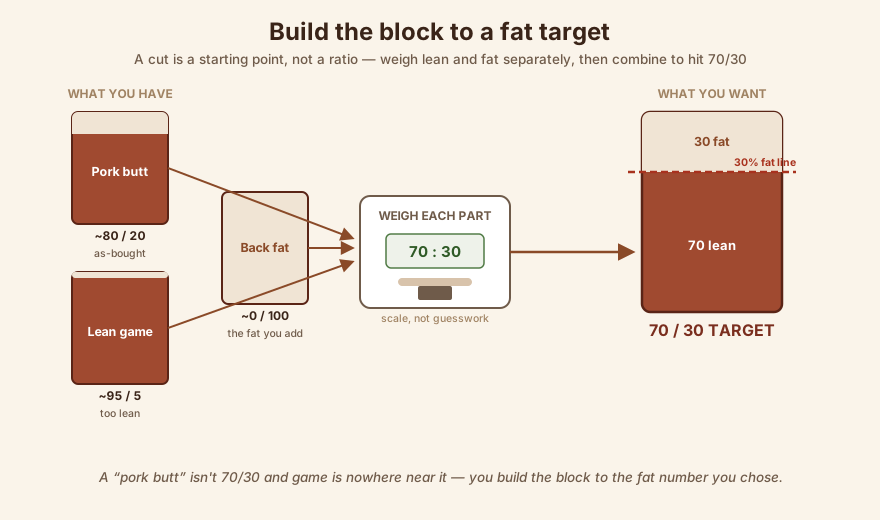
Here’s the single idea that changed my sausage more than any other, and it’s the reason this whole ingredients section leads with meat and fat: a sausage is a block of lean and fat built to a chosen fat percentage, not a cut of meat you hope lands right.
The amateur move is to say “pork butt is 80/20, so I’ll grind pork butt and I’ll get an 80/20 sausage.” Sometimes that’s true. Often it isn’t — butts vary by breed, by how the hog was fed, by the season, by how the butcher trimmed it. One butt is genuinely 78/22; the next is 85/15 and your sausage comes out dry. You didn’t do anything wrong; you trusted a cut to hand you a number, and cuts don’t make promises.
The pro move is to take control of the number. You do it one of two ways:
- Grind lean and fat separately and combine by weight. This is the clean way and it’s how I do anything I care about. I keep a pile of trimmed lean and a pile of pure pork back fat, both weighed. If I want a 70/30 block — the standard sausage target the fat page argues for — I weigh out 7 pounds of lean and 3 pounds of fat and I know exactly what I have. There’s no guessing, and I can hit the same sausage next year.
- Know your cut’s real ratio and correct toward the target. If you’re grinding whole butts, at least know they run ~80/20, taste and feel the batch, and add a little fatback if a lean butt left you short. You’re still building to a number; you’re just starting from a cut instead of a scale.
For game the point is even sharper, because game is nearly all lean — so the entire fat content of the sausage is whatever you added, by weight, on purpose. There’s no “the cut will sort it out.” You are the one who decides, every time, and a scale is how you decide.
The full case for the 70/30 target — why too lean is dry and crumbly, why too fat renders into greasy pools, why fat is the flavor carrier and part of the bind — lives on the fat page. Read it next. For here it’s enough to say: pick a fat percentage, then build the block to it with a scale, and stop hoping.
⭐ Safety — trichinae, and the game rule you must get right
This is the part of the page I most need you to read carefully, because there is one safety fact about wild game that a lot of otherwise-good sausage guidance gets flat wrong, and getting it wrong is how somebody ends up genuinely sick.
The parasite is Trichinella. It’s a roundworm that encysts in muscle, and you get trichinellosis by eating it in undercooked meat. Pork used to be the classic source; wild game — especially bear — is the source that matters most today.
Here’s the split that everything turns on:
⚠ Freeze the pork. COOK the bear.
Commercial US pork is very low-risk, and the trichinae strain it can carry is killed by freezing. USDA publishes an actual schedule for it — the freezing time-and-temperature tables in 9 CFR — and for domestic pork, freezing to those specs is a recognized way to kill the parasite. That’s a real, legitimate control for pork.
Bear and other wild-game trichinae are FREEZE-RESISTANT. Freezing does NOT reliably kill them. The Trichinella strains that circulate in North American wildlife — the ones in black bear, wild boar, and other wild carnivores and omnivores — survive freezing that would kill the pork strain dead. State wildlife agencies (Alaska Fish & Game among them) have documented this directly. Do not carry the pork “just freeze it” rule across to bear or game. It does not apply, and believing it does is dangerous.
So the rule for at-risk wild game — bear above all — is: cook it to a verified 160°F throughout, every part of the meat, checked with a thermometer. And understand the corollary: curing, salting, smoking, and drying do NOT reliably kill trichinae either. A cured, smoked, air-dried bear stick is not made safe by any of those steps. The only reliable kill for at-risk game is heat, to a verified internal 160°F.
Why 160°F when the parasite itself dies lower? Trichinella is actually killed around 137°F with a little hold time (140°F for a minute, 138°F for two, 136°F for three). But in a ground, stuffed, or fermented sausage you cannot verify that every particle reached temperature — a coarse grind and a fat stick have cold spots — so the conservative, defensible target for at-risk game is a solid 160°F throughout. That’s not overkill; it’s the number that accounts for the fact that you can’t probe every strand.
This is exactly how I make my own Bear Summer Sausage. It is cooked to a verified 160°F internal — it is not “frozen safe” the way I might handle a batch of commercial pork. If you take one thing from this page, take this: pork you can freeze on a schedule; bear and game you cook to 160°F, and nothing else — not the cure, not the smoke, not weeks of drying — takes its place.
Cold, fresh, and handled clean
The other half of good meat is how you treat it before it becomes sausage, and this comes down to three words: cold, fresh, clean.
Cold is the one people underestimate. Meat and fat grind cleanly when they’re partially frozen — right around 30°F is where I want the tray going into the grinder. Cold fat shears into clean, distinct particles; warm fat smears, coating the lean in a greasy film that blocks the bind and leaves you with a pasty, fatty-out sausage. Warm meat is the number-one cause of a batch gone wrong, and it’s entirely preventable: chill your cubes until they’re crunchy at the edges, chill the grinder parts if you can, and don’t let the meat sit warm while you fuss with seasoning. The grinder page develops this fat-smear discipline in full; it starts here, with the temperature of the meat.
Fresh means what it says. Sausage is not where you launder meat that’s on its way out — grinding multiplies surface area enormously, which means it multiplies bacterial growth too, so a sausage made from tired meat spoils faster than the roast it came from would have. Start with meat you’d be happy to cook whole.
Clean is the quiet one. Grinding, mixing, and stuffing give bacteria a lot of new surface and a lot of handling. Sanitize your equipment, keep your hands and boards clean, keep the whole operation moving and cold, and get the finished sausage back into the refrigerator or freezer promptly. None of this is exotic; it’s the same discipline as any careful meat handling, just applied to a process that touches every square inch of the meat.
Known meat, lightly
There’s one more thing worth naming, and then I’ll point you elsewhere for the full argument, because it doesn’t belong on this page in full.
The breed of the animal, what it ate, and how old it was all change the meat you’re building from — not just how much fat it carries, but the character of that fat and the depth of the flavor. A corn-finished commodity hog gives softer, oilier fat than a pasture-and-scrap-fed animal; an older animal gives a deeper, more developed flavor than a young one. This is real, it’s chemistry, and it’s part of why two “pork butt” sausages made the same way can eat differently.
My own animals are mixed-fed — pasture, grain, and table scraps — and I butcher everything myself except the hogs and beef, which I have done for me. That’s the kind of “known meat” that shifts your starting block, and it’s a big part of why I care about building to a target rather than trusting a label. But the full argument — how feed and breed and age actually change the fat and the flavor, and why it matters more today than it used to — lives on the meat itself. Go there for the whole case. Here, I just want you to know the meat is not a constant; it’s a variable you should try to know.
Where this leaves you
A sausage is a block of lean and fat, built to a number, kept cold and handled clean, and — if it’s at-risk game — cooked to a verified safe temperature no cure or smoke can substitute for. Pork is your workhorse and your fat donor. Beef gives color and bite; fat it with pork. Game gives you lean and nothing else, so you supply the fat, by weight, on purpose. And bear gets cooked to 160°F, full stop.
Get the block right and the rest of the section is refinement. Get it wrong and no spice blend on earth will save it.
If you want to put this to work, my venison sausages are scattered through the collection — browse the venison recipes — and the whole Sausage section shows the block turning into finished links. When you’re ready to source all of this well, the sourcing page is where I keep my notes on finding good meat and fat.
Part of Sausage Ingredients. Next: fat — the most under-taught variable in the whole craft, and the 70/30 target this page keeps pointing at.
Comments (0)