Binders & Extenders
Here’s a page for the ingredients nobody brags about. Salt, fat, the meat itself, the smoke, the cure — those all get their due, and they should. But say the word “filler” at a sausage table and watch the room curl its lip. Rusk, breadcrumb, oats, rice, dried milk, soy — the whole class gets waved off as padding, as what a cheat puts in to sell you less meat for more money. After forty years of making sausage I’ve come to think that reflex is mostly wrong, and wrong in a way that costs people good sausages. Some of the best sausages in the world are defined by what most Americans would call filler. A British banger without rusk isn’t a purer banger; it’s a failed one. A white pudding without oats isn’t white pudding at all.
So this page has two jobs. First, to get the vocabulary right, because “binder” and “extender” get thrown around as if they mean the same thing and they don’t — they’re two different tools doing two different jobs. Second, to take apart the snobbery, because the line between an honest traditional sausage and an adulterated one is real, but it is not the line most people think it is. It isn’t the presence of a grain or a crumb. It’s ratio, and it’s honesty.
Two different jobs, wrongly lumped together
Start with the distinction, because everything else hangs on it.
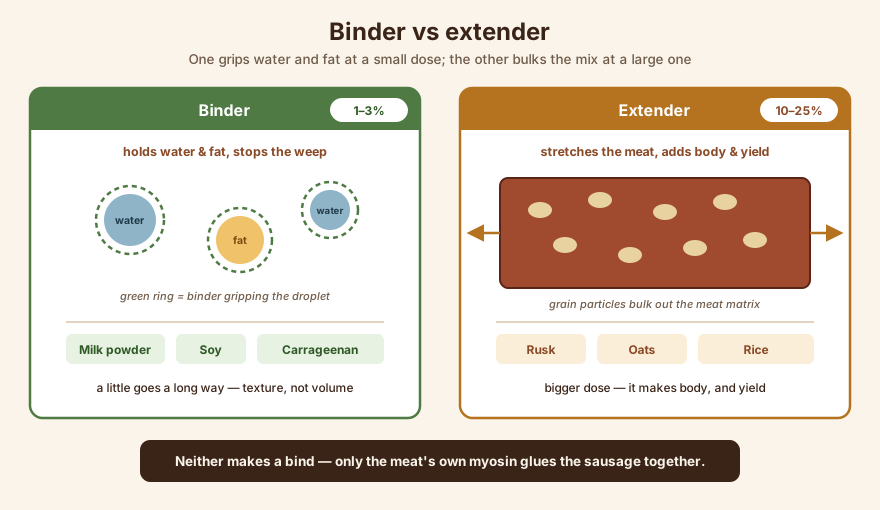
A binder is a functional ingredient you add in a small amount — think 1 to 3.5% of the batch — and its whole job is to hold water and fat in the sausage. It doesn’t pretend to be meat. You’d never notice it as a distinct thing in the finished bite. What you notice is the absence of its failure: no grease cooked out into the pan, no dry crumbly texture, no shrunken links. A binder improves the cooked yield and the mouthfeel and then disappears.
An extender is a different animal. You add it in a larger amount, and its job is to stretch the meat and give the sausage body and texture — it genuinely replaces a fraction of the meat, and often you can see and feel it in the finished sausage. The oats in a white pudding are extender. The rusk in a banger is extender. You are meant to know they’re there; they’re part of what the sausage is.
The line between the two isn’t chemistry — it’s role and ratio. The same material can play either part depending on how much you use. A spoonful of breadcrumb per pound is doing a binder’s quiet water-holding work; a third of the loaf being breadcrumb is an extender openly stretching the meat. So don’t memorize a list of “binder ingredients” and “extender ingredients” as if they were separate species. Ask what the ingredient is doing in the amount you’ve added.
Here’s the map I keep in my head:
| Binders | Extenders | |
|---|---|---|
| Job | Hold water and fat | Stretch meat, add body and texture |
| Amount | Small (≈1–3.5%) | Larger (often 10–25%+) |
| Noticeable? | No — works invisibly | Yes — part of the texture |
| Typical materials | Non-fat dry milk, soy protein concentrate, carrageenan, egg | Rusk, oats, rice, breadcrumb, potato |
⭐ Neither one is what holds the sausage together
Before I say a single good word about any of these ingredients, I have to plant a flag, because this is the misunderstanding that makes people think a binder is somehow cheating the structure of a sausage.
In a meat sausage, none of this is what makes the sausage cohere. That job belongs to the meat’s own myosin bind — full stop.
I go through the mechanism in detail on the salt page, and I’d rather you read it there, but the short version: salt worked into cold lean meat dissolves myosin, the structural muscle protein, out into a sticky tacky film that coats every particle. Mix to the tack and that extracted protein is the glue. When the sausage cooks, that glue sets into a cohesive gel that traps the fat and juices and gives the sausage its snap and its slice. That is the bind. That is what holds a bratwurst together.
A binder does not do that. A binder manages the water and fat around that protein network — it holds moisture the myosin gel would otherwise weep, it keeps fat from cooking out, it improves the yield. An extender doesn’t do it either; it adds body and soaks up moisture and lightens the texture, but the cohesion is still the myosin’s work. If you skimp on your salt and your mix and never develop the bind, no amount of dried milk or soy will save the batch — you’ll have a crumbly tube that happens to be moist. So keep the hierarchy straight: the meat’s own protein binds the sausage; binders and extenders manage the water and texture around that bind. Get that backwards and you’ll blame the wrong ingredient every time a sausage fails.
(Blood sausage is the one real exception, and it’s exactly because it has no myosin bind — it sets on heat-coagulated blood protein instead, and the grain in it is structural in a way it never is in a meat sausage. That’s a whole separate mechanism, and it lives on the blood page.)
The binders, and what each one actually does
Non-fat dry milk (NFDM). The old reliable, added at roughly 3%. It binds water and helps emulsify fat, and the lactose in it also browns a little and lends the faintest sweetness. If you’ve ever wondered why a lot of commercial hot-dog and bologna formulas call for dried milk, this is why — cheap, effective, invisible. Its action is very close to soy concentrate’s; pick whichever your palate and your allergen situation prefer.
Soy protein concentrate. About 70% protein, and it earns its keep by water: it binds something like four parts water for one of itself, and it coats fat particles in a fine emulsion that keeps them from breaking out during the cook. Two percent does real work. (Soy protein isolate is even more concentrated — same idea, turned up.) The word “soy” makes some people flinch, but at 2% in a sausage it’s a functional binder, not a meat substitute, and it’s been quietly holding commercial emulsions together for generations.
Carrageenan. A hydrocolloid pulled from red seaweed, and a clever one: when it heats, it traps and gels water, boosting the cooked yield and the volume. It shows up in lean and reduced-fat products and in injected/pumped meats where you want to hold a lot of added water. In a home batch you rarely need it, but it’s worth knowing what it is when you read a label — it’s seaweed doing water-management, not a mystery chemical.
Egg. The traditional binder, and the one your grandmother would recognize. Egg white is protein that coagulates with heat, and it’s long been used in finer and emulsion-style products — and, notably, in white pudding, where it helps set the mix. It’s the least industrial thing on this list and the oldest.
There’s a regulatory number that hangs over all of these in the United States, and it matters for the honesty argument I’m about to make: for a lot of cooked comminuted meat products, added binders and extenders like soy flour and dried milk are capped at around 3.5% of the batch, each, and go over that and the product has to be labeled differently — it stops being allowed to call itself plain sausage. Treat 3.5% as a working rule of thumb rather than a universal constant, because the exact figure moves around by product class in the regs. But hold onto the shape of it: the law doesn’t ban binders. It caps them, and it demands you say so past the cap. That’s the whole game, and it’s the key to the next section.
⭐ The class snobbery — and why it’s mostly wrong
Now the heart of the page.
Extenders get dismissed as “cheap filler” and “adulteration,” and the dismissal carries a whiff of class contempt — as if a sausage with a grain in it were a poor man’s counterfeit of a real one made of nothing but meat. I want to take that apart carefully, because there is a real abuse hiding in there, but it’s not where the snobs point.
Rusk in a proper banger is not cheating. It’s what a banger is. Rusk is a crumbled, twice-baked, egg-less dry biscuit — a zwieback-type dried bread — and it’s the defining extender of the British sausage. It absorbs far more liquid than ordinary breadcrumb, and that water-holding is exactly what keeps a banger succulent through the pan instead of squeezing its juices out. It’s the whole reason a good banger has that soft, yielding, almost bready bite rather than the tight snap of a coarse-ground continental sausage — that texture is a choice, and rusk is how you make it. Pull the rusk out and you don’t get a better, meatier banger. You get a dry, dense, over-bound thing that isn’t a banger anymore. It’s heritage, it’s functional, and it’s been standard in British sausage for well over a century.
Oats in a white pudding are the same story. Pinhead oatmeal is chosen deliberately — pinhead, not rolled, because rolled goes pasty and pinhead stays granular and gives the crumb its character. The oats hold water through the cook and give the pudding its structure and its bite. A white pudding is, at its heart, a pork-and-oatmeal sausage; the oats aren’t dilution, they’re a co-star. The blood-and-offal tradition makes exactly this point about grain generally: the grain in these sausages isn’t there to cheat you, it’s there because the sausage is built on it.
So what is the abuse? It’s ratio, and it’s honesty — nothing else. A rusk banger with meat as its foundation and rusk doing its traditional textural job is a heritage food. A mystery tube where the meat has been stretched down to almost nothing and bulked back up with cereal and water, sold to you as if it were mostly meat, is adulteration. The difference between those two is not whether there’s an extender in it. It’s how much, and whether the label tells the truth. That’s precisely what the 3.5% cap and the naming rules are about — they don’t outlaw the extender, they draw the line past which you have to stop calling it plain sausage and start being honest about what it is.
That’s the whole ethic, and it’s worth saying plainly because the snobbery gets it exactly backwards: a rusk banger is heritage; a meat-stretched-to-nothing mystery tube is the abuse. Know the difference, and don’t let anyone tell you the grain itself is the sin.
The extenders, one at a time
Rusk. Covered above as the exemplar, but the practical notes: it’s sold specifically as sausage rusk, in coarse (visible in the finished sausage) and fine (invisible) grinds. It comes both plain and, confusingly, as “brown breadcrumb,” but true rusk is the twice-baked dry biscuit, which is why it out-drinks ordinary crumb. It’s the British banger’s signature and near-universal in that tradition.
⚠ One thing rusk is not — settle this now. Rusk is thoroughly documented and traditional in the fresh British banger. Its role in black pudding specifically is a different and much weaker claim, and our own black-pudding page flags that we could find no authority establishing rusk as traditional there. Keep the two separate in your head: banger-rusk is heritage and functional; black-pudding-rusk is unverified. Don’t let anyone flatten the well-documented banger fact into a blanket claim that rusk belongs in blood pudding — it may or may not, and the sourcing doesn’t back it.
Oats. The pinhead oatmeal of white pudding (and of some black). Structural, chosen by cut, holds water, stays granular for a crumb. Rolled oats go gummy — use pinhead.
Rice. The extender of boudin in Cajun Louisiana, of morcilla de Burgos in Spain, of some Irish artisan puddings. Cooked rice gives you discrete grains studded through a soft matrix — a completely different texture from the fine bound crumb of rusk. Rice swells as it cooks, so you stuff those sausages loose.
Breadcrumb. The everyday British and continental filler, and the one that sits closest to the honest “economy” reading — it’s the plainest, cheapest way to stretch and lighten a sausage, and it’s been doing it in home kitchens forever. Ordinary crumb holds less water than rusk, which is exactly why rusk was developed.
Potato. Starch body and mild flavor — the Scandinavian potatiskorv leans on it, and some Irish white-pudding variants use it. It gives a soft, tender texture and almost no competing flavor.
Using them
The mechanics are simple once you’ve got the roles straight.
Hydrate your rusk. Dry rusk (or breadcrumb) goes into the mix hydrated — you add water to the batch and let the rusk drink it before or as you mix. The classic banger proportion is roughly rusk to soak up something like its own weight or more in water; the rusk carries that water into the sausage, and the myosin bind and the casing hold it there through the cook. That soaked-in water is a real part of the succulence — it’s why a banger is juicier than a lean sausage of the same meat. Add rusk dry and forget the water and you’ll get a sausage that drinks moisture out of the meat and comes out tight and dry.
Cook your grain first for rice and oats. For a blood or rice sausage, the rice and the oats go in already cooked — you cook the rice or the oats (or barley) to tender first, then fold it into the mix. Raw grain won’t finish cooking inside a gently-poached pudding, and worse, in a blood sausage the temperature of what you fold in matters enormously: hot grain or hot onion tipped into cold blood starts coagulating the blood right there in the bowl, and you get a grainy pudding before it ever reaches the oven. Cook the grain, cool it, then combine. That’s on the blood page too, but it’s worth repeating here because it’s the single most common way a first blood pudding goes wrong.
How much, and what texture you get. Rough directional numbers, meat-block basis:
| Ingredient | Rough amount | Texture it gives |
|---|---|---|
| NFDM / soy concentrate (binder) | ~2–3% | Nothing you taste — just moist, no grease-out |
| Rusk (banger) | ~10–20%, hydrated | Soft, bready, succulent — the banger bite |
| Oats (white pudding) | substantial, cooked | Granular, hearty crumb |
| Rice (boudin, morcilla) | substantial, cooked | Discrete grains in a soft matrix |
| Breadcrumb / potato | to taste | Light, tender, mild |
The binders sit low because a little does the water-holding job and more just dulls the flavor. The extenders sit high because they’re meant to be part of the eating — and the moment they climb past that 3.5%-ish binder ceiling for the invisible ones, or past the point where the sausage is honestly “meat with some grain,” you’ve crossed from a traditional sausage into something that owes you a different name on the label.
Where this leaves you
Don’t fear the grain. The best thing I can tell a nervous first-time sausage maker is that rusk and oats and rice are not compromises — they’re technique, as much as your salt percentage or your grind. Use them for what they do: hold water, add body, lighten a texture, make a banger a banger and a white pudding a white pudding. Keep the ratios honest and you’re making heritage food, not filler.
And keep the throughline from this whole section of the site in front of you: the meat’s own salt-extracted myosin is what holds a sausage together. Binders and extenders manage the water and texture around that bind — they don’t replace it, and they aren’t cheating when you use them the way the tradition uses them. The cheating is in the ratio and the lie, never in the ingredient.
Next in this series: phosphates and the other additives — the working ingredients that hold water and stabilize a mix, and the honest accounting of what they do and don’t do.
Comments (0)