Casings
Ask most people what a casing is and they’ll tell you it’s the wrapper — the tube you push the meat into, the thing that holds the sausage in a sausage shape. That’s true, and it’s also the part of the answer that gets a maker into trouble, because it treats the casing as packaging. It isn’t. The casing is the first thing your teeth hit and, on a good sausage, one of the best moments in the whole bite. It contributes flavor, it decides how much moisture the sausage keeps, it lets smoke in or keeps it out, and on the right sausage it delivers the single most satisfying thing a link can do — the snap, that clean audible break the moment you bite through. A casing is an ingredient. I pick it before I stuff, the same way I pick the fat and the salt, because it’s a flavor and texture decision, not a shipping decision.
This page is about the casing as a material — what each kind is made of, whether you eat it, and what it does to the finished bite. It is deliberately not the how-to. The mechanics — caliber sizing, soaking and flushing, loading the horn, hog rings, pricking, and linking — all live on the casings and tools page, and I’m not going to repeat them here. If you want to know how to get the casing onto the stuffer, go there. If you want to know what the casing is and what it gives you to eat, stay here.
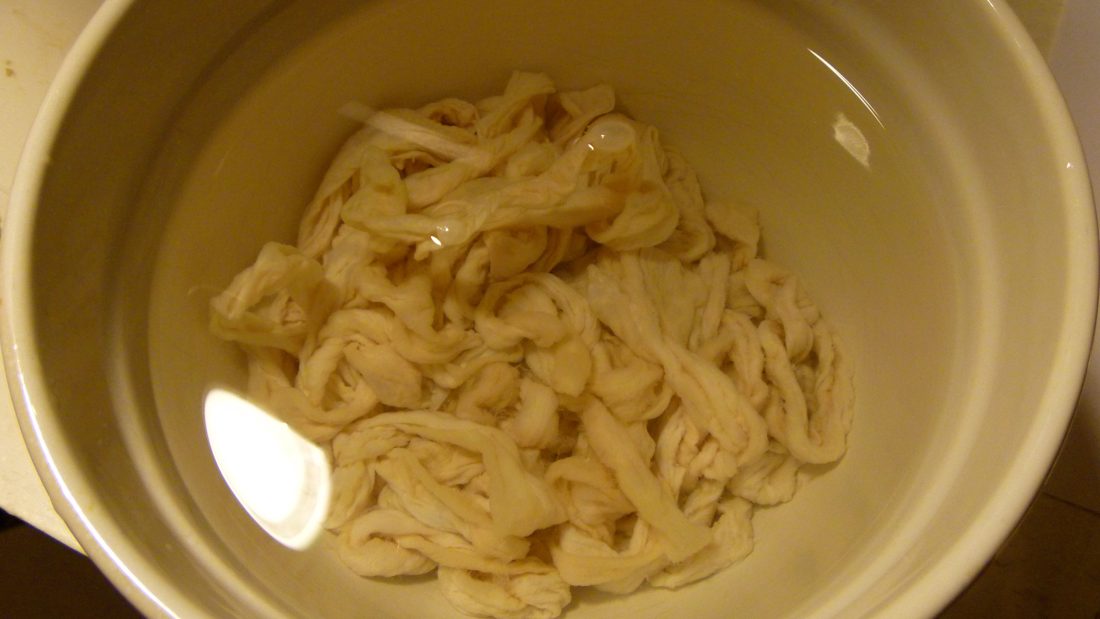
The casing is part of the bite
Four things the casing puts on the plate, and none of them is “containment”:
The snap. This is the headline. When you bite a good bratwurst or a natural-casing hot dog and it pops — that resistance, then the clean break, then the juice — that’s the casing, not the meat. A natural casing is a thin, tough membrane that resists your teeth for an instant and then gives all at once. No other component does this. You can build a perfect emulsion, season it flawlessly, smoke it beautifully, and if you stuff it into the wrong casing it will eat soft and dull. The snap is a texture the casing owns outright.
Moisture retention. The casing is the wall that holds the sausage’s water and rendered fat in while it cooks, and how much it holds depends on what it’s made of and how permeable it is. A tight natural casing keeps a brat juicy on the grill; a peeled skinless dog, with no casing at all, relies entirely on the emulsion and the cook to keep from drying out. The casing is part of your yield.
Smoke penetration. If you smoke your sausage, the casing decides how much smoke actually reaches the meat. A natural casing is beautifully permeable — smoke and the color and flavor that come with it pass right through and into the surface of the meat. Some casings barely let smoke in at all. If you’ve built a sausage around a day in the smoker, the casing you chose is going to make or break that work.
Shape, and the cook that shape demands. A thin sheep casing gives you a fast-cooking frankfurter or a snappy little link; a wide beef middle gives you a big salami that cures slowly and evenly. Diameter isn’t cosmetic — it sets the cook time, the cure time, and how the thing eats. A one-inch link and a three-inch summer sausage are different foods, and the casing drew that line.
Get those four in your head and the whole casing decision organizes itself. You are choosing snap, moisture, smoke, and shape — before the meat goes in the stuffer.
Natural casings — the real snap, and my default
A natural casing is exactly what it sounds like: cleaned animal intestine, plus a couple of wider parts of the gut for big sausages. It’s an actual piece of the animal — the submucosa layer of the intestine, scraped clean of everything else — and it has been the sausage-maker’s casing for as long as there have been sausages. It’s my default, and it’s the one I reach for on nearly everything I make. There’s a principle behind that, and it’s the same one I lay out on why I make sausage differently today: use natural casings except where a fibrous one is genuinely the only thing that works. Natural is the honest choice, and on the eating it’s not close.
Here’s why. A natural casing is:
- Edible. You eat it. It’s part of the sausage, it’s tender when cooked right, and it needs no peeling. Nothing gets thrown away.
- Smoke-permeable. Smoke, cure, and color pass through it into the meat. If you smoke sausage, this is enormous — the casing gets out of the way of the very thing you’re trying to do.
- The source of the snap. This is the whole ballgame. That clean pop when you bite through a good link is the natural casing and only the natural casing. Everything else on this page trades some or all of the snap away for some other convenience.
The trade-off is honesty of a different kind: a natural casing is a natural product, so its diameter wanders. One length of hog casing might run a little fat here and a little thin there, and your links come out slightly irregular. On my bench that’s charm — it’s the tell that a human stuffed it and an animal grew it. On a commercial line that wants a thousand identical packs, that irregularity is a problem, and it’s a big part of why the factory reaches for the uniform casings further down this page. But I’m not running a line, and neither, probably, are you.
Which natural casing to use is really a question of diameter, and each animal’s gut suits a different sausage:
- Sheep casings are the thinnest — narrow, delicate, and the snappiest of all. This is the frankfurter and breakfast-link casing: thin fresh links, natural-casing hot dogs, chipolatas. Because the wall is so fine, the snap is at its most pronounced, and the casing all but disappears into tenderness once you’re through it. If you want the crispest pop, sheep is where it lives.
- Hog casings are the workhorse and the middle of the range. This is bratwurst, kielbasa, Italian sausage, Polish — the sausages most people picture when they hear the word. Wide enough to hold a proper coarse grind, tough enough to grill hard without splitting, tender enough to eat clean. If I could keep only one casing on the bench, it would be hog. It’s what my grandfather’s kielbasa goes into, and it’s the casing I’ve stuffed more of than all the others combined.
- Beef casings — the rounds — are wider and heavier-walled, for the big rings and the coarse, robust sausages: ring bologna, big Polish rings, mettwurst, some blood sausages. Chewier than hog, sturdier, built for a bigger, longer cook.
And then, for the truly large sausages, there’s the wide stuff from the cow: beef middles and beef bungs (also called caps). These are wider sections of the beef gut, and they’re what real, big-diameter salami and mortadella are cased in traditionally — a genuine natural casing that holds a three- to four-inch sausage through a long cure or cook, and that you eat, and that lets smoke and air through the way the whole natural family does. When you see a proper artisan salame with a slightly irregular, matte, edible skin, that’s a beef middle or bung doing the job a fibrous casing does on the industrial version. It’s the natural answer to “I need a big sausage” — and it’s the case where natural genuinely competes with fibrous on size, which most of the time it can’t.
Collagen casings — edible, uniform, and a step down on snap
Collagen casings are the first of the manufactured casings, and the most sausage-like of them. They’re made from reconstituted animal collagen — the natural protein of hide and connective tissue, mostly beef hide, broken down into a gel and then extruded back out as a uniform tube and dried. So it’s still an animal product, still protein, still edible — you don’t peel a collagen casing off an edible-collagen sausage. But it’s been taken apart and rebuilt, and that shows in the eating.
What collagen gives you is consistency and speed. Every casing is exactly the same diameter, so your links come out identical — the very uniformity a natural casing can’t promise. And most edible collagen casings load straight off the pack with no soaking and no flushing; they’re clean, dry, and ready. For a maker turning out a lot of snack sticks or fresh links to eat in a day or two, that’s a real, legitimate convenience, and I use them for exactly that — snack sticks especially, where the small caliber and the ready-to-load form make sense.
What collagen costs you is the snap. A careful eater can feel it: a collagen casing doesn’t pop the way natural hog casing does. It has a bite, but it’s a softer, more uniform bite, and it lacks that clean audible break. It’s not bad — it’s just noticeably not the same, and once you’ve eaten enough natural-casing sausage you can’t un-notice it. Collagen also takes smoke, but not as generously as natural; it’s fine for a lightly smoked snack stick and less ideal for something you want to drive a lot of smoke into. So the honest placement is this: collagen is legitimate for fresh links and snack sticks you’ll eat soon, where uniformity and convenience earn their keep — and it’s the wrong choice anywhere the snap is the point. When the sausage is the snap, use a natural casing.
Fibrous casings — strong, uniform, and you don’t eat them
Now we cross a real line. Fibrous casings are inedible. You peel them off before you eat, always. They are not an animal product at all — they’re made from cellulose reinforced with abaca fiber (abaca is a banana-family plant, the same long, strong fiber you find in good manila rope and tea bags). That reinforcement is the point: fibrous casings are tough, dimensionally stable, and they hold their shape and their diameter through a long cook, a long smoke, or a long hang without stretching, splitting, or wandering.
That’s exactly what you need for the big, sliceable, cured and cooked sausages: summer sausage, bologna, large smoked sausages, big cooked salami — anything you want to come out three or four inches across, perfectly round, and the same size end to end so it slices into even rounds. A fibrous casing holds that shape where a natural casing would fight you. It also takes a printed label — the branded summer-sausage tube you see at the deli counter is a fibrous casing, printed right on the material — and it can be made micro-perforated (the trade calls it “pre-stuck”) so that smoke and moisture pass through during the cook even though you’ll never bite it. That’s how a summer sausage gets its smoke color and flavor through a casing you’re going to throw away.
So think about what a fibrous casing contributes to the eating: nothing textural, everything structural. It shapes the sausage, protects it, carries the smoke in, holds the diameter — and then it leaves. The eater never tastes it, never bites it, peels it off and drops it in the trash. Its whole contribution is made before the sausage reaches the table. That’s the trade: you give up the edible, snapping skin entirely in exchange for a big, uniform, sliceable sausage that a natural casing simply can’t deliver at that size and consistency. This is the “except where a fibrous one is truly needed” clause of my standard, and summer sausage is the honest case for it. My mother’s summer sausage is a different school — no casing at all, set in the oven — but the classic fibrous-cased summer sausage is where this casing earns its place.
Cellulose casings — the reason a skinless hot dog has no snap
Cellulose casings are the last kind, and they explain something you’ve eaten your whole life without thinking about it: why a skinless hot dog has no snap. These are made from pure plant cellulose — clear, thin, strong, and completely inedible — and their entire job is to be a temporary mold that gets removed before the sausage is ever packaged.
Here’s how a skinless frank is actually made. The emulsion is stuffed into a long cellulose casing, then cooked and smoked right inside it. The cellulose is permeable, so smoke still colors and flavors the surface of the dog during the cook — the casing does let the smokehouse do its work. But once it’s cooked, a machine peels the cellulose casing right off, and it’s discarded. What’s left is a bare hot dog with a smooth, uniform surface and no casing at all. That’s literally what “skinless” means: the casing was there for the cook and then removed.
And that’s the whole answer to the snap question. A skinless dog has nothing for your teeth to break through — no membrane, no wall, just the cooked surface of the emulsion itself. So it eats soft and smooth, with zero pop. That’s not a defect; it’s a design choice, and plenty of people prefer the tender, uniform bite. But if you’ve ever wondered why a natural-casing dog at a ballpark snaps and the one from the plastic pack doesn’t, this is it: one has a natural casing you bite through, the other had a cellulose casing peeled off before it ever reached you.
What the choice does to the eating
Step back and the whole thing lines up on a single axis — snap — with everything else the casing does arranged around it.
| Casing | Made of | Edible? | Snap | Smoke through it | What it’s for |
|---|---|---|---|---|---|
| Sheep (natural) | Cleaned sheep intestine | Yes | Highest — crispest pop | Yes, freely | Franks, breakfast links, chipolatas |
| Hog (natural) | Cleaned hog intestine | Yes | High | Yes, freely | Brats, kielbasa, Italian, Polish |
| Beef round / middle / bung (natural) | Cleaned beef gut | Yes | High, chewier wall | Yes, freely | Ring bologna, big salami, mortadella |
| Collagen | Reconstituted beef-hide collagen | Yes | Moderate — soft bite, no clean pop | Somewhat | Snack sticks, uniform fresh links |
| Fibrous | Cellulose + abaca fiber | No — peeled off | None (removed) | Yes, if pre-stuck | Summer sausage, bologna, big cured/cooked |
| Cellulose | Pure plant cellulose | No — peeled off | None (removed) | Yes, colors the surface | Skinless hot dogs |
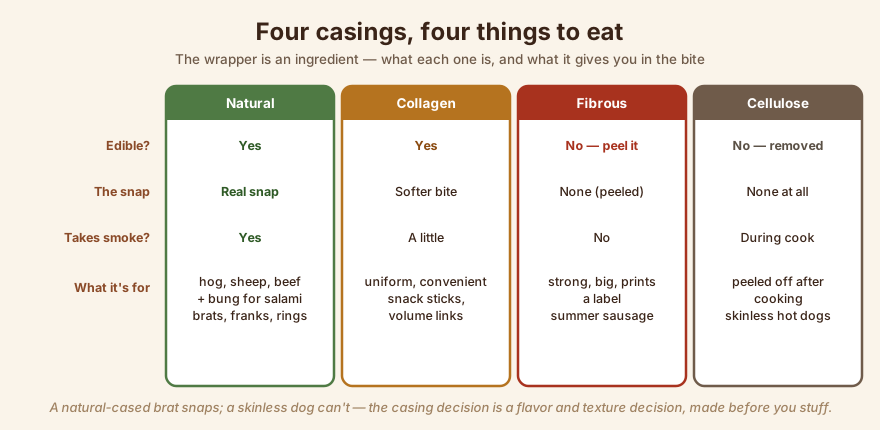
Read down the snap column and the trade is right there: natural gives you the most snap, collagen gives you a softer bite for the sake of uniformity and convenience, and fibrous and cellulose give you no snap at all because you take the casing off before you eat. A natural-casing brat snaps. A skinless dog doesn’t, and now you know exactly why. A collagen snack stick sits in between, with a bite but not a break. And smoke follows a parallel logic — it drives freely into a natural casing, passes reasonably through cellulose to color a skinless dog’s surface, and only reaches the meat inside a collagen or fibrous casing to the extent that casing was built to let it.
That’s why I keep saying the casing is an ingredient. Every one of those outcomes — the pop or the absence of it, the juice held or lost, the smoke driven deep or held at the surface, the size and the cook that size demands — is decided by which casing you reach for, and you reach for it before you stuff, before you even mix. By the time the sausage is on the horn the decision is made and the eating is largely determined. The tools and handling page will tell you how to get that chosen casing prepped and onto the stuffer and linked off cleanly; the choice of which casing, and what it’s going to do to the bite, is the ingredient decision, and it’s this one. Get it right and the casing does more for the finished sausage than almost anything else you put in it. Whether to case a sausage at all — and the sausages that skip it entirely — is its own question, and I take that up on to case or not to case.
Where to actually buy natural casings — and how to judge good ones from bad — is part of the next piece, on sourcing your ingredients. Casings keep a long time salt-packed or in brine, so they’re easy to lay in ahead — but a bad hank will ruin a good batch, and knowing what to ask for matters.
Part of Sausage Ingredients, and one piece of the whole craft at Sausage. For prepping, loading, hog-ringing, and linking your casings, see the casings and tools page. Next: sourcing — where to buy casings and everything else, and how to tell the good from the bad.
Comments (0)