Preserving: Drying, Freezing, Pickling and Canning
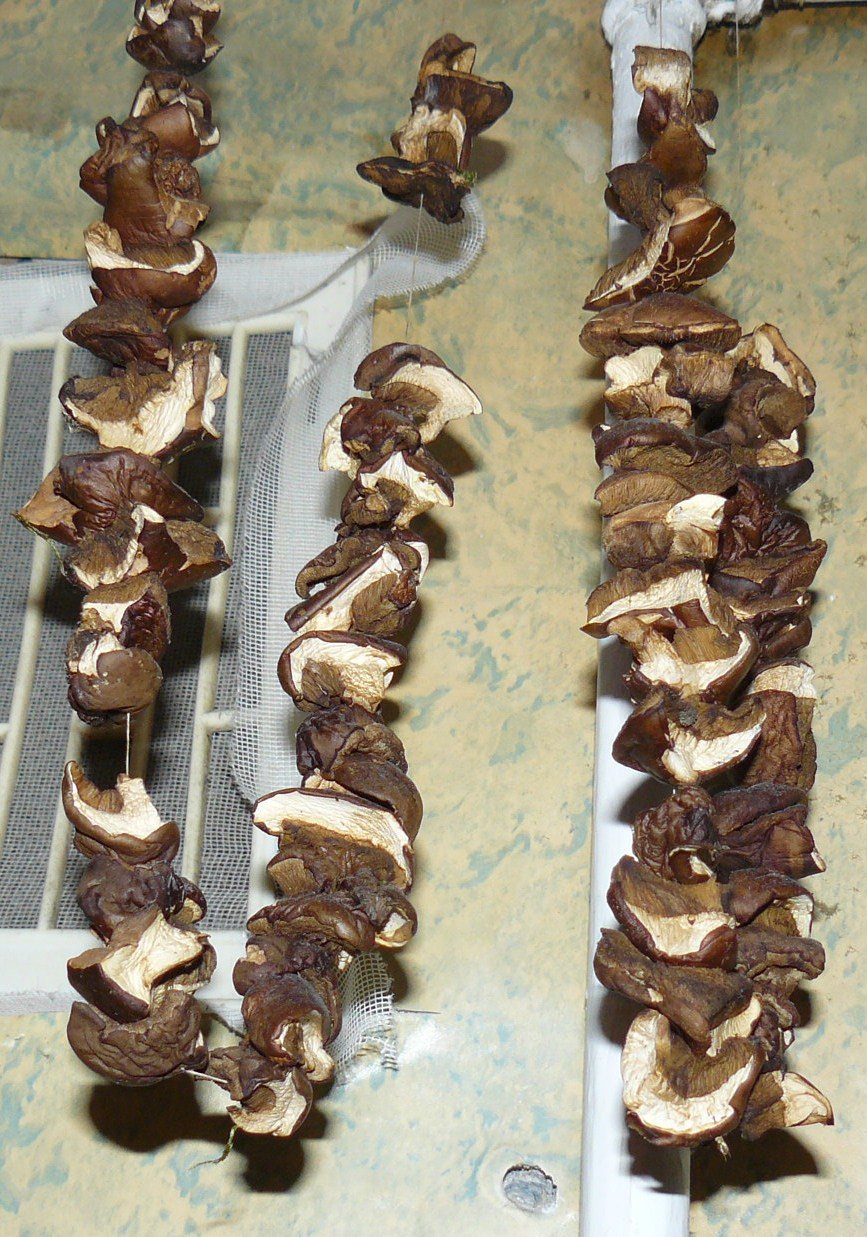
Mushrooms strung and dried in Poland, the oldest way to keep a harvest.
Wild mushrooms arrive all at once. A good morel spring or a single flush of hen of the woods can produce more than a household can eat in a week, and fresh mushrooms keep only days. Every mushroom culture in the world has had to answer that problem, and the answers — drying, salting, pickling, a bottle of ketchup — are on around the world. This page is about doing it safely at home, using tested processes wherever tested processes exist, and saying clearly where they do not.
The first rule of preserving wild mushrooms is the same as the first rule of eating them. Colorado State University’s extension service puts it in one sentence: “The toxins of poisonous varieties of mushrooms are not destroyed by drying or by cooking.” A jar or a dehydrator changes nothing about identification.
Drying
Drying is the oldest method, the simplest, and for flavour often the best: removing about 90% of the water concentrates everything that remains, and dried morels, porcini and shiitake are prized precisely for that intensity (the chemistry is on the science page).
The tested guidance comes from Colorado State University’s fact sheet 9.308 and the National Center for Home Food Preservation:
- Preparation (CSU): “Scrub. Discard tough, woody stalks. Slice tender stalks ¼ inch thick. Peel large mushrooms, slice. Leave small mushrooms whole.” Then dip in a solution of 1 teaspoon citric acid per quart of water for 10 minutes, and drain.
- Temperature: dehydrators are designed to dry foods “fast at 140 °F” (NCHFP); CSU’s oven method also dries at 140 °F, with the door propped open.
- Time: 8–12 hours.
- Done when: CSU’s test is “dry and leathery.”
Where the sources disagree. Many foragers’ guides skip the citric-acid dip, wipe rather than scrub, and dry mushrooms until brittle and crisp rather than leathery. Crisp pieces store longer and grind to powder; the extension endpoint is the tested one. Both are recorded here; for long storage, drier is safer.
Using dried mushrooms. Soak in hot water — Serious Eats soaks dried porcini in boiling water for 15 minutes; Saveur uses boiling water for 30 — then lift the mushrooms out and pour the soaking liquid off, leaving the last grit-laden spoonful in the bowl. The soaking liquid is some of the most flavourful stock in the kitchen. Dried shiitake are better soaked cold (see cooking mushrooms). The procedure is written up as Drying Mushrooms.
Freezing
Raw mushrooms freeze badly — their water forms ice crystals that wreck the texture, and they thaw into a limp, grey mass. The NCHFP’s tested method cooks them first:
- Prepare. “Choose mushrooms free from spots and decay. Sort according to size. Wash thoroughly in cold water. Trim off ends of stems.” Slice or quarter any over an inch across.
- Anti-darkening dip. Five minutes in a pint of water with 1 teaspoon lemon juice or 1½ teaspoons citric acid.
- Steam — whole mushrooms 5 minutes, buttons or quarters 3½ minutes, slices 3 minutes — then cool promptly, drain and pack. Or sauté small batches in butter until almost done, and cool.
- Pack with ½ inch of headspace, seal and freeze.
Steamed mushrooms keep longer than sautéed ones, according to the NCHFP. Morels are widely frozen after a quick sauté in butter, which is the sauté route above. The procedure is written up as Freezing Mushrooms.
Pickling: the tested recipe
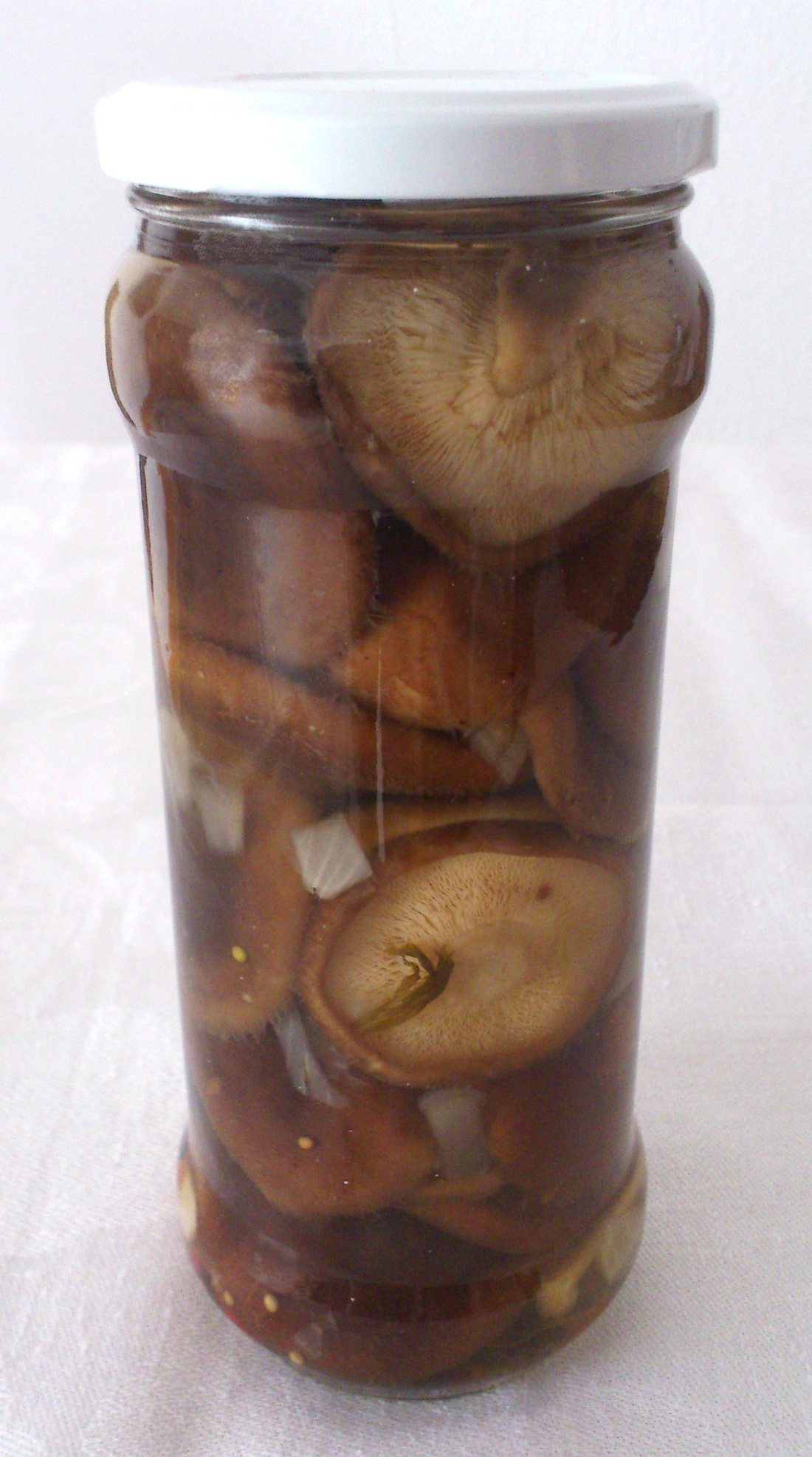
Marinated mushrooms in a jar. Whether one is safe on a shelf depends on its acid, not how it looks.
The United States has one tested, shelf-stable pickled mushroom recipe: the NCHFP’s Marinated Whole Mushrooms, which also appears in the USDA Complete Guide to Home Canning. It is worth knowing in detail, because it contradicts a common assumption: it contains two cups of oil, and it is processed in a boiling-water canner, not a pressure canner.
- 7 pounds of small whole mushrooms (caps under 1¼ inches), boiled 5 minutes in water with ½ cup of bottled lemon juice.
- A marinade of 2½ cups of 5% white vinegar, 2 cups of olive or salad oil, oregano, basil, salt, onion and pimento, brought to the boil.
- Packed into half-pint jars with garlic and peppercorns, ½ inch of headspace.
- Processed 20 minutes in a boiling-water canner at 0–1,000 feet; 25 minutes at 1,001–3,000 feet; 30 at 3,001–6,000; 35 above that. Yield: about nine half-pints.
Why oil does not make it dangerous: the acid does the work. A low-acid food becomes safe for a boiling-water canner when enough acid is added to bring it below pH 4.6, and this recipe adds a great deal — the oil is irrelevant to that. The same argument is made at length on Pickled: under oil, and the way to check acidity is on measuring pH. The recipe is Canned Marinated Whole Mushrooms. The collection’s older Tangy Pickled Mushrooms is a refrigerator recipe.
Mushrooms under oil: the Italian warning
Italy, where mushrooms preserved in oil (funghi sott’olio) are a household staple, has a botulism problem that makes the risk concrete. The Istituto Superiore di Sanità names home-preserved mushrooms in oil among the home foods most responsible for botulism — its list reads black olives in water, mushrooms in oil, preserved turnip greens, then preserved meat and fish — and Italy records an average of 20–30 cases of botulism a year, mostly from home preserves.
The ISS names the cause precisely, and it is not the oil: “for this type of product the most frequently committed error is insufficient acidification.” Its 2016 home-preserving guidelines require vegetables for oil to be blanched for a few minutes in equal parts water and vinegar, using wine vinegar of 6% acidity or more — or, with a 5% non-wine vinegar, undiluted — and the herbs and spices blanched too. If the oil is topped up, the jars must be pasteurised again. Rising bubbles or cloudy oil within 10–15 days mean the jar has spoiled — and even on suspicion, it must not be tasted.
The American rule is simpler. The CDC advises refrigerating homemade oils infused with garlic or herbs and throwing them away after four days. Mushrooms in oil that have not been acidified as the ISS specifies belong in the refrigerator, briefly.
A traditional pickle with no processing
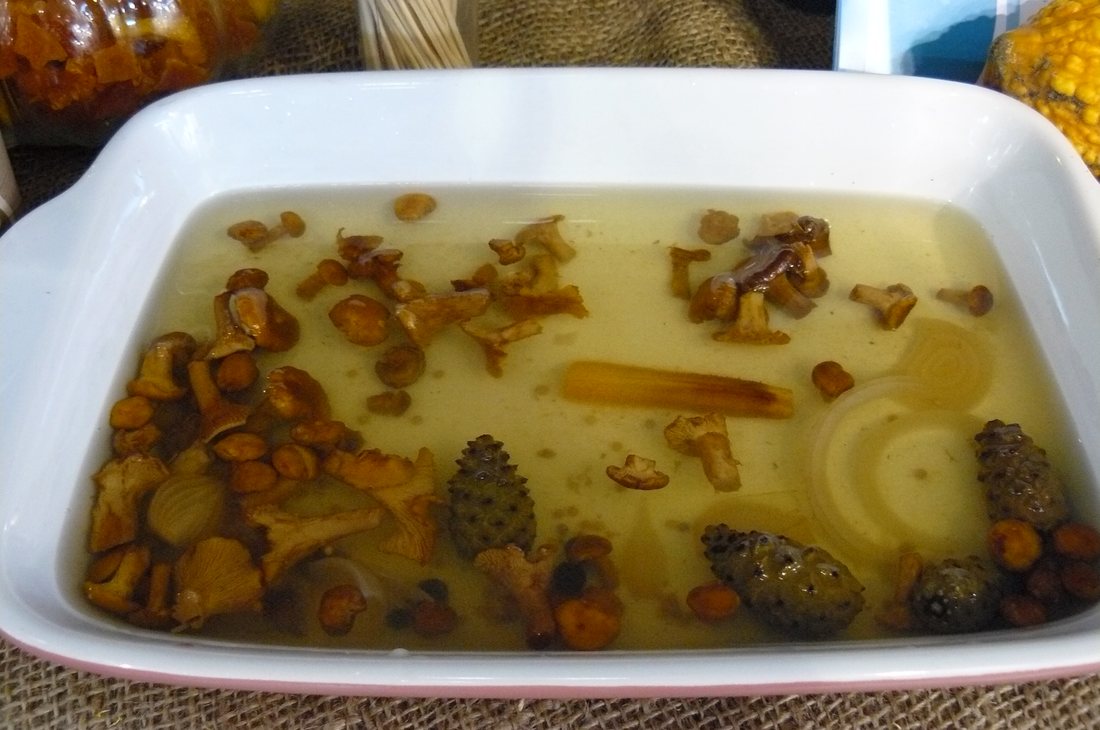
Mushrooms in brine at a regional food fair in Poznań, Poland.
The traditional Polish method for grzyby marynowane — boiled mushrooms packed hot into jars, covered with boiling spiced vinegar brine, capped and turned upside down to cool — has no processing step. Hot-filling and inverting a jar is not a tested method under US guidance, and it is not a reliable seal. The collection’s version is written as a refrigerator pickle for that reason: Polish Marinated Mushrooms. For shelf storage, the NCHFP recipe above is the tested choice.
Canning plain mushrooms: domestic only
The NCHFP does have a tested process for plain canned mushrooms, whole or sliced, in a pressure canner — 45 minutes for half-pints or pints, at 11 psi (dial gauge) or 10 psi (weighted gauge) up to 1,000 feet, with pressure rising with altitude. It is for cultivated mushrooms only. The NCHFP’s instructions say, in so many words: “Caution: Do not can wild mushrooms.” No tested process exists for them. (Why the process excludes them is not stated; it should not be guessed at.)
Salting
The Russian and Polish tradition of salting milk caps and saffron milk caps in crocks — letting them ferment under salt, as cabbage becomes sauerkraut — is a real and old practice, and the around-the-world page describes it. No tested process for it was found, the traditional salt proportions could not be verified, and the mushrooms involved include species that are only edible after careful preparation. It is described in this section, and no recipe is offered.
Ketchup
The Georgian answer to a glut was to turn it into a sauce that kept for years: salt the mushrooms, let them weep, boil the liquor down with spices, and bottle it. Mushroom Ketchup gives Eliza Acton’s recipe in her own words, with a modern note on keeping it safely — in the refrigerator.
In this dive: Forage at your own risk · What a mushroom is · The history · Around the world · Michigan · Morels · The giant puffball · Cooking mushrooms · Over the fire · Preserving · Corrections
Comments (0)