The Giant Puffball: A Soccer Ball on the Lawn
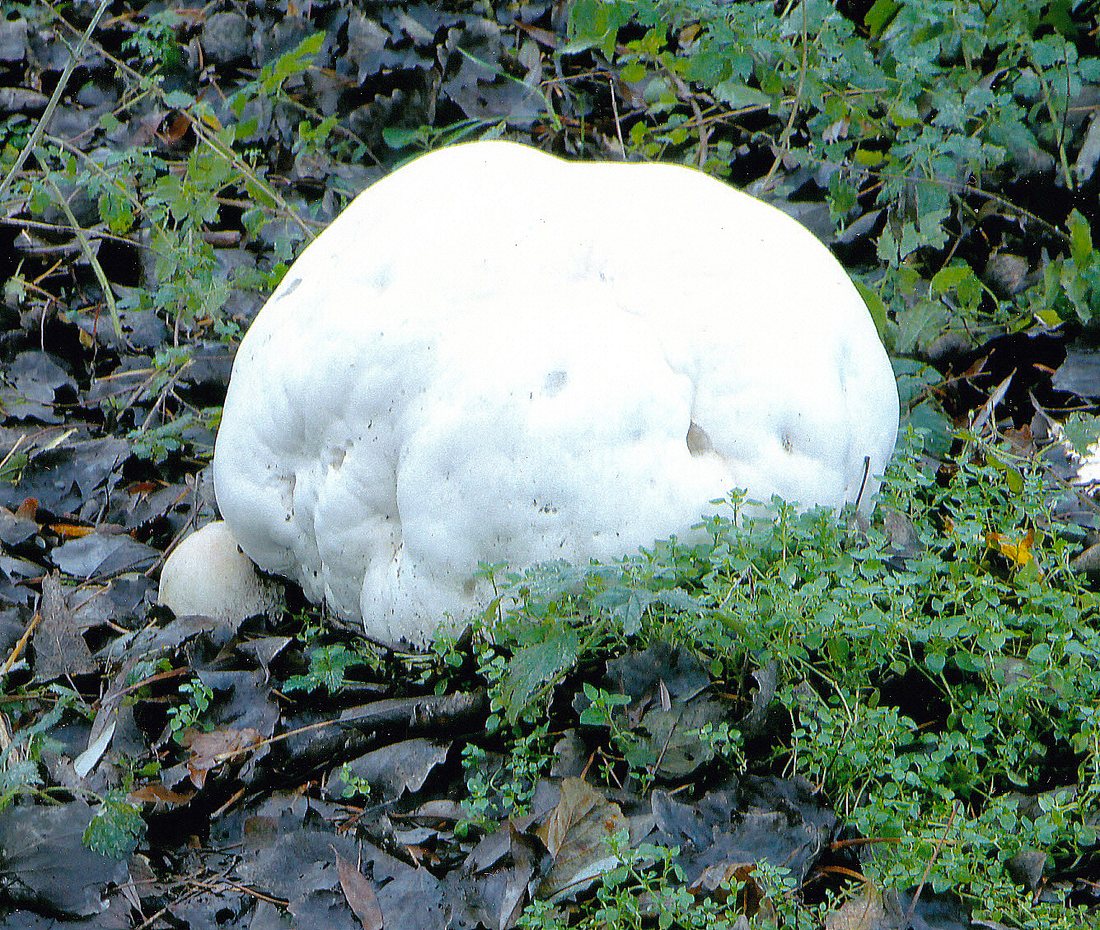
A giant puffball in the Netherlands, about the size that turns up on Michigan lawns in late summer.
The giant puffball, Calvatia gigantea, is the mushroom that makes people stop the car. It is a smooth, white, stalkless ball lying in the grass — the Midwest American Mycological Information society describes it as “somewhat resembling a large, white soccer ball” — and it is often the size of one. It is also one of the few wild mushrooms that a beginner can learn safely, provided one rule is followed without exception.
The one rule: slice it top to bottom
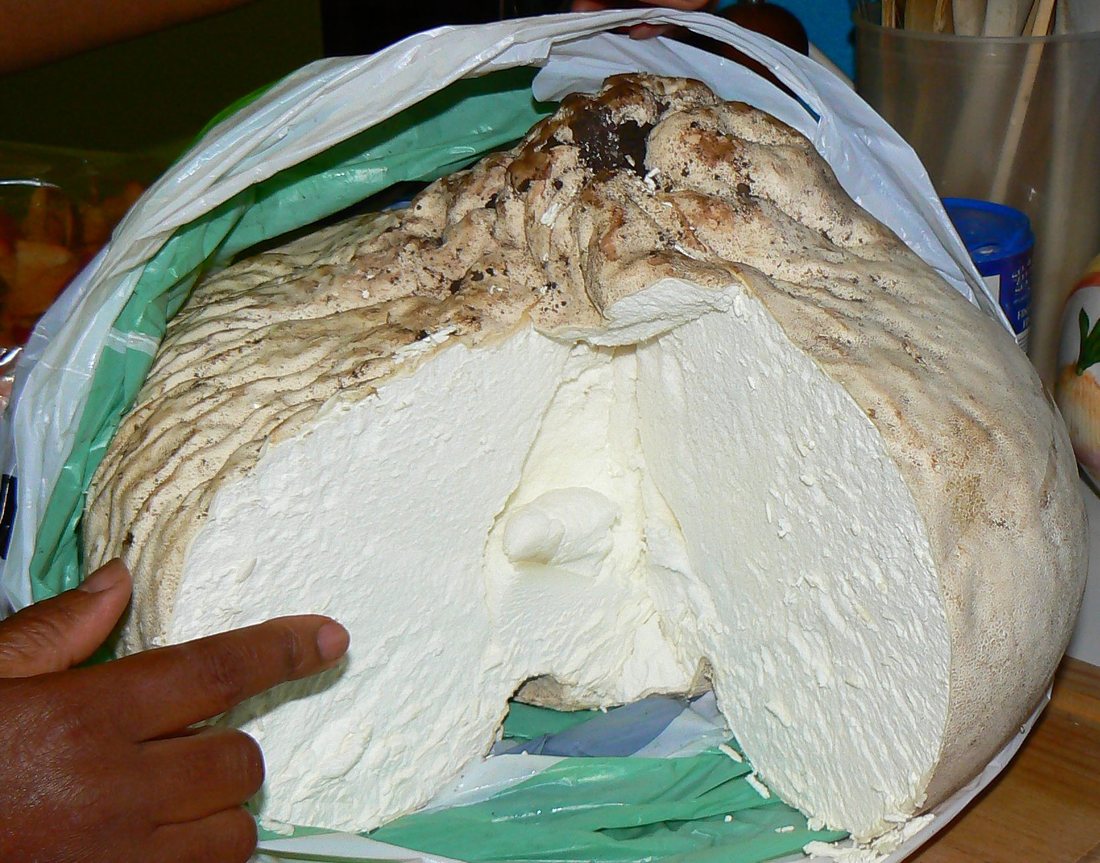
Cut open: solid, uniform white. That is the only edible stage.
A giant puffball is edible only while it is pure white and firm all the way through. Utah State University’s herbarium gives the check in one line: “Cut it open. It should have thick, hard, white flesh inside. Do not eat anything with a brown, black, purple, or yellow interior.”
The cut is made from the top to the bottom, through the centre — and every puffball gets it, every time. The reason is on the safety page: a young deadly Amanita starts life inside a white, egg-shaped membrane, and at that stage it can pass for a small puffball. MSU’s bulletin says it directly: “The egg-shaped button of the Amanita is encased in a thick membrane called a universal veil. At this stage, it can be mistaken for an edible puffball.” Sliced top to bottom, an Amanita egg shows the outline of a mushroom inside — a cap, gills and a stem, sketched in the flesh. A true puffball shows nothing but uniform white.
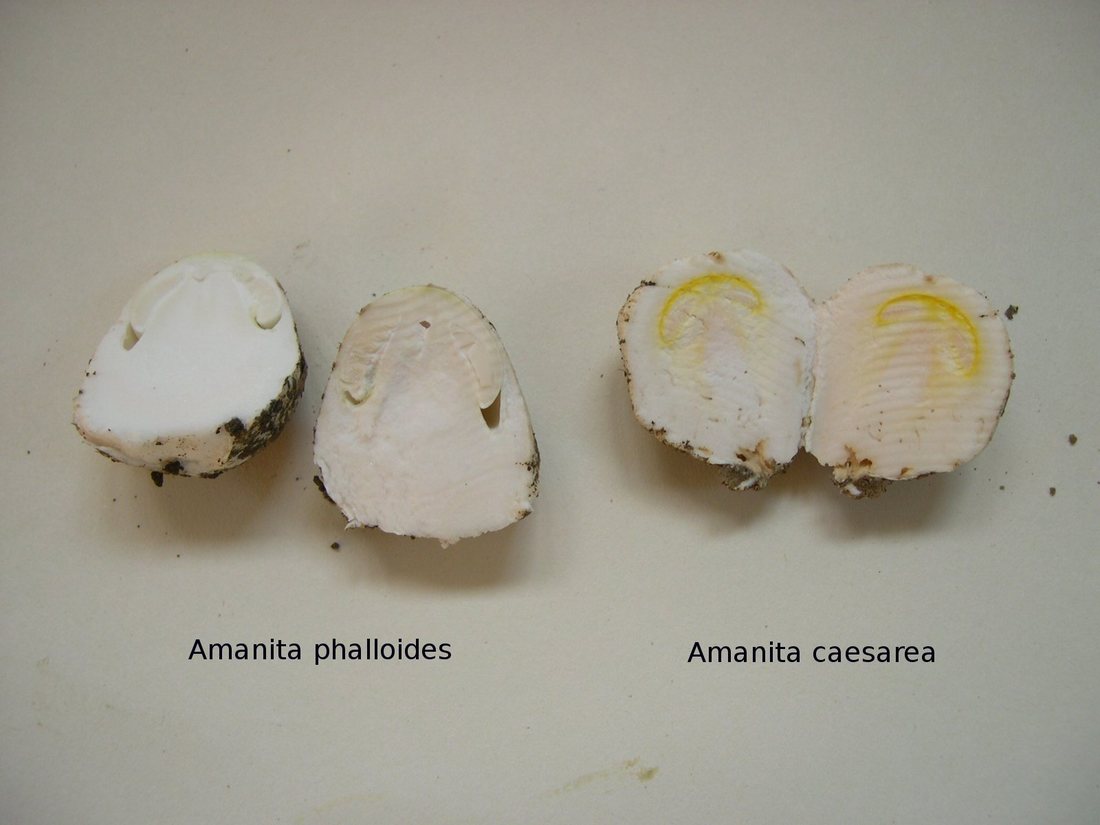
What a puffball must never look like inside: Amanita eggs cut top to bottom (death cap left, Caesar’s mushroom right), each with a mushroom sketched in the flesh.
Two other look-alikes are easier to rule out:
- Earthballs (Scleroderma) — the “false puffballs.” They are dark purple to black inside even when young, with a thick, tough skin. Mildly poisonous; NAMA records dogs killed by them.
- An old puffball — still a giant puffball, but past eating. As the spores mature, the white interior turns yellowish, then olive-green, then brown. MAMI says it is then “no longer edible, albeit not poisonous.” It should be left alone to do what it was doing.
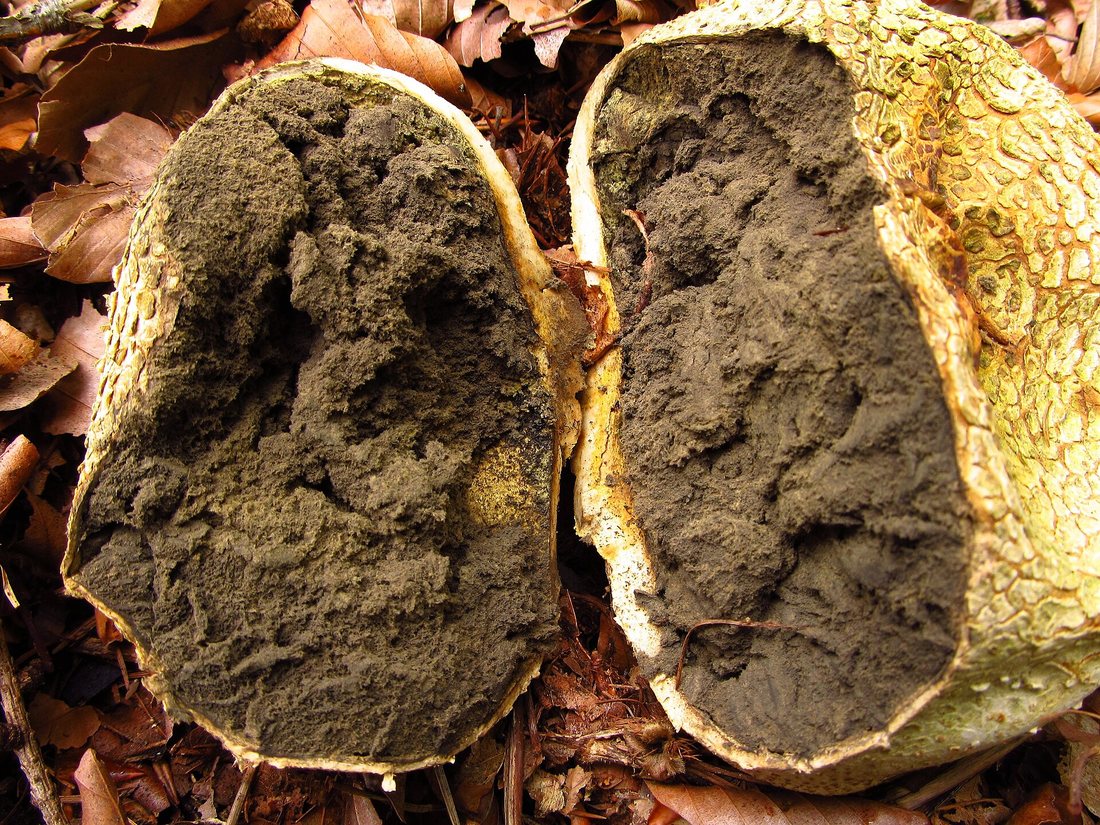
An earthball (Scleroderma) cut open: a thick rind and a dark interior even when young. Mildly poisonous.
The Amanita problem is the reason a small puffball deserves the most care. A giant puffball the size of a soccer ball is not going to be an Amanita egg — but the habit of slicing every one, whatever its size, is what protects against the one time it matters.
Where and when
Giant puffballs grow on grass litter in lawns, meadows, pastures, fields and the edges of woods, sometimes in rings. In Michigan they appear in late summer and autumn — no Michigan authority gives exact months, and the general North American pattern is late summer into fall. They grow fast and go over fast: a puffball found firm and white on Saturday may be yellowing by Wednesday.
How big they get. The Guinness record is a giant puffball 2.64 m (8 ft 8 in) in circumference, weighing 22 kg (48 lb 8 oz), found by Jean-Guy Richard in Montreal in 1987. A 2016 Ontario specimen reported at 52 pounds was never verified by Guinness. Typical specimens run from grapefruit to basketball size.
Seven trillion spores — and where that number comes from
Almost every account says a giant puffball holds “seven trillion spores.” The figure is real, and it comes from a single measurement.
In his Researches on Fungi (1909), the mycologist A. H. Reginald Buller took one dried puffball donated to the University of Birmingham — 40 × 28 × 20 cm, weighing 232 grams — counted the spores in a 0.1-gram sample, and multiplied. He got 7,500,000,000,000, then rounded down to allow for a missing piece: “it seems fairly safe to state that the puff-ball produced about 7,000,000,000,000 spores, or as many as would be liberated by about 4000 good-sized Mushrooms.” He added that a large giant puffball “is the most prolific organism living on our planet.”
So the famous number is one extrapolated estimate from one moderately sized, dried specimen, counted in 1909. A bigger puffball would hold more. “Several trillion” is the honest phrasing; “seven trillion” is Buller’s, and it deserves his name attached.
Older uses: tinder and wound dressing
Puffballs were used long before they were eaten in America’s suburbs. A 1983 survey of 102 ethnographies of North American peoples (W. R. Burk, Journal of Ethnobiology) found puffballs mentioned in 36, used for food, medicine, ritual and fire. Among the Great Lakes peoples:
- The Chippewa and Ojibwe used puffballs as a hemostat — to stop bleeding, including nosebleeds.
- The Menominee used a small puffball as a dusting powder, and believed its spore cloud could blind an enemy.
- The Meskwaki ate the giant puffball, and the Iroquois ate puffballs “especially in soups.”
- Across the continent, dried puffballs “were commonly used as tinder or punk for lighting fires.”
(A frequently repeated claim that the Lakota packed large wounds with puffball spores could not be found in Burk’s survey, and is not repeated as fact.)
Cooking a giant puffball
A fresh puffball has a texture somewhere between tofu and a marshmallow and a mild, earthy flavour. It drinks fat — which is both its weakness and the whole trick. The ways it is usually cooked:
- Slabs, “steaks,” seared or grilled — thick slices browned in butter until golden. The campfire version below is exactly this.
- Breaded and fried — Utah State’s herbarium calls frying in a batter the most common preparation. Fried slices layered with tomato sauce, béchamel and cheese become Puffball Parmesan, adapted from Alan Bergo, who insists: “Don’t skip the bechamel if you want the real deal.”
- As a pasta sheet — thin slices standing in for lasagne sheets are a common home idea, though no authoritative recipe was found for it.
Peeling the outer skin is common practice in recipes (some find it tough); no authority was found either way. Cook it through, as with every wild mushroom, and eat it fresh — a cut puffball deteriorates quickly. MAMI advises refrigerating whole specimens below 41 °F in paper or cloth, not plastic.
A field note: the Maple River puffball
On Sunday, 27 September 2026, a giant puffball about the size of a soccer ball was found in a yard at the edge of a grove of pine trees, just up from the Maple River in central Michigan, and cooked that afternoon over a campfire on a fishing trip. The photographs below were taken over about seven minutes, between 1:28 and 1:35.
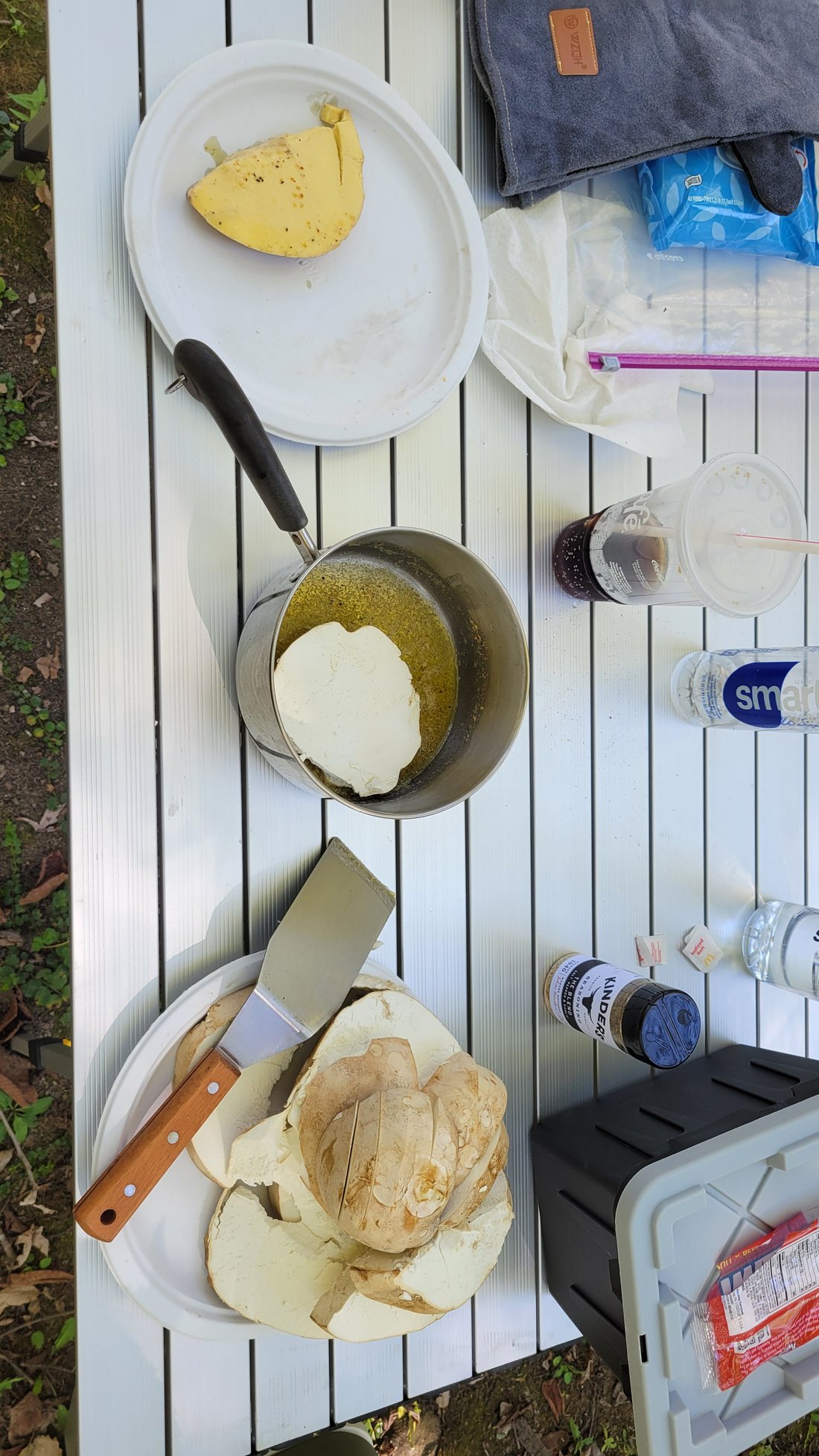
The Maple River puffball, 27 September 2026: pure white all the way through, and one slab going into the seasoned butter.
The preparation. The puffball was sliced into thick slabs — and the cut faces show exactly what the rule above demands: uniform, pure white flesh from edge to edge, with no outline, no yellowing and no dark core. The slabs were dipped, one at a time, into a small pot of melted butter with salt, pepper and garlic seasoning (SPG) stirred into it.
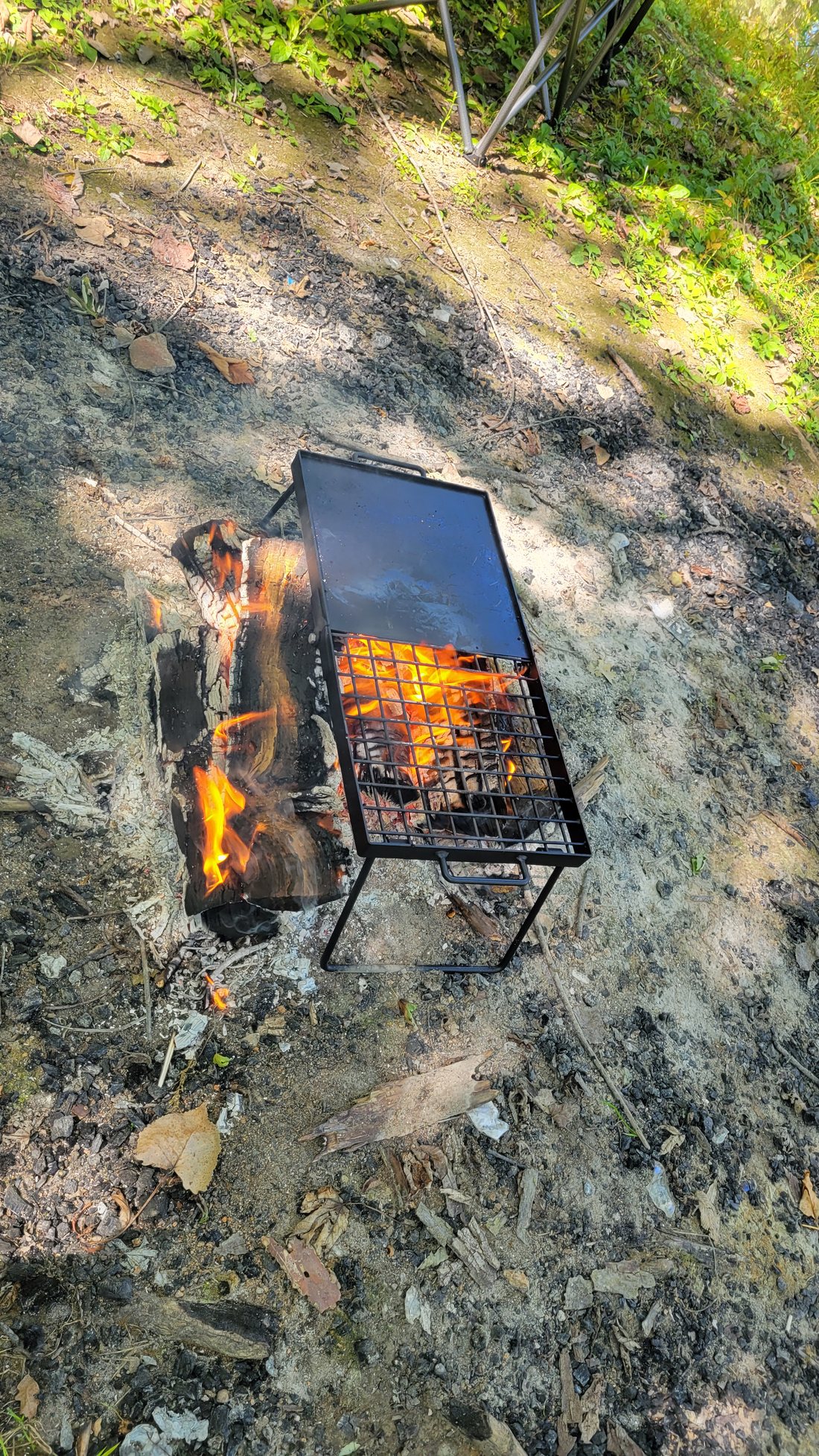
The fire: a folding camp grill over split logs. The slabs went on the open grate, not the griddle.
The fire. A folding camp grill — half solid griddle plate, half open grate — set over a split-log wood fire in a fire ring. The butter-dipped slabs went straight onto the grate, not the griddle.
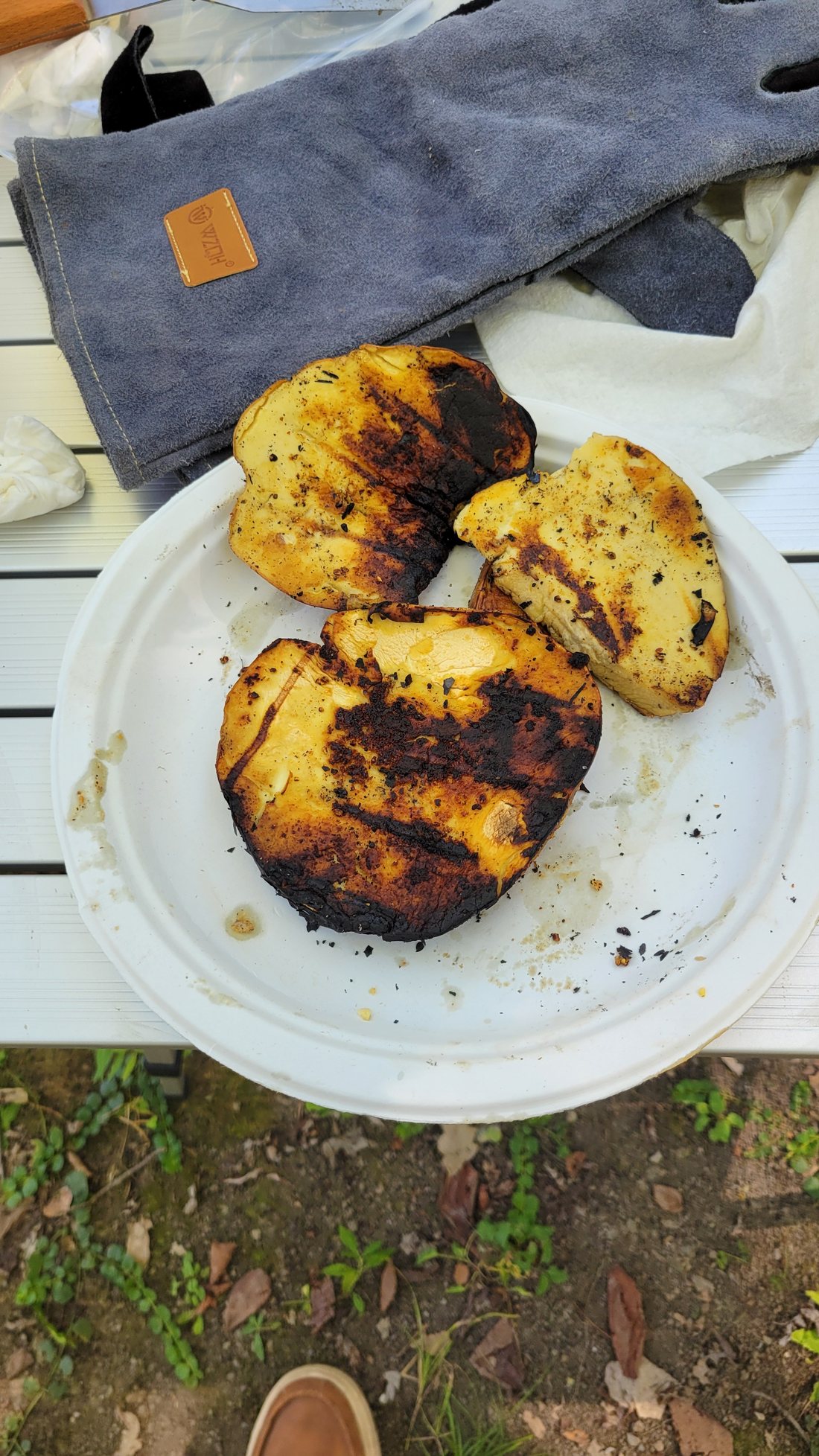
Finished: golden where the butter crisped, charred where the slabs met the bars.
The result. Golden where the butter crisped, charred black in stripes where the slabs touched the hot bars. Cooking on the open grate rather than in a pan gives a puffball something a skillet cannot: the butter drips off instead of being soaked back up, and the smoke and char give a mild mushroom a much stronger flavour.
The method is written up as the campfire puffball recipe. The general technique for cooking over a wood fire is on the fire page.
In this dive: Forage at your own risk · What a mushroom is · The history · Around the world · Michigan · Morels · The giant puffball · Cooking mushrooms · Over the fire · Preserving · Corrections
Comments (0)