Morels: The Mushroom Everyone Hunts
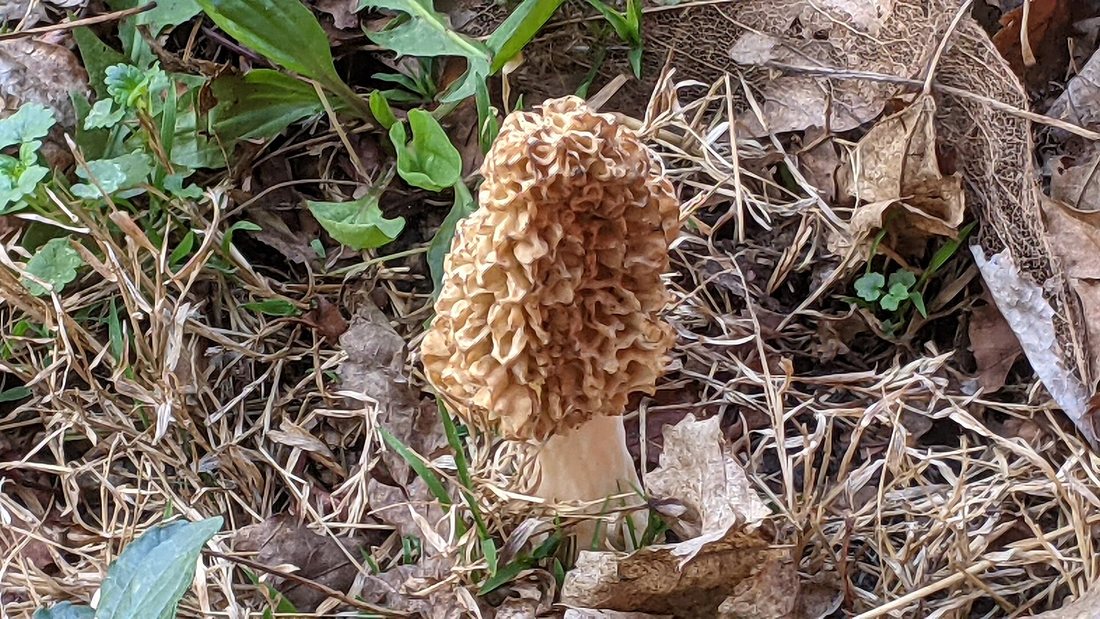
A yellow morel in spring leaf litter.
No mushroom is hunted with more devotion than the morel. It appears for a few weeks in spring, it will not be farmed on any scale Americans can buy, it resists every rule anyone tries to make about where it grows, and — cooked in butter — it tastes like nothing else in the woods. It also carries two warnings that the romance tends to hide: its most dangerous look-alike grows in the same woods at the same time, and the morel itself is poisonous raw.
True morel or false morel
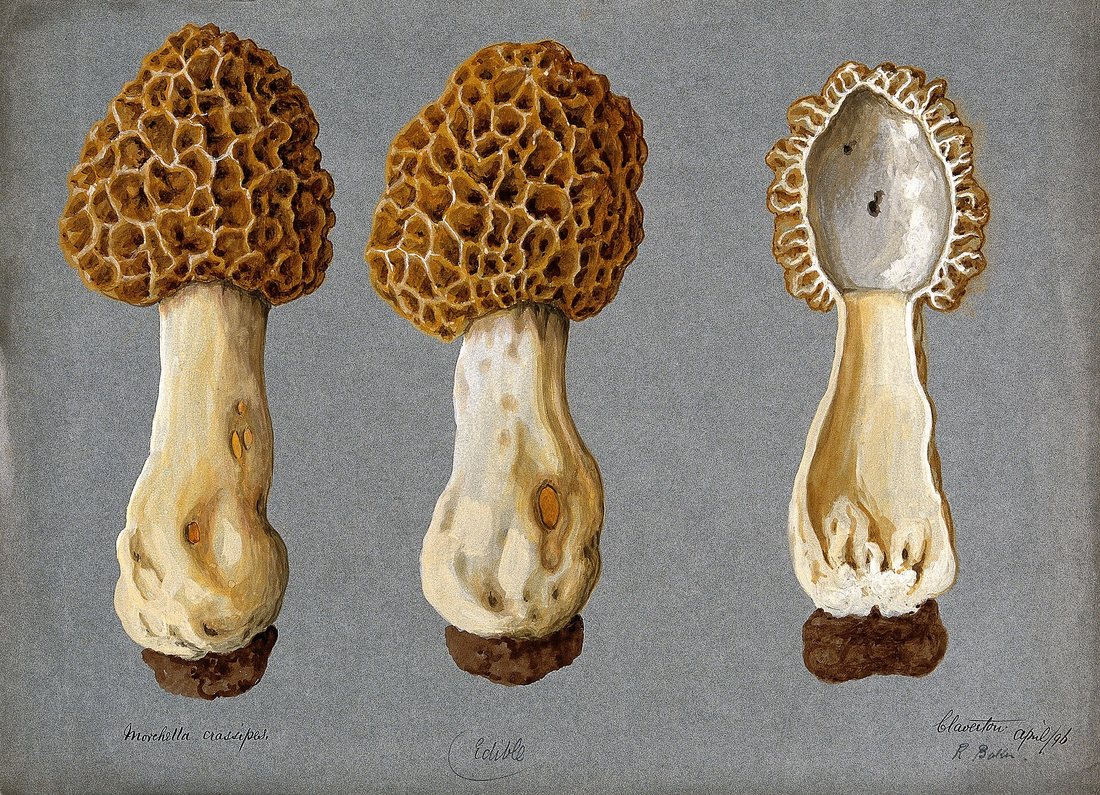
A watercolour, not a photograph: the right-hand morel is cut lengthwise, showing the one continuous hollow of a true morel.
The test that matters takes a knife and three seconds: slice every morel lengthwise, from the tip of the cap to the base of the stem. MSU Extension urges hunters to do exactly that “before cooking to verify your identification of it as a morel, and also to make sure there are no slugs or other invertebrates hidden inside the stem.”
- A true morel is hollow from the tip of the cap to the bottom of the stem — one continuous chamber. Its cap is covered in pits and ridges, “as if holes had been punched partway through” it (DNR), and the cap is fused to the stem at or near its base. In the half-free morel, the cap joins about halfway down.
- A Verpa (the “early false morel”) has a cap perched on top of the stem, attached only at the very top and hanging free “like a full skirt,” and its stem is stuffed with cottony tissue. It comes early — late April, before the leaves are out, often along stream banks. The DNR says it is not edible; MAMI calls it “slightly poisonous.”
- A Gyromitra (the true false morel) has a lobed, wrinkled, brain-like cap, not a pitted one, and the inside is chambered or cottony, not a single hollow. It is the poisonous one discussed on the safety page.
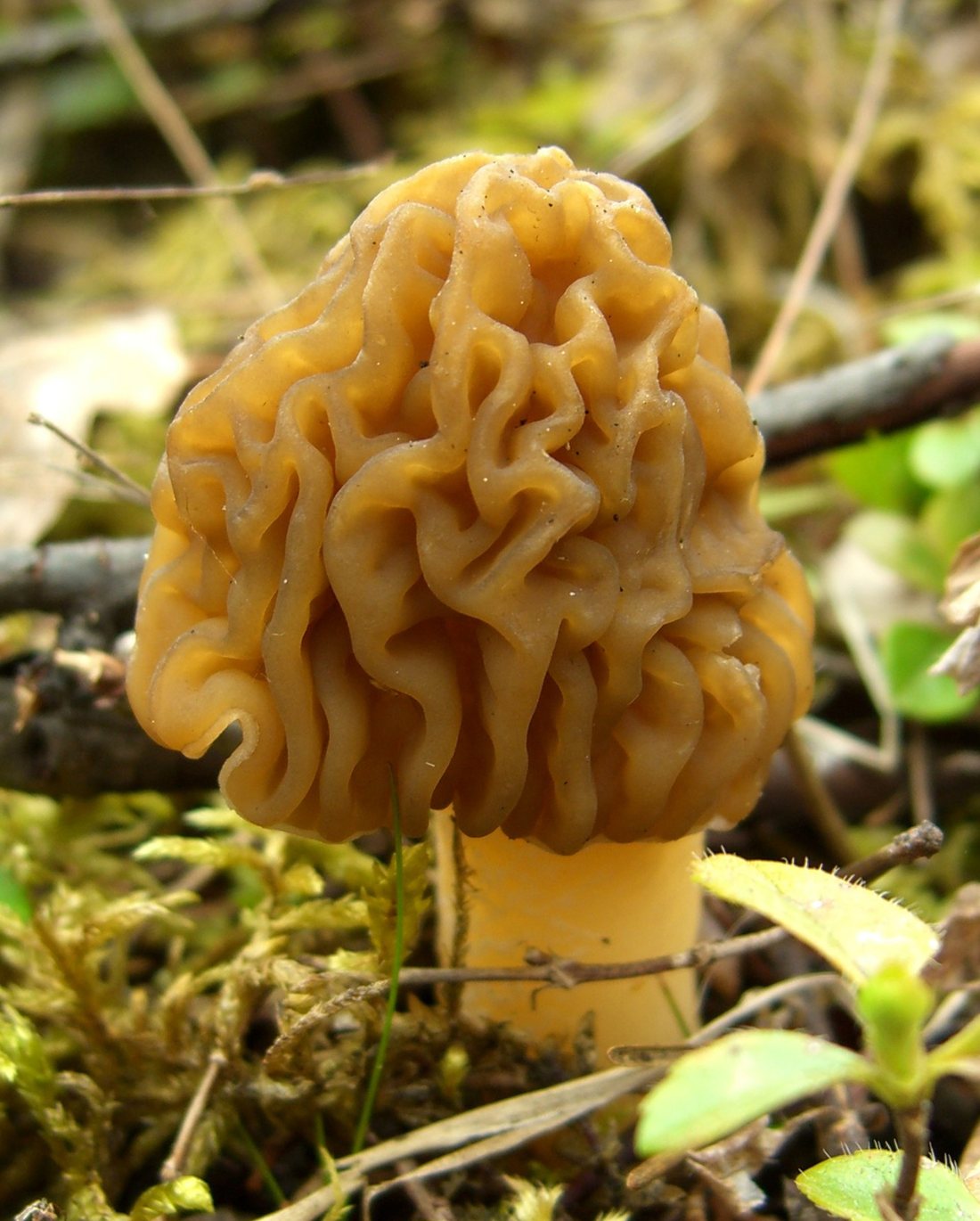
Verpa bohemica, the early false morel. Its cap is attached only at the top, and its stem is stuffed with cotton-like tissue.
One caution keeps the rule honest: burn morels can have a layered or chambered base, so the knife test is a strong guide, not a replacement for someone who knows the species. When unsure, the mushroom goes to an expert, not the pan.
Why a morel must be cooked
Morels are toxic raw. This has been known to mycologists for a long time — NAMA’s toxicology chair writes plainly that “morels (which are poisonous raw) must be well-cooked,” and MSU singles morels out as “particularly egregious” among edible mushrooms for causing illness when eaten raw. It became news in 2023.
Bozeman, Montana, March–April 2023 (CDC, MMWR 73(10), 2024):
- A restaurant served morels in a sushi roll — some raw, some “partially cooked” under a hot sauce and left to marinate.
- 51 people fell ill, including five employees. Three were hospitalised. Two died — both, the CDC notes, had chronic underlying medical conditions.
- A case-control study showed a dose-response effect — the more pieces eaten, the higher the risk — and raw morels were more strongly associated with illness than partially cooked ones.
- The morels were cultivated, imported fresh from China. They were not wild. And no toxin was identified: the CDC says the compounds in morels that cause illness “are not fully understood.”
France had already seen the same thing. French poison centres recorded, between 1976 and 2006, a distinct neurological syndrome after morel meals — tremor, dizziness, a drunk-like unsteadiness and visual disturbance, arriving about twelve hours after eating, usually after large quantities — separate from ordinary stomach upset. Between 2010 and 2020 they recorded 446 morel exposures and two deaths, both tied to imported cultivated morels; the authors suggest the shift from wild to cultivated morels “may have played a role.”
What this means in the kitchen: morels are cooked all the way through, every time — including over a campfire. Hank Shaw’s fried-morel recipe fries them “for at least 3 to 4 minutes per side… because morels must be fully cooked to be safe to eat.” The DNR’s own recipe is butter, halved morels and “about five minutes on each side.” No morel goes into a salad, a sushi roll, or a dish where it is only warmed through.
Two further notes, both honestly contested:
- Morels and alcohol. The DNR and MAMI both warn that black morels have caused stomach upset when eaten in quantity or with alcohol. NAMA’s toxicology chair, Michael Beug, writes that among the hundreds of people he has seen eat morels with a drink, “there has not been a single adverse reaction,” and attributes the reported cases to individual sensitivity. Both statements are recorded here; moderation settles it.
- Sensitivity can build. Beug also notes that some people develop a sensitivity to morels over time, with each meal producing a stronger reaction. A person who reacts once should stop.
Where morels grow — and why nobody quite knows
The field lore is consistent: dying elms, ash, old apple orchards, tulip trees, aspen, and the first spring after a forest fire. It works. What it does not do is explain the morel. For a century morels were described as partners of living trees; a 2025 genome study led from Michigan State University found that true morels carry the genetic signature of decomposers and lack the markers of a fungus that lives in partnership with roots. The dying elm matters, on this reading, because its roots are dying — and the burned forest because fire leaves a sudden flush of dead material and disturbed ground. MAMI still calls morel ecology unsettled.
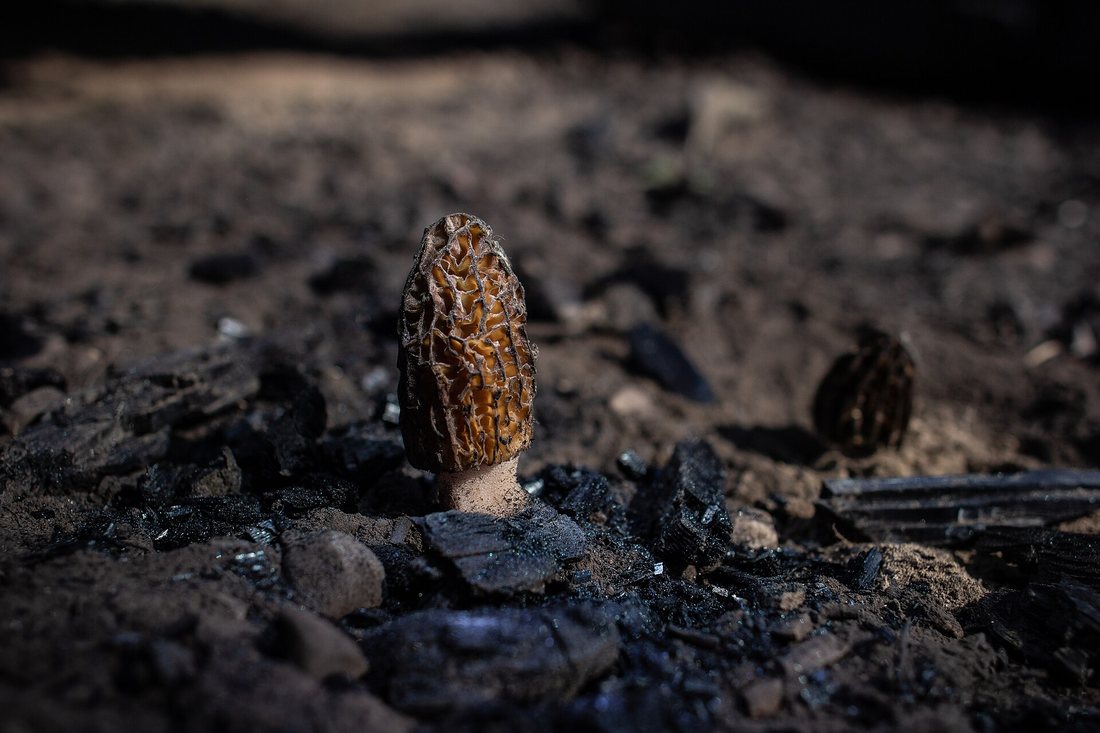
Morels on burned ground. Burn morels fruit the first spring after a conifer fire.
Two practical warnings come with the habitat:
- Old orchards may be contaminated with lead-arsenate pesticide residue, and morels concentrate lead 70 to 100 times (MAMI). The “dead apple orchard” advice is best retired for orchards of unknown history.
- Morel species cannot be told apart reliably in the field — a 2012 genetic study found nineteen North American species. Colour names (black, yellow, half-free) are field names, not species.
Growing morels: a Michigan patent and a Chinese boom
For most of history the morel could not be cultivated at all. Ronald Ower grew the first morel fruiting bodies in a controlled chamber at San Francisco State University, publishing in Mycologia in 1982. The patent that followed — US Patent 4,594,809, granted 17 June 1986 — was assigned to Neogen Corporation of Lansing, Michigan, and the method grew nutrient-rich hardened masses of mycelium, then triggered fruiting by starving and flooding them. Indoor morel production never became a large American industry.
China changed that outdoors. From about 2012, Chinese growers learned to grow black morels in open fields, feeding the mycelium with “exogenous nutrition” bags whose mechanism is still not fully understood. Output reached about 500 tonnes of fresh morels in 2015–16, and by the 2021–22 season about 16,466 hectares were under cultivation. Those cultivated imports are the morels in both the Montana and the French deaths. Cultivation has made morels cheaper and available in restaurants year-round; it has not made them safe to eat raw.
The price
Morel prices move with the season and the weather, and dated snapshots are more honest than a current figure. Michigan’s legislative analyses give two: “more than $20 per pound” in 1998, and “as much as $50 per pound” in 2016. Retail and vendor prices in 2025–26 sit well above that for fresh morels outside the Midwest peak, and dried morels vary enormously.
Cooking a morel
The flavour is nutty, earthy and faintly smoky, and it lives in fat — which is why the classic preparations all involve butter or a crust.
- Clean them. Slice lengthwise (the identification check), shake them in cool water to flush out grit and insects, and dry them well. Soaking in salt water is widely recommended, but no authority for it was found in either direction.
- Fry them. The Midwestern classic is a floured or crumbed morel fried in butter or lard. Hank Shaw’s version dredges in seasoned flour, egg and flour again, and fries in half an inch of fat at 325–350 °F for at least three to four minutes a side. Many Midwestern families use crushed saltine crackers in place of the second flour — a real regional practice, though one that turns up in recipe comments rather than cookbooks. The recipe is Fried Morels.
- In cream. Morels in butter and cream on toast — the French morilles à la crème family — is the other classic. The collection’s version, adapted from Hank Shaw’s “Morels Savoyard,” adds bacon and Gruyère: Creamy Morels on Toast.
- Dried. Drying concentrates the flavour, and dried morels rehydrate well. Alan Bergo’s morel butter — rehydrated morels and sherry worked into a pound of butter — was, in his words, “a restaurant secret I used to use to be able to afford to put morels on restaurant menus”: Dried Morel Butter.
- Over a fire. On the fire page, with the same rule: cooked through.
The collection also holds Salmon with Morel Vinaigrette.
In this dive: Forage at your own risk · What a mushroom is · The history · Around the world · Michigan · Morels · The giant puffball · Cooking mushrooms · Over the fire · Preserving · Corrections
Comments (0)