Corrections: What Almost Everyone Gets Wrong About Mushrooms
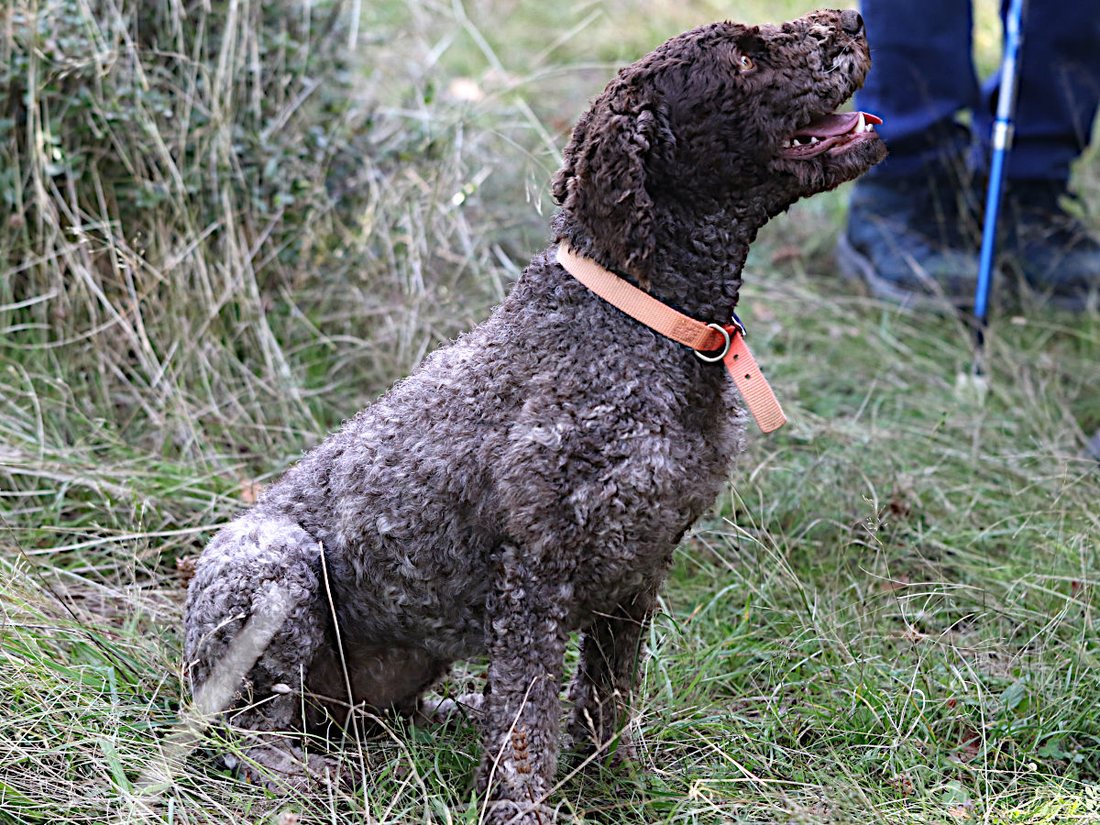
A truffle dog at work. The famous pig-and-pheromone explanation did not survive a field test.
This section found a great many confident claims that do not survive the evidence — some of them repeated by cookbooks, some by mushroom books, and a few by respectable institutions. They are collected here, each with what the record actually shows and an honest note on how firm that is. The corrections are the product. Anything genuinely contested is labelled as contested rather than resolved by preference.
Safety
1. “Cooking makes a poisonous mushroom safe.” — False for the ones that kill. Amatoxin, the toxin of the death cap and destroying angels, survives boiling, frying, drying and freezing. Colorado State University: the toxins “are not destroyed by drying or by cooking.” Confidence: high.
2. The folk tests — silver spoons, peeling caps, animals nibbling, “eat a little and wait.” — All false. Silver tarnishes from sulphur, not amatoxin; the death cap peels; slugs and squirrels eat deadly Amanita; and the deadliest toxins take six hours to three weeks to show. MSU: “THE ONLY RELIABLE WAY TO DISTINGUISH A POISONOUS MUSHROOM FROM AN EDIBLE ONE IS TO LEARN TO IDENTIFY THE INDIVIDUAL SPECIES.” Confidence: high.
3. “Death cap poisoning kills half its victims.” — Overstated, though still terrible. NAMA’s thirty-year registry found about 11% mortality among people who became ill, plus 3.5% needing a liver transplant. Confidence: high for North America under modern care.
4. “Morels are safe; it’s only false morels you need to worry about.” — Morels are poisonous raw. Undercooked morels caused 51 illnesses and 2 deaths in Bozeman, Montana in 2023 (CDC MMWR 73(10)), and French poison centres recorded two more deaths in 2010–2020. Cook every morel through. Confidence: high; the toxin itself is still unidentified.
5. “False morels kill people regularly in Michigan.” — Not in the recent record. The Michigan poison centre logged 118 false-morel cases from 2002 to 2020, with no deaths — mostly stomach upset, some liver injury (Vohra et al., 2024). They are still not to be eaten; every current authority says so. Confidence: high for the Michigan data.
6. “A phone app can identify a mushroom.” — About half the time. In a 2023 test on specimens from real poisonings, the best app was right 49% of the time; others, 35%; the death cap was misidentified three times. Confidence: high for the apps tested.
Biology and the kitchen
7. “Mushrooms are vegetables.” — In the kitchen, yes; in biology, no. Fungi are more closely related to animals than to plants (Baldauf & Palmer, PNAS, 1993). Confidence: high.
8. “Never wash mushrooms — they soak up water like sponges.” — Half right. Closed-cap mushrooms gain about 2% of their weight when rinsed (McGee; Serious Eats). Gilled mushrooms submerged for a minute gained up to 25% (America’s Test Kitchen). Rinse buttons; brush portobellos and shiitake; wash foraged mushrooms. Confidence: high.
9. “Never crowd the pan.” — Contested. Crowding delays browning; it does not prevent it, and a crowded, wet batch ends up less oily (Arnold & Norén, 2009). Both methods work. Confidence: moderate — the tests are kitchen tests, not controlled studies.
10. “Add more oil when the pan looks dry.” — Wrong. Raw mushrooms absorb oil early and release it once they collapse. Wait. Confidence: high.
11. “Overcooked mushrooms turn to mush.” — False. Chitin cell walls do not soften; a portobello steamed 40 minutes became 57% firmer (America’s Test Kitchen). Confidence: high.
12. “Button, cremini and portobello are different mushrooms.” — One species, Agaricus bisporus. “Portobello” is a marketing name from about 1986. Confidence: high.
13. “Dried shiitake contains its savoury flavour ready-made.” — Half true. The glutamate is there, but much of the guanylate is released by enzymes during heating, fastest between 60 and 70 °C (Sawada, 2003). How the soaking liquid is heated changes the result. Confidence: high for the mechanism; the popular home soak temperatures are unverified.
14. “Mushrooms have no vitamin D.” — It depends on the light. Grown in the dark, under 1 µg per 100 g; after 15–60 minutes in summer sun, roughly 17–33 µg (Cardwell et al., 2018). Confidence: high.
15. “Never reheat mushrooms.” — Outdated. Germany’s Federal Centre for Nutrition calls the rule a relic of poor refrigeration: keep leftovers no more than a day, and reheat to at least 70 °C for two minutes. Confidence: high.
History
16. “The pharaohs reserved mushrooms as plants of immortality.” — No evidence — no mushroom hieroglyph and no residue in any burial. Confidence: high that the evidence is absent.
17. “Claudius was murdered with a death cap passed off as Caesar’s mushroom.” — Contested at every step. The ancient sources describe poison placed on a mushroom and name no species; the death-cap theory dates from 1991; a 2002 medical paper argues he died of a stroke. Confidence: the story is unproven.
18. “The Romans prized the porcini.” — No. The Roman boletus was probably Amanita caesarea — and even that is a guess. The modern genus Boletus borrowed the name. Confidence: high.
19. “Wu Sangong invented shiitake farming a thousand years ago.” — Temple tradition. The documentary record is a Longquan county text of 1209; the founder figure was assembled over centuries and formally honoured by the industry in 2013. Confidence: high that the record and the legend are distinct.
20. “Paris mushrooms were grown in the catacombs.” — In the quarries. The Catacombs are one part of the tunnel network, used as an ossuary. The date of the move underground varies from 1810 to 1814. Confidence: high on the quarries; the date is unresolved.
21. “La Varenne invented duxelles.” — Not in his book. The attribution has no evidence behind it; the name honours the marquis d’Uxelles by tradition. Confidence: high that the attribution is unsupported.
22. “Ketchup began as a mushroom sauce.” — No. The first English recipe (Eliza Smith, 1727) is anchovy, shallot and vinegar; mushrooms arrive a few years later. The word is usually traced to a Hokkien fish brine, though that is disputed. Confidence: high on the 1727 recipe.
23. “Scandinavians have always loved chanterelles.” — A modern love. Pre-industrial Swedish peasants ate no wild mushrooms at all, and resisted campaigns to change that for a century (Svanberg & Lindh, 2019). Confidence: high.
24. “Pigs find truffles because truffles smell like a boar’s sex hormone.” — Did not survive the field test. The pheromone is in truffles (1981), but buried-sample trials found pigs and dogs located dimethyl sulphide and truffle flavouring, not the pheromone (1990). Confidence: moderate — one decisive study.
25. “Specialty mushrooms are booming in America.” — Not in the USDA’s figures. Tracked US specialty sales were $106 million in 2017–18 and $95 million in 2024–25. Small growers are under-counted, but the white button still dominates. Confidence: moderate.
Michigan
26. “The morel is Michigan’s state mushroom.” — Michigan has none. A 1998 bill (HB 4805) proposed the morel as “official state fungus” and never passed. Minnesota made the morel its state mushroom in 1984. Confidence: high.
27. “There’s a 25-pound limit on mushrooms from Michigan state land.” — Unconfirmed as a statewide rule. The figure appears in a 2016 rules summary for state game areas, not in the state-park rule or on the DNR’s current foraging page. Confidence: the limit’s scope is genuinely unclear; check the posted rules.
28. “Michigan certifies 21 mushroom species for sale.” — Twenty in the current study guide. The “21” dates from the program’s 2015 launch. Confidence: moderate.
29. “Hunt the old apple orchards.” — Still finds morels, but orchards sprayed with lead arsenate can contaminate them; morels concentrate lead 70–100 times (MAMI). Confidence: moderate.
30. “Morels live in partnership with elms and ash.” — Contested. A 2025 MSU-led genome study found true morels have decomposer genomes and no markers of a partnership. Confidence: the question is open, and leaning away from partnership.
31. “A giant puffball has seven trillion spores.” — One 1909 estimate. Buller counted a single dried puffball and rounded 7.5 trillion down to “about 7,000,000,000,000.” Real, but not a constant for the species. Confidence: high on the origin.
What could not be verified
For the record, these were looked for and not settled:
- The exact date Chambry moved mushroom growing into the Paris quarries (1810–1814).
- Who founded Kennett Square’s mushroom industry, and when (William or J. Bancroft Swayne; 1885 or 1896).
- Who found the white Agaricus mutant (Lewis Downing in 1926, or L. F. Lambert in 1925).
- The reported US ban on importing live shiitake cultures until 1972.
- The Orthodox fasting calendar as the cause of Russian mushroom culture.
- Popular temperatures for soaking dried shiitake.
- The founding year and story of Boyne City’s morel festival.
- Whether the Lakota packed wounds with puffball spores.
- The world production share of the button mushroom (sources range from about 15% to over 60%).
In this dive: Forage at your own risk · What a mushroom is · The history · Around the world · Michigan · Morels · The giant puffball · Cooking mushrooms · Over the fire · Preserving · Corrections
Comments (0)