Over the Fire: Mushrooms at Camp
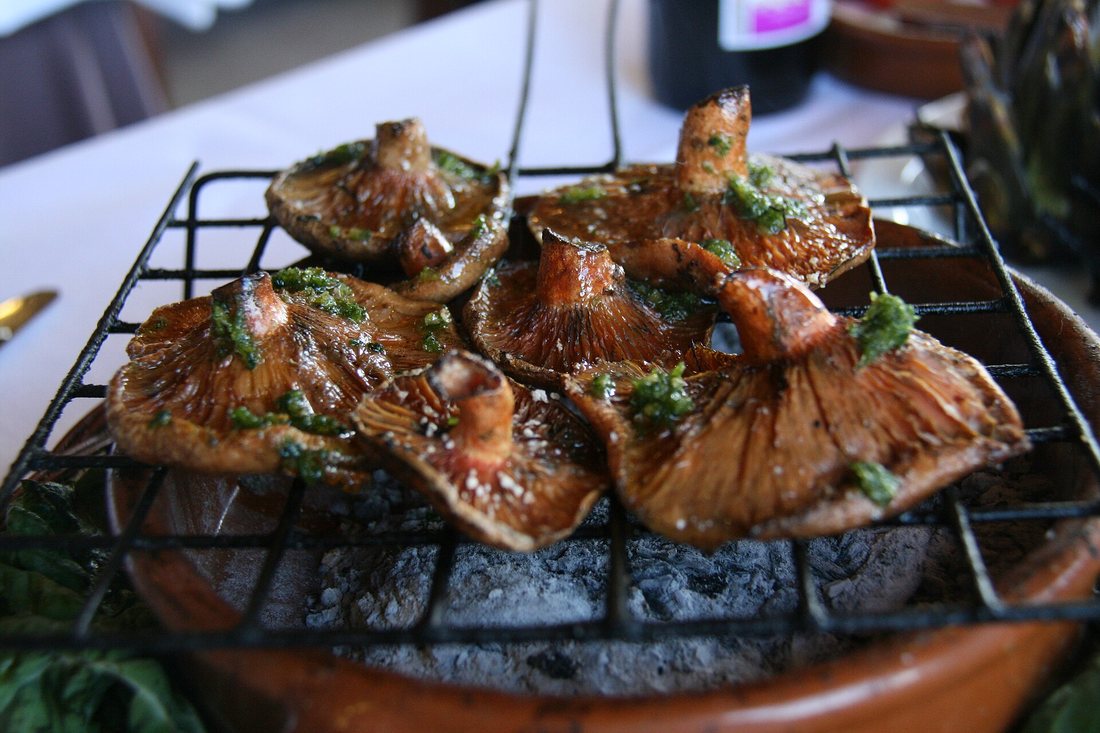
Saffron milk caps (rovellons) grilled over coals, Catalan-style.
Mushrooms and campfires belong together for a practical reason: the best wild mushrooms are found a long way from a kitchen, and they do not keep. A morel picked in the morning or a puffball found by the tent is at its best that day. Cooking it over the fire is not a novelty — it is the freshest mushroom that person will ever eat.
A note on sources. Much of what follows about managing a wood fire is long-standing outdoor-cooking practice rather than anything an extension service has measured; it is presented as practice. The food-safety points and the mushroom-specific rules are sourced, and are marked as such.
Two rules that do not bend at camp
- Identification does not relax because the pan is outdoors. Every rule on the safety page applies, and a mushroom found near camp is still sliced and checked — the puffball top to bottom, the morel lengthwise — before it goes near the fire.
- Wild mushrooms are cooked through. This matters most for morels, which are poisonous raw; undercooked morels were behind the 2023 Montana outbreak described on the morels page. A campfire makes undercooking easy: the outside chars while the inside is still cool. A morel on the fire gets the same three to four minutes a side it would get on a stove — and a thick puffball slab gets flipped until it is hot and soft all the way through.
Managing a wood fire (practice)
- Cook over coals and small flame, not over a roaring fire. A fire built an hour earlier and allowed to burn down gives a bed of coals with steady, even heat. Big flames blacken the outside of a mushroom before the inside cooks.
- Hardwood makes better coals than softwood. Oak, maple and fruitwood burn down to long-lasting coals; pine and other softwoods burn fast and sooty.
- Build two zones. Push most of the coals to one side for high heat and leave a cooler side where food can finish without burning.
- The hand test. Held a few inches above the grate, a hand that must be pulled away in about two seconds means high heat; four to five seconds, medium; six or seven, low. It is imprecise, and it is what outdoor cooks have used for generations.
Grate, griddle, cast iron or foil
Each surface does something different, and the choice follows from how much water the mushroom holds and how much fat it should keep.
- The open grate gives char, smoke and drip. Fat runs off instead of pooling, so a fat-hungry mushroom — a puffball slab, a thick portobello — is basted, browned and flavoured by the smoke without becoming greasy. It needs mushrooms big enough not to fall through: slabs, whole caps, or skewers.
- A griddle plate or cast-iron pan over the coals behaves like a stove. Everything on cooking mushrooms carries over — let the water cook off first, and the fat that seemed to vanish will come back out. Bacon rendered first in the pan is the traditional camp fat.
- A grill basket keeps small or sliced mushrooms on the grate.
- Foil packets steam rather than brown. They are forgiving and they keep all the juices, but they will not give a crust. A tested version — sliced mushrooms, olive oil, garlic, oregano, sealed in heavy-duty foil with a few holes in the top — cooks on a hot grill for about 8 minutes pierced side up, then 2–3 minutes flipped. Directly on coals, times vary too much to state. The recipe is Campfire Mushroom Foil Packets.
Fats
Butter tastes best and burns fastest; oil tolerates more heat; clarified butter (ghee) does both, which is why it travels well. Commonly quoted smoke points — around 350 °F for butter, around 450 °F for ghee — vary by source and were not independently verified here. Over an open fire, a practical approach is to brush or dip in butter and let the grate take it, rather than frying in a pool of it — which is exactly the method in the field note below.
Food safety at camp (sourced)
- The cooler. The USDA’s Food Safety and Inspection Service: perishable food should not sit above 40 °F “for more than 2 hours, or 1 hour if it’s a hot day (above 90 F).” That covers butter, meat and cooked mushrooms alike.
- Freshly picked mushrooms keep best in paper or mesh bags, not plastic, which traps moisture and hastens decay (DNR, MAMI).
- Keep one raw specimen of anything newly tried, in paper, in the cooler — as MSU advises, it is how a doctor would identify it if something went wrong.
Morels over a fire
A cast-iron pan of butter on the coals, morels halved lengthwise, and patience: about five minutes a side, as the DNR’s own recipe puts it, until they are browned and cooked through. Dredged in seasoned flour (or crushed saltines) and fried in half an inch of lard or butter, they become the camp version of Fried Morels — three to four minutes a side at minimum.
Field note: puffball steaks on the grate
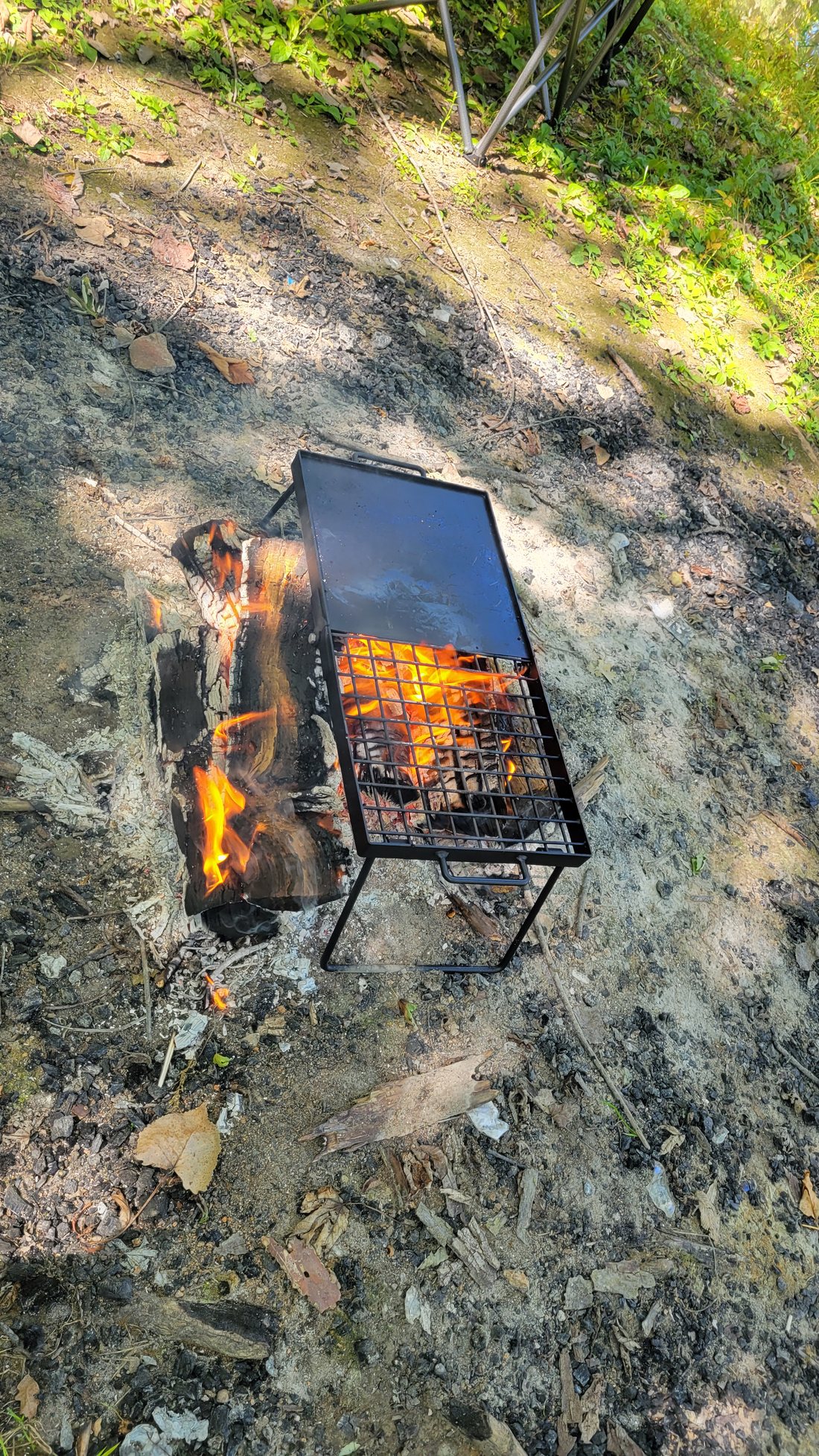
The fire: a folding camp grill over split logs. The slabs went on the open grate, not the griddle.
On a fishing trip in late September 2026, along the Maple River in central Michigan, a soccer-ball-sized giant puffball was cooked on exactly this kind of fire. The method was simple:
- Checked: sliced into thick slabs, each one pure white throughout.
- Dipped: each slab into a pot of melted butter with salt, pepper and garlic seasoning stirred in.
- Grilled: straight onto the open grate of a folding camp grill over a split-log fire — not the griddle half beside it.
- Turned until golden, with dark char lines where the slabs touched the bars.
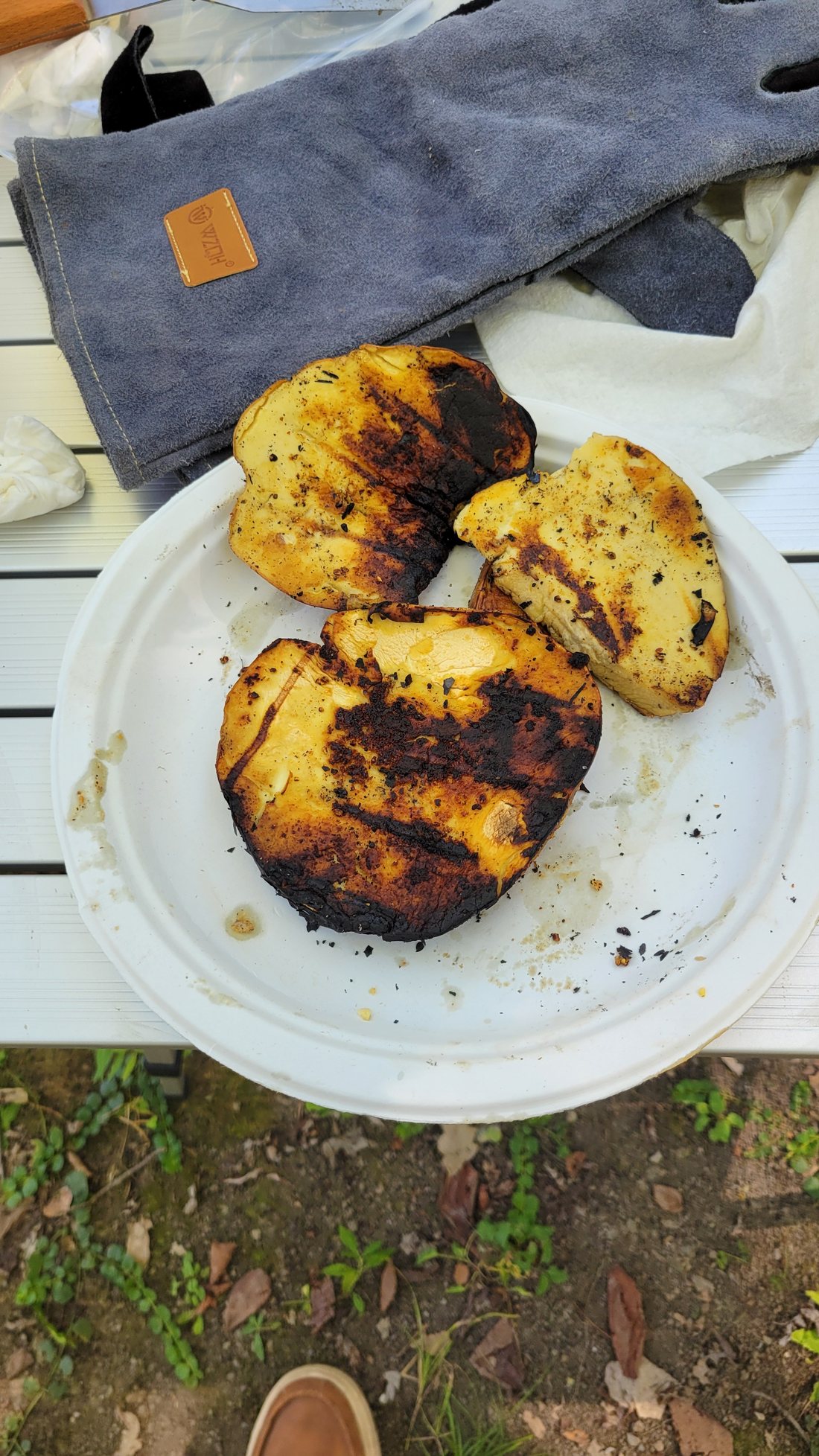
Finished: golden where the butter crisped, charred where the slabs met the bars.
The grate matters. A puffball in a pan drinks butter and gives it back slowly; on the grate the excess drips into the fire, and the flare-up and smoke season a mild mushroom far more than a pan can. The full account is on the giant puffball page, and the recipe is the campfire puffball steaks.
In this dive: Forage at your own risk · What a mushroom is · The history · Around the world · Michigan · Morels · The giant puffball · Cooking mushrooms · Over the fire · Preserving · Corrections
Comments (0)