What a Mushroom Is — and Why It Cooks Like Nothing Else
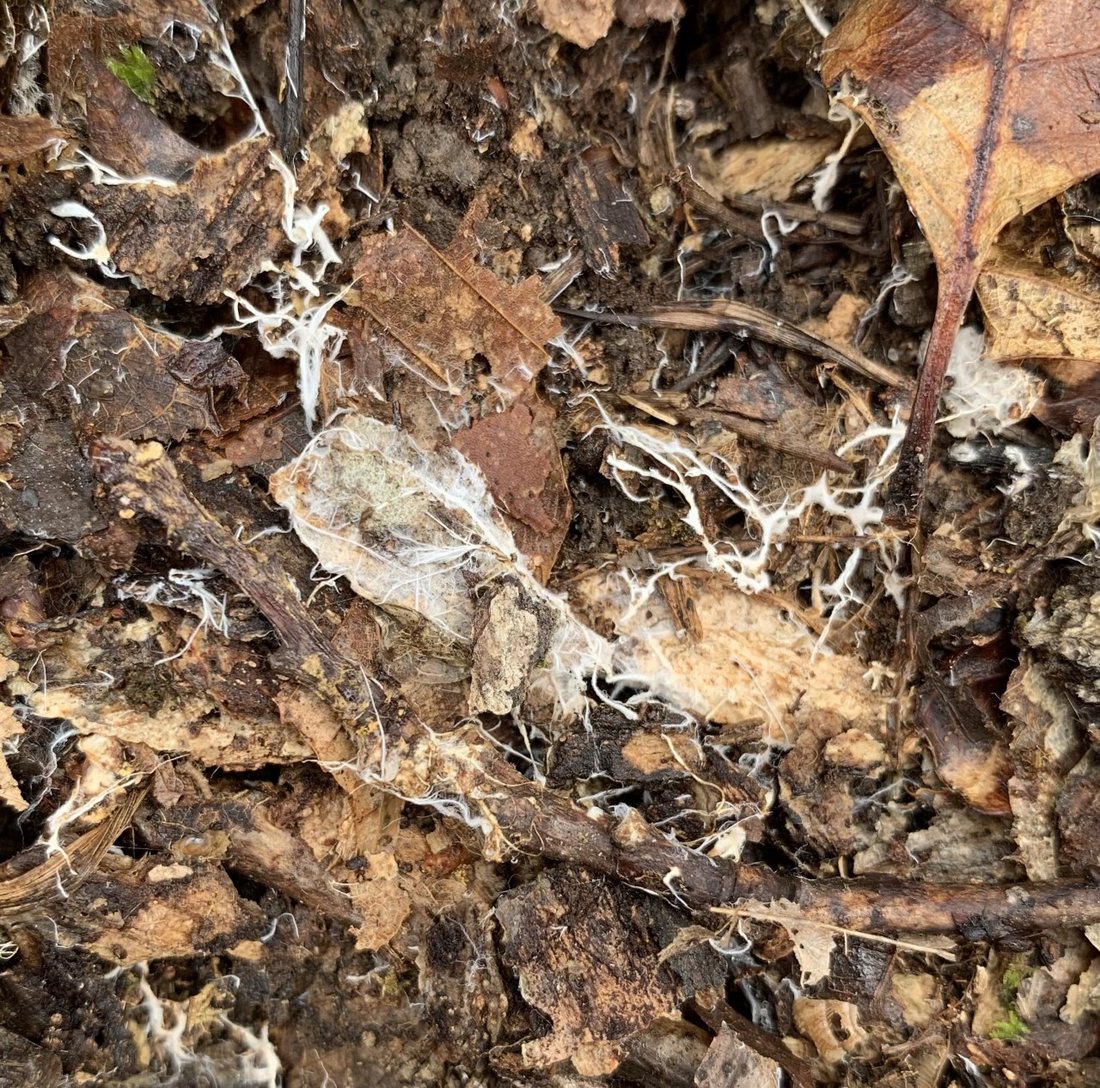
Mycelium in the leaf litter: the organism itself. The mushroom is only its fruit.
A mushroom behaves differently from every other ingredient in the kitchen. It will not turn to mush however long it cooks. It drinks oil and then gives it back. Dried, it becomes more flavourful than fresh. Left on a sunny windowsill, it makes vitamin D. Each of those oddities follows from what a mushroom actually is, and none of it follows from treating it as a vegetable.
The mushroom is the fruit, not the organism
The thing that is picked and cooked is the fruiting body — the reproductive structure of a fungus, raised briefly above ground to scatter spores. The organism itself is the mycelium: a network of fine threads called hyphae running through soil, wood or compost, sometimes for years, sometimes across acres. Utah State University’s extension service uses the right comparison: the mushroom is to the mycelium what an apple is to the tree.
That is why a patch produces again in the same place, why morels appear after a disturbance to the ground, and why picking a mushroom — cutting or twisting it off — does not kill the thing that made it.
Closer to animals than to plants
Fungi are more closely related to animals than to plants. This is not a figure of speech. In 1993, Sandra Baldauf and Jeffrey Palmer compared 25 proteins across the kingdoms of life and found molecular signatures — including a 12-amino-acid insertion in the protein elongation factor 1α — shared only by animals and fungi (PNAS 90:11558). Their conclusion was blunt: “animals and fungi are each other’s closest relatives.” The group the two kingdoms share has a name, Opisthokonta, and repeated studies since have confirmed it.
So “mushrooms are vegetables” is a kitchen category, and a useful one, but it is not biology. The biology explains the cooking.
Chitin: why a mushroom will not turn to mush
Plant cells are walled with cellulose and pectin, and cooking dissolves the pectin — which is why a carrot goes soft and a zucchini collapses. Fungal cell walls are built from chitin, the same tough polymer that forms insect shells and crab carapaces, bonded to glucans. One analysis of the white button mushroom’s cell wall found it 43% chitin. Chitin does not soften with heat.
America’s Test Kitchen measured the consequence. They steamed equal planks of portobello, beef tenderloin and zucchini for 40 minutes and ran them through a texture analyser:
| After 40 minutes of steaming | Change in firmness |
|---|---|
| Beef tenderloin | 293% tougher |
| Zucchini | 83% softer |
| Portobello | 57% tougher — and still pleasant |
A mushroom is very hard to overcook. It can be burned or dried out, but it will not dissolve. That makes mushrooms forgiving in long braises and stews, and it is why a mushroom in a sauce keeps its bite after hours on the stove.
Mostly water
A raw white button mushroom is about 92% water by USDA’s analysis; enoki, the driest common mushroom, is still close to 88%. The water is held in the hyphae, which are riddled with tiny air pockets. Both facts shape the frying pan:
- Cooking releases the water. Heat damages the hyphae, water floods out, the air pockets collapse, and the mushrooms shrink — often to less than half their raw volume. Nothing browns until that water is gone, which is why mushrooms dropped into a pan first steam, then squeak, and only then turn golden.
- The air pockets drink fat. Raw mushrooms soak up oil like a sponge — until the pockets collapse. Then they give much of it back. That single observation overturns a lot of kitchen advice, and the details are on cooking mushrooms.
The washing question is more nuanced than the old rule. Closed-cap mushrooms rinsed under the tap gain only about 2% of their weight. Gilled mushrooms are different: America’s Test Kitchen found portobellos, shiitake and oysters submerged for one minute took up as much as 25%. Rinse the buttons; brush the ones with open gills; wash foraged mushrooms, because they come with grit and insects.
Umami, and a flavour that is made in the pot
Mushrooms are savoury because they carry glutamate, the amino acid responsible for the taste now called umami. Many also carry 5′-guanylate, a nucleotide identified in 1957 by Akira Kuninaka as an umami compound and later traced to shiitake.
The two together are the interesting part. Glutamate and guanylate amplify one another: in human taste tests, a mixture tastes around eight times as savoury as glutamate alone. That synergy is why a Japanese stock made from kombu (rich in glutamate) and dried shiitake (rich in guanylate) tastes far deeper than either alone.
The best finding in the research for this section is that much of the guanylate in a shiitake broth does not exist until the broth is heated. A Japanese cookery-science review by Takako Sawada (Journal of Cookery Science of Japan, 2003) sets out the chemistry:
- Guanylate is released from the mushroom’s RNA by an enzyme (a nuclease) that keeps working up to about 60 °C (140 °F).
- A second enzyme (a phosphatase) destroys guanylate, turning it into a tasteless compound — and that one works at lower temperatures and is deactivated above about 40 °C.
- So the flavour builds fastest as the soaking liquid passes through 60–70 °C (140–160 °F). In the laboratory, heating rehydrated shiitake steadily, at about 4 °C per minute, produced the most; heating much faster (a microwave) or much slower produced less.
The practical translation: soak dried shiitake cold, then bring the soaking liquid up to heat gently rather than blasting it. Precise home temperatures for the soak itself are widely repeated by producers but were not independently verified here, so they are not printed.
Drying also concentrates what is there. Fresh shiitake carries about 70 mg of glutamate per 100 g; dried, about 1,060 mg — roughly fifteen times as much by weight, because 90% of the weight left as water. The trade knew this long before chemistry did: a 1982 US Forest Service paper notes that fresh shiitake at $1.50 a pound and dried at $15 were considered “equivalent value.”
A mushroom makes vitamin D in the sun
Mushrooms contain ergosterol, the fungal counterpart of cholesterol. Ultraviolet light converts it into vitamin D2 — the same chemistry by which sunlight makes vitamin D in human skin. The numbers, from a 2018 review in Nutrients (Cardwell et al.):
- Ordinary supermarket mushrooms, grown in the dark: under 1 µg per 100 g.
- Sliced mushrooms set in summer sun for 15 minutes: about 17 µg per 100 g; after an hour, about 33 µg — more than a day’s recommended intake in a single serving.
- Commercially UV-treated mushrooms: far higher still.
- Pan-frying keeps about 88% of it; boiling and baking, about two-thirds.
The review notes that how much is made depends on exposure, and on how the gills are turned and how much surface faces the light — so slicing them and setting them gills-up is sound advice rather than folklore.
Button, cremini and portobello are one mushroom
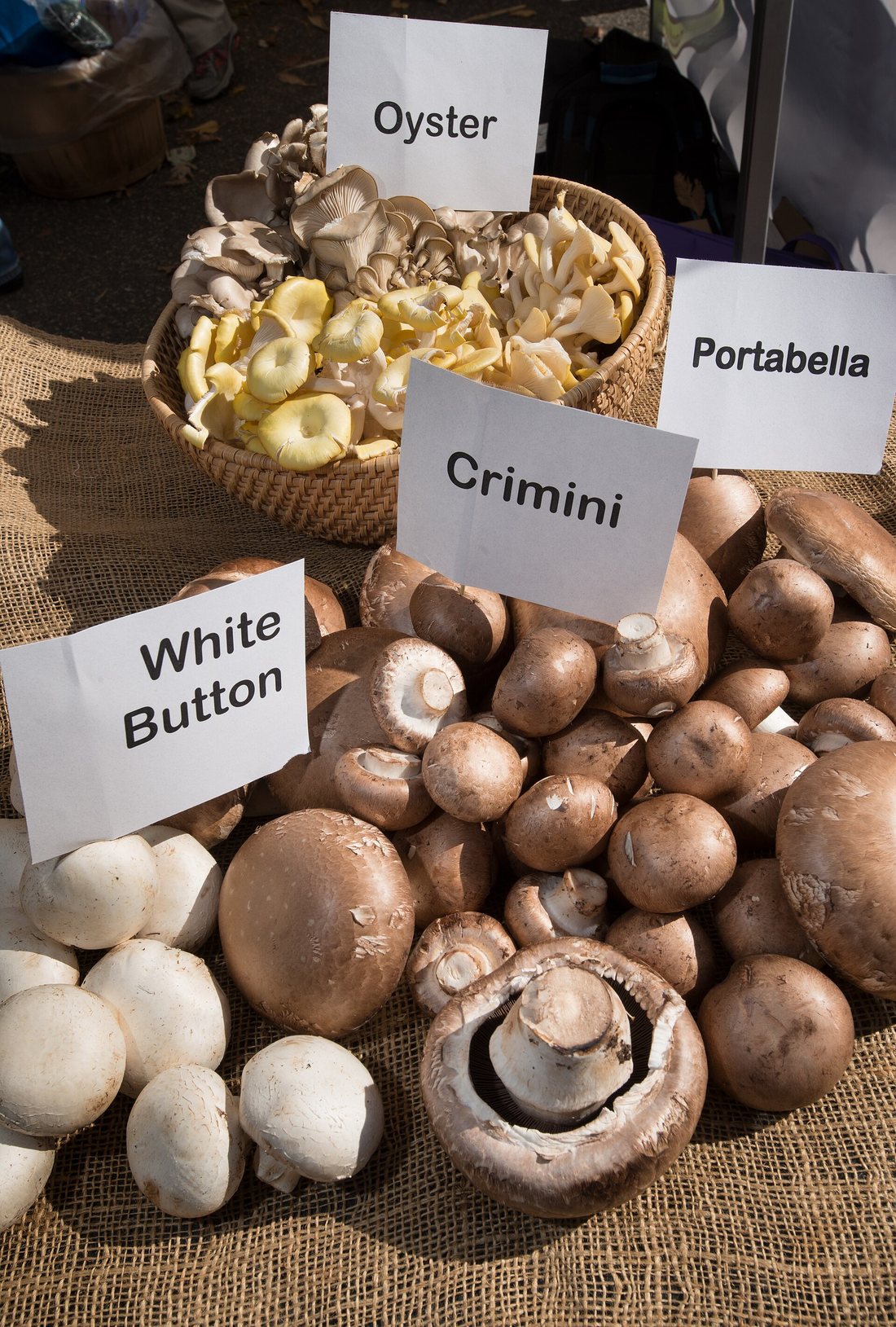
White button, crimini and portabella in a USDA market display: one species, Agaricus bisporus, at different ages and colours. The oyster mushrooms behind are a different fungus.
The three most common mushrooms in an American supermarket are one species, Agaricus bisporus, at different ages and in different colour strains:
- White button — a white strain, picked young and closed.
- Cremini — the original brown form, picked young.
- Portobello — the brown form left to open fully and flatten.
Every white button mushroom descends from a single white mutant found on a Pennsylvania mushroom farm in the mid-1920s — a 2023 genomic study names the farmer Lewis Downing in 1926, while popular histories credit L. F. Lambert in 1925, and the sources have not been reconciled. “Portobello” itself is a marketing name from around 1986, coined to sell overgrown brown mushrooms that growers had struggled to move. The full story is on the history page.
A note on the health claims
Mushrooms carry unusual compounds, and some of them are genuinely interesting. Ergothioneine, an antioxidant, is abundant in mushrooms — porcini highest of the thirteen species Penn State tested in 2017, with white buttons well ahead of most foods. The lead researcher suggested a link between national ergothioneine intake and neurological disease, and was careful to add: “whether that’s just a correlation or causative, we don’t know.” That caution applies to nearly every health claim about mushrooms, and this section repeats none as fact.
In this dive: Forage at your own risk · What a mushroom is · The history · Around the world · Michigan · Morels · The giant puffball · Cooking mushrooms · Over the fire · Preserving · Corrections
Comments (0)