The History: Emperors, Quarries and One Pennsylvania Mutant
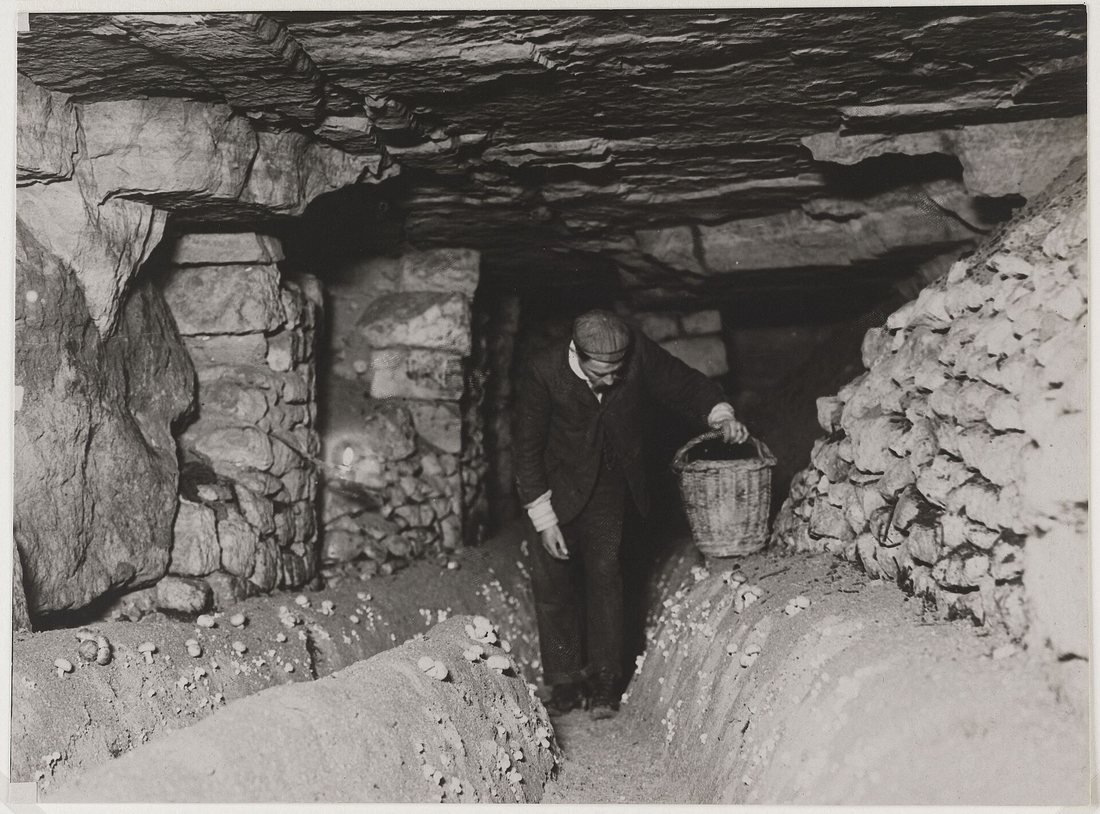
A mushroom grower in an old French quarry. This is how the champignon de Paris was grown for a century.
People have eaten wild mushrooms for as long as there have been people, and have been poisoned by them for exactly as long. The written history is shorter, patchier and more contested than the confident timelines in most mushroom books. This page follows what the record actually shows, and marks the places where a good story has outrun its evidence.
Egypt: no evidence at all
A good deal of mushroom writing says the ancient Egyptians thought mushrooms were “plants of immortality,” reserved for pharaohs. There is no evidence for it. The Egyptologist Andrea Sinclair points out that there is no mushroom hieroglyph, no archaeological residue of any mushroom in an Egyptian burial, and no evidence that pharaonic Egypt valued any fungus except yeast. She traces the psychedelic version of the story to a 1959 occult book based on séances. The claim appears here only so that it can be set aside.
Rome: Caesar’s mushroom and the death of Claudius
The Romans prized a mushroom they called boletus — Martial, Seneca and Petronius all mention it, and it is usually identified with the orange-capped Amanita caesarea, “Caesar’s mushroom.” Two cautions apply at once:
- The Roman boletus is not the modern Boletus (the porcini). The modern genus borrowed the old name. Writers who treat them as one thing have been caught by the botanists’ reuse of a word.
- Even the identification with A. caesarea is a guess. The classicist Mary Jaeger warns that “modern attempts to identify ancient mushrooms are guesses.” The species name caesarea itself was given in 1772, by the naturalist Scopoli, building on the classical tradition — it is an eighteenth-century label, not a Roman one.
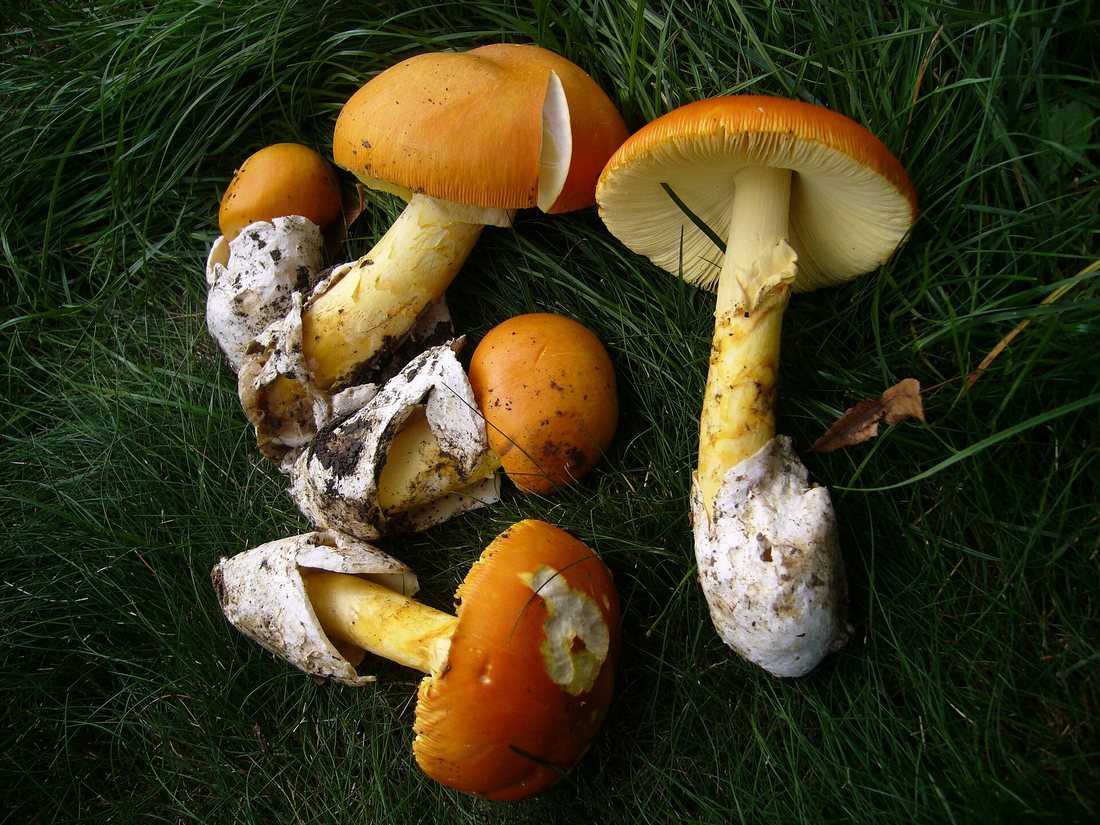
Amanita caesarea, “Caesar’s mushroom.” The name was given in 1772. Whether the Romans’ boletus was this mushroom is a modern guess.
Then there is the death of the emperor Claudius in AD 54, which nearly every mushroom history retells as “poisoned with a death cap passed off as Caesar’s mushroom.” Every part of that version is contested.
- Suetonius opens his account: “That Claudius was poisoned is the general belief, but when it was done and by whom is disputed.” One of his versions has the poison given at a banquet by a food taster; another has Agrippina serve it “in mushrooms, a dish of which he was extravagantly fond.”
- Tacitus has the poison “sprinkled on an exceptionally fine mushroom,” followed by a second dose on a feather.
- Cassius Dio has Agrippina eat the harmless mushrooms herself and give Claudius the largest, poisoned one.
Every ancient source treats the mushroom as the carrier of an added poison. None names a poisonous mushroom. The death-cap theory is a modern hypothesis (Grimm-Samuel, Classical Quarterly, 1991); another scholarly reading argues for a different mushroom toxin; and a 2002 paper in the Journal of the Royal Society of Medicine concluded there is “no reason to believe that Claudius was murdered” at all, the symptoms being “consistent with sudden death from cerebrovascular disease.”
What survives is a joke. According to Dio, Claudius’s successor Nero called mushrooms “the food of the gods, since Claudius by means of the mushroom had become a god.”
China: the first written cultivation, 1209
Mushroom cultivation — growing them deliberately rather than gathering them — is documented first in China.
- Wood ear (Auricularia) is generally said to have been cultivated in the Tang dynasty (618–907), on the strength of a Tang recipe preserved in Li Shizhen’s great 1578 pharmacopoeia: put steamed bran on logs, cover with straw, “Wood Ear will grow.” The evidence comes to us secondhand, through a sixteenth-century compilation.
- Shiitake has a firmer date. The Records of Longquan County, compiled by He Zhan in 1209, contains a 185-word description of the “cut-and-knock” method — gashing the bark of logs, then striking them to “startle” the mushrooms into fruiting.
The growers of the region honour a founder, Wu Sangong, credited with inventing the method; temples to him date back centuries, and China’s edible-fungi industry association formally honoured him as the founder of shiitake cultivation in 2013. But a 2022 Chinese study titled, pointedly, A synthesised deity traces how his biography was assembled from folk legend over centuries, and notes the growers once honoured a different deity altogether. The 1209 record is documentary history. Wu Sangong is temple tradition. Both are worth knowing; only one is evidence.
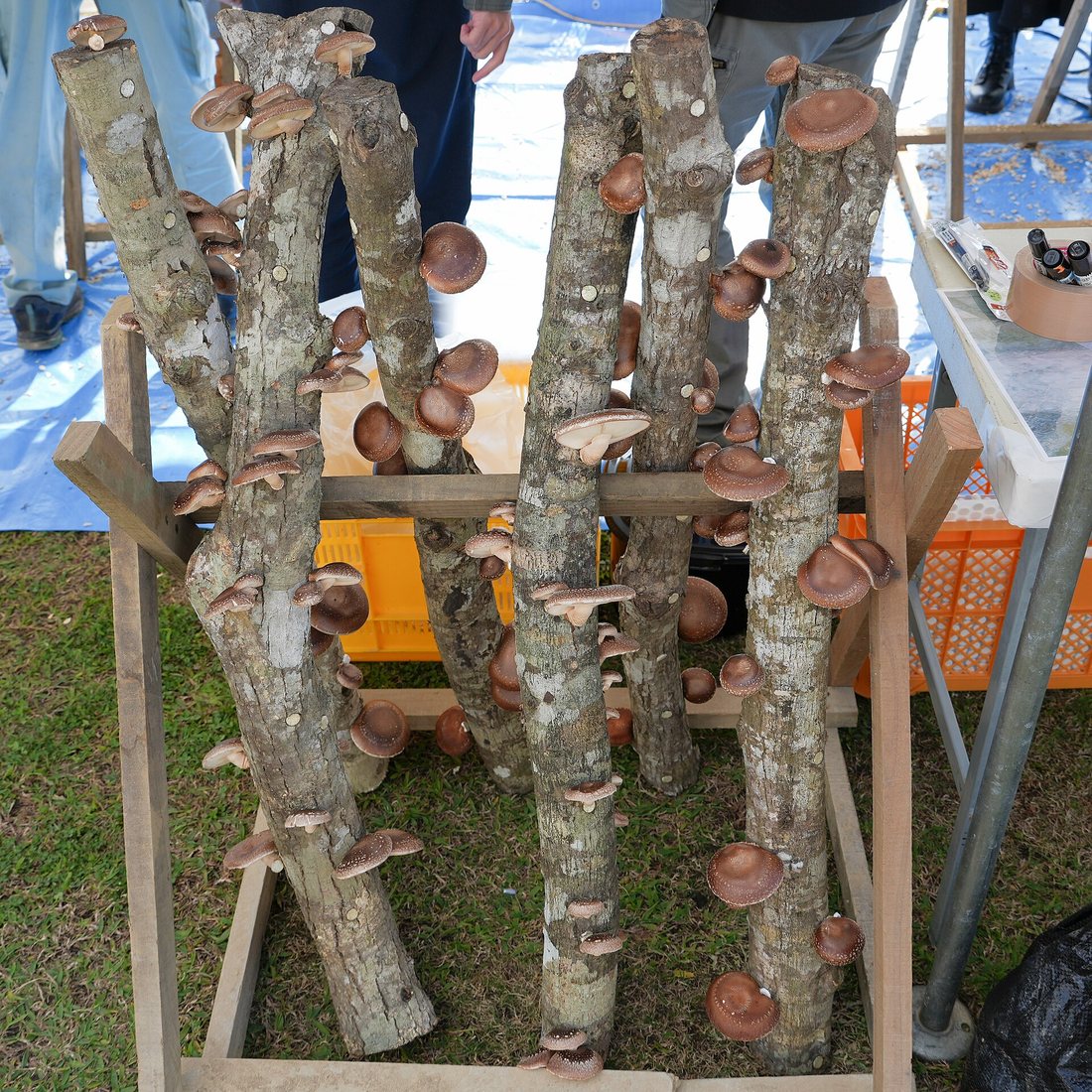
Shiitake growing on logs: the method described in a Chinese county record of 1209, and still used.
Japan learned shiitake growing from the Chinese record — its first book on the subject dates from 1796 — but the method stayed unreliable for another century and a half. According to a 1982 US Forest Service paper, reliable cultivation arrived only in 1943, when a Kyoto agricultural student, Kisaku Mori, inoculated logs with wood chips carrying a pure culture: the ancestor of the plug spawn that home growers use today. By 1978 the Japanese shiitake industry employed 188,000 people.
Paris: mushrooms in the quarries
The white mushroom of the European kitchen was being grown on beds of manure in France by the early 1700s — the botanist Tournefort described it in 1707, and the royal gardener at Versailles grew it for Louis XIV.
Then, in the early nineteenth century, growing moved underground. The story, first told in Victor Parquet’s 1847 treatise on mushroom growing, credits a market gardener named Chambry with discovering that the abandoned limestone quarries under the south of Paris — cool, dark and constant — were ideal. The date given varies from 1810 to 1814 depending on who retells it, and the original text was not consulted here, so “about 1810–1814” is the honest figure. By the later nineteenth century hundreds of growers worked beneath the city, and the mushroom took the name it still carries: champignon de Paris.
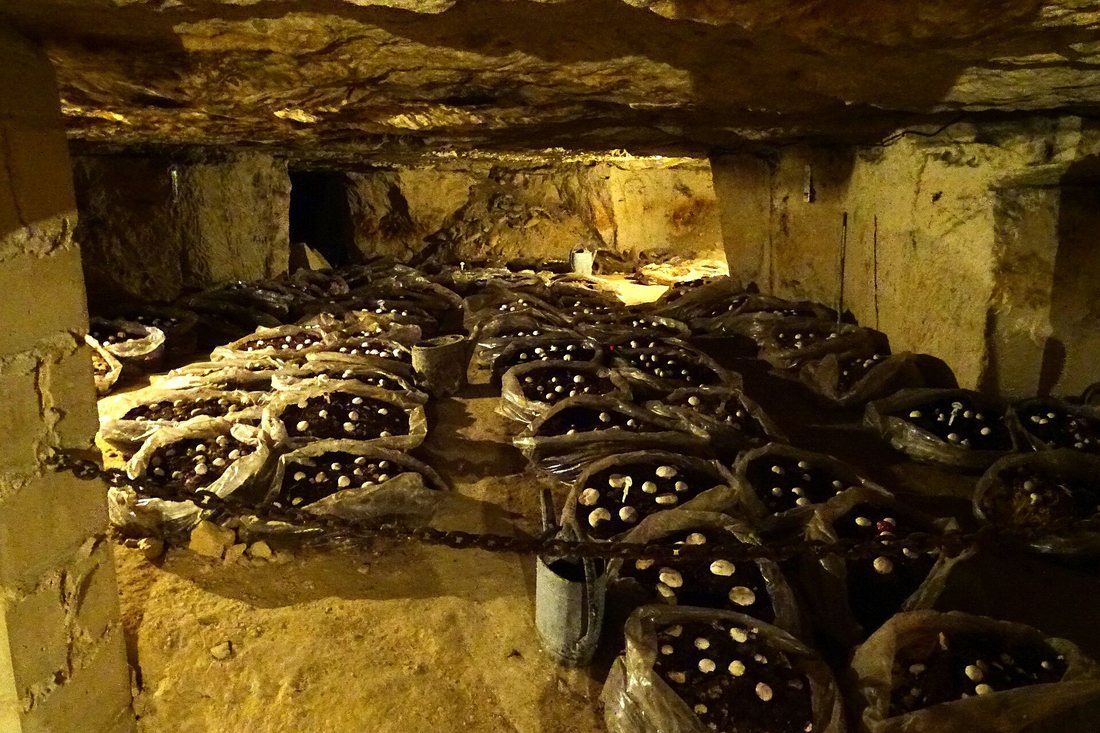
Mushroom beds in a former quarry at Marly-la-Ville, north of Paris.
They were grown in the quarries, not “in the catacombs.” The Catacombs are one part of that tunnel network, used as an ossuary; most retellings borrow the more dramatic word. The building of the Métro around 1900 pushed the growers out to the tufa caves of the Loire valley, where mushrooms are still grown in caves today.
Kennett Square, Pennsylvania: how America got the mushroom
The American mushroom industry began in Kennett Square, in Chester County, Pennsylvania, and it is still there: Pennsylvania grew 69% of the nation’s Agaricus mushrooms by volume in 2024–25, according to the USDA.
The standard story is that William Swayne, a Quaker florist, grew mushrooms under the benches of his carnation greenhouses in 1885, using spawn brought from England. Some details are disputed: other accounts put the start in 1896 and credit his son, J. Bancroft Swayne, who later built a spawn plant and cannery, and one account dates the first purpose-built mushroom house to 1902. No period document settles it. The safe version is “the Swayne family of Kennett Square, in the 1880s–1890s.” (A warning for anyone researching further: the Wikipedia article on “William Marshall Swayne” of the same county is about a sculptor, not the mushroom grower.)
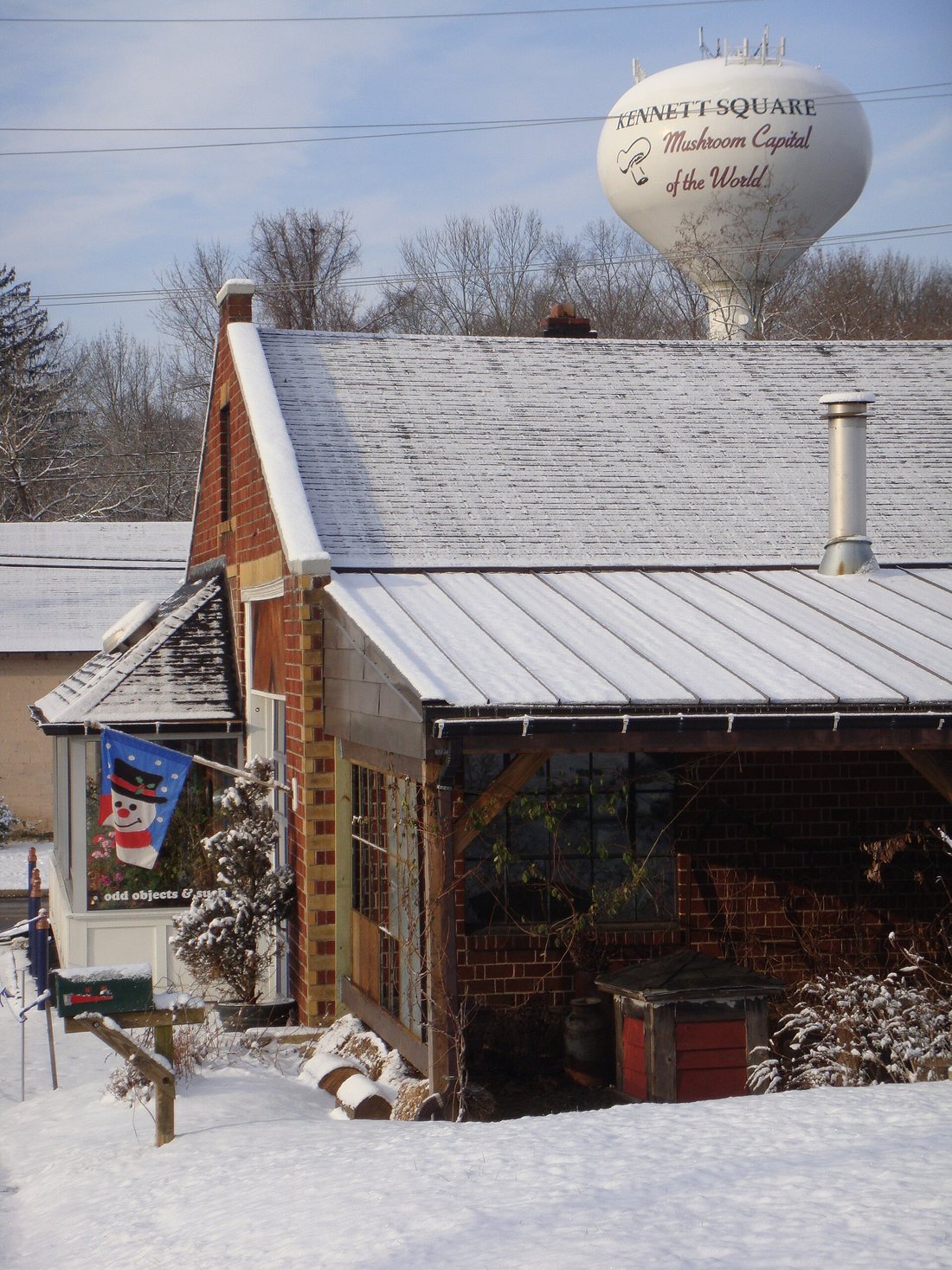
Kennett Square, Pennsylvania, still calls itself the Mushroom Capital of the World, and Pennsylvania grows 69% of America’s Agaricus.
The industry was built by immigrants. Italian quarry workers and stonemasons worked for the Quaker growers, then started farms of their own; Mexican workers later became the backbone of the workforce, and remain so.
One mutant, 1926
For its first decades the cultivated American mushroom was brown — the cremini. Then, on a Pennsylvania farm in the mid-1920s, a grower noticed a patch of pure white mushrooms. Every white button mushroom sold today descends from that single mutant, which carries a broken copy of a gene responsible for browning. A 2023 study of 361 strains (BMC Genomics) names the farmer Lewis Downing, in 1926; popular histories credit L. F. Lambert at the Keystone Mushroom Farm, Coatesville, in 1925. The two accounts have not been reconciled, and this page does not pretend otherwise.
The first commercial hybrid, Horst U1, arrived in 1980 and underlies most commercial strains. “Portobello” arrived around 1986, as a marketing name for overgrown brown mushrooms that had been hard to sell. The name has no agreed origin; it appears to have been invented to move the product, and it worked.
Mycophiles and mycophobes
In 1957 a New York banker, R. Gordon Wasson, and his wife, the Russian-born paediatrician Valentina Pavlovna Wasson, published Mushrooms, Russia and History. It divided the world into mycophiles — the mushroom-loving Slavs, above all the Russians — and mycophobes, the mushroom-fearing English-speaking peoples. The book founded the study of mushrooms and culture (ethnomycology), and the vocabulary stuck.
Scholars still use the scale, and still argue with it. A 2019 survey in Mazovia, Poland, recorded 76 different wild mushrooms eaten — “the longest regional list of edible mushrooms ever recorded” — which puts the region at the top of the mycophile scale exactly as the Wassons would have predicted. But the tidy map has holes in both directions:
- Eighteenth-century England, supposedly mycophobic, bottled mushroom ketchup by the gallon. (See around the world.)
- Sweden really was mycophobic — more than the Wassons knew. A 2019 study (Svanberg & Lindh) found that pre-industrial Swedish peasants ate no wild mushrooms at all. An ethnologist recorded that “not even a severe famine could overcome the peasantry’s reluctance.” Academic campaigns from the 1830s urging people to eat mushrooms met “sturdy resistance”; the urban gentry took them up in the 1880s, the middle class only after the Second World War. Scandinavia’s famous love of chanterelles is modern.
The specialty mushrooms
Oyster mushrooms were first cultivated deliberately in Germany during the First World War, on stumps and logs; maitake became a commercial crop when Yukiguni Maitake began growing it in Niigata in 1983; king oysters became an industrial crop in Japan and Korea in the 1990s; lion’s mane is the fastest-rising name of the last decade.
The “specialty mushroom boom,” though, is hard to find in the government’s own figures. USDA-tracked US specialty mushroom sales were $106 million in 2017–18 and $95 million in 2024–25. Shiitake led, followed by oyster. The survey only counts sizeable commercial growers, so small farm-market and supplement sales are probably missed — but on the evidence available, specialty mushrooms remain under a tenth of American mushroom sales, and the white button, grown in Pennsylvania, still rules.
In this dive: Forage at your own risk · What a mushroom is · The history · Around the world · Michigan · Morels · The giant puffball · Cooking mushrooms · Over the fire · Preserving · Corrections
Comments (0)