Around the World: Ten Kitchens, Ten Answers
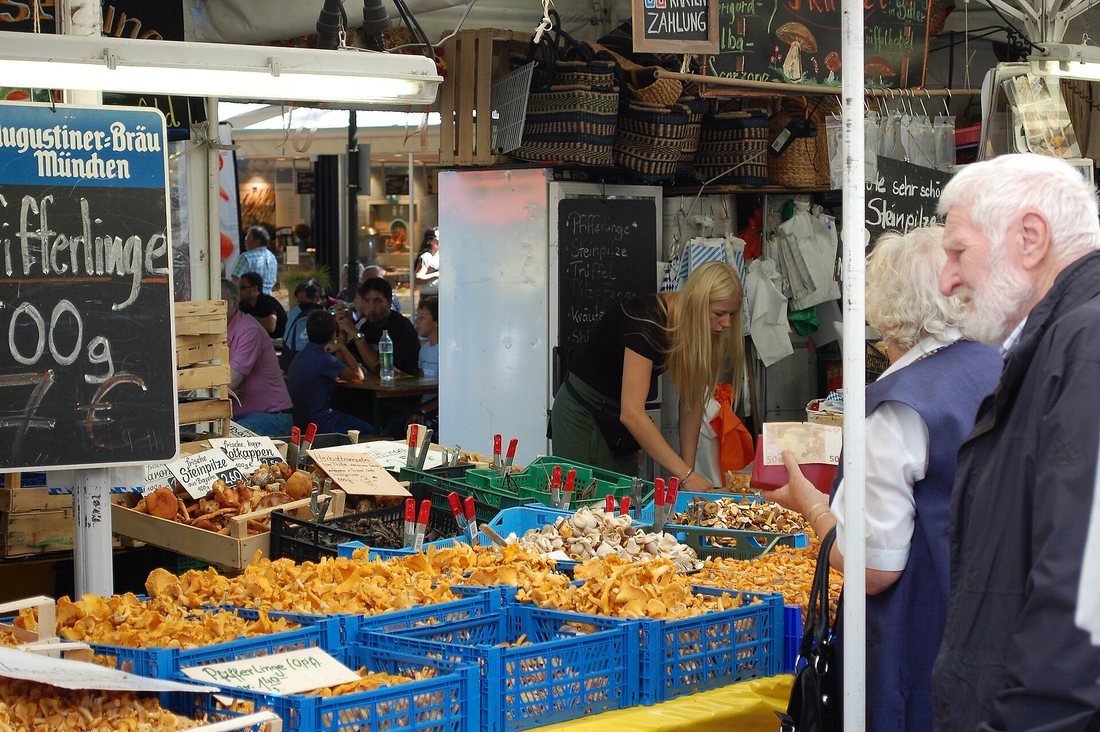
Chanterelles by the crate at Munich’s Viktualienmarkt.
Every mushroom-eating culture has solved the same three problems — the mushrooms arrive all at once, they spoil within days, and their flavour is locked inside a lot of water — and each has solved them differently. Seen side by side, the world’s mushroom dishes are a catalogue of answers: cook the water out, dry it out, salt it, pickle it, or turn the whole harvest into a sauce that keeps for years.
France: duxelles, and a story that will not die
Duxelles is the French answer to too many mushrooms: chop them fine with shallots, cook them in butter until every drop of water has gone, and what remains is a dark, dense paste that keeps for days and flavours anything it touches. It is the layer inside a Beef Wellington and the backbone of countless stuffings. The collection’s versions are Duxelles and Mushrooms Duxelles.
Nearly every account says duxelles was invented by the great seventeenth-century chef François Pierre de La Varenne and named after his employer, the marquis d’Uxelles. La Varenne did work for the marquis. But his book contains no trace of the preparation. French Wikipedia says so outright and adds that the attribution “should not be propagated.” The earliest English use recorded by the Oxford English Dictionary is 1877. The honest version: named, by tradition, for the marquis d’Uxelles; inventor unknown.
The same caution applies to Beef Wellington, which relies on duxelles. The dish is in print by 1891 (an Austrian cookbook’s “Filet à la Wellington,” without mushrooms) and appears on menus through the 1890s and 1900s; a Polish cookbook of 1910 has the duxelles. Who named it, and whether it has anything to do with the Duke of Wellington, is unknown. The collection’s version is Gordon Ramsay’s.
Italy: trifolati and the porcino
Funghi trifolati — mushrooms sliced thin and cooked fast with oil, garlic and parsley — is the everyday Italian mushroom dish, and its name holds a small surprise. The Treccani dictionary traces trifolato to trifola, the northern dialect word for truffle: the term means food “sliced thin, as is normally done with the truffle,” then cooked with oil, garlic and parsley over a lively flame. “Truffle-style” describes the knife-work, not the flavour. The recipe is Funghi Trifolati.
The king of Italian mushrooms is the porcino — “piglet.” The Fungo di Borgotaro from the Apennines above Parma received EU Protected Geographical Indication in 1996, and the protection covers four species of Boletus under a single name — the same pattern as the collection’s protected cheeses, where the name protects a place and a practice rather than a single organism. Dried porcini are the cornerstone of Mushroom Ragù and Risotto with Wild Mushrooms.
Poland and Russia: the mycophile belt
Eastern Europe is where the mushroom is most thoroughly woven into ordinary life. The 2019 Mazovia survey recorded 76 species eaten, many of them “dried, pickled, or frozen after brief boiling.” In a 2024 survey, 75% of Poles expressed interest in mushrooms, against 39% of Germans and 23% of Britons.
Two preserving methods, in the Russian vocabulary, map exactly onto the argument the Pickled section makes about acids:
- Solenie — salting. Milk caps and saffron milk caps are layered with salt and left to ferment; the acid grows in the crock.
- Marinovanie — marinating. Mushrooms are boiled and packed in vinegar; the acid is poured in.
One grows its acid and the other adds it — the fermentation-versus-pickling distinction, again, in a different language. The Polish marinated mushroom tradition is Polish Marinated Mushrooms (Grzyby Marynowane), with a safety note about how it is traditionally stored. At Christmas Eve, dried mushrooms and sauerkraut go into pierogi, and the Jewish delis of New York carried the barley-and-mushroom soup of the same belt into Mushroom Barley Soup. Czech kulajda is in the collection as Kulajda.
A popular explanation for the Russian mushroom culture is the Orthodox fasting calendar, which before 1917 forbade meat and dairy on close to two hundred days a year while permitting mushrooms. It is widely repeated and plausible; only popular sources for it were found, so it is offered here as an explanation rather than a fact.
Scandinavia: the chanterelle’s late conversion
The Scandinavian chanterelle is a modern romance. As the history page sets out, pre-industrial Swedish peasants ate no wild mushrooms at all, and resisted a century of official encouragement. Today, 98 of 100 Swedish foragers surveyed pick chanterelles. The conversion happened in living memory — which is why the chanterelle on toast, now a Nordic café standard, has no deep folk history behind it. The recipe is Chanterelle Toast.
China: dried shiitake and wood ear
China grows the majority of the world’s cultivated mushrooms, and its cooking uses them mostly dried. Dried shiitake is a store of glutamate and — as the science page explains — of the raw material for guanylate, which is released in the pot. Wood ear is prized for something else entirely: not flavour but texture, a crunchy, jelly-like bite. China produced an estimated 4.75 billion kg of wood ear in 2013.
The Shanghainese braise of dried mushrooms with bok choy is traditionally served at New Year; it is Braised Shiitake with Bok Choy. The collection also holds Shiitake Dashi, the Japanese stock built on the same dried mushroom.
Japan: matsutake, and a harvest that collapsed
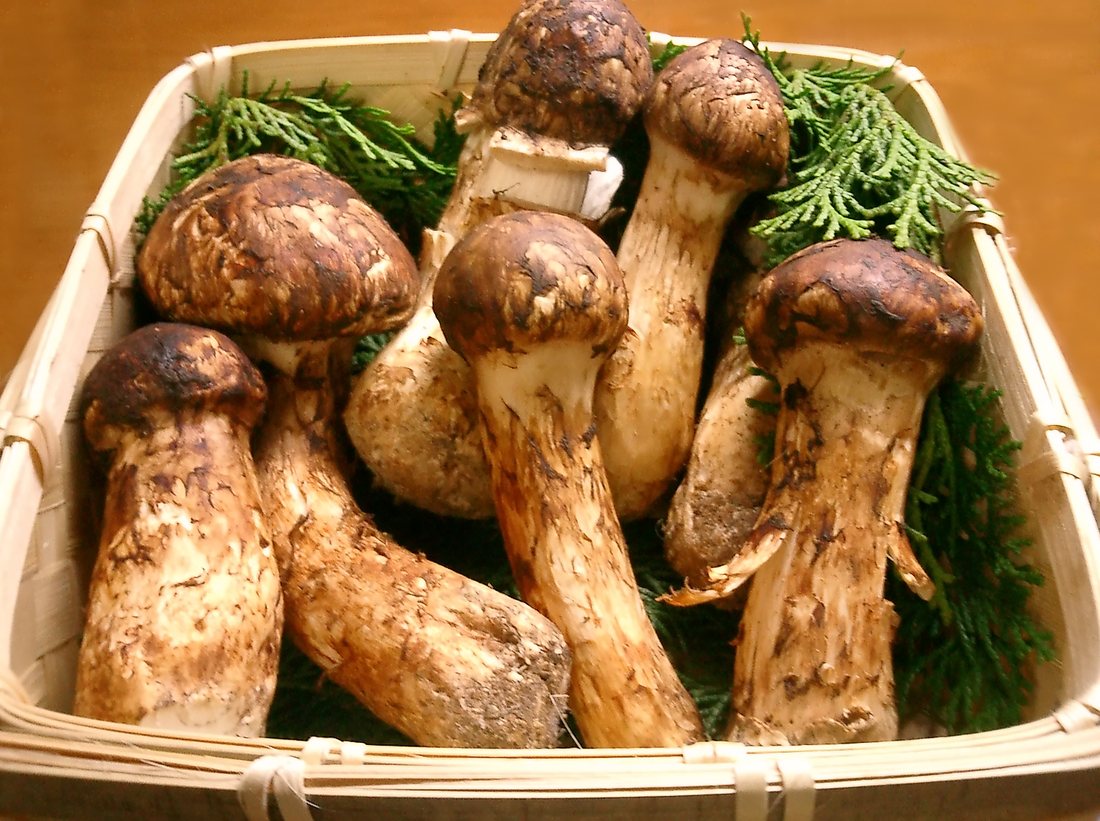
Matsutake. Japan’s harvest fell from about 12,000 tonnes in 1941 to 14 in 2019.
The matsutake, a pine-forest mushroom with a spicy, resinous smell, is the most expensive food many Japanese families buy all year. Japan’s matsutake harvest fell from about 12,000 tonnes in 1941 to 14 tonnes in 2019, recovering to 45 tonnes in 2024. Imports now make up over 90% of the market, and domestic matsutake sells for ¥5,000–10,000 per 100 g.
The main cause was not a disease but a change in how people lived. A 41-year study in Nagano attributes the collapse chiefly to the 1950s “fuel revolution”: when households stopped gathering firewood and litter from red-pine forests, the forest floor grew richer, and the matsutake, which thrives on poor soil, declined. Pine wilt disease, from the 1970s, did the rest. Matsutake cannot be farmed — it lives in partnership with living pine roots — which is why its price reflects only what the forests give.
Everyday Japanese mushroom cooking is humbler. Chicken and Shiitake Takikomi Gohan cooks dried shiitake into rice with its own soaking liquid, and Nameko Miso Soup uses the small, slippery nameko.
Korea
Korea shares the pine mushroom: the Yangyang Songi Festival in Gangwon province celebrates the matsutake harvest each autumn. Everyday cooking is built on shiitake and oyster mushrooms. Korean Stir-Fried Oyster Mushrooms are seasoned with toasted perilla-seed powder rather than soy; japchae, the glass-noodle dish, is in the collection twice, as Japchae (Korean Glass Noodle Stir-Fry) and Japchae (Beef and Glass Noodle Stir-Fry). Japchae itself began, according to the Joseon royal annals, as a dish made for King Gwanghaegun in the early seventeenth century — originally without noodles or meat; the sweet-potato noodles arrived only in the twentieth century.
A safety footnote. In 2020 the CDC linked 36 illnesses and 4 deaths across 17 states to Listeria on imported enoki mushrooms, which are often eaten barely cooked in hot pot. Enoki should be cooked through.
Mexico: huitlacoche
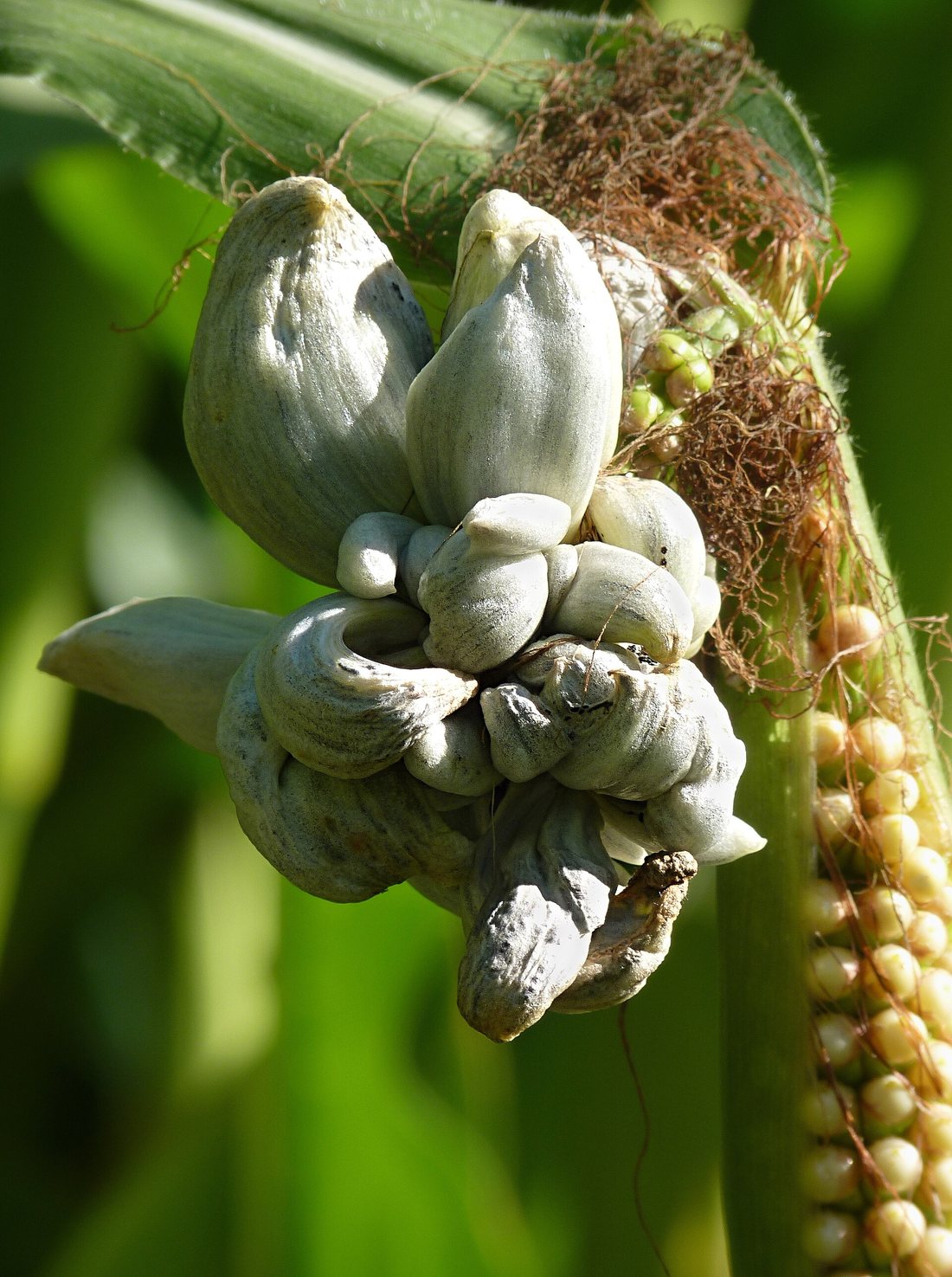
Huitlacoche on the ear: corn smut to an American farmer, a delicacy to a Mexican cook.
Huitlacoche is a fungus that infects ears of corn, swelling the kernels into grey-black, silvery galls with a smoky, earthy flavour. American farmers spent a century trying to eradicate it as corn smut; Mexican cooks have eaten it since before the Spanish arrived. The sixteenth-century Florentine Codex illustrates it and describes it in Nahuatl as an ear of corn “born deformed… black, dark, like a tamal.” More than twenty Mexican peoples have their own names for it.
Its reputation in the United States dates from a single evening: on 12 September 1989, Josefina Howard of the New York restaurant Rosa Mexicano cooked an all-huitlacoche dinner at the James Beard House, and the phrase “Mexican truffle” was born. Nutritionally, it supplies lysine — the essential amino acid corn protein lacks. The name’s origin is contested; readings include “sleeping excrescence” and less polite alternatives. The recipes are Huitlacoche Tacos and, for wild or cultivated mushrooms, Queso Fundido with Guajillo Garlic Mushrooms.
Britain: mushroom ketchup
The supposedly mushroom-shy English turned the autumn harvest into a sauce. Mushroom ketchup — the juice of salted mushrooms, boiled down with spices and bottled — was a staple of the Georgian and Victorian kitchen, and one company, Geo Watkins, still makes it, as it has since around 1830.
It was not the first English ketchup, though. The first English recipe, in Eliza Smith’s The Compleat Housewife (1727), is anchovies, shallots and white-wine vinegar with spices — no mushrooms at all. Mushrooms arrive a few years later, in Richard Bradley’s The Country Housewife (1732). Hannah Glasse, in The Art of Cookery, gives a mushroom ketchup made with stale beer and anchovies “to keep twenty Years,” for ships’ captains: “You may carry it to the Indies.” The word itself is usually traced to a Hokkien term for a fermented fish brine, though that etymology is disputed. Tomato ketchup came much later: the first known recipe is 1812.
The recipe in this section is Eliza Acton’s Mushroom Ketchup, with her words reproduced from the text. The family resemblance to Worcestershire sauce — anchovy, vinegar and spice, bottled to keep — is obvious; no documented line of descent between them has been found. The Worcestershire section tells the other half of that story. Everyday British mushroom cooking is simpler: Garlic Mushrooms on Toast.
Truffles: pig or dog?
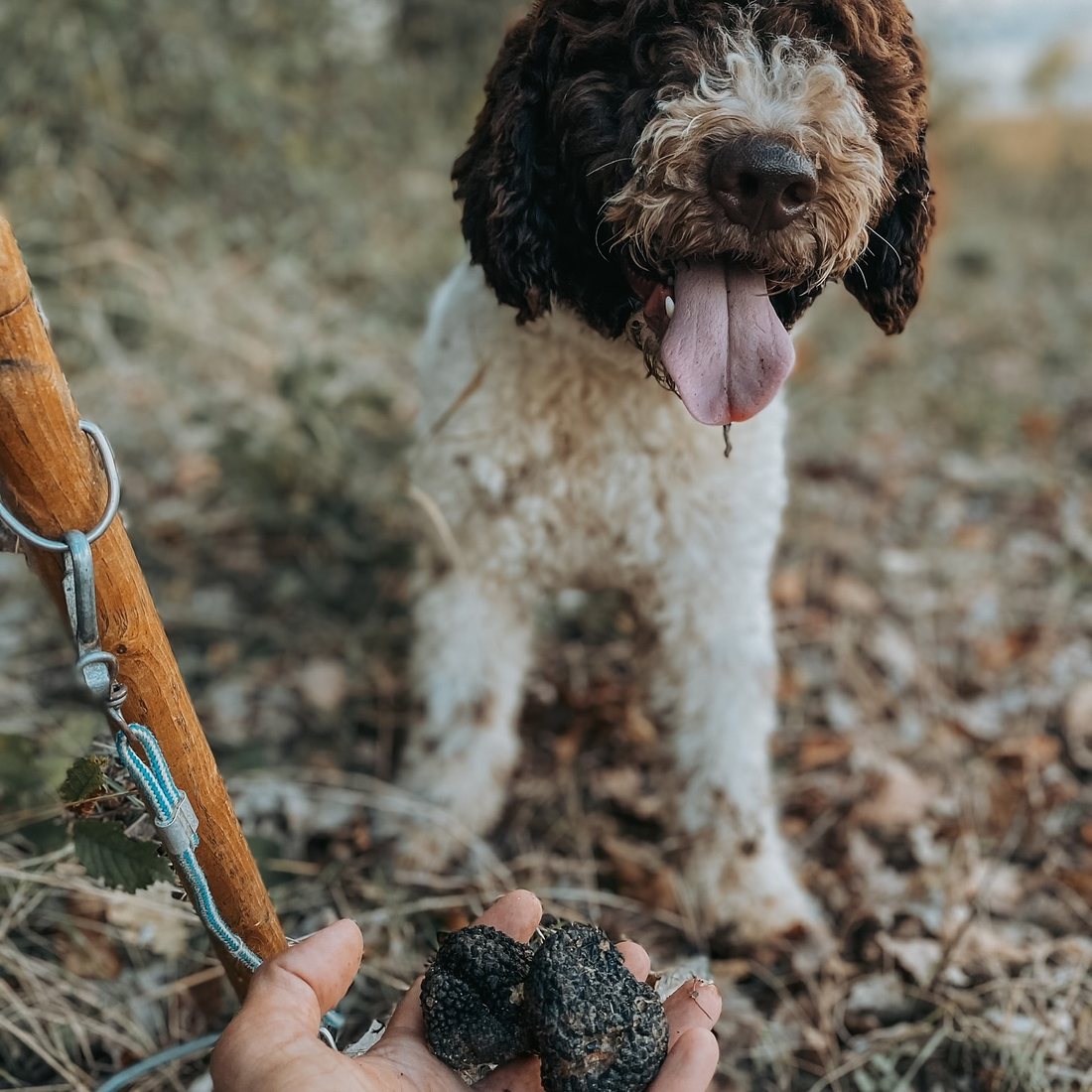
A Lagotto Romagnolo truffle dog and its find. Italian law has required a dog since 1985.
Truffles are fungi too — underground fruiting bodies that rely on animals to dig them up. The story that pigs find truffles because they smell like a boar’s sex hormone comes from real research: in 1981, Claus and colleagues found the boar pheromone androstenol in black truffles. But in 1990, Talou and colleagues buried samples in a field — androstenol, truffle flavouring, and individual truffle aroma compounds — and trained pigs and dogs found only the flavouring and dimethyl sulphide, never the pheromone. The famous explanation did not survive the field test.
Italy settled the pig question by law: Law 752 of 16 December 1985 requires truffle hunting to be done “with the assistance of a dog trained for this purpose,” digging only where the dog indicates. The usual reasons given are that pigs eat the find, and that their rooting damages the ground the truffles grow from.
In this dive: Forage at your own risk · What a mushroom is · The history · Around the world · Michigan · Morels · The giant puffball · Cooking mushrooms · Over the fire · Preserving · Corrections
Comments (0)