Forage at Your Own Risk: The Safety Page
Read this before anything else in this section. Nothing on these pages is an identification guide, and nothing here can make a wild mushroom safe to eat. Wild mushrooms are picked and eaten entirely at the reader’s own risk. A photograph, a description, a phone app or a web page cannot identify a mushroom in hand. Only a person who knows the species, looking at that specimen, can. When there is any doubt at all, the mushroom stays out of the pan.
Suspected poisoning: call Poison Control at 1-800-222-1222 (in Michigan it reaches the Michigan Poison & Drug Information Center). Keep any uneaten mushrooms, whole and uncooked, in a paper bag in the refrigerator for identification. Do not wait for symptoms to get worse. With the deadliest mushrooms, feeling better is not a sign of recovery.
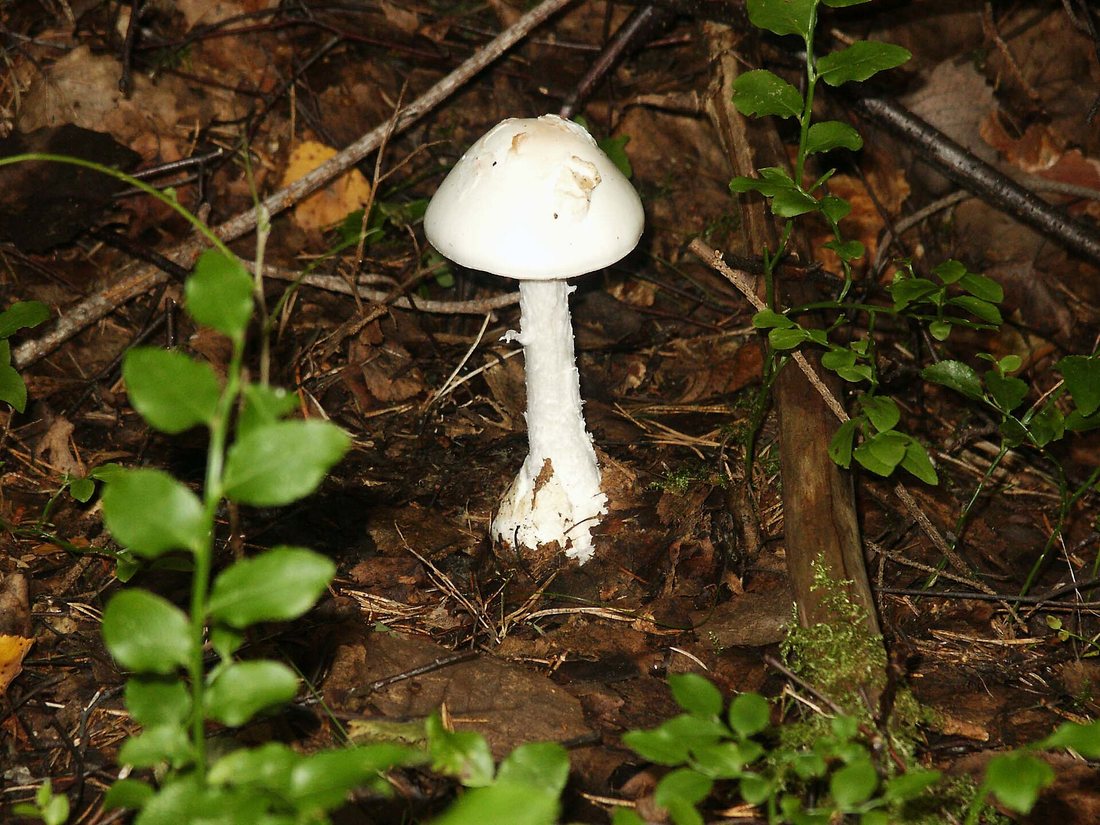
A destroying angel: clean, white and deadly. “All white mushrooms are safe” is one of the folk rules that kills people.
This is the least appetising page in the section and the most important one. It is short on romance and long on numbers, because the numbers are what change behaviour.
The scale of the problem
Mushroom poisoning is common and serious poisoning is rare, which is exactly the combination that breeds overconfidence.
- About 7,400 mushroom exposures a year reached US poison centres between 1999 and 2016 — 133,700 in all. Most were harmless: 86% caused no effect or only a minor one, and 62% involved children under six who had put something from the lawn in their mouths. (Brandenburg & Ward, Mycologia, 2018.)
- But about 39 a year caused major harm, and 52 people died over those eighteen years. The deaths were “mostly from cyclopeptide-producing mushrooms ingested by older adults unintentionally” — adults who believed they had picked something edible. The authors’ conclusion: “Misidentification of edible mushroom species appears to be the most common cause.”
- The CDC counted roughly 1,300 emergency-room visits and 100 hospitalisations for mushroom poisoning in 2016 alone (MMWR 70(10), 2021).
- Those official figures undercount the dangerous cases. The North American Mycological Association (NAMA), whose volunteer identifiers are called in when a poisoning is serious, estimates that about 90% of mushrooms in poison-centre data are never identified at all.
The pattern in that data is the whole argument of this page: the people who die are not children eating random mushrooms. They are adults who were confident.
The mushrooms that kill
Michigan State University’s extension bulletin Don’t Pick Poison! counts roughly 2,500 species of large fleshy fungi in Michigan. At least 50 are known to be poisonous; only 60 to 100 are generally regarded as safe to eat. The ones that kill fall into a handful of groups.
Amatoxins: the destroying angels and the death cap
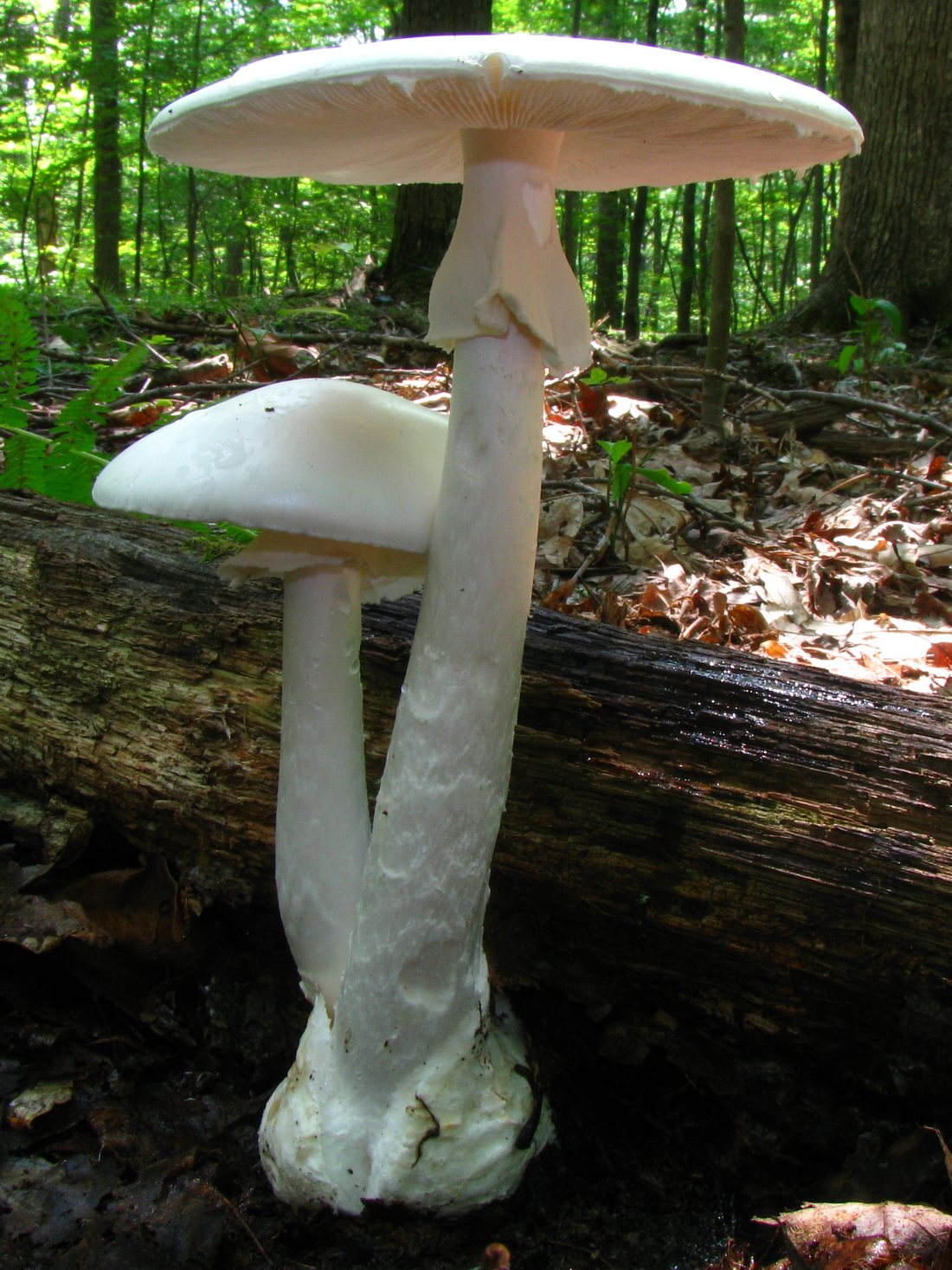
The eastern destroying angel, Amanita bisporigera. The cup at the base (the volva) is often below the soil, which is why the whole base is dug up.
The white Amanita species — Amanita bisporigera, the eastern destroying angel, and its relatives — and the death cap, Amanita phalloides, cause most fatal mushroom poisonings worldwide. They are handsome, clean-looking, pure white or pale green mushrooms, and “all white mushrooms are safe” is one of the folk rules that kills people (the destroying angel is white).
Their toxin, α-amanitin, shuts down a basic enzyme in every cell, and it is heat-stable and water-soluble: boiling, frying, drying and freezing do nothing to it.
What makes amatoxin poisoning so dangerous is its timing. The pattern recorded in a 2016 Northern California outbreak (MMWR 66(21), 2017) is the textbook one:
| Time after eating | What happens |
|---|---|
| 6–24 hours | Violent vomiting and diarrhoea begin — hours after the meal, so the mushroom is not suspected |
| 24–36 hours | An apparent recovery. The patient feels better and often goes home |
| 3–5 days | Liver failure, sometimes kidney failure. Transplant or death |
The false recovery is the trap. By the time symptoms return, the liver is failing. MSU’s bulletin turns this into a rule of thumb worth memorising: symptoms within about two hours of a meal are, oddly, a good sign, because the most dangerous toxins rarely cause symptoms before six hours. Delayed onset is the danger signal.
The popular “50% death rate” overstates the odds, and the true figure is still terrible. NAMA’s thirty-year registry found a death rate of about 11% among people who became ill, with a further 3.5% needing a liver transplant. Modern intensive care is the difference between those numbers and the historical ones.
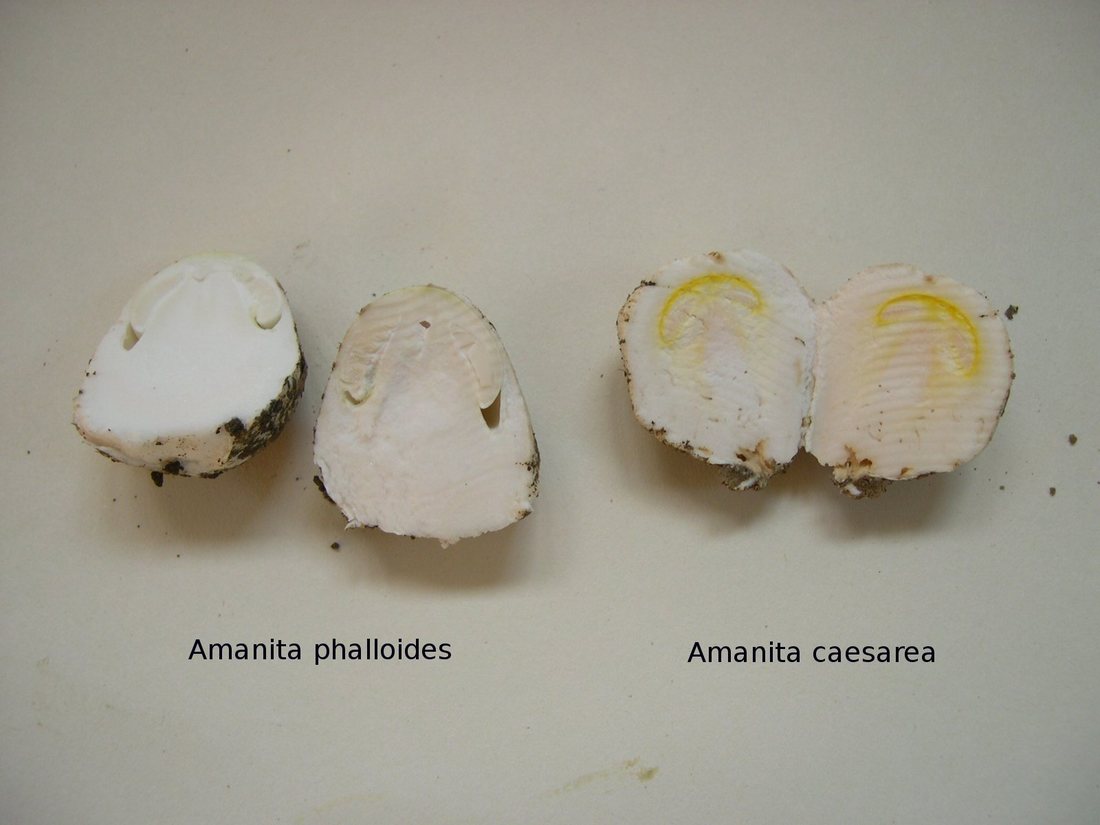
Young Amanita eggs cut top to bottom: a death cap (left) and a Caesar’s mushroom (right). Each shows a mushroom sketched inside. A true puffball shows only uniform white.
Why this matters on the giant-puffball page. A young Amanita begins life enclosed in a white egg-shaped membrane (the universal veil), and at that stage it can be mistaken for a puffball. Sliced top to bottom, the egg shows the ghostly outline of a cap, gills and stem inside. A true puffball is uniform white all the way through. Every puffball is sliced top to bottom before it is cooked, without exception — see the giant puffball.
Galerina: the little brown mushroom on the log
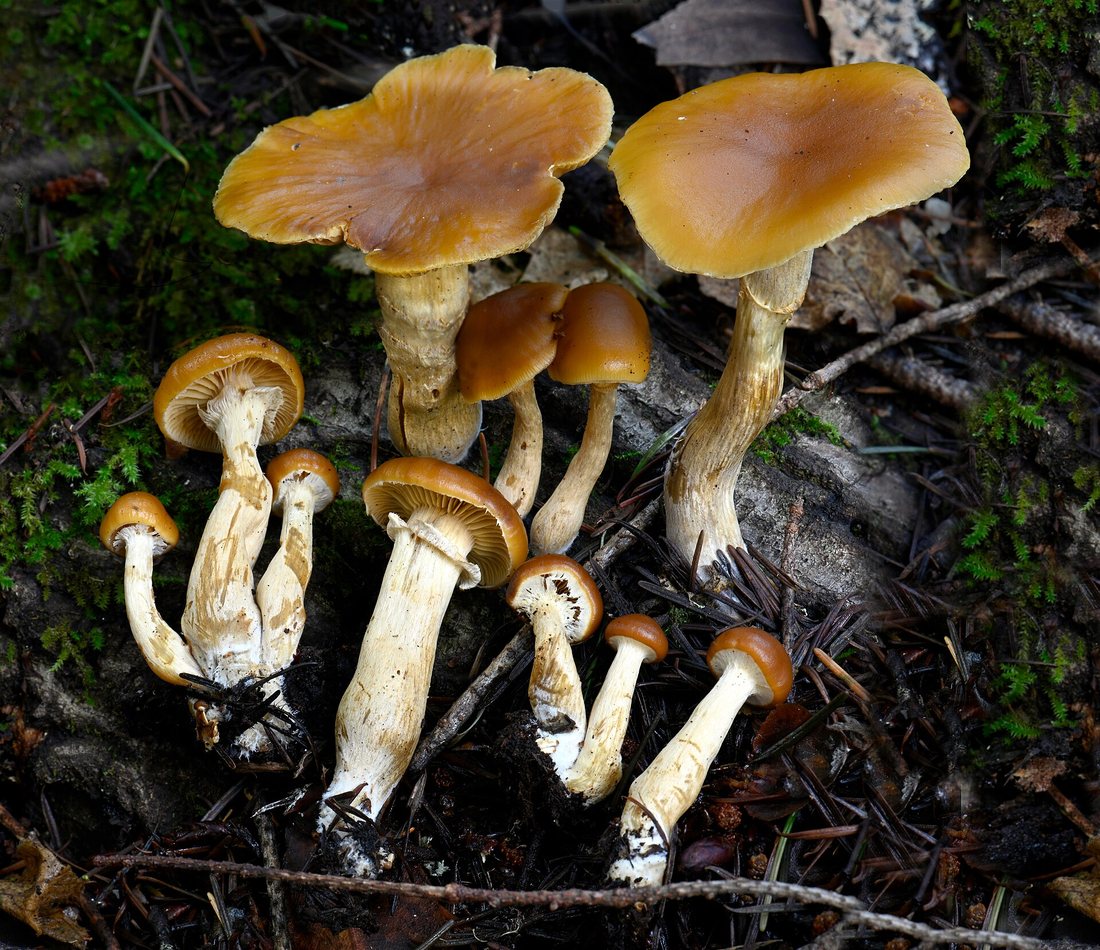
Galerina marginata: a little brown mushroom on rotting wood, carrying the same toxin as the death cap.
Galerina marginata is a small, forgettable brown mushroom that grows on rotting wood — and in a DNA-verified study of seventy samples, every specimen of the G. marginata group contained amatoxins at levels comparable to the death cap (Landry et al., PLoS One, 2021). In Michigan it grows alongside honey mushrooms (Armillaria) on the same stumps. The spore print separates them: rusty brown for Galerina, white for the honey mushroom. It also puts the lie to another folk rule: “mushrooms that grow on wood are safe.”
False morels: Gyromitra
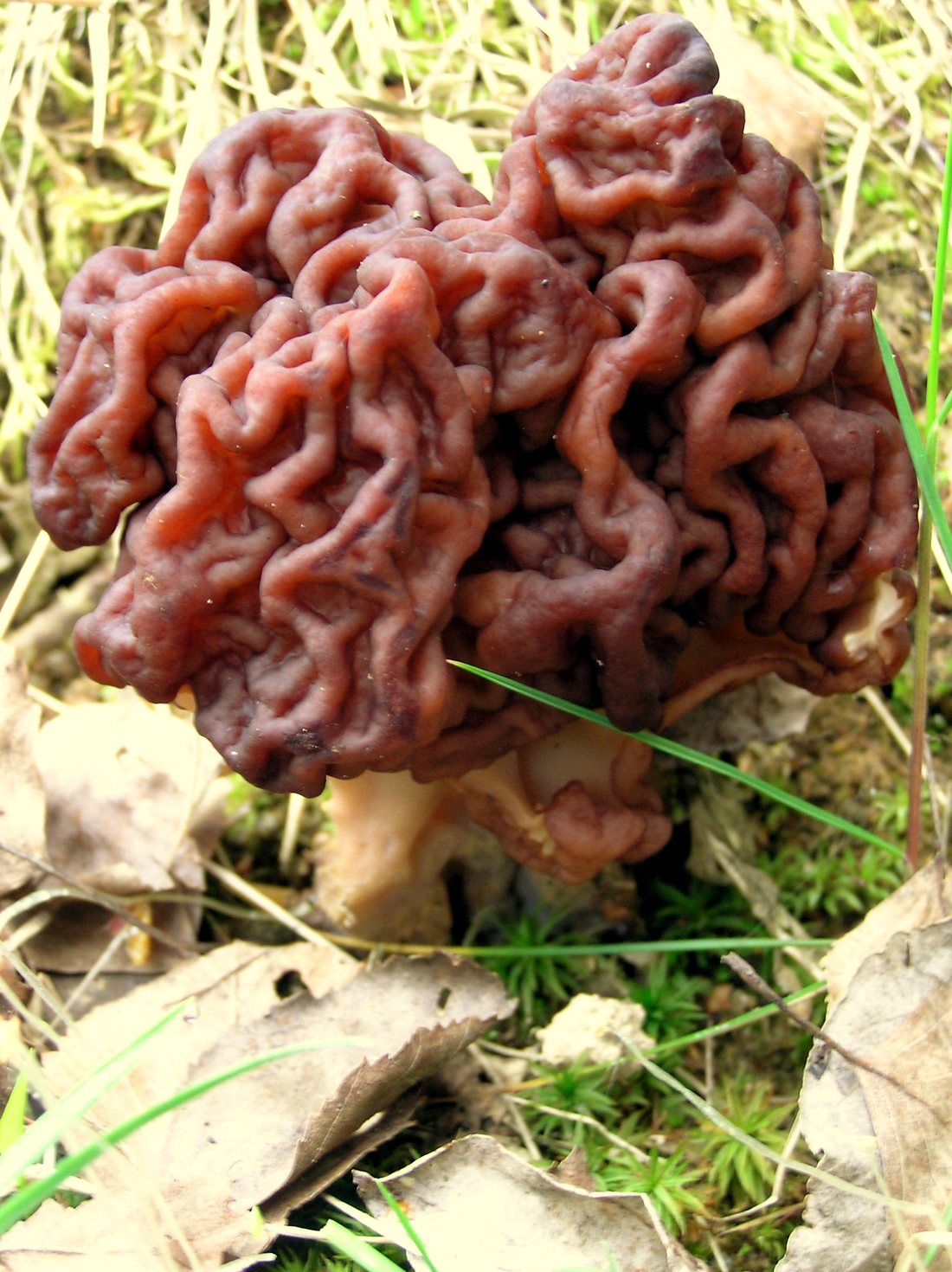
The false morel, Gyromitra esculenta: a lobed, brain-like cap rather than the pitted cap of a true morel.
The brain-shaped false morel, Gyromitra esculenta, contains gyromitrin, which the body converts into monomethylhydrazine — a compound better known as a rocket propellant, and a carcinogen. It appears in the same spring woods as true morels.
Michigan has its own good data on this. The Michigan Poison & Drug Information Center recorded 118 Gyromitra poisonings between 2002 and 2020 (Vohra et al., Toxicon, 2024). Most were gastrointestinal, about a quarter involved neurological signs and one in six showed liver injury — and there were no deaths. That is a genuine and reassuring finding, but the DNR still warns that some people who ate false morels safely for years later suffered acute poisoning, “and a few have died.” Old books describe parboiling false morels and discarding the water; that removes much of the toxin but not all of it, and every current authority — the DNR, MAMI and NAMA — says not to eat them at all. How to tell them from true morels is on the morels page.
Cortinarius: the slowest poison
The orellanine-bearing Cortinarius species attack the kidneys, and symptoms can take ten days to three weeks to appear — long after anyone would connect them to a meal. There is no antidote. In fairness to the record: NAMA’s registry had found no confirmed orellanine poisoning anywhere in North America as of 2006, and orellanine had been detected in only one small North American species. MSU still lists the whole genus as deadly because it holds over a thousand species, most never tested. The honest summary is rare here, and catastrophic when it happens.
The others worth knowing
- Jack-o’-lantern (Omphalotus illudens) — bright orange, in clusters on wood, and the classic chanterelle look-alike. Severe vomiting rather than death.
- The green-spored lawn mushroom (Chlorophyllum molybdites) — the most common cause of serious gastrointestinal poisoning in lawns. MSU recorded a large fruiting on its own East Lansing campus.
- Earthballs (Scleroderma) — the “false puffballs.” Dark purple-black inside even when young, with a thick, tough skin. Mildly poisonous to people; NAMA records dogs killed by them.
- The inky cap (Coprinopsis atramentaria) — edible, with a catch: its coprine blocks the breakdown of alcohol, so a drink with the meal, or up to 48 hours afterwards, brings on flushing, a racing heart and nausea. It works the same way as the anti-drinking drug disulfiram.
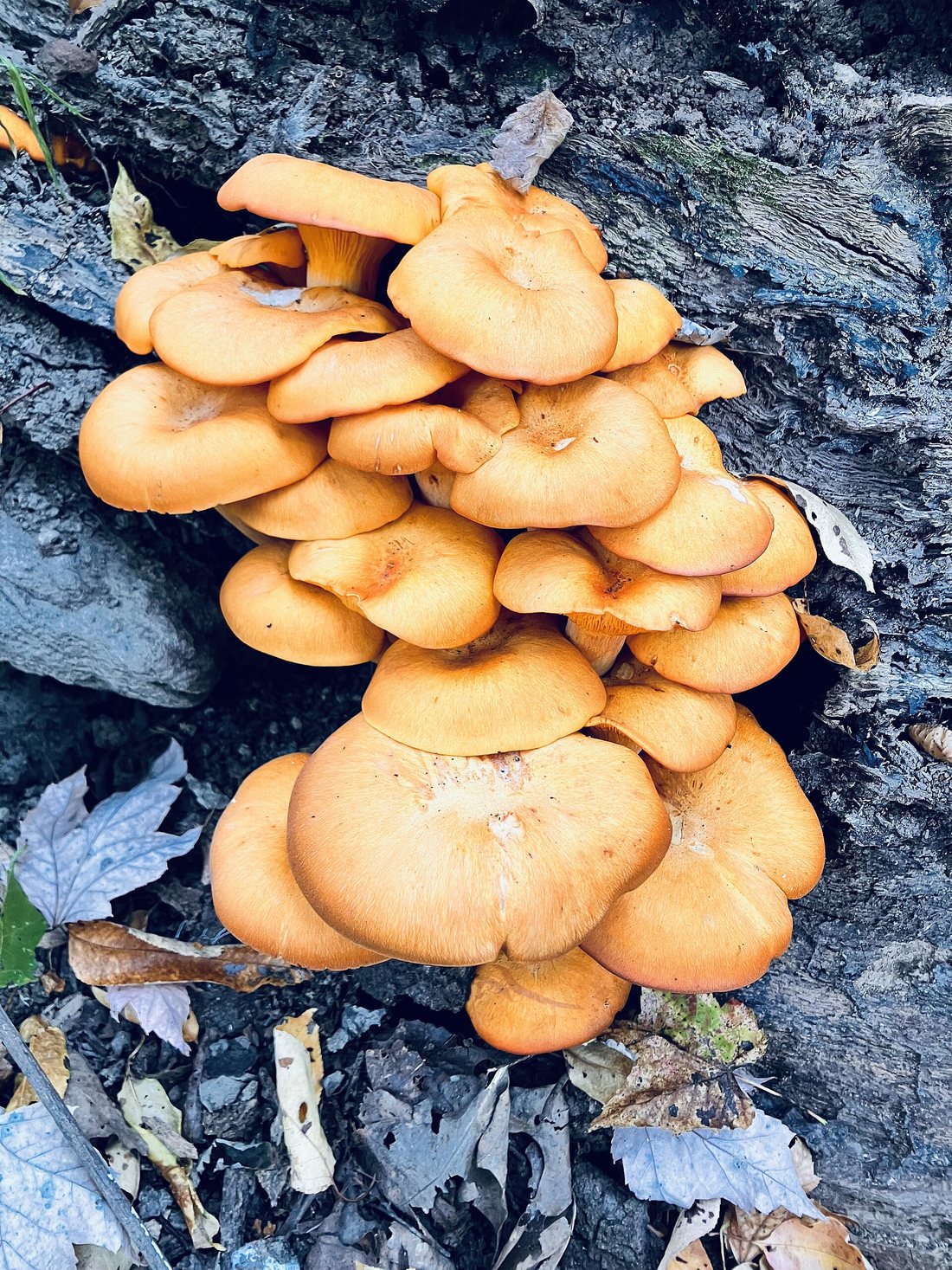
The jack-o’-lantern, Omphalotus illudens: orange like a chanterelle, but in dense clusters on wood, with true gills.
Folk tests that do not work
Every one of these is still repeated, and every one is rejected by MSU and the Midwest mycological societies:
| Folk test | Why it fails |
|---|---|
| A silver spoon or coin darkens in a poisonous mushroom | Silver tarnishes from sulphur compounds. Amatoxins contain none that do this |
| If the cap peels, it is safe | The death cap peels easily |
| Mushrooms on wood are safe | Galerina grows on wood |
| If animals eat it, people can | Squirrels and slugs eat deadly Amanita without harm. Dogs die from mushrooms people can eat |
| Eat a little and wait | The deadly toxins take 6 hours to 3 weeks to show. Waiting overnight proves nothing |
| Cooking destroys the poison | Not the ones that kill. Amatoxin survives boiling, frying, drying and freezing |
| White mushrooms are safe | The destroying angel is white |
MSU’s bulletin puts the only rule that works in capital letters: THE ONLY RELIABLE WAY TO DISTINGUISH A POISONOUS MUSHROOM FROM AN EDIBLE ONE IS TO LEARN TO IDENTIFY THE INDIVIDUAL SPECIES. The Midwest American Mycological Information society adds the corollary: every individual mushroom that is going to be eaten must be identified — not the patch, not the first one, each one.
Phone apps are not identification
Mushroom identification apps get about half their answers wrong. The Victorian Poisons Information Centre in Australia tested three popular apps on 78 mushrooms from real poisoning cases (Hodgson et al., Clinical Toxicology, 2023). The best app was right 49% of the time; the other two, including iNaturalist, 35%. They misidentified the death cap three times. The authors, who had seen poisonings follow app identifications, concluded the apps “are not reliable enough to exclude exposure to potentially poisonous mushrooms.” An app is a way to learn a name to look up. It is not a way to decide what to eat.
Even good mushrooms have rules
- Cook every wild mushroom thoroughly. MSU singles out honey mushrooms, blewits and morels as “particularly egregious” in causing stomach upset when raw, and undercooked morels killed two people in Montana in 2023 — the story is on the morels page.
- One new species at a time, and not too much of it. Some people react badly to a mushroom most people eat happily. NAMA’s toxicology chair has noted that with some edible species, “individuals can develop a sensitivity over time.” Chicken of the woods, lobster mushrooms and honey mushrooms all appear in NAMA’s adverse-reaction tables.
- Keep one whole, raw specimen in the refrigerator whenever a new species is eaten. MSU’s reasoning is practical: a mycologist or physician can identify a whole mushroom far more easily than stomach contents.
- Never eat old, soft or decaying mushrooms. A mushroom that has started to rot can make people sick whatever species it is.
- Dig up the whole base. The cup (volva) at the base of a deadly Amanita is often below the soil line, and it is one of the features that identifies it.
- What is safe for one person is not proof it is safe for another — the DNR’s warning, and the reason a successful meal proves nothing about the next person at the table.
Where to learn properly
The honest path to eating wild mushrooms runs through people, not pages:
- A local mycological society’s forays, where experienced identifiers look at what members bring back. The Michigan Mushroom Hunters’ Club has run forays for decades.
- The Midwest American Mycological Information (MAMI) workshops, which include Michigan’s state certification course (see the Michigan page). Even those who never intend to sell a mushroom can learn a great deal from the course material.
- MSU Extension’s Don’t Pick Poison! (bulletin E-2777), which remains the best plain-language introduction to what grows in Michigan — though the archived copy carries a note that it is not current advice, so treat it as background rather than rules.
- A regional field guide used alongside a person who knows the species. Never the book alone.
In this dive: Forage at your own risk · What a mushroom is · The history · Around the world · Michigan · Morels · The giant puffball · Cooking mushrooms · Over the fire · Preserving · Corrections
Comments (0)