Cooking Mushrooms: What the Tests Actually Measured
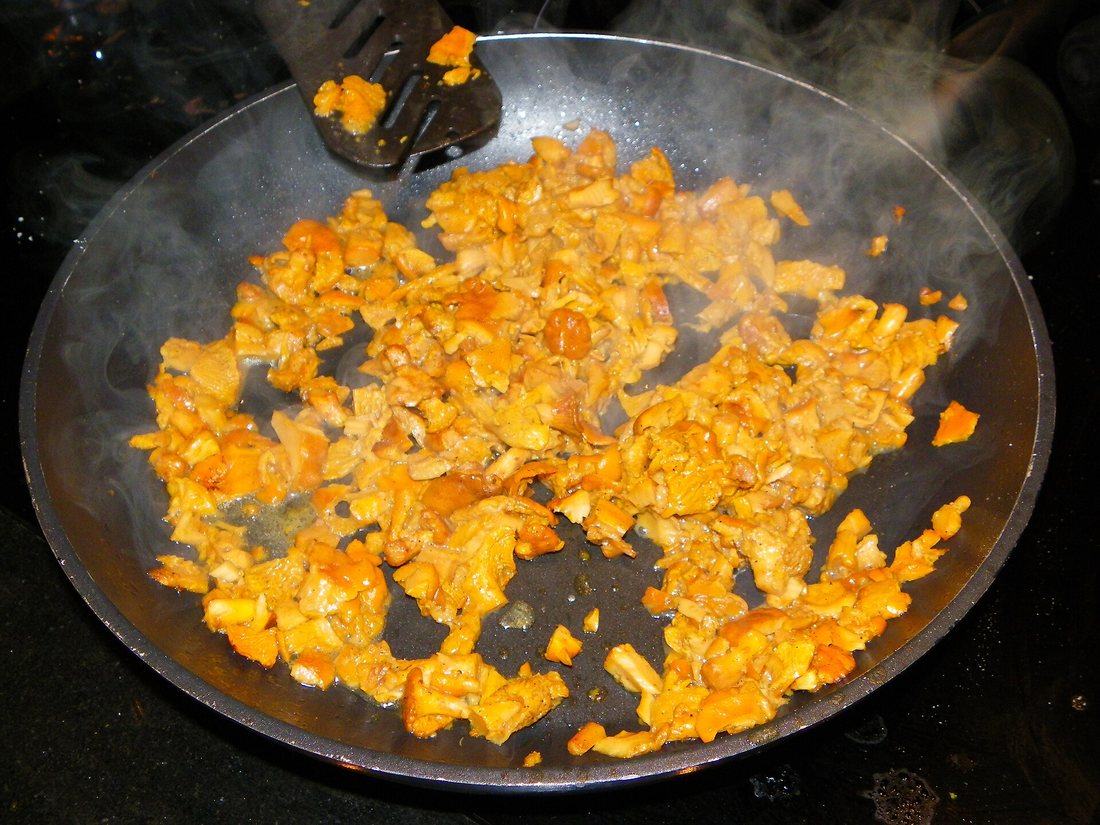
Chanterelles in the pan. They release a lot of water before they will brown.
More confident kitchen rules have been written about mushrooms than about almost any other ingredient: never wash them, never crowd the pan, salt at the end, use plenty of fat. Several of them turn out to be wrong, and one of them is half right in a way that matters. This page goes through what has actually been measured, and says where the evidence runs out. The biology behind all of it — chitin walls, 92% water, air pockets — is on what a mushroom is.
To wash or not to wash
The rule “never wash mushrooms, they soak up water like a sponge” is right for some mushrooms and wrong for others.
| Test | What was done | Result |
|---|---|---|
| Harold McGee (The Curious Cook, 1990) | 252 g soaked 5 minutes, blotted | Gained 6 g — about 2.4% |
| Serious Eats (J. Kenji López-Alt) | Rinsed under running water, spun dry | Gained about 2% — “about 1½ teaspoons of water per pound,” or “an extra 15 to 30 seconds of cooking time” |
| America’s Test Kitchen | Six kinds submerged for one minute | Mushrooms without exposed gills “retained almost no water”; gilled ones took up as much as 25% of their weight |
So: rinse closed buttons and cremini freely, just before cooking — Serious Eats notes that wet mushrooms keep less well in the fridge. Brush or wipe portobellos, shiitake and oysters, whose open gills really do hold water. And wash foraged mushrooms, which come with grit, bark and insects — America’s Test Kitchen’s advice as well. German and Italian official and household advice still says to wipe rather than wash; for gilled mushrooms, they are right.
Fat: absorbed first, released later
The most useful single observation about mushrooms in a pan is this: raw mushrooms soak up fat, and cooked mushrooms give it back.
The earliest controlled test found for this section is a side-by-side by Dave Arnold and Nils Norén at the French Culinary Institute, published on their Cooking Issues blog on 21 December 2009. One batch was cooked the textbook way — dry, uncrowded. The other was soaked and crowded. The dry batch “ended up absorbing all the oil.” The wet, crowded batch, once its water had cooked off, left “a significant amount of oil… in the pan,” and “tasted better and less oily.”
America’s Test Kitchen explains why: mushroom tissue “contains numerous air pockets in which oil can collect. Cooking damages the fibers, which release water, and collapses the air pockets.” Once the pockets collapse, there is nowhere for the oil to go.
The practical rule: when a pan of mushrooms looks dry in the first few minutes, do not add more fat. Keep cooking. The fat will come back out once the mushrooms have collapsed — and then, if more is wanted for flavour, it can go in at the end, where it stays on the surface as flavour instead of disappearing inside.
Steam first, then brown
From that observation grew what is now the mainstream method:
- Start the mushrooms wet — with a splash of water, or covered — so they steam and collapse. America’s Test Kitchen: “We steam the mushrooms in water until they collapse.”
- Let the water cook off. Serious Eats’ 2025 method covers the pan and cooks “until mushrooms have released their liquid, 8 to 10 minutes.”
- Only then add fat, and brown. America’s Test Kitchen adds “a mere ½ teaspoon of oil” once the pan is dry.
Nothing browns while there is water on the surface. Browning is the Maillard reaction, and it cannot begin until the surface water has gone; before that, the mushrooms are simply boiling in their own juice. Steaming first gets that stage over with quickly and on purpose, rather than leaving it to happen slowly while fat soaks in. The method is written up as Steam-First Sautéed Mushrooms.
Crowding the pan: contested
“Don’t crowd the mushrooms” is usually credited to Julia Child’s Mastering the Art of French Cooking, and the film Julie & Julia made it famous. (The book itself was not consulted for this page, so it is given here as her rule rather than as a quotation.)
The tests say crowding delays browning; it does not prevent it. The crowded, soaked batch in the 2009 test browned perfectly once its water was gone, and ended less greasy. Serious Eats calls cooking in small batches the traditional approach, which “does work, but it’s time consuming.” Both approaches produce brown mushrooms. Small batches are faster to colour and use more fat; one crowded batch takes longer but uses less. Neither is wrong.
When to salt: contested
The traditional rule is to salt at the end, because salt draws water out of the mushrooms and delays browning. Serious Eats’ 2025 method does the opposite, on purpose: salting early “encourages the mushrooms to release their water in much less time,” which suits the steam-first method, since the water is going to be driven off anyway. No controlled test comparing the two was found. Salting late suits the dry-pan method; salting early suits the steam-first one.
Mushrooms are very hard to overcook
America’s Test Kitchen steamed portobello, beef and zucchini side by side for forty minutes. The beef became nearly three times tougher and the zucchini collapsed; the mushroom became only 57% firmer, and stayed pleasant. The reason is chitin, the heat-stable material of the fungal cell wall. Mushrooms can be scorched or dried out, but a long braise will not ruin them — which is why they hold their texture in stews, ragùs and sauces.
How much they shrink
A lot. Serious Eats puts it at “more than half of their starting volume” for sautéed mushrooms, and USDA’s nutrient laboratory recorded a moisture loss of about 10% when white mushrooms were stir-fried and about 17% when they were microwaved. No authority gives a single weight figure, because it depends on how long they cook. Buy about twice the volume that should end up on the plate.
Particular mushrooms
- Morels — slice lengthwise (to check identification and evict insects), rinse, dry, and cook through: see morels.
- Giant puffballs — slice top to bottom to check, then cook as thick slabs: see the giant puffball.
- Chanterelles — commonly dry-sautéed first to drive off their considerable water before any fat goes in; that is standard technique rather than a measured finding. See Chanterelle Toast.
- Hen of the woods (maitake) — the “pressed maitake steak”: thick clusters seared under a weight — a bacon press, a foil-wrapped brick, a heavy pan — so every part touches the metal. Hank Shaw credits the method to his friend Alan Bergo. See Pressed Hen-of-the-Woods Steaks.
- Chicken of the woods — only the tender young outer edges; cook thoroughly. See Chicken-Fried Chicken of the Woods.
- Oyster mushrooms — tear rather than cut; the Korean home method blanches them for a minute and squeezes them before stir-frying: Korean Stir-Fried Oyster Mushrooms.
- Shiitake — the stems are tough and usually removed (they flavour stock well). Raw or undercooked shiitake can cause “flagellate dermatitis”, a striking whip-mark rash that NAMA reports “remain[s] common.” Cook them.
- Dried mushrooms — soak, lift the mushrooms out, and strain the soaking liquid through a fine strainer or leave the last grit-laden spoonful behind. The liquid is the best part. For dried shiitake, soak cold and heat the liquid gradually — the reason is on the science page.
- Enoki — cook through; imported enoki were linked to a fatal Listeria outbreak in 2020.
Leftovers
The old warning never to reheat mushrooms dates, according to Germany’s Federal Centre for Nutrition, from “earlier times with inadequate refrigeration” and is “today considered outdated.” Its current advice: keep cooked mushrooms no more than one day in the refrigerator, and reheat them to at least 70 °C (158 °F) for two minutes.
The recipes
Everyday: Steam-First Sautéed Mushrooms · Funghi Trifolati · Garlic Mushrooms on Toast · Cream of Mushroom Soup · Mushroom Ragù · Mushroom Barley Soup
Forager’s: Fried Morels · Creamy Morels on Toast · Dried Morel Butter · Chanterelle Toast · Chicken-Fried Chicken of the Woods · Pressed Hen-of-the-Woods Steaks · Puffball Parmesan
From other kitchens: Pierogi with Sauerkraut and Mushrooms · Chicken and Shiitake Takikomi Gohan · Braised Shiitake with Bok Choy · Nameko Miso Soup · Korean Stir-Fried Oyster Mushrooms · Huitlacoche Tacos · Queso Fundido with Guajillo Garlic Mushrooms · Mushroom Ketchup
In this dive: Forage at your own risk · What a mushroom is · The history · Around the world · Michigan · Morels · The giant puffball · Cooking mushrooms · Over the fire · Preserving · Corrections
Comments (0)