Michigan: The Law, the Seasons and the Morel Towns
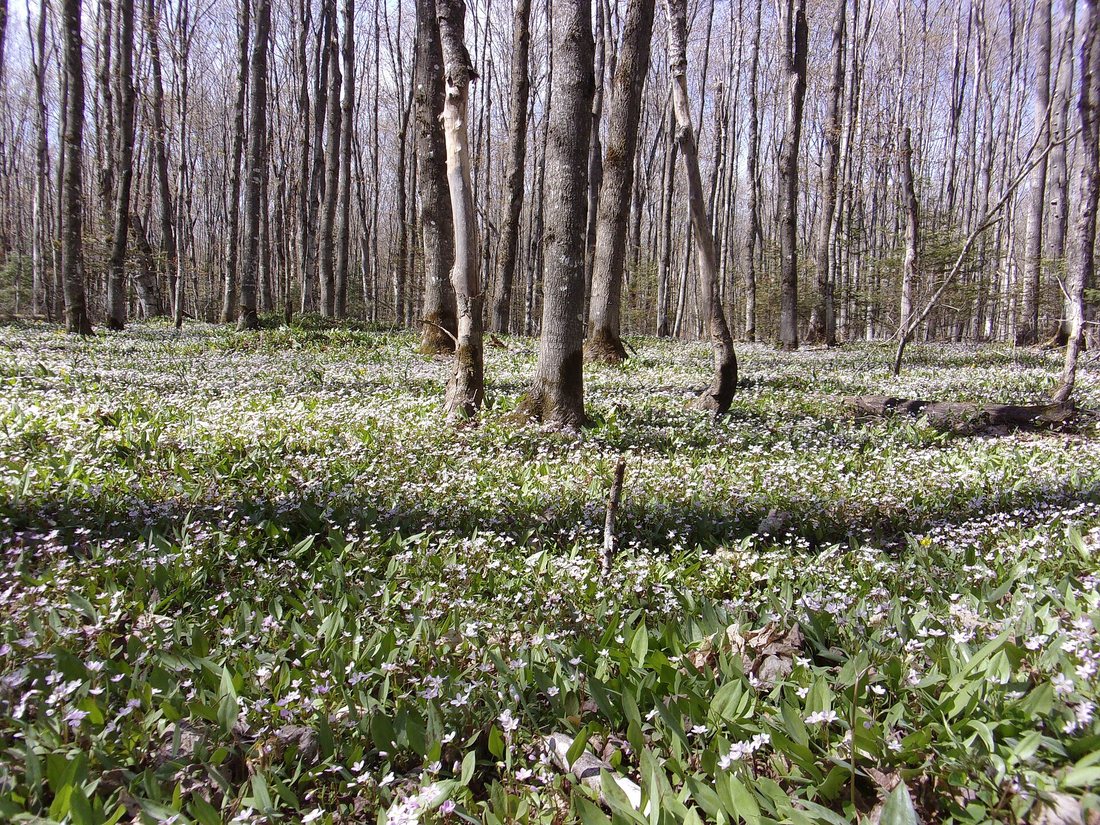
A Michigan hardwood forest in spring (Pictured Rocks National Lakeshore). Morel season begins about now.
Michigan is one of the best mushroom states in the country — roughly 2,500 species of large fleshy fungi, by Michigan State University’s count, in a landscape of hardwood forest, burned-over jack pine, old orchards and sandy fields. It is also one of the few states with a formal system for deciding who may sell a wild mushroom. This page covers the rules, the calendar and the culture. It assumes the safety page has been read first.
Picking on public land
Wild mushrooms from Michigan’s public land are for personal use only. The DNR’s rule is short: “Foods harvested from state lands are for personal use only, and are not for resale.” Its morel page says it more emphatically: “Morels found on public land are for personal use and cannot be sold!”
- State parks and recreation areas. The administrative rule that forbids removing vegetation (R 299.922) makes a specific exception: it “does not apply to picking and removing mushrooms, berries, and edible fruits or nuts for personal use,” except in wildlife food plots.
- State game areas. A DNR rules summary for state wildlife and game areas (revised 2016) gives a personal-use figure of 25 pounds. That limit does not appear in the state-park rule or on the DNR’s current foraging page, and could not be confirmed as a statewide mushroom rule. Check the posted rules for the particular parcel.
- National forests. The Huron-Manistee National Forest states that no permit is needed “when you are gathering edible material (morels, etc.) for your own consumption”; commercial picking needs a special-use permit. The Hiawatha and Ottawa were not checked for this page.
- Burn morels. The DNR publishes an annual Mi-Morels map of recent large burns and prescribed burns — especially former jack, red and white pine stands, where morels often fruit heavily the spring after a fire. The DNR adds, reasonably: “We cannot guarantee the presence of morels at these locations!”
- Etiquette the DNR puts in writing: never rake an area for morels, never drive cross-country, and carry mesh bags — plastic speeds decay.
Selling wild mushrooms: the certification
Michigan adopted the FDA’s Food Code in its Food Law, and the Food Code requires that wild mushrooms sold to the public come from a source where “each mushroom is individually inspected and found to be safe by an approved mushroom identification expert.” Michigan turned that into a program.
- It began in 2015, according to the Michigan Department of Agriculture and Rural Development’s own presentation (some secondary articles say 2014), run in partnership with Midwest American Mycological Information (MAMI).
- It applies to every wild mushroom sold for food — at a farmers market, to a restaurant, to a store — whether fresh, dried or processed. Every container must carry the scientific and common names, and sellers keep records of what they sold and to whom for two years.
- Certification lasts five years. The course is an all-day workshop ending in a written exam with an 80% pass mark. A separate morel-only certification, taught online, is available to people who intend to sell only morels.
- The approved list. The program’s launch material spoke of 21 species; MAMI’s current study guide lists 20 groups — morels, giant puffball, chanterelles, black trumpets, hen of the woods, chicken of the woods, oysters, lion’s mane and its relatives, hedgehogs, lobster mushrooms, shaggy manes, honey mushrooms, the aborted entoloma, pheasant back, and a handful of others including chaga and a Midwestern truffle. Boletes (porcini) are not on it, and MAMI notes that Verpa, the early false morel, is not authorised for sale.
- The register. MDARD’s public list of certified identifiers held about 390 current names in September 2026, 359 of them in Michigan — though certificate numbers run past 1,035, which suggests more than a thousand certificates have been issued since 2015.
Buying advice from MDARD: at a market, ask the seller for proof of inspection by a certified individual. Stores and restaurants are required to buy from an approved source.
The bill that would have exempted morels
In 2016, a bill in the Michigan House (HB 5532) proposed exempting morels from the certification: morels were easy to identify, its supporters argued, and the certificate — $175 for five years at the time — was a burden on small sellers. Opponents noted that morels “can sell for as much as $50 per pound” and pointed to the false-morel risk. Governor Rick Snyder vetoed it on 5 January 2017, citing the FDA Food Code, a recent rise in morel-related poisonings, and the bill’s loose definition of “morel,” which he said could have exempted species that are not morels at all.
Michigan’s mushroom year
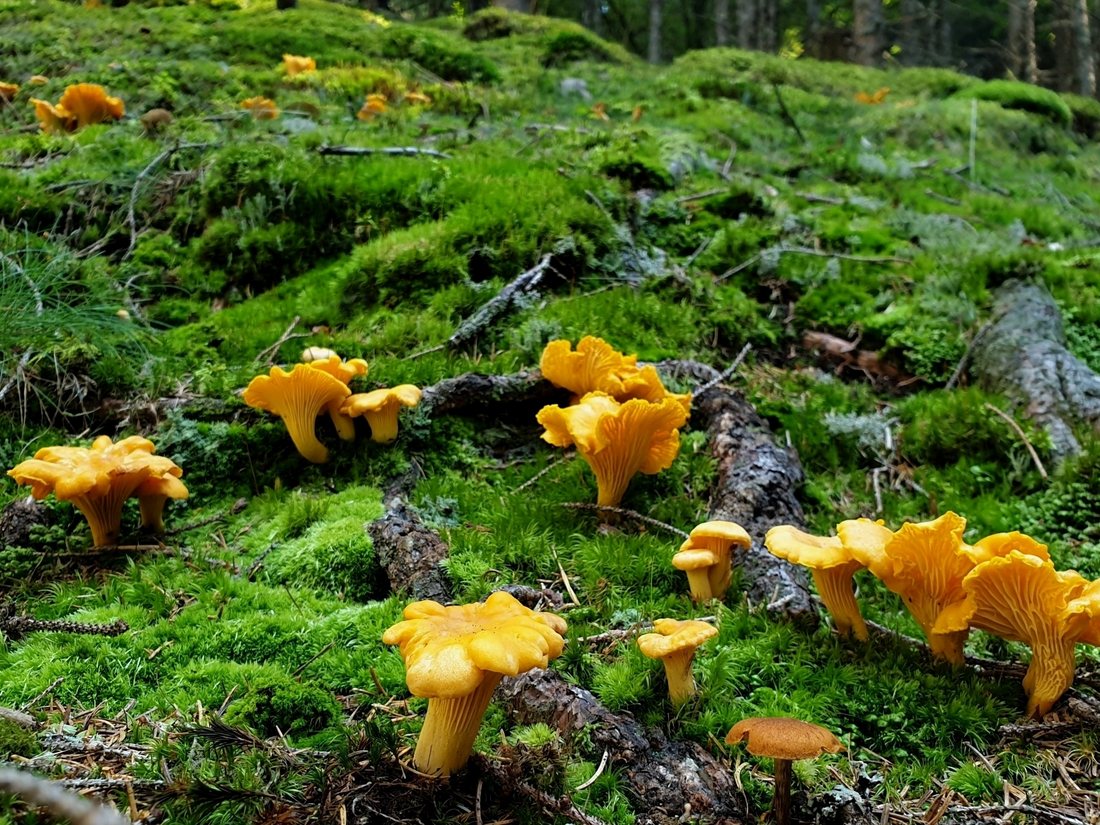
Chanterelles in moss. In Michigan they peak in July; the jack-o’-lantern is the look-alike to know.
The DNR’s summary of the morel season is the right place to start: “May is morel month in Michigan, but the actual fruiting period is from late April until mid-June, depending on the location and species. Morels are not just found in the north — some of the best picking is in southern Michigan.” The rest of the year belongs to other mushrooms.
| Mushroom | When and where in Michigan | The look-alike that matters |
|---|---|---|
| Black morels | First to appear, early to mid-May, under ash, aspen, cherry and tulip tree; “often peaks when serviceberry bushes are in full bloom” (DNR) | Verpa bohemica, which comes earlier (late April), with a cap hanging free like a skirt |
| Yellow (white, grey) morels | Latter half of May; hardwoods, dead elms, ash, old orchards, occasionally lawns | Gyromitra, the false morels |
| Half-free morels | May; fruits heavily “about one year in three” | Verpa |
| Burn morels | The first spring after a conifer fire, May into June | — |
| Chanterelles | Late June to early September, peaking in July | Jack-o’-lantern (Omphalotus), orange and clustered on wood |
| Chicken of the woods | Summer into fall, on oaks and other hardwoods | Few look-alikes, but a notable share of adverse reactions |
| Lobster mushroom | Midsummer to early fall, oak and poplar woods | Its host mushroom often cannot be identified |
| Oyster mushrooms | Year-round in good conditions; one species on aspen in late spring and summer | — |
| Hedgehogs | Summer and fall; spines under the cap instead of gills | Bitter spined relatives, not dangerous |
| Hen of the woods (maitake) | Late August to October, at the base of oaks; specimens over 100 lb have been recorded | ”No poisonous look-alikes” (MAMI) |
| Honey mushrooms | Autumn clusters on wood | Deadly Galerina on the same wood — rusty-brown spore print |
| Giant puffball | Late summer into fall in lawns, meadows, fields and woodland edges | Young Amanita “eggs” and earthballs |
(Sources: DNR morel pages; MAMI species pages; MSU bulletin E-2777. No Michigan-specific authority gives exact months for the giant puffball; “late summer into fall” is the general North American pattern.)
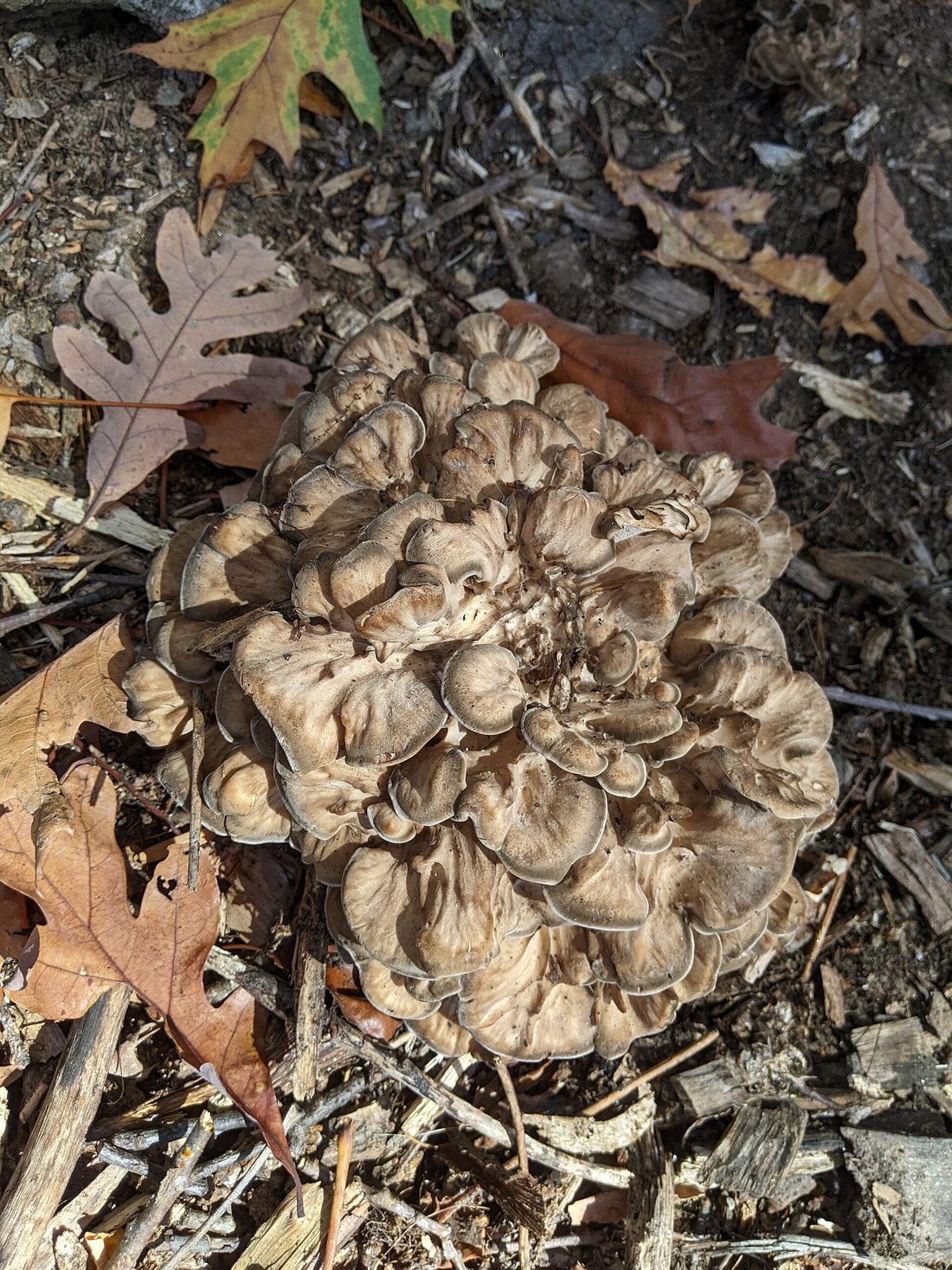
Hen of the woods (maitake) at the base of an oak, as it appears in Michigan from late August.
On morel species names: in 2012, a genetic study split North American morels into nineteen species, fourteen of them new to science. MAMI quotes the lead author on the practical consequence for the Great Lakes: “we are stuck not knowing… whether the most commonly collected… morels are M. cryptica or M. americana without testing their DNA.” This section therefore says “yellow morel” and “black morel” rather than pretending to a precision nobody has in the field.
The old advice about orchards
The traditional Michigan morel advice — hunt the dead elms, the ash and the old apple orchards — still describes where morels are found. Two findings complicate it.
- Orchards can be contaminated. For decades, apple orchards were sprayed with lead arsenate, and the residue persists in the soil. MAMI warns that morels concentrate lead 70 to 100 times and cites research on morels from treated orchards. It also advises avoiding highways, golf courses and industrial sites.
- Morels may not “partner” with trees at all. A 2025 genome study led from Michigan State University (Bonito et al., Current Biology) found that true morels carry the genetic signature of decomposers and “a lack of biotrophic markers” — unlike their false-morel relatives. The dying elm and the burned forest still produce morels; the likelier reason is a pulse of dead and dying roots and disturbed ground, not a relationship with a living tree. MAMI still describes morel ecology as unsettled, and so does this page.
A Michigan patent
The first successful morel cultivation patent — US Patent 4,594,809, “Cultivation of Morchella,” granted 17 June 1986 — was assigned to Neogen Corporation of Lansing, Michigan. Its inventor, Ronald Ower, had grown the first morel fruiting bodies in a controlled chamber at San Francisco State University earlier in the decade. What became of the patent afterwards is told only in secondary sources, and is not repeated here. The story continues on the morels page, where cultivated morels turn out to matter a great deal.
Michigan has another claim in mushroom history: NAMA’s Mushroom Poisoning Case Registry, created in 1982 and still the best source of North American poisoning data, was set up with groundwork by Dr. Kenneth Cochran at the University of Michigan, who published its first annual report in 1985.
The morel towns
Two northern Michigan towns hold spring festivals, and both claim a title.
- Mesick (Wexford County) has held its Mushroom Festival every Mother’s Day weekend since 1959 and calls itself “the Mushroom Capital of the US.”
- Boyne City (Charlevoix County) holds the National Morel Mushroom Festival, which reached its 66th year in May 2026, with a competitive hunt, tastings and a carnival. Its origin is told as oral history — a bar argument around 1960 over who was the better picker, formalised by a Lions Club member, and named “National” because “nobody else is doing it.” That story comes from a 2011 interview, not a primary record.
No authority grants the title “mushroom capital” — Mesick’s is a self-designation, and towns in Wisconsin and Missouri claim similar ones. By date, Mesick’s festival is the elder by a year or so.
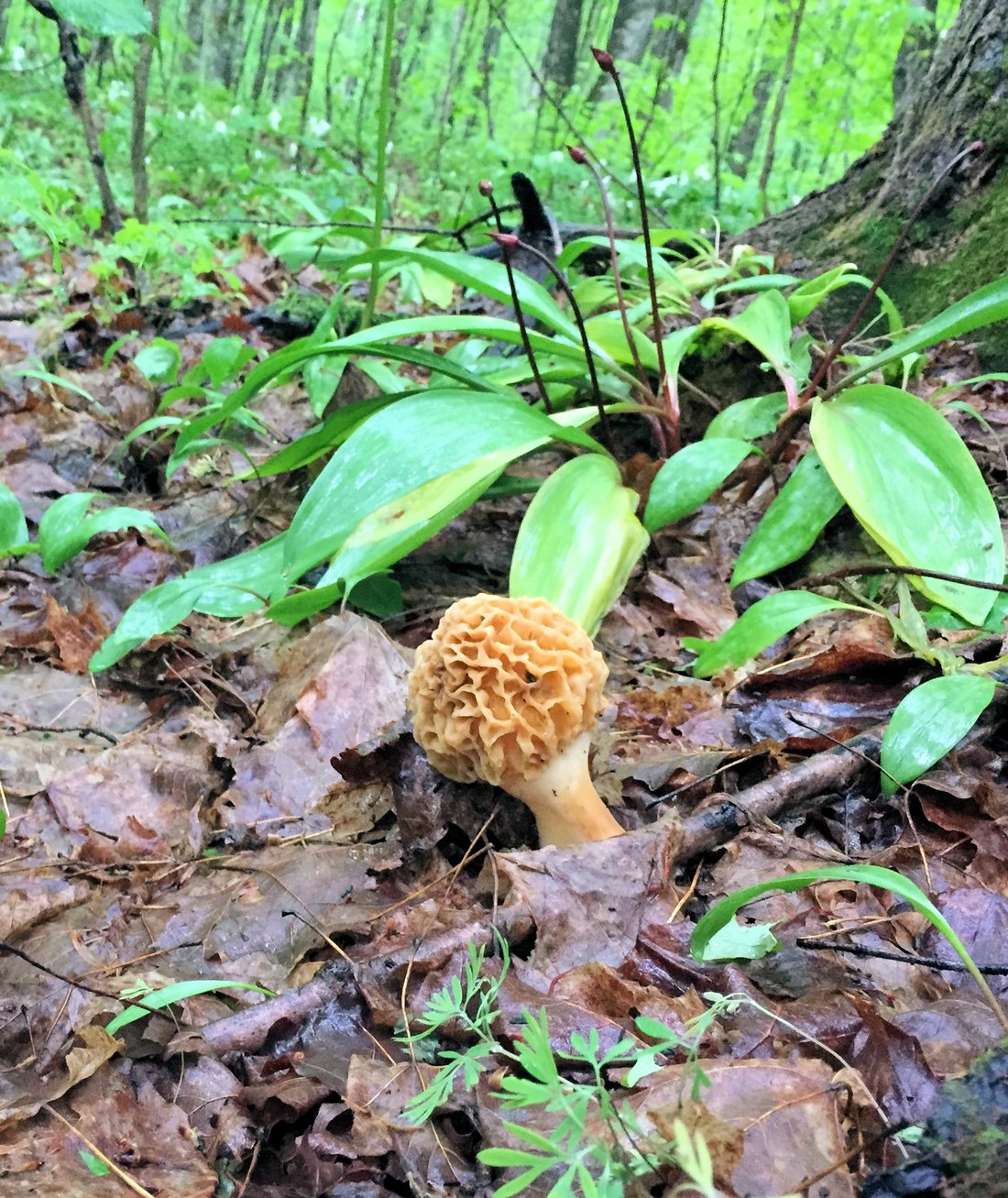
A morel on the forest floor at Pictured Rocks National Lakeshore, Michigan.
The state mushroom that never was
Michigan has no state mushroom. In 1998, a campaign by fourth-graders at Stadium Drive Elementary in Lake Orion produced House Bill 4805, which would have made the morel “the official state fungus.” The legislative analysis records the arguments — including an objection that the state already had too many symbols, citing proposals for a state “cherry burger” — and the bill never passed. The official list of Michigan symbols contains the robin, the brook trout, the apple blossom, the mastodon and Kalkaska sand, but no fungus. Minnesota named the morel its state mushroom in 1984, the first state to name one.
A field note from the Maple River
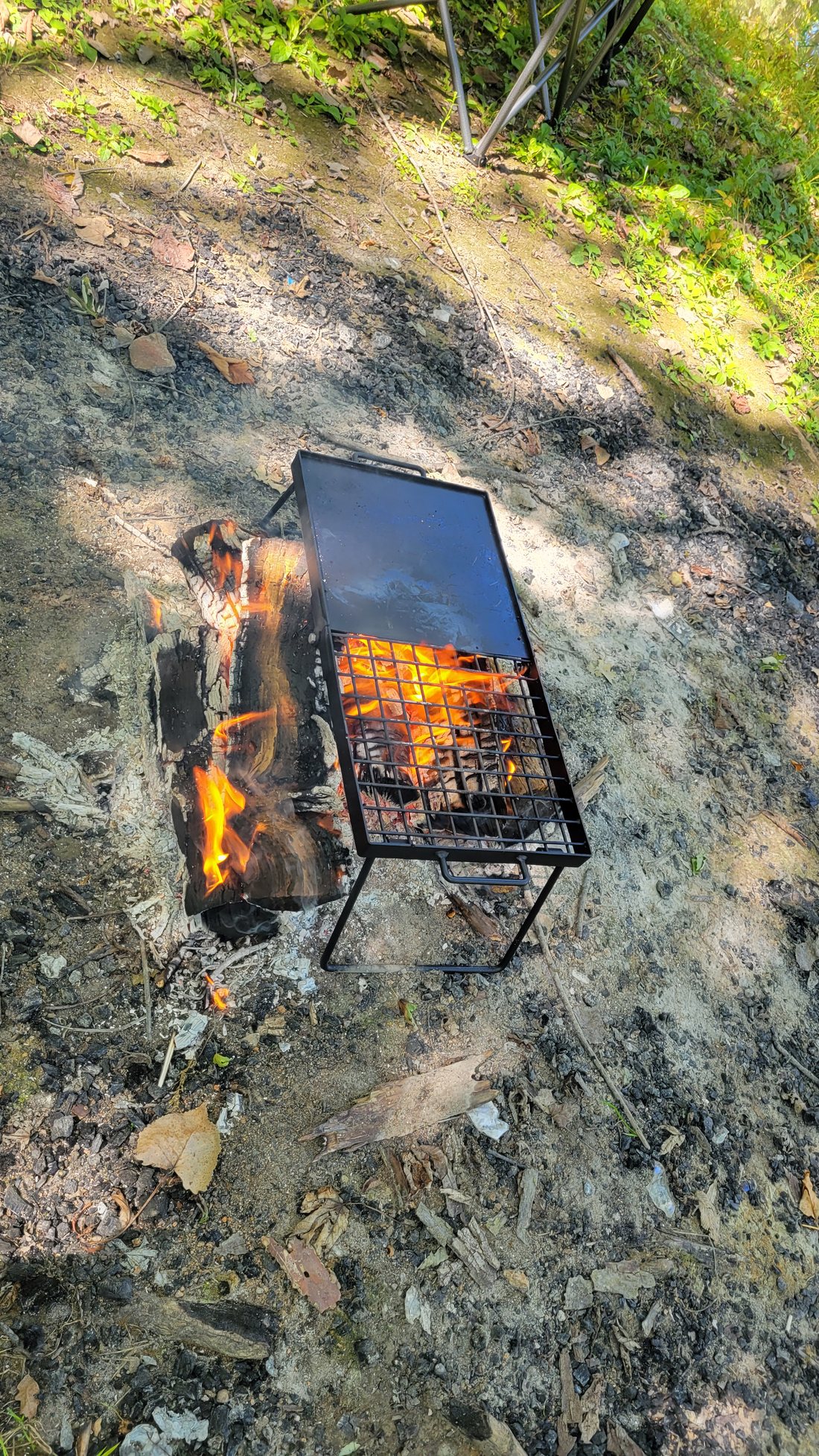
The fire: a folding camp grill over split logs. The slabs went on the open grate, not the griddle.
In late September 2026, a giant puffball the size of a soccer ball turned up in a yard at the edge of a grove of pine trees above the Maple River in central Michigan. It was sliced into slabs, checked pure white all the way through, dipped in melted butter seasoned with salt, pepper and garlic, and cooked straight on the grate of a folding camp grill over a wood fire. The full account, with the photographs, is on the giant puffball page, and the method is written up as the campfire puffball recipe.
In this dive: Forage at your own risk · What a mushroom is · The history · Around the world · Michigan · Morels · The giant puffball · Cooking mushrooms · Over the fire · Preserving · Corrections
Comments (0)