Ovens and Griddles
Most of the world’s flatbreads are named for, or shaped by, the thing they cook on. Italian tigelle took the name of the terracotta discs they were baked between; the Iranian sangak is named for the pebbles it lies on; the English griddle and grill are the same word, from Latin craticula, a small gridiron. Learn the surface and the bread follows.
The griddle family
A griddle is a hot plate — stone, clay or iron — over a fire. It is the oldest and commonest flatbread tool, because it needs no building. Archaeologists have found late Neolithic baking pans in the Balkans from the early fifth millennium BC and moulded-rim baking trays in Bronze Age Syria and the Levant (Pasqualone, 2022).
- Comal (Mexico and Central America), from Nahuatl comalli. Molina’s Nahuatl dictionary of 1571 defines it as the plate “where they cook corn tortillas.” The word tortilla, by contrast, is Spanish — “little cake,” from Latin torta.
- Tava or tawa (North India and Pakistan): a flat or slightly curved iron griddle for roti, chapati and bhakri.
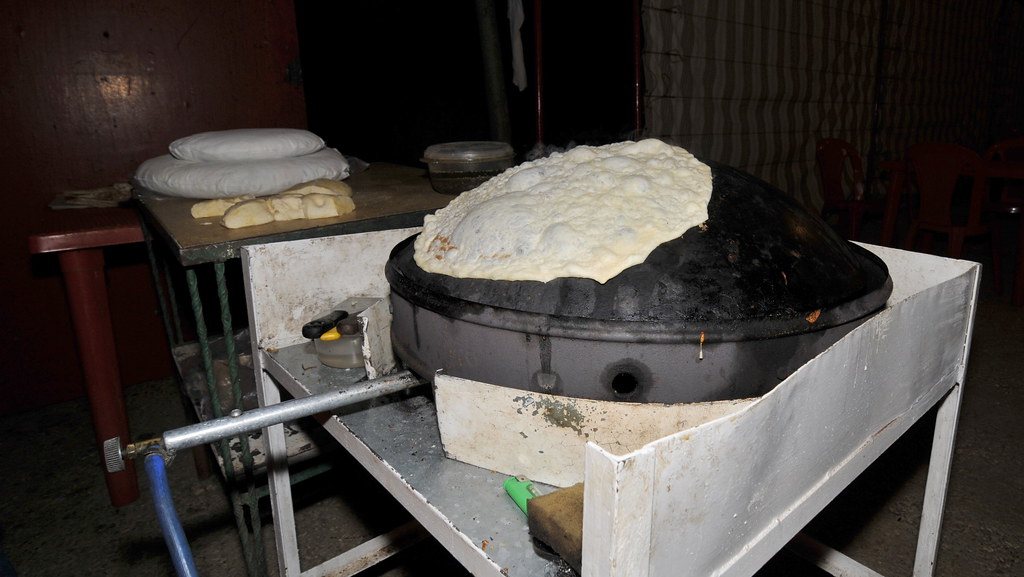
- Saj or sac (the Levant and Turkey): a domed metal disc about 50 cm across, set over embers with the dome up, for the huge paper-thin sheets called markouk, shrak or yufka. The name comes from Old Turkic for “frying surface.”
- Mitad (Ethiopia and Eritrea): a large round clay griddle for injera, with a lid. Injera cooks on one side only and is finished by its own steam. The oldest known mitads come from Aksum and date to the late fifth or sixth century AD.
- Budare (Venezuela and Colombia): the griddle for arepas and cassava bread.
- Takke or bakstehelle (Norway): a round iron or stone plate, defined in the Norwegian dictionary as being “especially for flatbrød and lefse.”
- Girdle (Scotland): a round iron plate with a hooped handle, hung over the fire. The word is a Scots rearrangement of griddle.
- Bakestone (Wales), in Welsh maen, “stone”: the name records that it was once literally a stone slab, before cast iron arrived in the nineteenth century. (This claim rests on a single secondary source.) The Staffordshire oatcake’s baxton is the same word.
A cast-iron skillet or flat griddle is a good stand-in for all of these. A carbon-steel crêpe pan or a comal from a Latin grocery works too.
The wall oven: tannur and tandoor
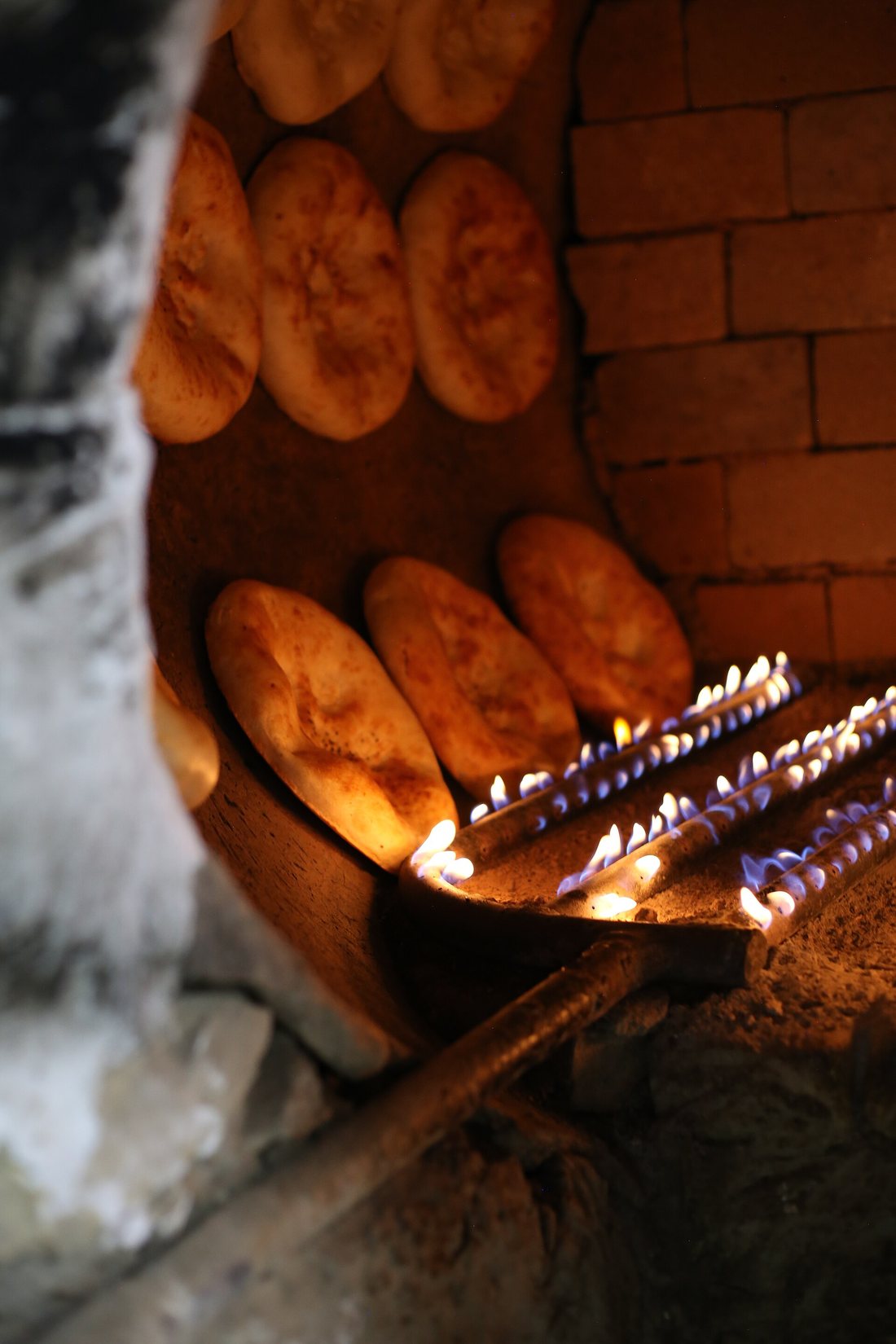
The tannur is a clay cylinder with a fire at the bottom. The baker slaps the dough onto the hot inside wall, where it sticks and bakes in a minute or two, and then picks it off with a hook or tongs. The word is very old — Akkadian tinūru — and wood-fired vertical ovens run above 300 °C.
Pasqualone notes practical details that decide whether it works: bakers wipe the wall with a damp cloth and wet the dough so it sticks; the clay has to be fired for many hours before first use; and the inner surface crumbles with use, so that after two or three years bread stops sticking and the oven is replaced. Underground versions (the tandir or tonir) run from eastern Turkey and Armenia through Central Asia to the Punjab and Xinjiang. Armenian lavash is stretched over an oval cushion and slapped against the wall of such an oven.
In India, tandoor cooking became widespread only after the Partition of 1947, when Punjabi refugees opened restaurants in Delhi; before that, rural Punjab had communal village tandoors. That history is why naan is thought of abroad as “Indian bread,” while in most Indian homes the everyday bread is roti, made on a tava.
A home kitchen has no tandoor. A baking steel or stone under a hot broiler is the practical stand-in — it gives the sudden, fierce heat that makes a naan blister and puff.
The floor oven: pebbles, stone and brick
The third family bakes flatbread on the floor of a domed oven. Pita and khubz need the even, flat floor to puff into a pocket.
Two breads bake on pebbles, and the pebbles matter:
- Sangak, Iran’s long whole-wheat bread, is slid onto a sloping shelf of red-hot pebbles, which leave dents in the bread. Sang means stone, and Encyclopaedia Iranica says the bread takes its name from the pebbles. It is about 70 cm long.
- Taboon bread bakes on a bed of hot limestone pebbles in the low taboon oven of Palestine and Jordan. The uneven surface stops a pocket forming (a single-source claim that fits the physics: see the science).
The taboon is often assumed to be ancient. Pasqualone reports that the word is first attested in Palestine in the tenth century AD and that the oven probably arrived after the Arab conquest.
A wood-fired pizza oven is a floor oven, and it bakes pita and naan well — see the pizza ovens section.
Ashes, embers and oil
The oldest way of all needs no tool: dough laid in hot ashes or on a hot stone at the edge of a fire. This is how the bread at Shubayqa 1 was most likely baked. The Scots and Indigenous bannock, “bread baked on the hearth or under ashes” (Etymonline), and the campfire bannock on a stick are its descendants.
Frying is the other way round. Puri, frybread and many bannocks are cooked in hot fat, where they puff for the same reason a pita does.
Flatbreads: What a flatbread is · The history · The science · Ovens and griddles · The Middle East · South Asia · The Americas · Europe · Africa and East Asia · Making them at home · Corrections · ← Breads
Comments (0)