The Middle East and the Eastern Mediterranean
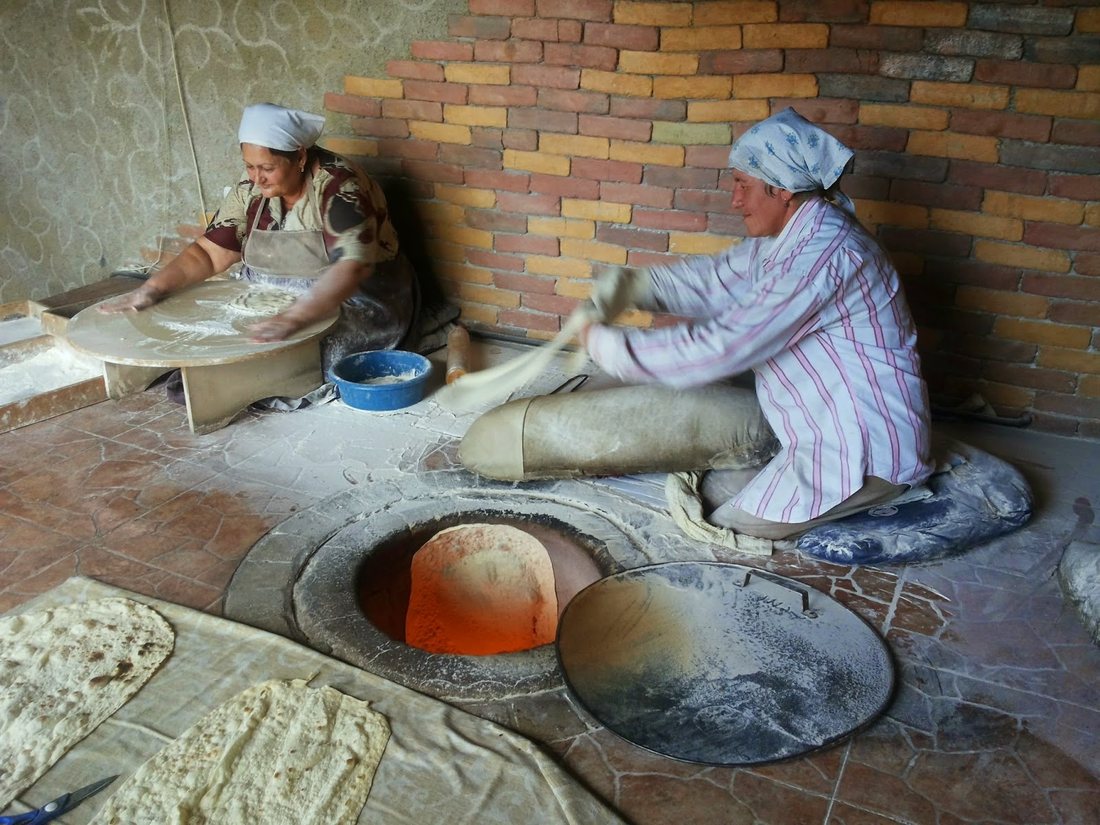
The Fertile Crescent is where flatbread began, and it still has the widest range of them: paper-thin sheets from a domed griddle, loaves slapped on an oven wall, pocket breads, pebble breads and breads topped with thyme or meat. The collection’s owner has eaten Middle Eastern breads while travelling, and has made pita and lavash at home.
Khubz and pita
Khubz is simply the Arabic word for bread. What English calls pita — the thin, round pocket bread — is, in Arabic, just khubz.
In Greece, “pita” is the bread without a pocket. The thick, soft round wrapped around a gyro is the Greek pita; the thin pocket bread is called aravikí pita, “Arab pita.” The Greek word is attested in Byzantine Greek in 1108, and its origin is uncertain. English borrowed it only in 1936.
The pocket itself may be newer than people assume. The food historians Charles Perry and Gil Marks are cited as finding no record of the steam-puffed, two-layer pocket pita in ancient texts or in any medieval Arab cookbook. That rests on a secondary citation, and is best read as “not documented” rather than “proved modern.” The mechanism of the pocket is on the science page.
The collection has Pita Bread (Pizza Oven).
Lavash
Lavash is a large, thin, soft or crisp sheet. It is on UNESCO’s intangible heritage list twice:
- Armenia, 2014. The UNESCO description gives a dough of “wheat flour and water,” stretched over an oval cushion and slapped against the wall of a conical clay oven for “thirty seconds to a minute.” It is made by a small group of women, can be kept for up to six months, and at weddings is laid on the shoulders of the couple “to bring fertility and prosperity.”
- Azerbaijan, Iran, Kazakhstan, Kyrgyzstan and Turkey, 2016, as “flatbread making and sharing culture: lavash, katyrma, jupka, yufka.” Armenia is not a party to this file. It describes baking in a tandyr, on a sāj or in a kazan, by at least three people.
Neither listing is a ruling on who invented lavash; UNESCO records living practices, not ownership.
“Lavash is unleavened” is too simple. The Armenian file describes flour and water. But Encyclopaedia Iranica says Iranian bakery lavash is made from “a more or less leavened dough,” and that village lavash varies “in the amount of leavening added.” It is the thinnest bread in Iran, 2–3 mm, and keeps for weeks wrapped in cloth, which is why it is eaten in western Iran in winter.
The new collection recipe is Lavash, a thin-rolled version finished on a baking steel.
Iran’s four breads
Iranica lists four main urban breads in Iran: tāftūn, “probably the most popular,” lavāš, sangak and barbari.
- Sangak is leavened, 3–5 mm thick and about 70 cm long, baked on a sloping shelf of red-hot pebbles. It takes two men: the baker spreads the dough on a convex board at the end of a long-handled peel and flips it onto the stones. A story that sangak was the bread of the Persian army, with soldiers carrying their own pebbles, is not in Iranica and has no known primary source.
- Barbari is thicker, 3–4 cm, and oval. It is named for a people, not a method: a “Barbar” community that settled south of Tehran in the Qajar period.
- Tanur breads are pricked with a comb-like tool before baking, for the same reason a cracker is docked.
Saj breads: markouk, shrak, yufka
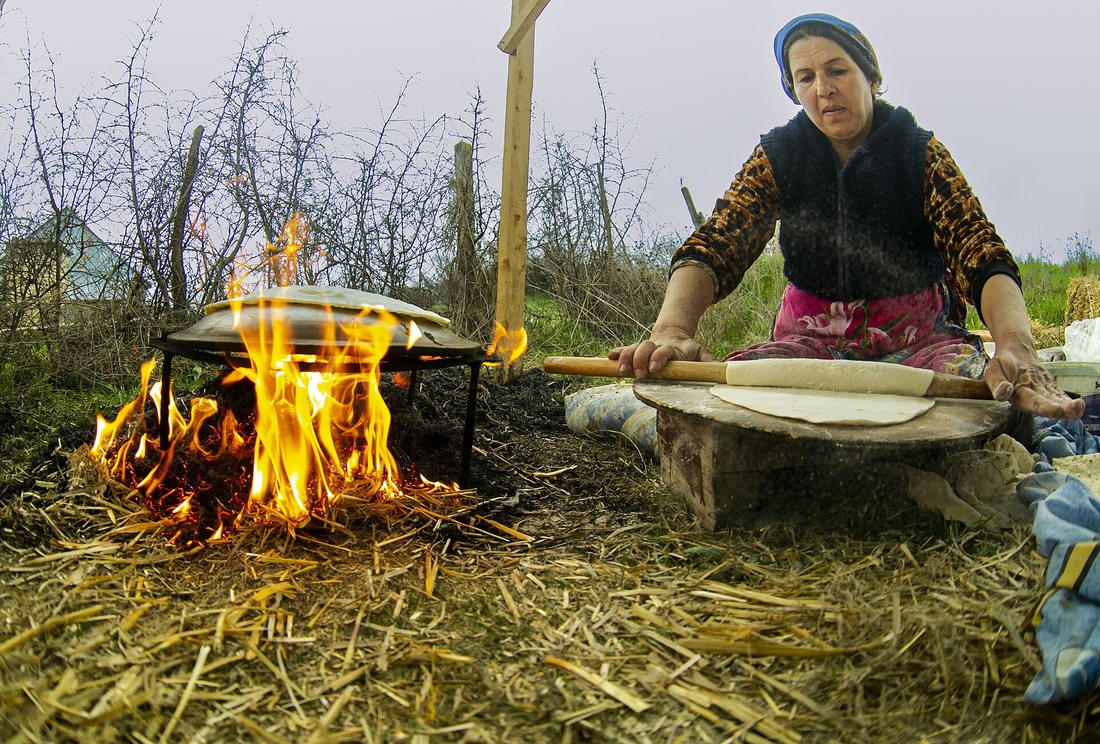
On the domed saj, bakers stretch an unleavened dough of flour, water and salt until it is nearly transparent, drape it over the dome, and turn it in seconds. It goes by many names — markouk, shrak, ruqaq — and a tenth-century Baghdad cookbook describes “large and paper-thin, unleavened bread.” In Jordan, shrak lines the platter of mansaf.
The Turkish equivalent is yufka, rolled with a long thin pin called an oklava. It appears in an eleventh-century Turkic dictionary as yuvgha, “folded bread.” In modern Turkish, yufka names both the griddled bread and the raw sheet used for börek; the claim that it is the ancestor of filo is often repeated but hedged.
Topped flatbreads
- Man’oushé (plural manakish): dough indented with the fingertips and topped with za’atar — thyme, sumac, sesame, salt and olive oil. UNESCO listed it for Lebanon in 2023, describing morning gatherings around it. Its name is said to come from naqasha, “to engrave,” which matches the fingertip dimples. The collection has Man’oushe with Za’atar.
- Lahmacun: a thin round spread with minced meat. The name is Arabic, laḥm bi-ʿajīn, “meat with dough,” and a thirteenth-century Aleppo cookbook describes “minced meat spread on thin dough and baked.” It spread widely in Istanbul only from the 1950s. With no cheese and no tomato sauce, it is neither “Turkish pizza” nor “Armenian pizza.” The collection has Lahmacun.
- Pide: in Turkish a cognate of pita; the plain round is the Ramadan bread, and the boat-shaped topped pides are a family of their own.
The Yemeni layered bread
Malawach, a Yemeni Jewish bread brought to Israel with the migration of 1949–50, is dough brushed with fat, stretched, coiled and pan-fried into a flaky round. It is sold frozen in Israel today. The same dough baked slowly overnight is jachnun, for Shabbat. The new collection recipe is Malawach.
Flatbreads: What a flatbread is · The history · The science · Ovens and griddles · The Middle East · South Asia · The Americas · Europe · Africa and East Asia · Making them at home · Corrections · ← Breads
Comments (0)