The Americas: Tortillas, Arepas, Pupusas and Johnnycakes
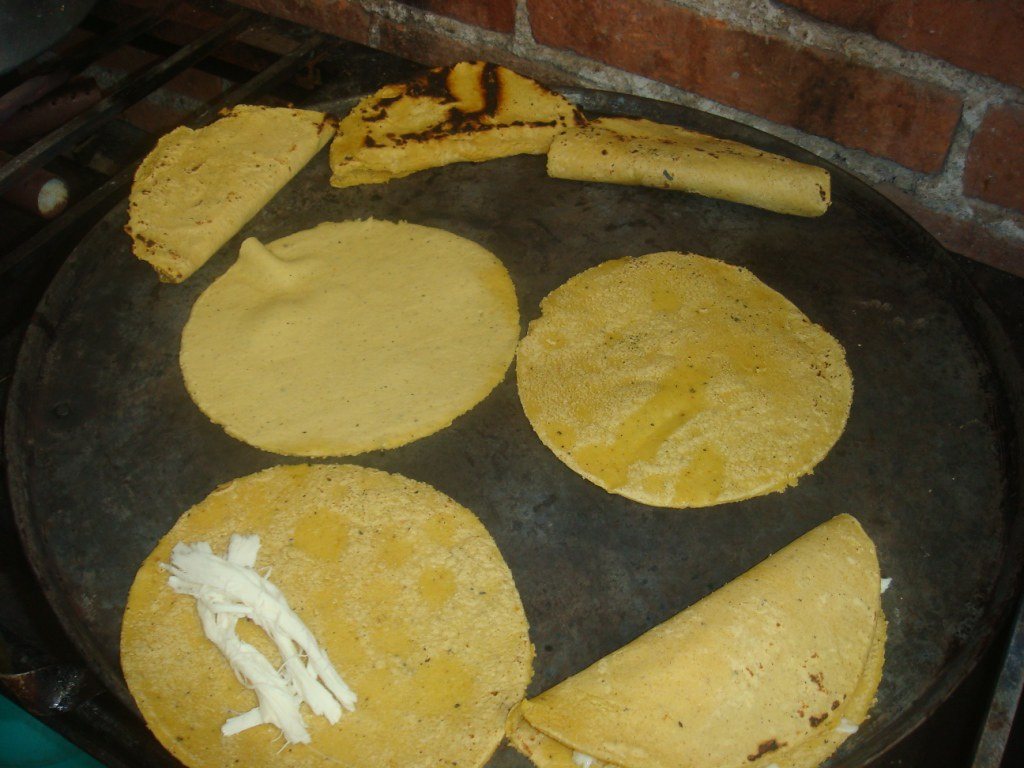
Before 1492 the Americas had no wheat. Their flatbreads were made of corn — and, in the Caribbean, of cassava. The collection’s owner has made both flour and corn tortillas with a tortilla press, arepas and johnnycakes, on cast iron.
Corn tortillas
A corn tortilla is made from masa: dried field corn cooked and steeped in water with lime (calcium hydroxide), washed, and ground wet. The process is nixtamalization, from Nahuatl nixtamalli, usually glossed as “ash” plus “cooked corn dough.” The dough is pressed thin and cooked on a comal. It has no leavening; a good tortilla puffs on the comal from steam alone.
A sixteenth-century Spanish naturalist, Francisco Hernández, recorded women forming “thin, medium-sized round tortillas, which they cook straight away in a comalli over hot coals,” and called it “the most common method of preparing bread from corn.” UNESCO’s 2010 listing of traditional Mexican cuisine names nixtamalization among its core practices.
What the lime does is explained on the science page. The short version: it makes masa hold together, raises calcium sharply, and prevented the disease pellagra among people who ate it — but why it prevents pellagra is still argued.
At home, masa harina — dried, powdered masa — is the practical starting point. The two things that matter most are dough moisture (it should feel like soft clay and not crack at the edge when pressed) and a two-temperature cook: a first side on a medium-hot comal, then a hotter second side, where the tortilla should puff.
The new collection recipe is Corn Tortillas (Masa Harina). The collection also has Soft Corn Tortillas and Gluten-Free Corn Tortillas.
Flour tortillas
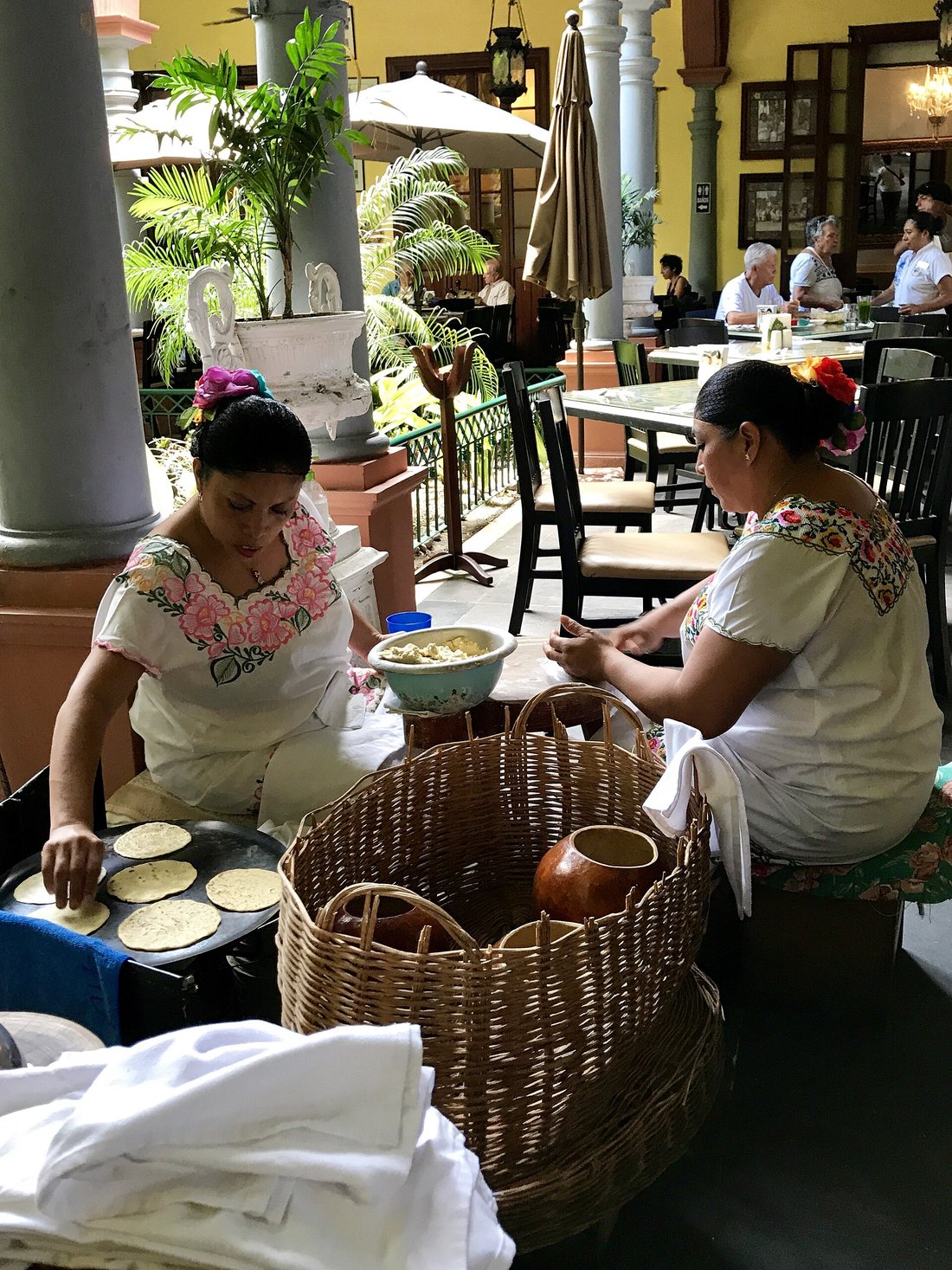
Wheat reached Mexico with the Spanish, planted near Mexico City around 1523. The flour tortilla — wheat flour, lard, salt and water, rolled thin and cooked on a comal — is usually said to come from Sonora, in the north, because the north could grow wheat.
That origin story is contested. Wheat was grown mostly in central Mexico until the twentieth century; a flour-tortilla recipe appears in an 1845 cookbook whose recipes are mainly central and southern Mexican; and a Jesuit who lived in Sonora in the 1750s and 1760s described its people living on maize. The evidence leaves the Sonora story unproven rather than disproven. What is certainly northern is the modern identity of the flour tortilla: the huge, thin Sonoran rounds and the burrito.
A second popular story, that crypto-Jews in northern Mexico invented flour tortillas as an unleavened bread, is contradicted by seventeenth-century Inquisition records describing Jews there eating corn tortillas (as reported secondhand).
The collection has Flour Tortillas, Flour Tortillas Made with Bacon Fat, Gluten-Free Flour Tortillas and Gluten-Free Cassava Flour Tortillas.
Arepas
An arepa is a thick, round, unleavened corn cake from Venezuela and Colombia, cooked on a budare and often then baked or fried, split and stuffed. The dish predates both countries, and which one “owns” it is a genuine dispute best left alone.
Masarepa is not masa. Arepa flour is corn that has been cooked and dried; traditionally the hulls were removed by pounding in a wooden mortar (pilado), not by lime. Masarepa and masa harina cannot be swapped — one makes arepas, the other tortillas.
The modern pre-cooked flour, Harina P.A.N., grew from a patent granted in 1954 to the engineer Luis Caballero Mejías, sold to Empresas Polar, and went on sale in 1960. P.A.N. stands for Productos Alimenticios Nacionales.
The collection has Arepas, Colombian Arepa, 3-Ingredient Arepas and Arepas with Perico.
Pupusas
The pupusa of El Salvador is a thick round of masa stuffed with cheese, beans, chicharrón or loroco (an edible flower bud), sealed and griddled, and served with curtido, a vinegar slaw. Since 2005 the second Sunday of November has been El Salvador’s National Pupusa Day. The origin of the name is not settled: the usual derivation, from a Pipil word meaning “fluffy,” is disputed by a linguist who says the Pipil name for the dish was different. Rice-flour pupusas are said to come from the town of Olocuilta.
The new collection recipe is Pupusas with Curtido.
Johnnycakes
The johnnycake is a griddled cornmeal cake of New England, above all Rhode Island, where it is made from white flint corn. “Johnny-cake” is attested in 1739; “journey cake” appears only from 1775, so the familiar explanation — a cake for a journey — is younger than the word it claims to explain. The real origin is unknown.
The Jamaican “johnny cake” is an unrelated food: a fried wheat dumpling.
The collection has Cornmeal Johnnycakes, Johnny Cake and Johnny Cake (Sugar and Milk, Jeff’s).
Bannock and frybread
Bannock is an old Scots word (Gaelic bannach, “a cake”) for a thick flat cake baked on the hearth or under ashes. In Canada, Indigenous and Métis bannock today is wheat flour, baking powder, lard and water, fried, baked or cooked on a stick. The name and the wheat came with Scottish fur traders; earlier breads were made from corn, roots and tree sap; and reserve rations of flour and lard entrenched the wheat form. It is both “Indian soul food” and a reminder of colonialism, and both halves are true.
Frybread, of the Diné and many other Native nations, is covered on the history page. It became South Dakota’s official state bread in 2005, the same year the writer Suzan Shown Harjo published an essay linking it to Native health crises.
The collection has Oat Bannock (Skillet), a Scottish-style oat bannock cooked in cast iron, and Bannock, Campfire (Pan or Stick), the flour-and-baking-powder trail bannock from the British Columbia booklet Bannock Awareness, cooked in a pan over the fire or wound around a green stick.
Cassava bread
In the Caribbean, casabe is made from bitter cassava, grated and pressed to squeeze out its poisonous juice, then baked on a griddle into large crisp rounds. It descends from the Taíno. In December 2024 UNESCO listed cassava bread for Cuba, the Dominican Republic, Haiti, Honduras and Venezuela. Jamaica’s thick cassava bammy is a relative, but Jamaica was not a party to that listing.
Flatbreads: What a flatbread is · The history · The science · Ovens and griddles · The Middle East · South Asia · The Americas · Europe · Africa and East Asia · Making them at home · Corrections · ← Breads
Comments (0)