Beyond Pizza: Flatbreads, Cast Iron, and Cooking on the Falling Heat
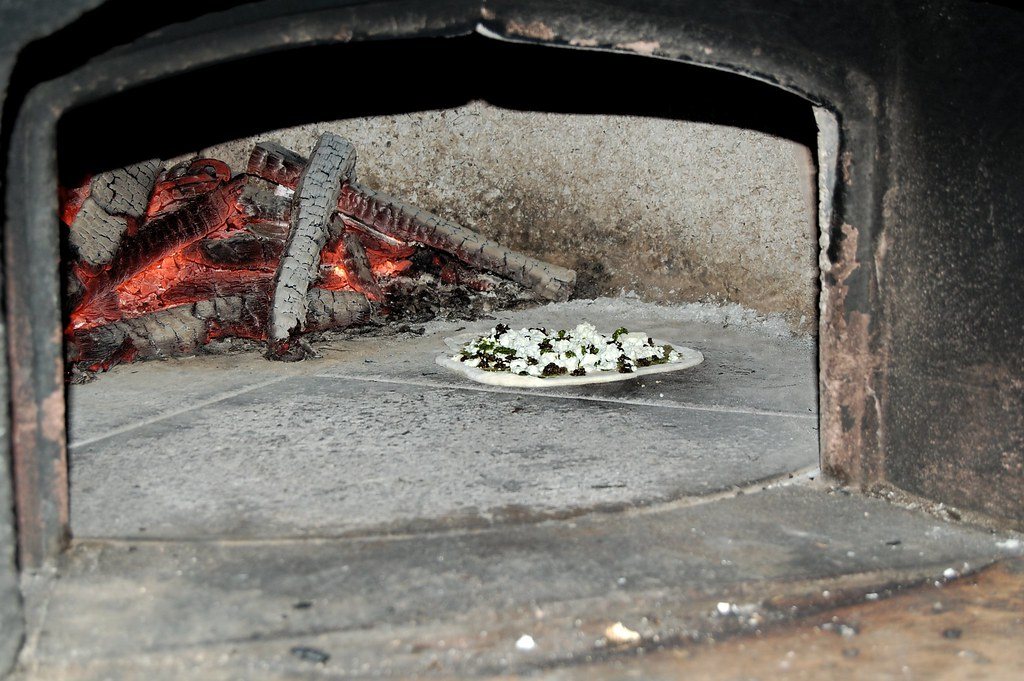
A flatbread on the oven floor. Most things other than Neapolitan pizza want the oven cooler, as the fire is let down.
Almost nothing else wants a pizza oven at full blast. Of the recipes gathered for this section, only the Neapolitan pizzas are baked at 850 °F or more. Everything else is cooked cooler, or on a fire that is being turned down — flatbreads at 570–750 °F, a steak on cast iron with the flame lowered, a roast chicken at 464 °F, a skillet cookie on an oven that has been switched off. In a wood oven that means an evening has an order: pizza while the fire is at its hottest, then the other dishes as it falls away.
Flatbreads
A pizza oven is a very good flatbread oven: the hot floor and the hot roof make breads puff and blister in a minute or two. The flatbreads section of the Breads dive, coming later in this program, covers them in depth; these are the ones the oven does especially well.
| Bread | Where from | Stone | Time | Recipe |
|---|---|---|---|---|
| Man’oushe with za’atar | Levant | ~750 °F | ~1 min | Man’oushe with Za’atar |
| Lahmacun | Turkey | very hot, full flame | 1½–2 min | Lahmacun |
| Pita | eastern Mediterranean | 600–700 °F, far from the flame | 30 s–2 min | Pita Bread (Pizza Oven) |
| Naan | South Asia | oven hot, flame at its lowest | ~3½ min | Garlic Naan (Pizza Oven) |
| Flammkuchen | Alsace and Baden | ~570 °F | 3–4 min | Flammkuchen |
| Focaccia in a tray | Liguria | ~570 °F, then ~390 °F | ~14 min | Focaccia from Leftover Pizza Dough |
Notes from the sources:
- Pita puffs from steam. Ooni bakes pita as far from the flame as possible, on an unfloured peel so the dough grips the stone, and holds the finished breads under a towel so they stay soft.
- Lahmacun and flammkuchen are rolled thin with a rolling pin — the opposite of Neapolitan pizza. Selin Kiazim’s lahmacun has the meat topping spread “as thin as possible,” with the vegetables blended and squeezed dry first so the thin dough doesn’t go soggy.
- Flammkuchen wants a cooler oven. Ooni’s recipe bakes it at about 570 °F, “a lower temperature than usual … since this hardens the dough for that signature flaky flammkuchen base.”
- Naan in Gozney’s recipe is baked with the oven fully heated but the flame turned to its lowest, in the front third, then brushed with browned garlic butter.
Cast iron
Cast iron turns a pizza oven into a very hot stove and a very hot roaster.
- Steak. Ooni sears thick steaks on a cast-iron plate preheated in the oven for five minutes at about 930 °F, then turns the flame down to medium-low: two to three minutes a side for a 1-inch steak, pulled at 125 °F for rare or 135 °F for medium-rare, then rested with butter: Flame-Cooked Steak (Pizza Oven).
- Vegetables. Ooni roasts squash, eggplant, peppers, onion and tomatoes at about 450 °F for 15–20 minutes, stirring, then finishes them with feta, lemon and herbs: Fire-Roasted Vegetables with Feta.
- Handles get as hot as the pan. Always use a completely dry glove or towel (see safety).
Roasts
A whole bird is too tall for most portable ovens; a spatchcocked one is not. Ooni roasts a butterflied 3-pound chicken in cast iron at about 464 °F for 45 minutes, basting with lemon-herb butter every ten minutes and turning the pan, until the breast reads 165 °F: Spatchcock Roast Chicken (Pizza Oven).
Desserts on a dying fire
A skillet cookie is baked on falling heat. Ooni preheats its oven to about 570 °F, then turns it off for the first five minutes of the bake and runs it at its lowest after that — sixteen minutes in all, turning the skillet often: Salted Chocolate Chip Skillet Cookie. In a wood oven, that is the end of the evening: the fire allowed to die down, the oven still full of heat.
Bread, and the masonry oven’s long tail
The traditional wood-fired oven’s great advantage is what it does after the fire. A masonry oven stores heat for hours — Mugnaini says its smallest kit “holds 250–350 [°F] overnight” — so the sequence can run for a day: pizza, then bread in the high retained heat, then roasts, then beans or braises overnight. Wirecutter used the heavier Gozney Dome this way, “capping the flue, sealing the oven with a door, and roasting a pork shoulder with residual heat from a bank of coals.”
A light portable oven cannot do most of this. It cools within a couple of hours once the fire is out. Loaves in a portable oven have to be baked on a live, turned-down fire; long, low roasts need fuel added to hold the temperature. For bread baked on a true stone deck, the Breads section’s Rofco B40 is an electric deck oven built for the purpose.
The order of an evening, in a wood oven
- Full heat (800–900 °F stone): Neapolitan pizzas.
- Let down a little (700–750 °F, smaller flame): New York–style, calzone, New Haven clam pie, man’oushe, lahmacun.
- Lower (570–700 °F): pita, flammkuchen, naan. (A steak on cast iron fits in anywhere: the plate is preheated in a hot oven and the flame turned down once the steak goes in.)
- Falling (400–500 °F): roast chicken and vegetables in cast iron — with fuel added in a portable oven.
- Dying fire: a skillet cookie, baked fruit, and — in a masonry oven — bread and slow dishes into the night.
In this dive: The history · What makes it Neapolitan · How the oven cooks · Choosing an oven · The Ooni Karu 2 Pro · Wood and fire · Using the oven · Safety and the law · The dough · Pizza styles · Beyond pizza · Corrections
Comments (0)