The History: Older Than Farming
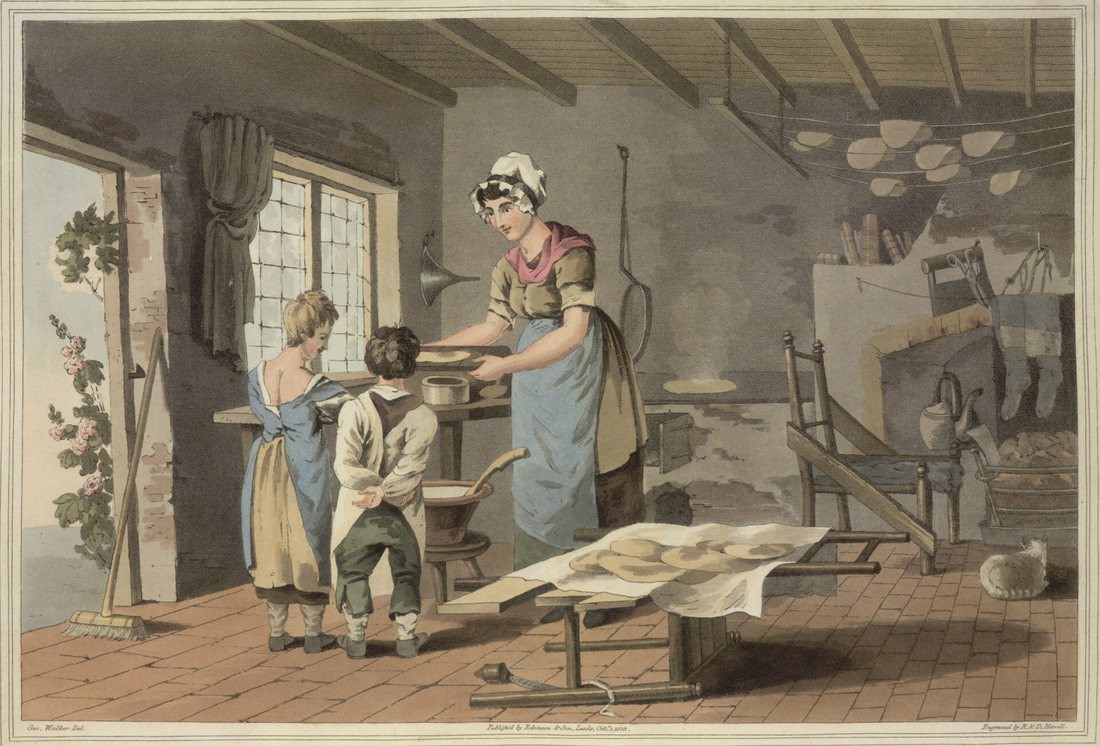
Flatbread is the oldest bread by a wide margin. It was made before farming, before pottery and before ovens.
The oldest bread is a few crumbs
In 2018 a team led by Amaia Arranz-Otaegui published charred food remains from Shubayqa 1, a site of hunter-gatherers (the Natufians) in the Black Desert of north-eastern Jordan (PNAS, 2018). In the ashes of two stone fireplaces they found tens of thousands of plant remains and at least 642 lumps of charred food. Twenty-four were analysed. Seven radiocarbon dates put the older fireplace at 14,400–14,200 years ago — the source of the “14,400-year-old bread” in the headlines.
What the paper actually describes is more interesting than the headline:
- The pieces are tiny — on average about 4 mm wide and 6 mm long. They are crumbs of a bread-like food, not loaves.
- The authors say they “probably represent unleavened flat bread-like products,” judged by their thinness and their small, sparse air pockets.
- They were not only wheat. The flour included wild einkorn or similar cereals, and the tubers of club-rush, a wetland sedge. The oldest bread was partly made of roots.
- The flour was finely ground and sieved, finer than that of later farmers’ bread.
- There were no ovens. “It is most likely that dough was placed in the ashes of a fireplace or on a hot stone.”
- Bread came at least 4,000 years before farming — but the authors add that it was “probably not routinely consumed.” They suggest it may have been a special or feast food, and even that its value may have encouraged people to cultivate cereals. That last point is a hypothesis.
Earlier still, at Ohalo II in Israel, about 23,000 years ago, starch grains of barley and possibly wheat were found on a grinding stone — the earliest direct evidence of people processing grass seeds (Nature, 2004). The excavators found an oven-like hearth and suggested dough was baked there; no bread was found.
The oven that slaps bread on its wall
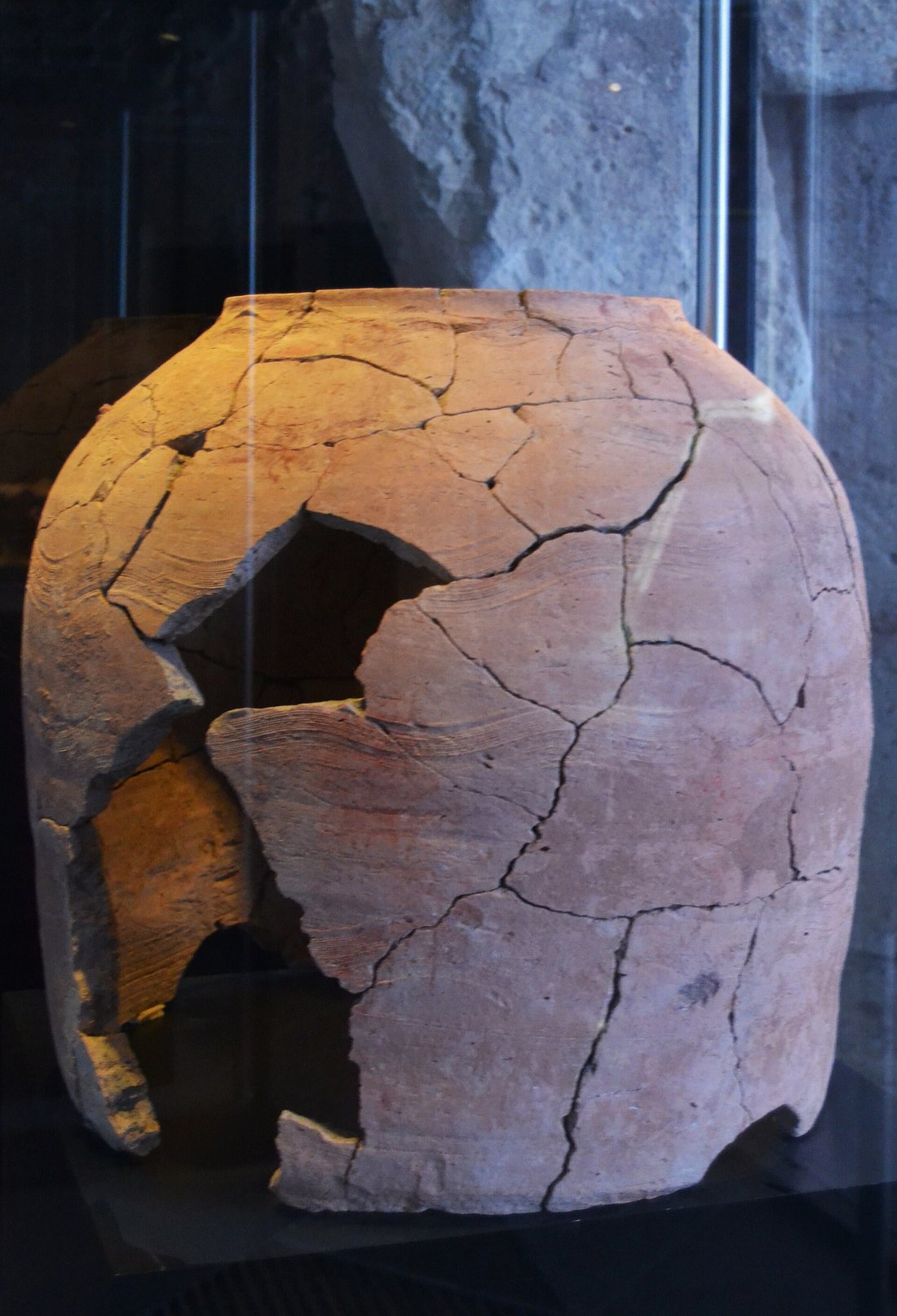
The word tandoor travels back through Persian tanūr and Arabic tannūr to Akkadian tinūru, a word of ancient Mesopotamia. The same Arabic word gave Spanish atanor, a water pipe and the furnace of an alchemist’s still. Remains of vertical ovens reach back to about 5000 BC in Syria and Iraq. By the tenth century, a Baghdad cookbook’s six recipes for khubz were all baked in the tannur. English first borrowed “tandoor” in the 1660s, for a Persian heating device; the clay oven of India and Pakistan comes later.
The tabun — a low clay oven where bread bakes on a bed of hot pebbles — is often described as ancient. Pasqualone, citing a paper titled “The tabun and its misidentification in the archaeological record,” says the word is first attested in Palestine in the tenth century AD, and the oven probably arrived after the Arab conquest. Calling older ovens “tabuns” may be a mistake.
Bread in the Bible, and bread that split a church
Matzah commemorates bread that did not have time to rise: the Israelites baked unleavened cakes “for it was not leavened, because they were driven out of Egypt and could not tarry” (Exodus 12:39). The famous “18-minute rule” for matzah is really a walking distance. The Talmud says dough leavens in the time it takes to walk a mil — “from Migdal Nunaya to Tiberias,” about two thousand cubits. Sixteenth-century Jewish law converted a mil into “a quarter of an hour and a twentieth” — 18 minutes. The same law says that dough being worked, “even the entire day,” does not leaven. The practice of finishing everything in 18 minutes is a stringency built on top.
Communion bread divided Christianity. The Latin Church uses unleavened wheat bread (Canon Law 926); the Eastern Orthodox churches use leavened bread; and the dispute is counted among the traditional causes of the Great Schism of 1054. Armenian churches use unleavened bread.
The field ration of 1327
The earliest detailed description of an oatcake is a soldier’s ration. The chronicler Jean Froissart, describing Scottish raiders in 1327, wrote that “under the flaps of his saddle, each man carries a broad plate of metal; behind the saddle, a little bag of oatmeal.” They heated the plate over the fire, mixed the oatmeal with water, and “make a thin cake … which they eat to warm their stomachs: it is therefore no wonder that they perform a longer day’s march than other soldiers.” That plate became the Scottish girdle — which is simply a Scots form of the word griddle. By 1725 the girdle-smiths of Culross claimed “the sole and exclusive privilege of making girdles … for the service of all Scotland.”
Maize, and a technique that saved lives
In the Americas the flatbread was made of corn, and it depended on a technique: nixtamalization, cooking dried corn in an alkaline solution of lime or ash before grinding it. The word is Nahuatl. Corn eaten without it — as it was in the American South and northern Italy in the nineteenth and early twentieth centuries — caused the deficiency disease pellagra; corn eaten as tortillas did not. See the science.
Wheat arrived with the Spanish, near Mexico City in about 1523, and with it the flour tortilla.
Ration flour
The frybread of the Diné (Navajo) and other Native nations is made from wheat flour, lard and sugar — foods issued as US government rations. The story told in Diné families is that it was born at Hwéeldi (Bosque Redondo, New Mexico), where the US Army held about 8,500 Diné after the forced marches known as the Long Walk of 1864; about 2,000 of them — one in four — died there (Smithsonian National Museum of the American Indian). No document from the 1860s records frybread itself; the origin is carried by family tradition and later journalism, and for other nations the route ran through reservation rations and boarding schools.
Native writers see frybread two ways. Sherman Alexie called it “the story of our survival.” The chef Sean Sherman (Oglala Lakota) writes that it “represents perseverance and pain, ingenuity and resilience,” but “is everything that isn’t Native American food.” Suzan Shown Harjo linked it to diabetes and “slow death.” The same flour-and-lard history lies behind the Indigenous bannock of Canada, whose name came with Scottish fur traders.
Flatbreads: What a flatbread is · The history · The science · Ovens and griddles · The Middle East · South Asia · The Americas · Europe · Africa and East Asia · Making them at home · Corrections · ← Breads
Comments (0)