Africa and East Asia: Injera, Msemen, Bing and Nan
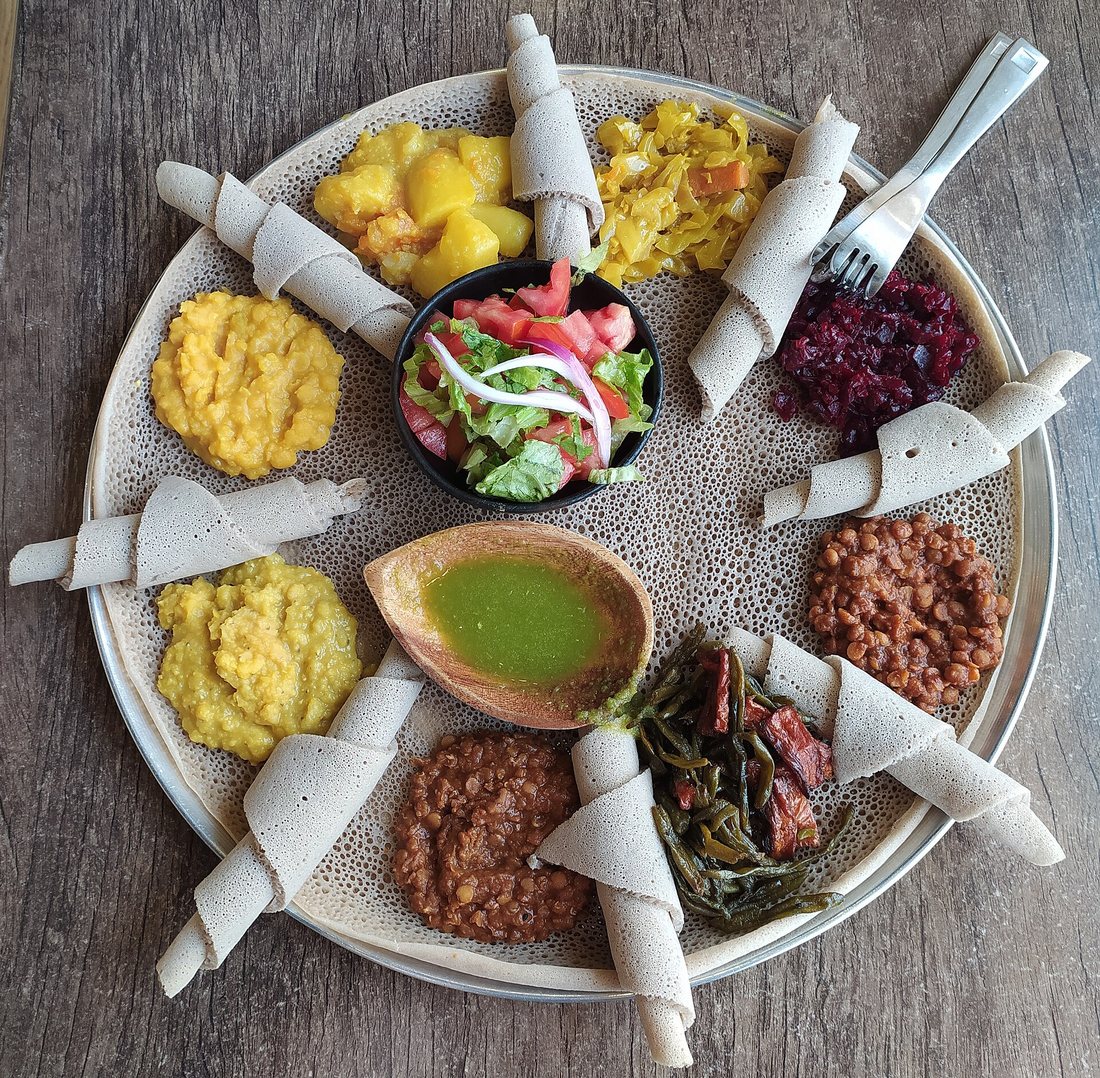
Injera
Injera, the bread of Ethiopia and Eritrea, is a large, spongy round made from a batter of teff — a grain so small that a thousand seeds weigh about 0.3 g — sometimes mixed with barley, sorghum, maize or wheat. It is both the plate and the spoon: stews are served on it and eaten with torn pieces of it. The standard description is about 6 mm thick and 60 cm across, with “uniformly spaced honeycomb-like ‘eyes’” on top.
The method is unlike any European bread (Neela and Fanta, Journal of Ethnic Foods, 2020):
- Teff flour and water, about 1 to 2, are mixed with ersho, liquid saved from the last batch.
- The batter ferments for 30 to 72 hours, depending on altitude and temperature.
- A portion is boiled into a gruel called absit, cooled to about 46 °C and stirred back in.
- A short second fermentation of about two hours follows. The absit makes the batter rise and form the eyes.
- The batter is poured in a spiral onto a large clay griddle, the mitad, covered, and cooked on one side only.
So injera is not a crêpe: it is fermented for days, bound by cooked starch, steamed under a lid and never flipped.
History. A date of “100 BC” is widely repeated, but it comes from unpublished sources and is folklore. The hard evidence is mitads found at Aksum and dated to the late fifth or sixth century AD.
The teff patent. A Dutch company held a patent on a method of processing teff flour. In November 2018 the District Court of The Hague, in Ancientgrain v. Bakels, found the patent void because the method “belongs to the general professional knowledge.” The popular version, that the “Dutch patent office” voided it, is wrong.
Sudan’s kisra is sometimes called “Sudanese injera,” but it is its own tradition: a sorghum batter spread paper-thin on a hot griddle and cooked in about 30 seconds.
The new collection recipe is Injera (All Teff).
North Africa: msemen and harcha
Msemen of Morocco and Algeria is a dough of flour and fine semolina stretched paper-thin on an oiled surface, dusted with semolina and butter, folded into a square packet of layers, flattened and griddled. Its cousin meloui is pulled into strands and coiled. Harcha is a different bread: a crumbly semolina griddle cake leavened with baking powder.
Msemen belongs to the same laminated family as paratha, roti canai and malawach — fat between thin layers, then a griddle — a shared technique rather than a proven shared ancestry.
The new collection recipe is Msemen.
East Africa: chapati
In Kenya, Uganda and Tanzania, chapati is an everyday bread, usually said to have been brought or popularised by Indian workers on the Uganda Railway from the 1890s. Uganda’s street-food rolex — a chapati rolled around an omelette, “rolled eggs” — is its best-known descendant.
China: bing
In Han China, bing (餅) did not mean “flatbread.” A dictionary of about AD 200, the Shiming, defines it as “to combine: mix flour with water so it binds,” and lists soup bing (noodles or dumplings in broth) and steamed bing alongside the sesame-topped hubing, “foreign bread.” Bing meant any wheat-dough food; only later did it narrow to flat breads, which is why a pizza is still pisa bing in Chinese.
Hubing came from the “Western Regions” — Central Asia — and the Shiming shows it existed by about AD 200, topped with sesame.
A much-repeated story says Emperor Ling of Han “loved hubing.” The received text of the Book of the Later Han actually says he loved hu fan (胡飯), “foreign food,” in a list of foreign fashions — clothes, tents, chairs, food, harps, flutes and dances — and the historian recorded the whole list as an omen of the foreign troops who later sacked the capital.
Shaobing (燒餅) is a baked, layered, usually sesame-topped northern flatbread, plain or filled. The story that the general Ban Chao brought it from Central Asia is legend.
Scallion pancakes (cong you bing) are an unleavened wheat dough laminated with oil and scallions, coiled, flattened and pan-fried — the East Asian member of the laminated family. The collection has Scallion Pancakes; the new recipe is Shaobing (Sesame Flatbread).
Central Asia: nan
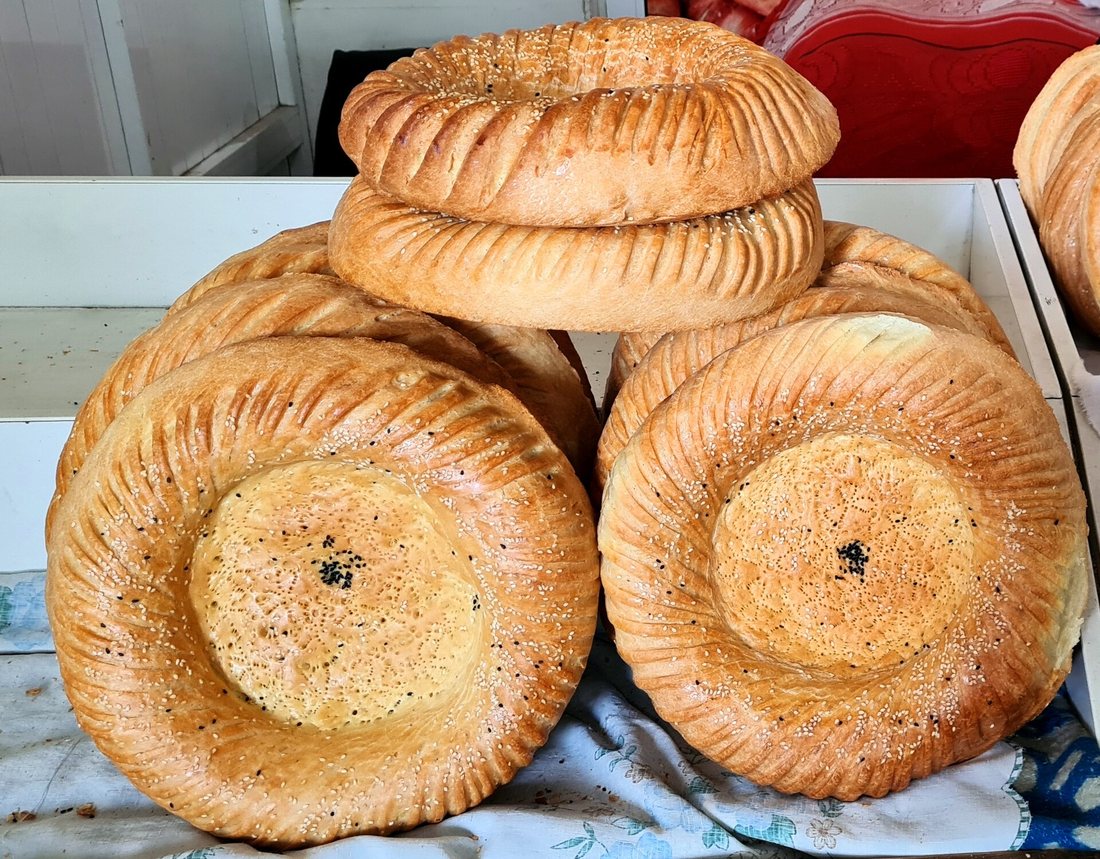
Across Uzbekistan, Kazakhstan and among the Uyghurs of Xinjiang, nan (or non) is a yeasted wheat round slapped onto the inside wall of a clay tandyr. It has a thick rim and a thin, patterned centre. The pattern is pressed with a spiked stamp, the chekich; the holes let steam escape so the centre stays flat while the rim rises. The decoration is a by-product of the function. (That each baker’s pattern is a personal signature is often said but was not found in any source.)
Uzbek custom holds that nan must not touch the ground or be cut with a knife; it is broken by hand. A traveller bites a nan before leaving, and the rest is dried and hung until they return.
Malaysia and Singapore: roti canai
Roti canai (or roti prata in Singapore) is an unleavened dough of flour, ghee and water, oiled and rested, then stretched paper-thin by flipping it through the air, folded and griddled. It came with Tamil Muslim communities in nineteenth-century British Malaya. The popular idea that canai means Chennai is less likely than the Malay canai, “to roll thin.”
Flatbreads: What a flatbread is · The history · The science · Ovens and griddles · The Middle East · South Asia · The Americas · Europe · Africa and East Asia · Making them at home · Corrections · ← Breads
Comments (0)