The Science: Why Flatbreads Puff, and Why Some Must Not
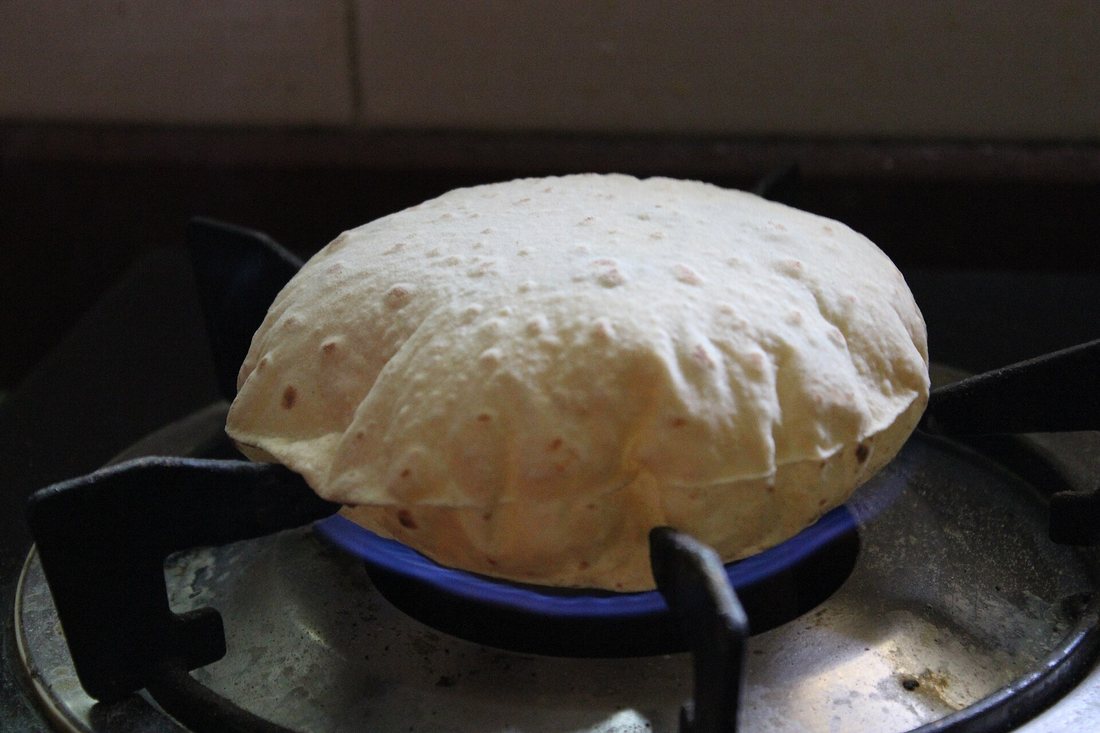
A good pita balloons in the oven; a good phulka puffs over a flame; a good corn tortilla rises on its third turn on the comal. The same bakers prick matzah and stamp Central Asian nan so they stay flat. Both are the same physics.
The puff
A thin sheet of dough, dropped on a very hot surface, sets a skin on both faces almost at once. Inside, gas expands and has nowhere to go but between the two skins, so they separate and the bread inflates.
Which gas? The usual answer — “it’s steam” — is incomplete. Pasqualone explains that a pita inflates “due to the thermal expansion of gases such as carbon dioxide developed during fermentation, dough humidity, and air entrapped during kneading.” In a leavened pita all three expand together. In an unleavened roti or chapati, steam from the water in the dough is the only gas available — which is why a phulka is finished over an open flame, where the steam expands fast enough to balloon it.
Three things decide whether it works:
- A very hot surface. The skins must set before the inside dries out. A cool surface just dries the dough into a cracker. Tannur and wood ovens run above 300 °C; a home recipe for lavash wants a baking steel under the broiler.
- Good gluten. “The expansion in volume is optimal if the flour used has good viscoelastic properties; therefore, good-quality gluten-containing flour is needed” (Pasqualone). Stretchy gluten lets the dough balloon instead of tearing.
- An even support. Pocket breads are baked on a flat floor, not slapped on an oven wall: “optimal puffing requires a horizontal support.”
The deliberate flat
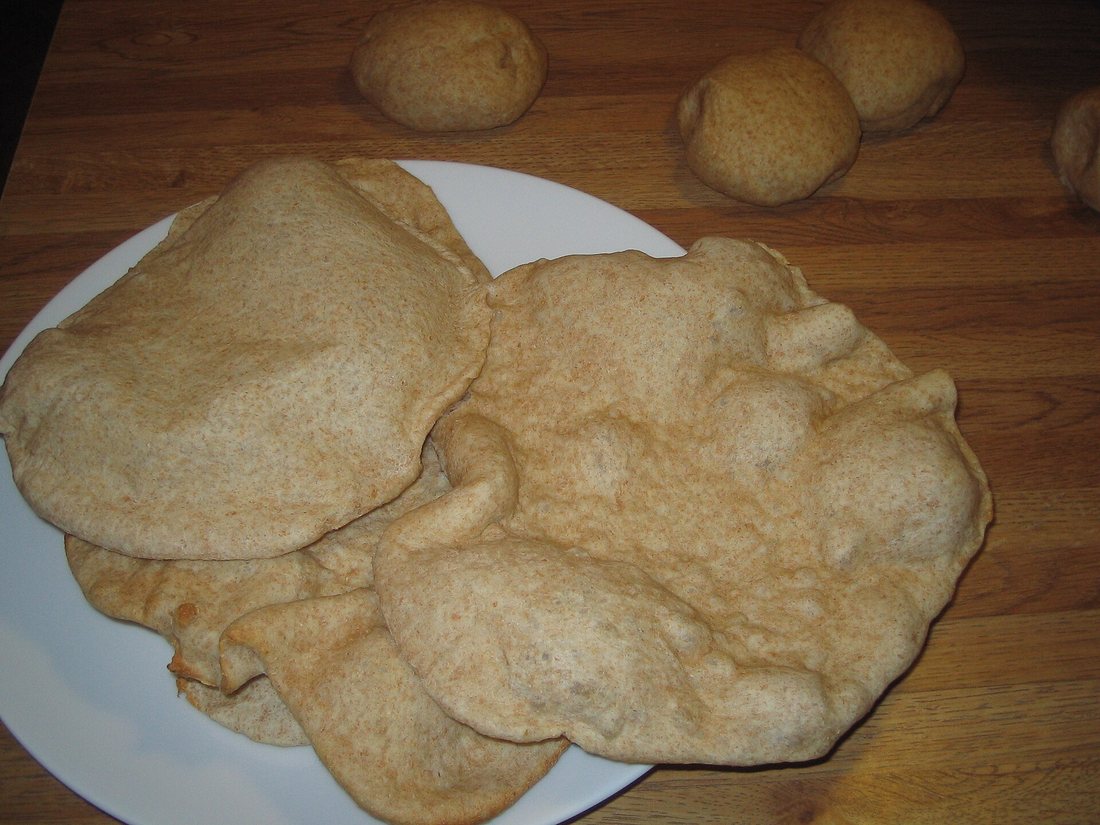
When a baker wants a flat bread, the pocket has to be switched off — by piercing the dough so the gas can escape:
- Matzah is pricked all over to stop it puffing.
- Central Asian nan is pressed in the centre with a spiked stamp called a chekich. The holes let steam escape, so the centre stays thin and flat while the rim rises — the pattern is a by-product of the function.
- Thick leavened flatbreads “have to be pressed with fingertips or punched to prevent excessive expansion” (Pasqualone).
- Taboon bread gets the same result another way: it bakes on a bed of hot pebbles, whose uneven surface keeps a pocket from forming.
- Piadina and lavash recipes often dock the dough with a fork.
Gluten, and breads without it
Gluten is what makes a flatbread stick to a tandoor wall. The Shubayqa researchers note that experimental bread made only from club-rush tubers is “brittle, crumbly, and flaky,” and that adding wheat gluten makes the dough elastic enough to press onto the wall of an oven.
Breads without gluten need another way to hold together:
- Injera uses a boiled-starch trick. After days of fermentation, part of the teff batter is boiled into a gruel called absit and stirred back in, starting a short second fermentation. Without absit, injera is “powdery” with fewer of the prized “eyes” (the bubbles on top). The cooked starch gives a gluten-free batter enough body to hold gas — the same idea as the Japanese yudane or Chinese tangzhong in bread-making.
- Bhakri, the sorghum or millet flatbread of western India, is mixed with hot water and patted out by hand rather than rolled, because a gluten-free dough will not stretch under a pin. (That the hot water helps by gelatinising the starch is a reasonable inference, not a sourced finding.)
- Masa for corn tortillas holds together because nixtamalization changes the corn itself (below).
Nixtamalization
To make masa, dried corn is cooked in water with lime (calcium hydroxide) — in rural Mexico, about 1% lime at around 80 °C for 20–45 minutes — left overnight, washed and ground. The alkali loosens the tough hull and partly breaks down the starch, which is what lets masa form a dough (FAO).
It also changes the nutrition, in ways that are still argued:
- Calcium in tortillas rises by up to about 400%.
- Corn eaten without the process caused pellagra, a niacin-deficiency disease, in the American South and northern Italy; corn eaten as tortillas did not.
- Why is not settled. The FAO calls it “extensively debated” between those who say lime frees niacin that is “bound” in corn and those who say it improves the balance of amino acids. The process actually destroys 28–36% of corn’s niacin. So the popular one-line explanation — “lime unlocks the niacin” — is at best half the story. The outcome is not in dispute; the mechanism is.
Masarepa, the flour for arepas, is not nixtamalized: it is corn that has been cooked and dried, and traditionally hulled by pounding. It cannot be swapped for masa harina.
Layers
Paratha, roti canai, msemen, malawach and the Chinese scallion pancake are all made the same way: a dough is spread thin, brushed with fat, then folded or coiled so the fat separates many layers, then rolled out again and griddled. As the bread cooks, the water in each layer turns to steam and pushes the layers apart. This is a shared technique across South Asia, North Africa, Yemen and China — but a shared technique is not proof of a shared ancestry.
Flatbreads: What a flatbread is · The history · The science · Ovens and griddles · The Middle East · South Asia · The Americas · Europe · Africa and East Asia · Making them at home · Corrections · ← Breads
Comments (0)