Mixing and the Bind
This is the page I would hand to someone whose sausage keeps crumbling.
Everything up to now has been preparation: cold meat, clean trim, the right particles off the plate. Mixing is where those particles stop being a pile of ground meat and become a single cohesive thing that will hold a slice, keep its juices, and not fall apart in the pan. And unlike almost every other step, the bind is invisible until it is too late to fix. You cannot see it in the raw block the way you can see a smear. You have to know how to test for it.
It took me an embarrassing number of years to understand that the bind is not a mixing technique. It is a chemical reaction, and mixing is just how you make it happen.
What the bind actually is
Here is the mechanism, because knowing it makes every rule on this page obvious rather than arbitrary.
Muscle is made of proteins. The important one for us is myosin, and myosin is salt-soluble — it will not dissolve in water alone, but in a salt solution it does. When you add salt to ground meat and work it, the salt draws water and dissolves myosin out of the muscle fibers. That dissolved protein migrates to the surface of every particle and forms a sticky, tacky exudate.
When the sausage is then heated, that dissolved protein coagulates — it sets, like an egg white — and in setting it welds every particle to its neighbors. That coagulated protein matrix is the bind. It is what holds a slice of summer sausage together, what keeps a bratwurst juicy instead of letting the fat run out, and what makes a salami sliceable months later.
So the bind requires three things and nothing else: salt, mechanical work, and low temperature.
- Salt dissolves the myosin. No salt, no bind. This is why an unsalted sausage never coheres and why salt is structural, not seasoning.
- Work brings the salt into contact with the protein and moves the exudate around. Under-work it and the protein hasn’t been extracted.
- Cold matters because smeared fat coats the particles and physically blocks the salt from reaching the muscle. A warm block can be mixed forever and never bind properly. The fat is in the way.
That third point is the one that surprises people. The most common cause of a failed bind is not insufficient mixing — it is a broken cold chain three steps earlier.
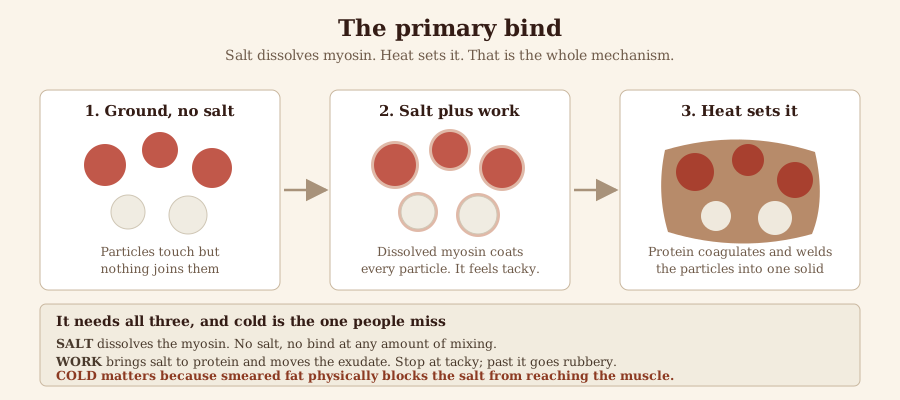
Salt dissolves the myosin, work distributes it, heat sets it. Cold matters because smeared fat gets between the salt and the muscle.
Primary bind, and why it comes first
The term you will see in the literature is primary bind: the protein-to-protein bond formed by extracted myosin, as distinct from anything a binder ingredient contributes.
This distinction matters because a lot of home sausage makers reach for non-fat dry milk or rusk to fix a crumbly sausage, and those ingredients are not doing what they think. Milk powder, soy protein, rusk and potato starch are water binders — they hold moisture in the sausage and improve juiciness and yield. They are genuinely useful and there is nothing shameful about them; the British banger’s rusk is heritage, not adulteration.
But they do not create the primary bind. They cannot. Only extracted myosin does. If your sausage crumbles, adding milk powder will make it a slightly moister crumble. Fix the primary bind first.
The protein extraction test
You do not have to guess whether the bind has developed. There are two tests, and I use both on every batch that matters.
Test 1: the hand test
Mix until the block changes character, which it does noticeably. Ground meat straight off the grinder feels loose and granular and falls apart between your fingers. Properly mixed, it becomes tacky — it clings to itself, pulls away from the side of the bowl as a mass, and strings slightly.
The test: press the flat of your open hand into the surface of the block, then turn your hand over. If the block hangs from your palm against gravity for a couple of seconds, the primary bind has developed. If it drops off cleanly, keep mixing.
It is a crude test and it is remarkably reliable. Once you have felt the difference twice you will never mistake it.
Test 2: the patty fry test
The one that catches everything, and the one I would not skip on any batch I have not made before.
Take a golf-ball-sized piece of the finished mix, flatten it, and fry it through in a small pan. Then look at it and eat it.
What it tells you, all at once:
- Seasoning. This is the only chance you get. Once it is in a casing you are committed. Raw sausage mix does not taste like cooked sausage — salt in particular reads much lower raw — so tasting the raw mix is nearly useless and tasting a fried patty is nearly perfect.
- The bind. Does the patty hold together, or does it fall into crumbs when you turn it? A well-bound mix fries into a coherent patty with a springy bite.
- Fat behavior. Is there a puddle of rendered fat in the pan out of proportion to the size of the patty? That is a smear telling on itself.
- Texture. Rubbery and bouncy means over-mixed. Loose and crumbly means under-mixed. There is a right feel in between and the patty shows it.
Adjust and re-test. If it needs salt, it needs salt — add it, mix briefly, fry another. Doing this costs five minutes and has saved me entire batches.
One caveat: on a cured sausage, do not adjust the cure based on a taste test. Cure is calculated on the meat block and dosed on a 0.01 g scale; it is a safety number, not a seasoning. Adjust the salt and the spices only.
How long, and how to tell when to stop
Roughly 2 to 4 minutes of real work for most sausages, but time is the wrong unit — the block tells you when.
Under-mixed looks like ground meat. It crumbles when you cut a cooked slice. The fix is obvious: keep going.
Over-mixed is the failure people don’t expect. Keep working past the bind and the texture goes rubbery and bouncy — a springy, slightly hot-dog-like quality in a sausage that was meant to be coarse. You have essentially begun to emulsify it. In a coarse sausage that is a fault; in a frankfurter it is the goal. Same process, different destination.
Over-mixing also warms the block, which brings the smear risk back around.
Stop at the bind. Not before, not well after.
What to add, and when
Order matters more than people expect.
- Salt and cure first, into the cold ground meat, with whatever liquid the formula calls for. Salt needs contact time with the protein and it needs to be in solution to work. If the formula uses a starter culture, rehydrate it separately in distilled water and add it at this stage too — chlorinated tap water kills it.
- Liquid as ice or ice water. It hydrates the mix, helps distribute everything evenly, and pulls heat out of the block while it melts. This is why water and ice is treated as an ingredient rather than a technique.
- Spices next. They don’t need the same contact time and adding them with the salt just means more mixing.
- Mix to the bind. Test.
A specific warning: do not add the cure late as an afterthought. Uneven cure distribution in a fermented or dried sausage is a genuine safety problem, not a cosmetic one. It goes in early, in solution, and gets mixed thoroughly.
Mixing by hand, and why I stopped
For most of forty years I mixed by hand in a big bowl. It works. But I want to be honest that it has a real flaw, and it is one I taught for years without acknowledging: your hands are 98°F. Two minutes of hard hand-mixing puts meaningful heat into a block you have spent an hour keeping at 30°F. I could feel the block go from crisp to slack while I worked it, and I would tell people to “keep it cold” while being the warmest thing in the bowl.
I bought a Vevor BMM-10 hand-crank sausage mixer and it solved it two ways at once. I freeze the drum and the paddles along with the grinder parts, so the vessel is pulling heat out rather than adding it. And my hands never enter the meat. The paddles fold the block over on itself far more evenly than my hands did, and the bind arrives sooner and colder.
Getting a better bind at a lower temperature is not a trade-off I expected to win. If you make sausage regularly it is the upgrade I would point at first. More on the bench at my bench.
If you are mixing by hand: freeze a stainless bowl, work in short bursts with the block going back in the freezer between them, and use one hand rather than two so half the block is always away from the heat.
A stand mixer with a paddle works too — low speed, short time, and watch the temperature, because the motor housing gets warm and so does the bowl.
The overnight rest
For fresh sausages I like to mix, then rest the block overnight in the refrigerator, then stuff the next day. Two things happen: the seasoning distributes and mellows, and the bind continues to develop as the salt keeps working. A rested block also stuffs better — it is firmer and holds its shape in the casing.
For cured and fermented sausages the schedule is dictated by the cure and ferment instead, and the rest is built into that.
What a failed bind looks like afterward
- A cooked slice that crumbles when you cut it — no primary bind. Cause: not enough mixing, not enough salt, or a warm block whose fat blocked the salt.
- A greasy patty and a puddle in the pan — smeared fat. Cause is upstream, at the grinder.
- A springy, hot-dog texture in a coarse sausage — over-mixed.
- A cut face with a dry crumbly interior and a firm rim — often a cured sausage that lost water without ever having a bind to hold it.
Every one of those is in the symptom table on troubleshooting.
Part of Making Sausage. Next: emulsions — where the same protein chemistry gets pushed all the way, and where the temperature ceiling stops being a preference and becomes a hard limit.
Comments (0)