Emulsions
A frankfurter, a bologna, a weisswurst, a mortadella, a good braunschweiger — these are the same craft as a bratwurst taken all the way to its logical end. Instead of a mosaic of visible particles, you get a single smooth homogeneous paste that cooks into something springy and uniform. It is the most technically demanding thing in ordinary sausage making, and it is the one where the rules stop being preferences and start being physics.
The reason is simple: an emulsified sausage has a hard temperature ceiling, and past it the batch is destroyed with no recovery. Everywhere else in this section, “keep it cold” buys you quality. Here it buys you a sausage at all.
What an emulsion actually is
The word is slightly wrong, and the pedantry is worth two paragraphs because it explains the failure mode.
A true emulsion is one liquid dispersed in another — oil in water, as in mayonnaise. A sausage “emulsion” is really a fat-in-protein-matrix suspension: solid or semi-solid fat particles, ground extremely fine, suspended in a gel of water and dissolved muscle protein. The fat is not dissolved. It is held.
What holds it is the same extracted myosin that binds a coarse sausage, but here it is doing a much harder job. In a bratwurst the protein welds particles to each other. In a frankfurter the protein has to form a continuous film around every microscopic fat droplet and keep it there, through mixing, through stuffing, and through cooking.
That film is a protein structure. Protein structures are temperature-sensitive. Warm the mix and two things happen at once: the fat softens toward liquid and wants to coalesce, and the protein film loses its integrity. Past a threshold the droplets merge, the film gives way, and the fat separates out into pockets and channels.
That is a broken emulsion, and it cannot be fixed by mixing more. Mixing more is what broke it — the mechanical work is what generates the heat.
The temperature ceiling
The number that matters: do not let a pork emulsion exceed about 59°F (15°C). That is the working ceiling for the common pork-and-beef products.
I run well below it. My working targets:
| Stage | Target | Absolute ceiling |
|---|---|---|
| Meat and fat into the machine | 26–30°F | — |
| During chopping/emulsifying | 40–50°F | — |
| Final mix, off the machine | ≤55°F | 59°F (15°C) |
| Stuffing | ≤55°F | 59°F |
Different fats have different tolerances, which is why the number moves in the literature:
- Poultry fat is the softest and the least forgiving — treat 50°F as the ceiling.
- Pork fat is the standard case: ~59°F.
- Beef fat is the firmest and most tolerant, and beef-heavy emulsions can be run a few degrees warmer.
If your formula is mixed pork and beef, work to the pork number. The ceiling is set by the softest fat in the block, not the average.
Measure it. Do not estimate it. This is the one step where I take the temperature continuously rather than at checkpoints, because the temperature climbs while the machine runs and the whole batch turns on a number you cannot feel through a bowl.
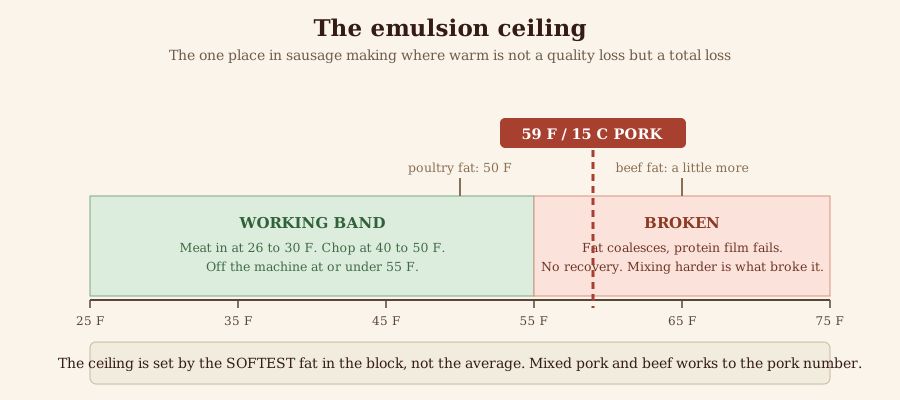
Everywhere else in this section, cold buys you quality. Here it buys you a sausage at all.
How you actually make one at home
The commercial answer is a bowl chopper — a rotating bowl and a set of high-speed curved knives that reduce the meat to a paste in a couple of minutes while a jacket keeps it cold. There is no home equivalent that works as well, and I don’t own one. The bowl chopper page in Equipment covers what the machine is doing and why.
What actually works in a home kitchen:
Grind fine, then finer
Take the meat and fat down through the plates: coarse first, then 1/8”, and then 1/8” a second time. Chill hard between every pass — into the freezer on a sheet pan, not just into the refrigerator. Three passes of grinding puts a lot of energy into the block and the only way to survive it is to shed the heat between passes.
This alone gets you to a fine sausage. It does not get you to a true emulsion.
Then the food processor
The food processor is the home stand-in for the bowl chopper, and it works if you respect it.
- Work in small batches. Overfilling means the blade churns rather than cuts and the whole load heats.
- Use ice, not water, for the formula’s liquid, and add it during processing in stages. This is the entire trick. The melting ice absorbs the heat the blade is generating. Without it you will hit the ceiling in ninety seconds.
- Pulse, check the temperature, pulse again. Do not just hold the button down.
- Stop the moment it is smooth, which is sooner than you expect.
The order that makes it work
- Lean meat, salt, cure and about a third of the ice first. Process until it is a sticky paste. You are extracting protein — this is the primary bind step and it must happen before the fat goes in. Protein first, fat second, always.
- Add the fat and another third of the ice. Process until incorporated.
- Remaining ice, spices, phosphate if you’re using it. Process to smooth.
- Stop. Check temperature. Stuff immediately.
Getting this order wrong is the second most common cause of a broken batch after temperature. If the fat goes in before the protein is extracted, there is no film to form around it.
Phosphates, and why commercial franks are juicier than yours
Worth being straight about. A commercial frankfurter has a springy, juicy quality that is genuinely hard to hit at home, and it is not all skill. Sodium tripolyphosphate raises the pH slightly and dramatically increases the meat’s water-holding capacity, which means the emulsion holds more water without weeping and survives cooking better.
It is not a cheat and it is not a health concern at the levels used. It is a real tool, legal, and used by essentially every commercial producer. If you want a home frank that eats like a good commercial one, phosphate is a large part of the gap. Phosphates and additives covers the how-much.
You can make a perfectly good emulsion without it. It will be slightly less juicy and slightly less forgiving.
Diagnosing a break
A broken emulsion looks and feels wrong before you cook it. The paste loses its glossy, homogeneous look and goes slightly grainy or separated; you may see free fat as a slick. If you see that, stop — do not stuff it.
After cooking, a broken emulsion shows as:
- Fat caps and fat pockets — visible yellow-white deposits under the casing or in channels through the sausage.
- A greasy exterior and a puddle in the pan or on the smoker rack.
- A dry, mealy interior, because the water went out with the fat.
- A wrinkled, loose casing, because the sausage shrank away from it.
Can you rescue it? Honestly, no — not as the product you were making. What you can do is treat it as a coarse forcemeat: add a binder, mix it into a pâté or a meatloaf, and use it. Do not stuff and smoke a broken emulsion hoping it will come back.
The commonest causes, in order
- Too warm. Nearly always. Either the block started warm, or the machine ran too long.
- Fat added before the protein was extracted. Order error.
- Over-processing. Past smooth, you are just adding heat with no benefit.
- Too little salt. No salt, no dissolved myosin, no film. Emulsions are salt-dependent in a way coarse sausages can tolerate slack on.
- Too much fat for the protein available. A 40% fat emulsion needs more lean protein to hold it than a 25% one. If you push the fat up, the formula has to give the protein somewhere to come from.
Where emulsions sit in the family
It is worth seeing the continuum, because it makes the whole craft click:
- Coarse ground, mixed to the bind → bratwurst, Italian, Landjäger. Particles visible, protein welding them together.
- Finely ground, mixed hard → a fine-textured sausage, particles small but still discrete.
- Emulsified → frankfurter, bologna, weisswurst. No particles at all; protein film around microscopic fat.
It is one spectrum, one chemistry, and the only thing that changes is how far you take it — and how cold you have to stay to get there. An over-mixed bratwurst is a failed bratwurst precisely because it started to become a frankfurter.
What I make, and what I don’t
I make weisswurst and I make a decent bologna. I have never been satisfied with my home frankfurters, and I will say so plainly rather than pretend — the snap and the specific springiness of a really good frank come from a bowl chopper and a phosphate-and-cure formulation tuned tighter than I have managed with a food processor. It is on the list.
Braunschweiger and the liver emulsions are a slightly different animal, since liver brings its own emulsifying capacity, and those I have had better luck with at home.
Part of Making Sausage. Next: stuffing — getting the mix into a casing without undoing everything you just did.
Comments (0)