What Offal Is: The Fifth Quarter, and the Words for It
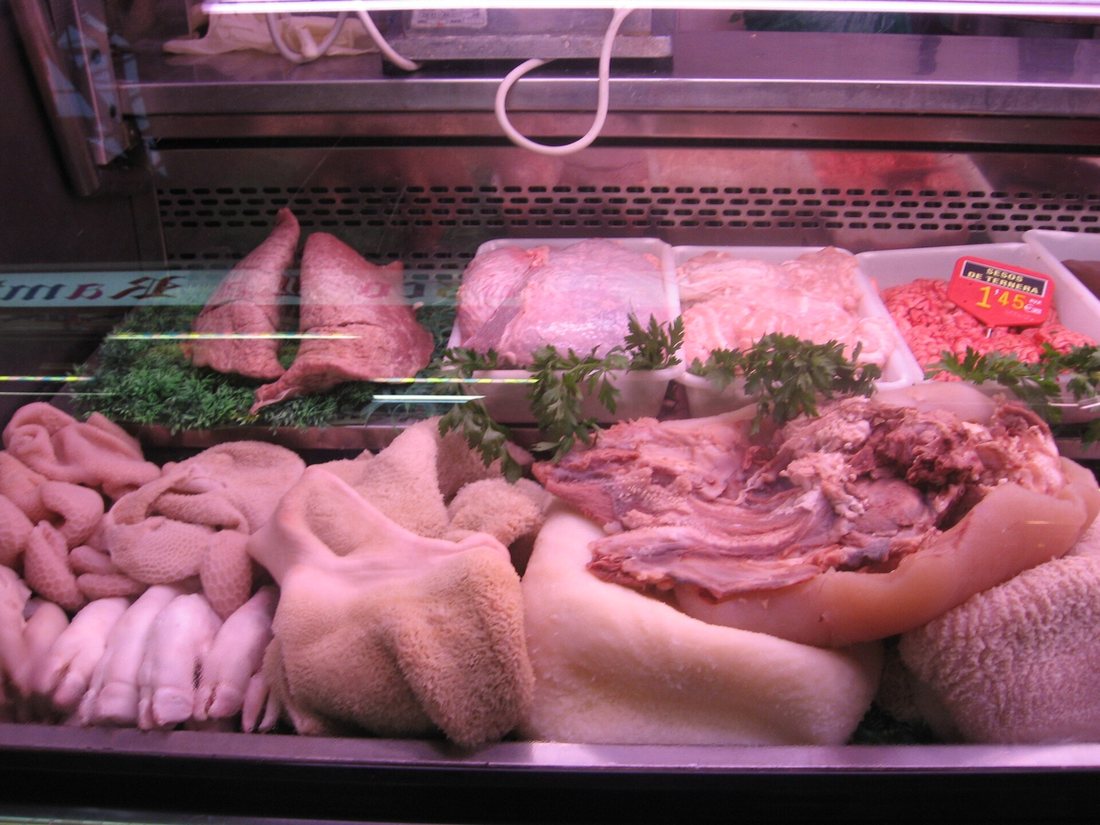
The fifth quarter for sale: tripe, feet, lungs and hearts at La Boqueria, Barcelona.
Offal is everything edible on an animal that is not the ordinary muscle meat: the organs, the blood, the head, the feet, the tail, the stomach and intestines, the glands, the bones’ marrow. Butchers in Rome called it the quinto quarto, the fifth quarter — a carcass is cut into four quarters, and everything else is the fifth. In weight and in variety it is a large share of the animal, and for most of human history nobody would have thought of throwing it away.
This section covers every part on a long list, from liver and heart through tripe, blood and brains to the parts that are not really food at all. It starts here, with the words, because the words turn out to carry most of the history.
“Offal”: what falls off
“Offal” is a late-fourteenth-century English word, “off” plus “fall” — in Etymonline’s gloss, “that which is allowed to ‘fall off’ the butcher’s block as being of little use.” Middle Dutch afval and German Abfall (“rubbish”) are its cousins. It also named the waste of milling grain.
The earliest use found in the research for this section is a surprise. The Forme of Cury, compiled by Richard II’s master cooks around 1390, has a recipe called Chawdoun for Swannes: “Take þe lyuer and þe offall of the Swannes & do it to seeþ in gode broth” — a sauce of swan’s liver and offal, thickened with the swan’s own blood and spiced with cloves and pepper, to be served with the roast swan at the King’s table. The word begins in a royal kitchen, not a poor one.
“Umbles” and humble pie
The same cookbook has Noumbles — “Take noumbles of Deer oþer of oþer beest… colour it with blode.” Numbles were the edible innards of a deer; by around 1400 “a numble” had become “an umble,” the n drifting to the article. Umble pie — a pie of deer offal — is recorded in Samuel Pepys’s diary in 1663.
“Eating humble pie” is a genuine pun, and it was being used as one by 1774. The h of humble was silent into the nineteenth century, so umble and humble sounded the same; a Dublin magazine puzzle of 1774 clued “Pride reversed in a pie” as “Humble pye.” The two words are unrelated — umble from French nombles, humble from Latin humilis — but the joke is real and old, not a folk etymology invented later.
The other old words
- Lights — the lungs, from around 1200: literally the light (in weight) organs. It survives in “knock someone’s lights out.”
- Pluck — the heart, liver and lungs together, pulled (“plucked”) from the carcass; from the 1610s. Courage was called “pluck” from 1785 boxing slang, from the organ sense. Having pluck originally meant having guts, literally.
- Chitterlings — pig’s small intestines, recorded as cheterlingis in the late thirteenth century. Chitlins is from 1842. The word is English and medieval; the dish was eaten in England for centuries before it became a Southern American one.
- Sweetbreads — the thymus or the pancreas of a young animal, from the 1560s. Nobody knows why they are called that. “Sweet” may mean rich-tasting; “bread” may come from Old English brǣd, “flesh,” or Middle English brede, “roast meat.” Both dictionaries say the origin is unclear, and so does this page.
- Haslet — from Old French hastelet, a piece of spit-roasted meat. In Britain now a Lincolnshire pork-and-sage meatloaf.
- Brawn, head cheese, souse — the jellied, pressed meat of a pig’s head. “Head cheese” is a translation of Dutch hoofdkaas. There is no cheese in it.
“Variety meats”: a wartime word
American butchers and the USDA call offal “variety meats,” and the term has a visible birth date in print. Google’s book data show “variety meats” in only trace use before the war, then a roughly 45-fold jump between 1940 and 1943 — exactly when meat rationing began (March 1943 to November 1945). Organ meats cost as little as 1 ration point per pound, against as many as 13 for prime beef. The National Park Service’s account of the home front says government food researchers suggested families try organ meats weekly “for ‘variety.’ The name stuck.” Who coined the term is not known; it existed before the war, and the war made it common.
What the law calls meat
US federal law draws its own line, and it is not the kitchen’s. Under 9 CFR 301.2, “meat” is skeletal muscle or the muscle found in the tongue, diaphragm, heart, or esophagus. So heart and tongue are legally meat. Liver, kidney, brain, tripe and the rest are “meat byproducts.” And the same regulation adds, verbatim: “Meat does not include the muscle found in the lips, snout, or ears.” A hot dog that contains them must say “with byproducts” or “with variety meats” beside its name.
Three kinds of offal cannot be sold as food in the United States at all, each for a different reason:
- Lungs — banned since 1971, because inspection cannot see into them (the reason real haggis cannot be made or imported).
- Thyroid and laryngeal muscle — a hormone gland; a 1984–85 outbreak gave 121 people thyrotoxicosis from hamburger made with neck trimmings.
- Brain, eyes, spinal cord and several other tissues from cattle 30 months and older, and tonsils and part of the small intestine from all cattle — the BSE rules of 2004.
Everything else is legal. “Offal is banned in America” is false. The details are on safety and the law.
Why it matters: nutrition, briefly
Offal is extraordinarily nutrient-dense, and one organ is dense enough to need a warning. USDA figures, per 100 grams:
| Vitamin A (µg RAE) | Vitamin B12 (µg) | Iron (mg) | Cholesterol (mg) | |
|---|---|---|---|---|
| Beef liver, pan-fried | 7,744 | 83 | 6.2 | 381 |
| Chicken liver, simmered | 3,981 | 17 | 11.6 | 563 |
| Pork liver, raw | 6,502 | 26 | 23.3 | 301 |
| Beef heart, simmered | 0 | 10.8 | 6.4 | 212 |
| Beef kidney, raw | 419 | 27.5 | 4.6 | 411 |
| Beef brain, simmered | 6 | 10.1 | 2.3 | 3,100 |
| Beef spleen, raw | 0 | 5.7 | 44.6 | 263 |
| Beef tripe, raw | 0 | 1.4 | 0.6 | 122 |
Two things stand out. Liver is spectacular for vitamin A and B12 — and a single 100 g serving of beef liver carries about 2.6 times the adult upper limit for preformed vitamin A (3,000 µg), and about one and a half times the upper limit for copper. That is why liver is a weekly food, not a daily one, and why the NHS in Britain advises avoiding liver in pregnancy. And brain is the most cholesterol-dense ordinary food there is — around 3,000 mg per 100 g.
In this dive: What offal is · The history · Safety and the law · Liver · Heart and tongue · Kidneys, sweetbreads and brains · Tripe and intestines · Blood · Heads, feet and tails · Gizzards · Game offal · Fish offal · Every part on the list · Corrections
Comments (0)