Tripe and Intestines
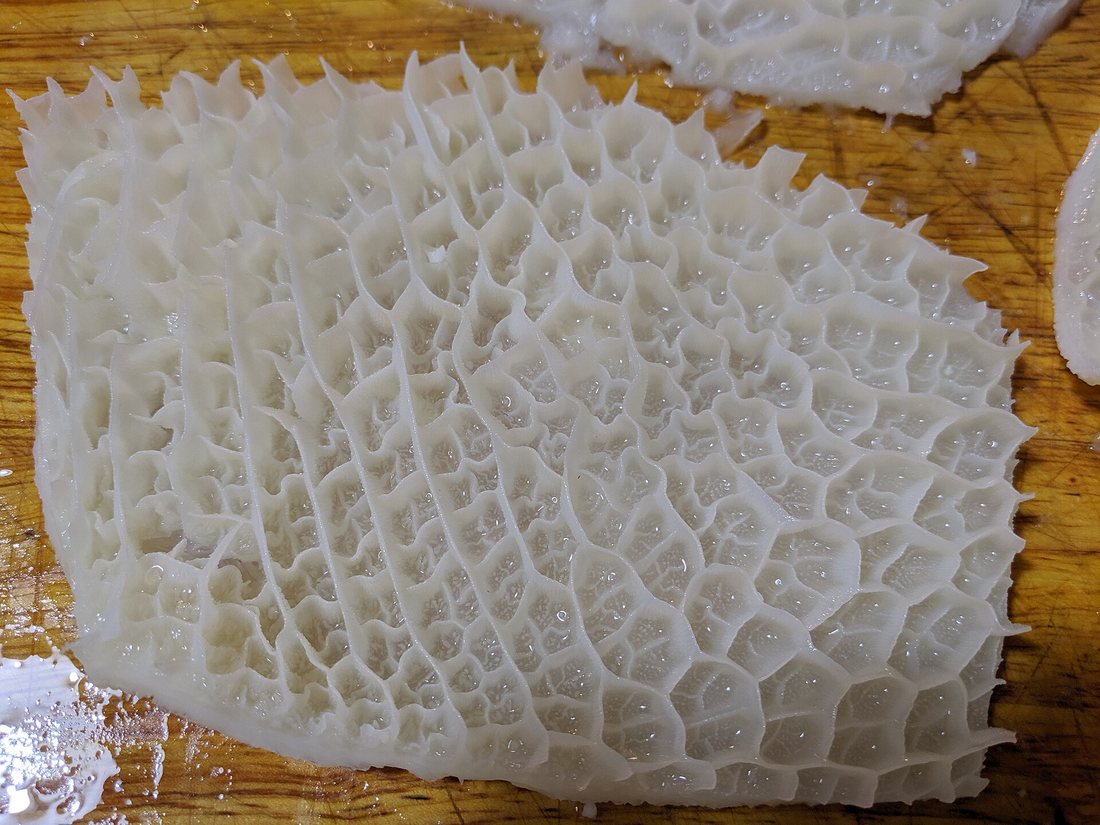
Honeycomb tripe, from the second stomach (reticulum) — the most prized of the four.
Stomachs and intestines are the offal that needs the most work and gives back the most texture. Cleaned and cooked long, they become tender, faintly chewy and a sponge for whatever they are cooked in — which is why almost every tripe dish in the world is really a dish about its sauce or its broth.
Tripe: four stomachs
Tripe is the stomach lining of ruminants, mostly cattle and sheep. A cow has four chambers, and each makes a different tripe:
| Chamber | Tripe | What it looks like |
|---|---|---|
| Rumen | Blanket, flat or smooth tripe | Smooth, with a short pile |
| Reticulum | Honeycomb or pocket tripe | Deep hexagonal cells — the most prized |
| Omasum | Book, bible or leaf tripe | Thin leaves like pages |
| Abomasum | Reed tripe | Glandular; less common — Florence’s lampredotto |
American supermarket tripe is white because it is bleached. US regulations (9 CFR 424.21) expressly allow tripe to be “denuded” of its mucous membrane with agents such as lime or sodium hydroxide and bleached with hydrogen peroxide, which must be rinsed off. That is “dressed” tripe. Unwashed “green” tripe is sold in the US almost entirely as dog food; whether it may legally be sold for people was not confirmed for this page.
Preparation: rinse in several changes of cold water, soak briefly in vinegar water, then cook low and long — around four hours — until tender “but still with some texture.”
The tripe dishes
- Menudo (Mexico). Tripe (and often feet) in a red chile broth, sometimes with hominy — menudo blanco in Sinaloa and Sonora leaves out the red chile. A weekend and New Year’s dish, and famous as a hangover cure — a belief with no scientific backing. Mexican cookbooks of the 1830s–40s already document it: Red Menudo.
- Lampredotto (Florence) — the fourth stomach, named for its resemblance to a lamprey, slow-cooked in broth and served in a roll with green sauce.
- Trippa alla romana — tripe with tomato, mint and pecorino, a staple of Rome’s quinto quarto.
- Callos a la madrileña — Madrid tripe stew with chickpeas, blood sausage and peppers; also a Philippine celebration dish.
- Tripes à la mode de Caen (Normandy) — all four stomachs with beef feet, cider and calvados, baked for hours. (Intestine was once included; that has been banned in France since 1996.)
- Philadelphia pepper pot. Tripe in a heavily peppered soup. The story that it was invented to feed Washington’s army at Valley Forge is “almost certainly untrue”; the soup came to Philadelphia from the Caribbean and West Africa and was sold on the street by Black “pepper pot women.” Campbell’s canned it from 1899 to 2010.
- Fuqi feipian (Chengdu) — “husband and wife lung slices,” cold slices of beef, honeycomb tripe, tongue and heart in chili oil. It contains no lung. The name comes from a 1930s Chengdu street stall kept by a couple; why “lung” is in it is disputed — one account says the first character was once fèi 废, “waste,” later written as the sound-alike 肺, “lung.”
Intestines
The small and large intestines of pig, cattle, sheep and goat, and in Chinese hot pot, duck. Scrub them thoroughly — Korean cooks rub gopchang with flour and coarse salt, rinse repeatedly and trim the fat.
For pig intestines, follow the USDA’s rule first: boil raw chitterlings for five minutes before cleaning them. The reason — infants infected through the cook’s hands — is on safety and the law.
Chitterlings
Chitterlings are the pig’s large intestine, and the word is English and medieval — cheterlingis, thirteenth century. In the American South they became a winter-holiday tradition, spread across the country with the Great Migration, and gave their name to the Chitlin’ Circuit. Salley, South Carolina, holds a Chitlin Strut every November. In France the same intestines go into andouillette, a coarse sausage with a famously strong smell, graded since 1970 by an association of devotees, the AAAAA (Association Amicale des Amateurs d’Andouillette Authentique).
A name that misleads: Cajun andouille is not an intestine dish. It is a double-smoked coarse pork sausage. French andouille is made from chitterlings and tripe. They share a name and little else.
The intestine dishes
- Gopchang (Korea) — beef small intestine or pork large intestine, grilled at the table or stewed in hot pot. Once cheap food for the poor and the sick, it now costs more than ordinary meat.
- Chinchulines (Argentina, Uruguay) — beef small intestine, often braided, grilled first at the asado.
- Tacos de tripa (Mexico) — the first few metres of small intestine, pressure-cooked, then fried crisp with garlic and onion.
- Kokoretsi (Greece and Turkey) — lamb intestines wrapped around seasoned offal and spit-roasted; a Greek Orthodox Easter dish, and in Turkey (kokoreç) one of the most-eaten street foods. Fears during Turkey’s EU accession talks that it would be banned never came true.
- Duck intestine in Chongqing hot pot — dipped “seven up, eight down” to stay crisp.
- Sausage casings. Most natural casings are the cleaned intestines of pigs and sheep. In 1805 the Lewis and Clark expedition recorded Toussaint Charbonneau making boudin blanc in buffalo intestine.
US law: the last part of every steer’s small intestine (the distal ileum) is a BSE “specified risk material”; the rest of the small intestine may be sold once at least 80 inches have been removed.
In this dive: What offal is · The history · Safety and the law · Liver · Heart and tongue · Kidneys, sweetbreads and brains · Tripe and intestines · Blood · Heads, feet and tails · Gizzards · Game offal · Fish offal · Every part on the list · Corrections
Comments (0)